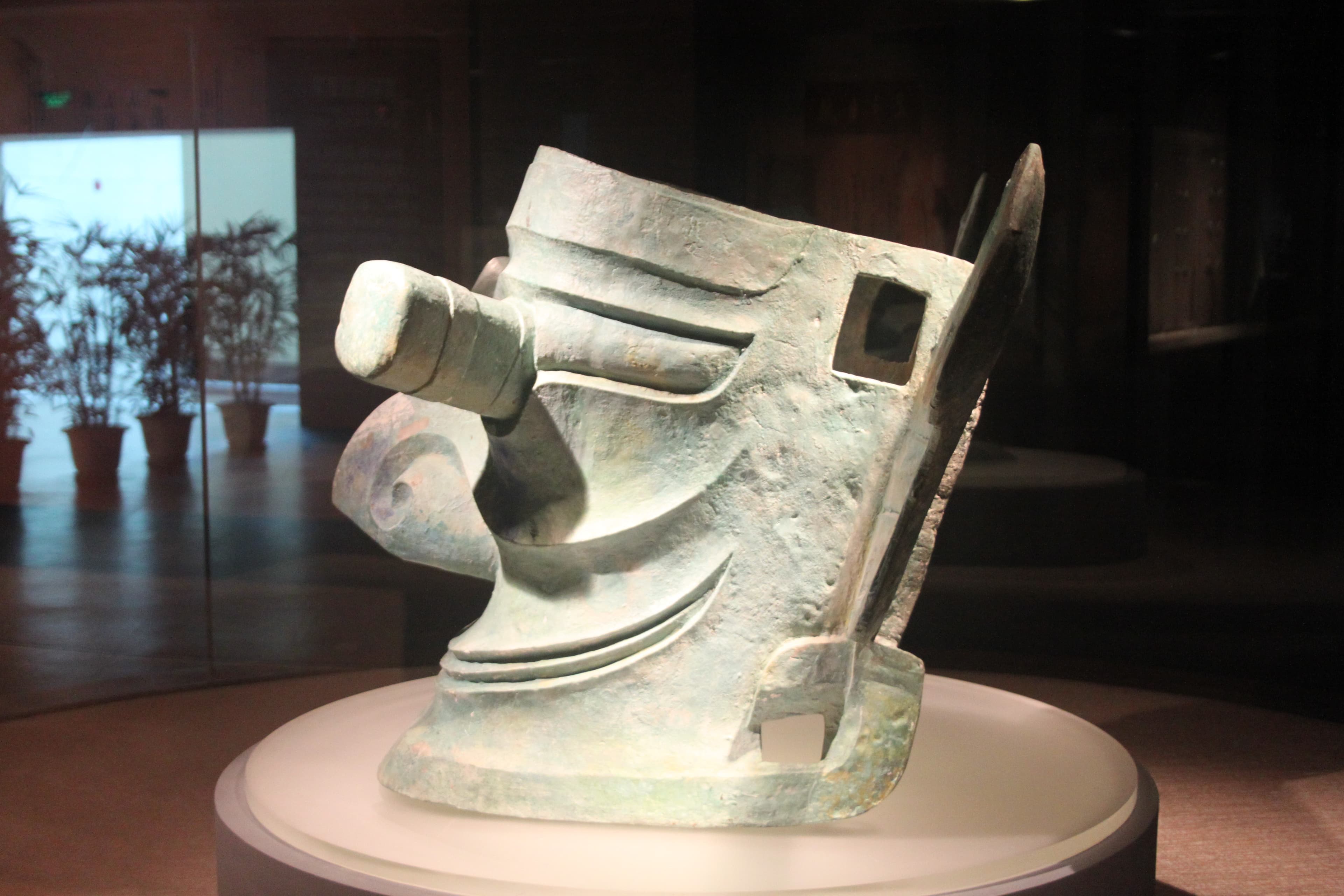
Sanxingdui: The Bronze Faces of a Lost, Wordless Kingdom
A Bronze Age culture in Sichuan built giant bronze gods, then smashed and buried them. It left no writing, and no one knows who they were or why they vanished.
In the summer of 1986, workers at a brick factory near the town of Guanghan, on the fertile plain northeast of Chengdu in China's Sichuan province, were digging clay when their tools struck jade. They had broken into a pit, and the pit was full of faces. Bronze heads with sharp cheekbones and almond eyes stared up out of the earth, some still wearing the remains of gold foil over their features. Beside them lay elephant tusks, charred and cracked by old fire, and a tangle of bronze limbs and ornaments that had plainly been smashed before they were buried. Weeks later, on August 14, a second pit opened only a short distance away, holding around eight hundred objects more. Among them stood a mask so strange that photographs of it would travel around the world: a face more than a metre wide, its eyes pushed out of their sockets on cylindrical stalks, its ears spread like wings.
Nobody had expected any of this. The received history of early China placed its Bronze Age heartland far to the north and east, along the Yellow River, where the Shang dynasty cast ritual vessels and scratched the first Chinese writing onto oracle bones. Sichuan was supposed to have been a backwater, a remote valley civilization barely worth a line in the chronicles. Instead, the pits at a place called Sanxingdui revealed a people who had been casting bronze on a monumental scale around three thousand years ago, in a style that looked like nothing else on Earth, and who had then taken their gods, broken them, burned them, and put them in the ground. They left no name for themselves. They left no readable word. And then they were gone.
This article contains affiliate links. If you buy through them we may earn a small commission at no extra cost to you.
What You'll Learn
- •A Pit Full of Gods
- •The Farmer, the Ditch, and Sixty Years of Waiting
- •Faces That Belong to No One Else
- •The Giant and the Bronze Tree
- •A Civilization With No Words
- •The King With Protruding Eyes
- •Why Were the Gods Burned and Buried?
- •The New Pits: 2019 to 2022
- •Where Did They Go?
- •What Sanxingdui Is Not
- •Frequently Asked Questions
- •Further Reading
A Pit Full of Gods
The two pits found in 1986 were not graves. There were no human remains laid out inside them, no single body around which the treasure was arranged. What they held instead was the entire ceremonial wealth of a society, dismantled. Bronze heads had been snapped from figures. Masks had been crumpled. A great deal of the metal showed signs of having been heated in fire before burial, and the elephant tusks stacked above the bronze were scorched. Then the whole deposit had been packed down into rectangular shafts dug into the earth and sealed.
Archaeologists called them sacrificial pits, for want of a better term. The word carries an assumption that the burial was an offering, a gift sent to gods or ancestors by destroying it. That may be exactly right. It may also be wrong. What is beyond dispute is that a community capable of producing some of the most ambitious bronze casting of the ancient world chose, at a particular moment, to take that bronze out of use forever, and did so with what looks like deliberate, ritualized violence. The objects were not looted. They were not melted down for scrap. They were escorted into the ground with their faces broken.
The Farmer, the Ditch, and Sixty Years of Waiting
The 1986 discovery was not the first sign that something lay beneath the Guanghan fields. In the late 1920s, a local farmer dredging an irrigation ditch beside his home turned up a cache of jade and stone discs and blades, finely worked, clearly old, clearly not ordinary. The find circulated among collectors and caught the attention of a few scholars, and a first, limited archaeological survey followed in the 1930s. For decades afterward, the site produced the occasional jade, the occasional sherd, enough to mark it on a map and no more.
The name Sanxingdui, meaning "three star mounds," came from three low earthen rises that stood on the plain, remnants, it later turned out, of the rammed-earth walls of an ancient city. The scale of what the walls enclosed was not understood until the 1980s, when systematic excavation revealed a settlement covering several square kilometres, one of the largest known Bronze Age cities anywhere in East Asia. The jade in the ditch had been the faint edge of something enormous, and it had taken more than half a century, and a brick factory's clay pit, for anyone to see it.
Faces That Belong to No One Else
The thing that stops people, the moment they first see Sanxingdui bronze, is the faces. The culture produced dozens of large bronze heads and masks with a single, consistent look: a strong straight nose, a wide mouth set in a faint flat smile, heavy angular brows, and enormous almond eyes. On the heads, that was striking enough. On the masks it became something else entirely. The largest masks have eyes that do not sit in the face at all but jut forward on cylindrical columns, like twin telescopes, while the ears flare out to either side in great pointed sweeps. One such mask measures roughly a metre and a third across.
Several of the bronze heads were originally covered in gold foil, pressed over the features so that the face shone. The combination, a shining masked face with its eyes thrust outward, has no parallel in the bronze of the contemporary Shang world to the north, where artisans poured their skill into covered food and wine vessels for ancestral rites. Sanxingdui spent its bronze on bodies and faces, on a population of metal beings that seem to have stood in a temple and looked outward. Whether they represent gods, ancestors, rulers, or something with no equivalent in our vocabulary, the people who made them clearly wanted to be looked at, and to look back.
The Giant and the Bronze Tree
Two objects from the pits push the strangeness past the point of comparison. The first is a figure that stands, on its pedestal, about two and a half metres tall and weighs roughly a hundred and eighty kilograms: a lean, barefoot man in an ornate robe, his oversized hands curled into rings as if he once gripped something now missing, perhaps an elephant tusk, perhaps a staff. It is among the oldest life-sized bronze human statues known from anywhere, and it was cast by a people the standard histories had barely acknowledged.
The second is a tree. The largest of several bronze trees recovered from the site rises nearly four metres, its trunk branching into tiers hung with fruit and flowers and birds, a dragon running down its length. Trees that join earth to sky, with birds perched in the sun, recur across early Chinese myth, and it is tempting to read this bronze tree as a cosmic axis, a ladder for spirits. Tempting, but unprovable, because the makers left no caption. The tree is magnificent and completely silent about its own meaning. That silence is the real subject of Sanxingdui.
A Civilization With No Words
Here is the fact that turns a remarkable archaeological site into a genuine mystery. The Sanxingdui culture, for all its sophistication, left behind no writing that anyone has been able to read. A handful of marks and symbols appear on a few objects, but there is nothing like the oracle-bone script the Shang were incising in the same era to record divinations, royal hunts, and the names of kings. The people of Sanxingdui could organize labor to raise city walls, could master the metallurgy for castings two and a half metres tall, could sustain long-distance trade that brought them jade, cowrie shells, and ivory. What they apparently could not, or chose not to, do was write.
This is why their gods stare out of museum cases without names. We do not know what they called the figure with the ringed hands, or the masked face with the stalked eyes, or themselves. We cannot read a single prayer they said over the fire before they buried their bronze. Compare the Antikythera mechanism, whose Greek inscriptions let researchers reconstruct its purpose, or the still-unbroken Voynich manuscript, which at least teases us with the shape of text. Sanxingdui offers no text at all. Everything we say about what these objects meant is inference laid over a void. The civilization is mute, and it will stay mute unless a buried archive someday surfaces.
The King With Protruding Eyes
There is one thread, thin and late, that seems to reach back toward the people of Sanxingdui. A geographical and historical text called the Chronicles of Huayang, compiled by the scholar Chang Qu during the Jin dynasty more than a thousand years after the pits were sealed, records the legends of the ancient kingdom of Shu, which occupied this part of Sichuan. According to that text, the first Shu king was named Cancong, and Cancong, it says, had protruding eyes.
The detail lands with a jolt, because protruding eyes are the single most distinctive feature of Sanxingdui's great masks. It is possible that a memory of those stalked-eyed bronze faces survived in the region for a millennium, folded into a founding myth, and was finally written down by a chronicler who had no idea he was describing real metal. It is also possible the resemblance is a coincidence, two separate impulses toward the same image. The honest position is that we cannot prove the link, only feel its pull. A people who left no words of their own may have left one trace in someone else's, a king remembered for the way he saw.
Why Were the Gods Burned and Buried?
Every theory about Sanxingdui eventually collides with the central act: the deliberate destruction and burial of the culture's entire sacred inventory. Why would a society smash and burn its most valuable and labor-intensive objects and put them underground?
One idea is defeat. Perhaps the city was conquered, and the burial was an enemy's desecration or a fleeing people's attempt to deny the invader their gods. Another is religious upheaval, a change of belief or dynasty that rendered the old images not just obsolete but dangerous, something to be ritually killed. A third points to natural catastrophe: the Minjiang river and its tributaries have shifted course across this plain for millennia, and a great flood could have been read as the abandonment of the city by its own powers, prompting the burial of everything that had failed to protect it. A fourth, quieter possibility is that the burials were routine on a scale we simply have not grasped, the periodic "retirement" of sacred objects whose power was spent, sent into the earth the way worn-out holy things are respectfully disposed of in many cultures.
None of these has won the argument, and the pits themselves resist a tidy reading. The objects were treated with what looks like reverence and violence at the same time, carefully arranged yet broken, buried yet burned. A desecrating enemy does not usually lay out tusks in neat layers. A respectful retirement does not usually require shattering every face.
The New Pits: 2019 to 2022
For more than three decades, the two pits of 1986 were the whole story, and they left enormous gaps. Then, late in 2019, archaeologists working the ground near the original pits found a third. Over the following months, through 2020, they found five more, numbered up to eight, clustered in the same part of the old city's sacrificial zone. Between 2020 and 2022, a collaboration led by the Sichuan Provincial Cultural Relics and Archaeology Research Institute, working with the Chinese Academy of Social Sciences and several universities, excavated all six under conditions the first discoverers could only have dreamed of: climate-controlled enclosures built over the pits, airtight glass work cabins, and teams in protective suits lifting fragile ivory and gold foil millimetre by millimetre.
What came out was staggering. Thousands upon thousands of objects, the catalogue running past thirteen thousand and still climbing as fragments are cleaned and matched, including bronzes, jades, a great mass of ivory, and gold. From one of the pits came a gold mask, crumpled and incomplete, its surface still bright. There were bronze forms no one had seen before: altars, composite figures, an object topped with a human figure bearing a vessel on its head. And there was a discovery that reframed everything: pieces from the new pits fit onto objects pulled from the ground back in 1986. A fragment here completed a figure there. The burials in the separate pits, in other words, were not scattered across centuries of unrelated rituals. They look increasingly like a single coordinated event, one moment in which an entire sacred world was taken apart and committed to the earth together.
A vast new museum hall opened at the site in the summer of 2023 to hold the growing collection. It has done nothing to close the mystery. More bronze gods simply mean more silent faces.
Where Did They Go?
The city at Sanxingdui was abandoned not long after the pits were sealed, around three thousand years ago. Its people did not vanish from the region, though. About forty kilometres away, near modern Chengdu, lies a later site called Jinsha, discovered in 2001, whose art carries the Sanxingdui style forward: the same reverence for gold and jade, the same bird and sun imagery, including a delicate gold foil disc of four birds circling a flaming sun that has become one of the emblems of China's cultural heritage. Jinsha reads like the next chapter, a relocated capital of the same culture, which later traditions would remember as the kingdom of Shu.
Shu endured, in legend and then in history, until the state of Qin conquered Sichuan in 316 BCE and folded it into the empire that would soon unify China. By then the bronze giants had been underground for seven centuries, forgotten by everyone, their city reduced to three grassy mounds. The people did not disappear so much as transform and move and be absorbed, their most spectacular achievement left sealed beneath the fields until a brick factory's clay pit opened it again. Where they "went" is answerable. What they believed, and why they buried their gods, is not.
What Sanxingdui Is Not
Because the art is so unfamiliar, Sanxingdui attracts a particular kind of claim. The stalked eyes and the flaring ears get called the faces of aliens; the whole culture gets cast as a visitation from somewhere off the Earth, precisely because it does not fit the textbook story of early China. It is worth being clear about why that reading misses the deeper strangeness.
Sanxingdui is not evidence of visitors from the sky. It is evidence of something arguably harder to absorb: that a fully human civilization, sophisticated, organized, and artistically radical, grew up in a place the records ignored, developed a religious imagination with no parallel among its neighbors, and left no way for us to enter its mind. The masks are not strange because they are not human. They are strange because they are entirely human and we still cannot read them. Like Göbekli Tepe rewriting how early people built, or the Nazca lines drawn for an audience we cannot name, Sanxingdui expands what we know people did, and then refuses to explain itself. The void where the explanation should be is not empty because aliens filled it. It is empty because the people who could have filled it never wrote anything down, and the fire took the rest.
Frequently Asked Questions
How old is Sanxingdui?
The sacrificial pits have been radiocarbon dated to roughly the twelfth century BCE, making their contents around three thousand years old, and the walled city around them is older still, with the culture flourishing across several centuries before the burials. That places the monumental bronzes in the same broad era as the Shang dynasty's oracle bones far to the north, which only sharpens the puzzle: two advanced Bronze Age worlds, contemporaries, one of them writing and one of them silent.
Why did they bury all that bronze?
No one knows, and that is the honest center of the case. The objects were broken, burned, and carefully committed to the earth, which suggests ritual rather than theft or salvage. Whether the ritual marked a defeat, a change of faith, a natural disaster, or the routine retirement of sacred objects on a scale we cannot yet picture remains unsettled. Every theory explains part of the evidence and stumbles on the rest.
Did the Sanxingdui people have writing?
Not that anyone has been able to read. A few isolated marks appear on objects, but there is no body of script comparable to the oracle bones of the same period. This is why the culture's gods sit in museums without names, and why nearly everything said about their meaning is inference. A readable Sanxingdui text would be one of the most important finds in the archaeology of China. So far, the ground has not produced one.
Are the masks supposed to be aliens?
The people who made them were human beings living in Bronze Age Sichuan, and the masks almost certainly represent gods, ancestors, or spirits important to that community. The protruding eyes may even echo in a much later legend, that of the Shu king Cancong, said to have had eyes that stuck out. The alien reading says more about our own need to explain the unfamiliar than about anything the makers intended. The real mystery is not where they came from. It is what they were thinking.
Can I see the bronzes?
Yes. The finds are held at the Sanxingdui Museum on the site near Guanghan, which opened a large new exhibition hall in the summer of 2023 to display the flood of material from the recent excavations, alongside the famous standing figure, the bronze trees, and the masks first unearthed in 1986. The collection keeps growing as conservators clean and reassemble fragments, some of which turn out to complete objects dug up decades ago.
Further Reading
The definitive English-language starting point is Robert Bagley (editor), Ancient Sichuan: Treasures from a Lost Civilization, the catalogue of the landmark exhibition that introduced Sanxingdui to the West, with detailed plates and essays on the bronzes. Find it on Amazon.
For the wider world these finds belong to, Li Feng, Early China: A Social and Cultural History places Sanxingdui and the Shu kingdom in the context of Shang and Zhou China and is readable without specialist background. Find it on Amazon.
And for the deeper archaeological backdrop, the classic Kwang-chih Chang, The Archaeology of Ancient China remains a standard reference on how Chinese civilization took shape and where the southwestern cultures fit. Find it on Amazon.
The bronze faces of Sanxingdui have been out of the ground, and under the lights, for decades now. Thousands more have joined them from the new pits. We can date them, scan them, match their broken pieces back together, and build a museum grand enough to hold them. The one thing we cannot do is ask them anything, because the people who cast them, who gave them eyes that reach toward us, chose silence or never learned to break it. They looked outward three thousand years ago, into a fire and then into the dark. We are still trying to meet their gaze.
Want to explore more mysteries?
We've got plenty more rabbit holes to go down.