The Phaistos Disc: A Printed Page No One Can Read
A fired clay disc stamped with 45 signs over 3,000 years ago on Crete. It may be the world's first printed document, and no one has ever read a word of it.
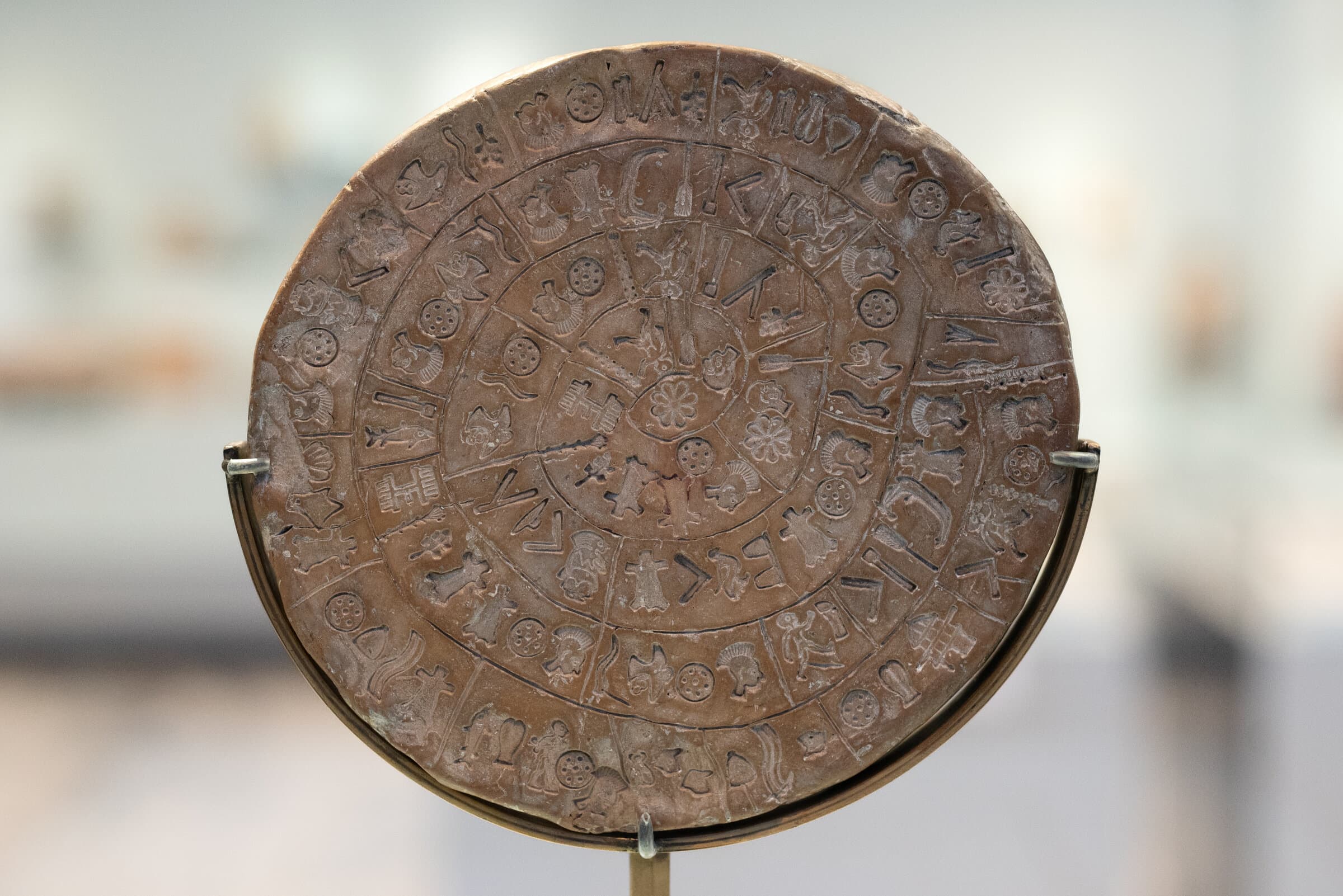
On the evening of July 3, 1908, an Italian archaeologist named Luigi Pernier was digging through a ruined building just northeast of the great Minoan palace at Phaistos, on the warm southern coast of Crete. In a room among the rubble, in a deposit that also held a clay tablet inscribed in the old Cretan script now called Linear A, his team lifted out a disc of fired clay about the width of a spread hand. Both faces were covered edge to edge with tiny pictures arranged in a spiral: a walking man, a plumed head, a fish, a flower, a shield, a child, a bird, forty-five different signs in all, pressed into the clay before it was baked hard. Pernier had found something no spade had ever turned up before and none has turned up since. More than a century later, it is still the most famous thing in the Heraklion Archaeological Museum, and not one person on Earth can tell you what it says.
This article contains affiliate links. If you buy through them we may earn a small commission at no extra cost to you.
What You'll Learn
- •The Disc in the Dirt
- •Reading a Spiral
- •The World's First Printed Page
- •Why This Code Will Not Break
- •The People Who Say They Have Read It
- •The Forgery Charge
- •The Axe That Complicates Everything
- •Is It Even Writing?
- •What the Disc Is Not
- •Frequently Asked Questions
- •Further Reading
The Disc in the Dirt
The dig at Phaistos belonged to the Italian school of archaeology on Crete, led by Federico Halbherr, with the younger Pernier working under him. The accounts of the exact moment differ in their small details, which is itself a little suspicious to some and simply human to others. In one telling, Pernier spotted the half-buried disc himself as the team cleared a deposit of charred earth and ash. In another, the foreman supervising the afternoon's work brought the object to him that evening while he sat writing a letter. What everyone agrees on is the setting: a room in a building the excavators labelled with a number, a layer that felt like something deliberately deposited rather than dropped, and the Linear A tablet lying near the disc as a companion no one could read either.
Pernier carried the find to Heraklion and published it the following year, in 1909, in the Italian journal Monumenti Antichi. He assigned it, on the strength of the pottery around it, to the Middle Minoan period, somewhere in the centuries on either side of 1700 BCE. Later scholars have pulled that date looser, offering ranges that run anywhere from about 1850 to 1400 BCE, because the one clean context the disc had, the deposit it came out of, was dug in an age before modern stratigraphy, and the records are thin. From the start, the object refused to behave. It had a date nobody could pin down, a script nobody could match, and a shape, flat and round and stamped on both sides, that looked like nothing else to come out of the Bronze Age Aegean.
Reading a Spiral
Hold the disc, or a cast of it, and the first thing you notice is the craftsmanship. It is roughly sixteen centimetres across and a couple of fingers thick, baked to a golden brown. On each face a single line of signs winds inward in a tight spiral, starting at the rim and curling toward the centre, the whole run of text broken into little boxes by vertical scored lines. Those boxes hold between two and seven signs each, which almost everyone reads as words, or at least as units of some kind. In total the two faces carry two hundred and forty-two impressions, a hundred and twenty-three on the side archaeologists call A and a hundred and nineteen on side B. Some counts say two hundred and forty-one, the disagreement coming down to a single worn mark.
Those impressions were made from a set of just forty-five distinct signs. And they are pictures, unmistakably: a human figure striding, a head crowned with what looks like a feathered mohawk, a woman, a child, a bird in flight, a fish, a ram's head, a bee, a ship, a shield studded with dots, a branch, a flower. The plumed head is the most common sign on the whole disc, repeated again and again. The images are so clear that you feel you ought to be able to read them, the way you feel you ought to understand a rebus. That feeling is the trap the Phaistos Disc has set for everyone who has ever stared at it.
The World's First Printed Page
Here is the detail that lifts the disc out of the ordinary run of ancient puzzles. The signs were not scratched or drawn by hand. Each one was stamped, pressed into the soft clay with a prepared punch, one punch per sign, and then the whole thing was fired. You can see it in the repeats: every instance of the plumed head is identical, because every instance came from the same tool. Whoever made the disc owned a set of at least forty-five little seals and used them like a typesetter, impressing them in sequence into the clay.
That makes the Phaistos Disc, by one reading, the earliest known example of movable-type printing in the world, roughly three thousand years before Johannes Gutenberg set his first page of metal type in Mainz. The geographer Jared Diamond, in his book Guns, Germs, and Steel, went so far as to call it "the earliest printed document in the world," and used it to make a sharp point: the stamping technique was more trouble than it was worth for a single object, which may be exactly why nobody on Crete ever did it again. The linguist Herbert Brekle argued that if the disc is a text at all, it meets every definition of true typographic printing. And yet the tools that made it, those forty-five punches, have never been found. Not at Phaistos, not anywhere.
Think about what a set of stamps implies. You do not carve forty-five reusable seals to write one thing once. Stamps are for repetition, for making the same marks over and over, on object after object. The technology is built for mass production. But the clay that survives from the entire Minoan world gives us exactly one stamped disc. Either the rest has crumbled to dust, or the Phaistos Disc is the single surviving run of a press that printed almost nothing. Both possibilities are strange, and no one has been able to account for either.
Why This Code Will Not Break
Every few years a headline announces that the Phaistos Disc has finally been cracked. None of the claims has ever held. The reason is not that codebreakers have not been clever enough. The reason is mathematical, and it is worth sitting with, because it is the real heart of the mystery.
To read an unknown script, you need a corpus: enough text, in enough different combinations, that the patterns of a real language start to show through. You count how often each sign appears, which signs cluster together, which ones begin and end words, how endings shift. The triumph that proves the method is Linear B, the script of the Mycenaean Greeks. For decades it sat unread, until the English architect Michael Ventris, building on the patient statistical groundwork of the American scholar Alice Kober, announced in 1952 that the language underneath it was an archaic form of Greek. Ventris could do that because he had thousands of clay tablets to work from, from Knossos and from Pylos on the Greek mainland, a mountain of signs deep enough to test a guess against.
The Phaistos Disc gives a would-be decipherer two hundred and forty-two signs. Total. That is less text than this paragraph. Forty-five distinct symbols appearing a couple of hundred times, with no second document to check any theory against, is simply not enough information to carry a solution. You can map the signs onto almost any language you like and find something that sounds plausible, which is precisely the problem: with so little data, plausibility is cheap and proof is impossible. The disc is not a hard code. It is an underdetermined one. Linear A, the script on the tablet found beside it, remains unread for a related reason, and Linear A at least has hundreds of inscriptions. The disc has one. Unless the ground someday yields a second disc, or a bilingual key, the signs may stay silent not because they are cunning but because they are alone.
The People Who Say They Have Read It
That has never stopped anyone from trying, and some of the attempts are serious. The most widely reported in recent years comes from Gareth Owens, a linguist based on Crete, working with the Oxford phonetician John Coleman. Owens assigns sound values to the disc's signs by comparing them to the signs of Linear B and the related Cretan scripts, then reads the result as a religious text, a prayer or invocation addressed to a Minoan mother goddess. He has said publicly that he can read the great majority of it, and his talks draw crowds. Press accounts have put the figure as high as ninety-nine percent.
Read in the right spirit, this is fascinating, and Owens is careful to call it a reading rather than a decipherment. But it runs straight into the wall described above. Without a second text to test it on, a sound-by-sound reading of a single short inscription cannot be confirmed, only admired. The same holds for the long line of earlier solvers who found in the disc a hymn, a calendar, a court record, a call to arms, a letter home, a board game's instructions. Each solution fits its author's expectations and nobody else's evidence. The disc has a way of returning to each visitor the thing they brought with them. To this day, no reading satisfies the scholars who spend their lives on Aegean scripts.
The Forgery Charge
In 2008, the question took a sharper turn. The American antiquities dealer Jerome Eisenberg, editor of the journal Minerva, published an article arguing that the Phaistos Disc is not an undeciphered ancient text at all. It is, he said, a modern forgery, made around 1908 and planted in the dig. His suspect was Pernier himself. The motive Eisenberg proposed was ambition: Pernier was a young man working in the shadow of Halbherr's discoveries at Gortyn and Arthur Evans's spectacular finds at Knossos, and a unique, world-famous object would make his name. Eisenberg pointed to the disc's suspicious perfection, its cleanly finished edge, its unparalleled stamping, and the fact that it stands entirely alone. He organised a conference on the question at the Society of Antiquaries in London that autumn and later wondered aloud whether the restorer Emile Gillieron, who worked on Cretan finds, might have had a hand in it.
Most scholars did not buy it. Eisenberg was a dealer and an editor, not a specialist in Aegean epigraphy, and researchers who do that work for a living have generally held that the disc is genuine, that its signs and style fit the Bronze Age Cretan world well enough, and that the burden sits with the accuser. The archaeologist Pavol Hnila laid out the case that the evidence still favours authenticity and that the disc cannot be called a fake until those arguments are answered.
And here is the part that keeps the whole argument open: there is a test that could settle it. Thermoluminescence dating can tell you, within a margin, when a piece of fired clay was last heated, which for the disc would mean when it was baked. An ancient firing date would close the forgery question for good. The writer Andrew Robinson, among others, has called for exactly this. By the accounts that circulated after Eisenberg's article, permission for the test has been refused, with the Heraklion museum unwilling to risk its most famous object to the small sample the method requires. So the disc sits in its case, a question that could in principle be answered, left unanswered. Whether that is caution or something else, the result is the same. The mystery is preserved.
The Axe That Complicates Everything
The forgery charge leans hard on the claim that the disc is utterly unique, a one-off with no relatives anywhere. That claim has a problem, and its name is the Arkalochori Axe.
In 1934, the Greek archaeologist Spyridon Marinatos excavated a sacred cave at Arkalochori, in the hills of central Crete, and brought out a bronze votive double axe, a labrys, of the kind the Minoans offered to their gods. Along one face ran a short inscription, about fifteen signs, and several of them look like signs on the Phaistos Disc. A nearby find, a stone block from Malia carrying its own run of signs, sits in the same uneasy family. If the disc is a modern fake invented out of one man's imagination, why do some of its signs turn up, scratched rather than stamped, on a bronze axe pulled from a different cave by a different archaeologist a quarter-century later?
The honest answer is that this cuts in more than one direction, and scholars have taken it every way. Some read the axe as proof that the disc's script was real and shared, part of a wider Cretan sign system we have simply lost. Others, including the epigrapher Louis Godart, have dismissed the axe's inscription as a "pseudo-inscription," signs copied by someone who did not understand them, imitating real writing without writing anything. The resemblances are partial, the matches debated sign by sign, and whether the axe, the disc, and the Malia block belong to one script or three separate things, or to no true script at all, has never been resolved. The one object that should either clear the disc or convict it instead deepens the fog.
Is It Even Writing?
Underneath every theory lies a question most popular accounts skip past, and it is the most unsettling one of all. We assume the Phaistos Disc is language. It looks like language. It has word-like groups, a repeating sign set, a direction of reading. But assuming is not the same as knowing, and a few scholars have pressed the uncomfortable alternative: that the disc may be pseudo-writing, a ritual or decorative imitation of a script, meaningful as an object without encoding any spoken words at all. The classicist Helene Whittaker has raised exactly this possibility.
Even the basic mechanics stay contested. Most scholars think the text was stamped from the outer rim inward, winding toward the centre, which would mean the maker worked from the edge and the reader followed. Yet the little figures themselves face outward, the walking man and the plumed head oriented as if to be read from the centre toward the rim. The disc will not even tell us which way to hold it. It could be a prayer. It could be a hymn sung in a spiral to match the spiral. It could be a label, a receipt, a game, a charm, or a beautiful piece of clay pretending to say something it never said. After more than a century in a museum case, under every light and lens we own, the disc keeps all of these open at once.
What the Disc Is Not
It is worth saying plainly what the Phaistos Disc is not, because the gaps invite invention. It is not an alien transmission, not a star map from elsewhere, not a device. It is a human object, made by human hands on a Greek island in the Bronze Age, by people who sang and prayed and buried their dead and kept records in scripts their neighbours could read. Those same people are the ones who built the palace at Phaistos and wrote the Linear A tablet that lay beside the disc in the ground. The enigma is not exotic. It is intimate. It is the enigma of a message left by our own kind, in our own medium, that we have lost the key to.
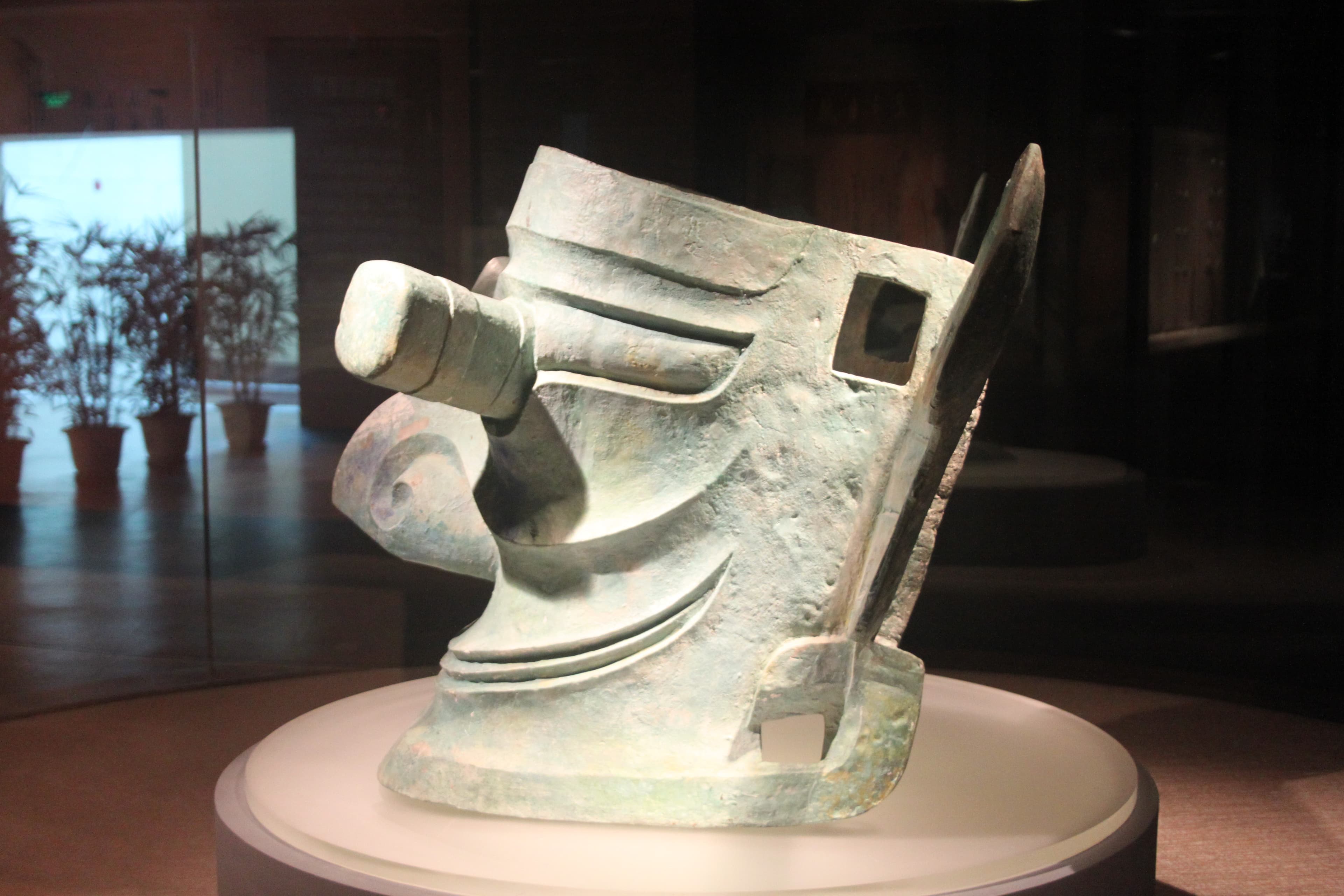
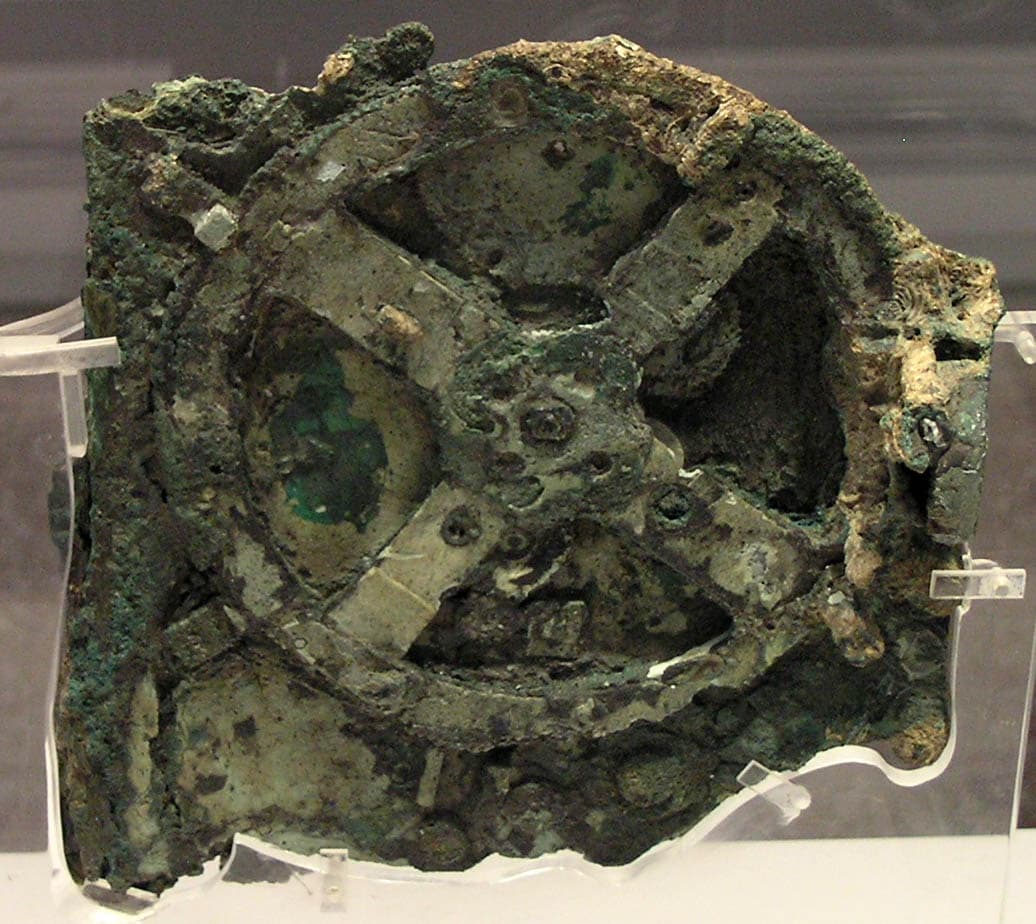
And it is not solved, no matter how many headlines say otherwise. There is a difference between a reading that pleases its author and a decipherment that others can check and build on, and the disc has only ever produced the first kind. The connection worth drawing is to the other things on this site that human beings made and human beings can no longer read: the Voynich Manuscript with its plants that grow nowhere, the sculpture Kryptos standing uncracked inside the walls of the CIA, the wordless bronze gods of Sanxingdui, the geared bronze of the Antikythera Mechanism that we did eventually come to understand. The disc sits with the first three, on the far side of a line we have not been able to cross.
Frequently Asked Questions
How many signs are on the Phaistos Disc?
Two hundred and forty-two impressions in total, a hundred and twenty-three on side A and a hundred and nineteen on side B, though you will see two hundred and forty-one in some sources because of one worn mark that is hard to count. Those impressions were made from a set of only forty-five distinct signs. That small a sample, with no second document to compare it against, is a large part of why the disc has resisted every attempt to read it.
Has the Phaistos Disc been deciphered?
No, not in any way that the scholars who study Aegean scripts accept. Many readings have been proposed, including a recent and widely reported one by Gareth Owens that reads the text as a prayer to a goddess, but none can be confirmed, because there is no other text in the same script to test a solution against. A reading that cannot be checked is a hypothesis, not a decipherment, and the disc has produced only the former.
Is the Phaistos Disc a fake?
A small number of researchers, led by the dealer Jerome Eisenberg in 2008, have argued that it was forged around the time of its discovery. The majority of specialists consider it genuine. The frustrating thing is that thermoluminescence dating could test when the clay was last fired and likely settle the matter, and by the accounts that followed Eisenberg's claim, permission for that test has not been granted. So the question stays technically open, by choice as much as by ignorance.
Why can't computers or AI just solve it?
Because the problem is not a lack of processing power, it is a lack of data. Codebreaking an unknown script depends on having enough text for statistical patterns to emerge and enough context to anchor a guess. The disc offers a couple of hundred signs and nothing to check an answer against. A machine can generate a thousand plausible readings as easily as a human can generate one, and plausibility without a second text is worth nothing. More computing does not create information that was never recorded.
What is the Arkalochori Axe, and does it help?
It is a bronze votive axe found in a Cretan cave in 1934 whose short inscription shares several signs with the disc, which suggests the disc's script may not be a one-off after all. Whether the two objects use the same writing system, or whether the axe is itself a meaningless imitation of real script, has never been agreed. It is the closest thing the disc has to a relative, and even that relationship is disputed.
Further Reading
For the whole family of scripts the world has never cracked, the disc among them, the best single book is Andrew Robinson, Lost Languages: The Enigma of the World's Undeciphered Scripts, which treats the Phaistos Disc with a clear eye and sets it beside the other great holdouts. Find it on Amazon.
To understand why some ancient scripts fall and others never do, read the story of the one that fell: John Chadwick, The Decipherment of Linear B, written by the man who worked alongside Michael Ventris, remains the classic account of how a dead script is actually read. Find it on Amazon.
And for the human drama behind that breakthrough, and a clear view of what decipherment really demands, Margalit Fox, The Riddle of the Labyrinth: The Quest to Crack an Ancient Code tells the story of Alice Kober and the race to read Linear B. Find it on Amazon.
The Phaistos Disc has been out of the ground for more than a hundred years. We have photographed it, cast it, scanned it, fed it to computers, and argued over it in conference halls from Heraklion to London. We can tell you how it was made, that someone pressed forty-five little stamps into wet clay in a careful spiral and baked it hard, three and a half thousand years ago, on a bright island in the middle of the sea. We cannot tell you a single word of what they wanted to say. It lies in its glass case in Crete, the first printed page in the world, holding its message the way it has held it since the Bronze Age, in plain sight and out of reach.
Want to explore more mysteries?
We've got plenty more rabbit holes to go down.