Nan Madol: The Stone City Built on the Sea
A megalithic city of 92 islets rises from a coral reef in Micronesia, built from millions of basalt logs no one can fully explain moving.
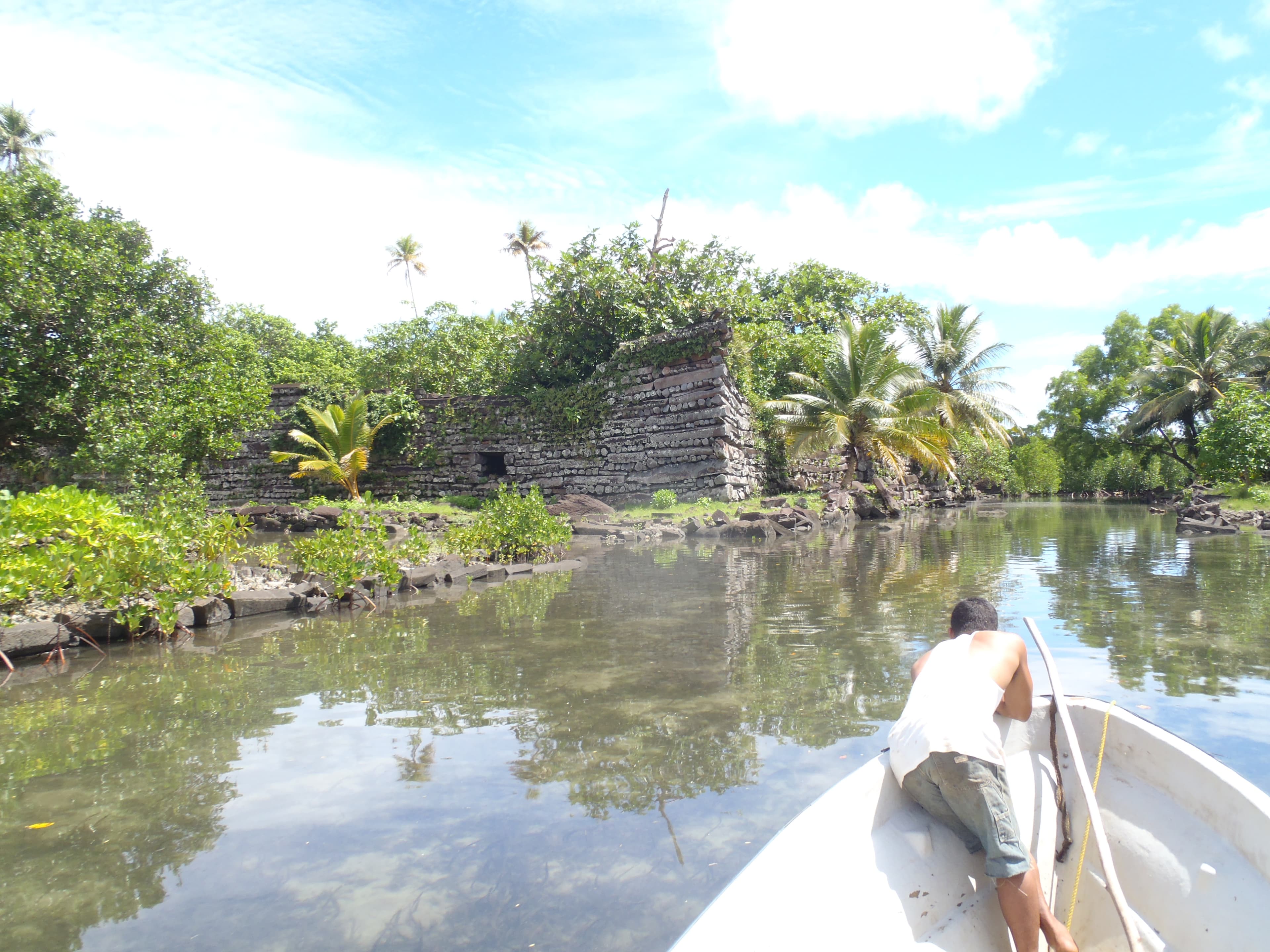
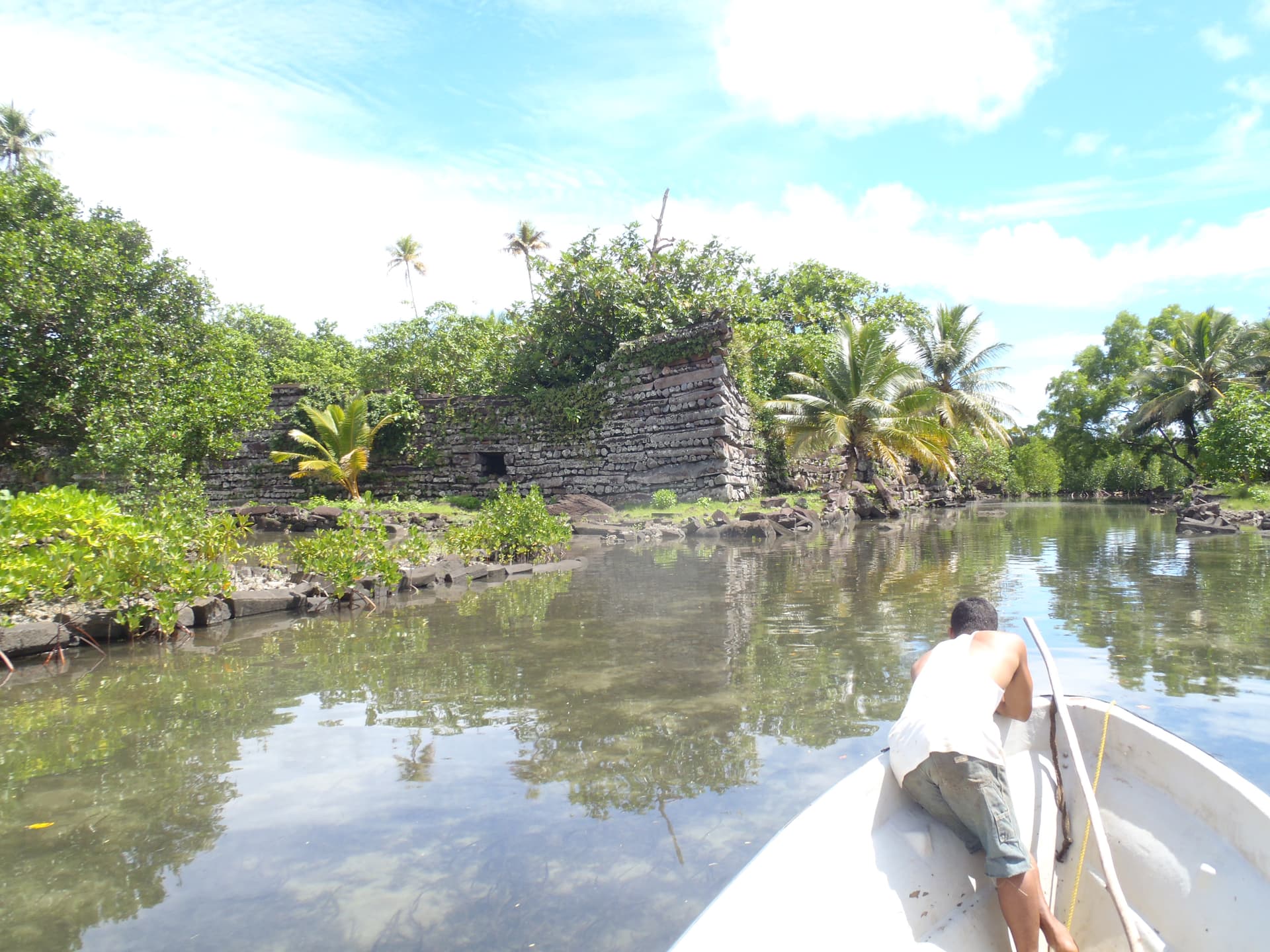
On a tiny island off the eastern shore of Pohnpei, in one of the most remote corners of the Pacific Ocean, a city sits in the water. Not beside it. In it. Ninety-two artificial islands rise out of a shallow lagoon, separated by a grid of tidal canals, their walls built from long black columns of basalt stacked like cordwood. At high tide the channels fill and you can paddle a canoe between the walls. At low tide the foundations show themselves, vast and silent, draped in mangrove roots and humidity. Locals call it Nan Madol, which means "the spaces between," a reference to the canals that thread the whole place together.
It has another name too, the one the outside world reached for when it first tried to describe what it was looking at: the Venice of the Pacific. But Venice grew slowly over centuries along the edges of dry land. Nan Madol was built directly onto a coral reef, in open water, by a culture that left no written records, using stones that in total weigh an estimated 750,000 metric tons. The nearest source of that basalt sits on the far side of the island. And to this day, no one has produced a satisfying account of how it got here.
What You'll Learn
- •What Is Nan Madol?
- •Who Built It, and When?
- •The Basalt Problem
- •How Were the Stones Moved?
- •The Legend of the Flying Stones
- •A City Designed by Function
- •Why Was Nan Madol Abandoned?
- •The Curse and the Things That Happen There
- •What Modern Science Has and Hasn't Settled
- •Frequently Asked Questions
What Is Nan Madol?
Nan Madol is a ruined city built on a reef flat off Temwen Island, which itself hugs the larger island of Pohnpei in the Federated States of Micronesia. The core of the site covers roughly 1.5 kilometers by 0.5 kilometers and contains 92 man-made islets, each one a platform of stone and coral fill bordered by retaining walls of columnar basalt. Tidal canals run between them, which is why the city only fully reveals its logic when the water moves.
The walls are the part that stops people in their tracks. They are made of naturally occurring basalt columns, six-sided and seven-sided prisms that form when thick lava cools slowly and fractures into geometric pillars. Whoever built Nan Madol gathered these columns by the millions and laid them in alternating courses, headers and stretchers, the same interlocking pattern a bricklayer would recognize. Some of the walls still stand more than 7 meters tall. Individual stones in the structure are estimated to weigh as much as 50 tons.
The largest and most famous islet, Nandauwas, is a royal mortuary complex. Its outer walls rise to roughly 8 meters and enclose a central tomb. Standing inside it, surrounded by tons of stacked black rock with the sea lapping at the foundations, it is hard to hold onto the idea that this was built by hand on a coral reef in the open ocean.
Who Built It, and When?
The builders were the Saudeleur, a dynasty that unified Pohnpei under a single rule and made Nan Madol their ceremonial and political capital. Carbon dating from the site points to megalithic construction beginning around 1180 AD, though people had been living and working on the reef flat for centuries before that, as early as the first or second century AD by some readings of the evidence.
The Saudeleur ruled from Nan Madol until roughly 1628. At its height the city served as the seat of power over an island population estimated at around 25,000 people. The nobility and priests lived on the islets. Commoners brought them food and water, because remarkably, for all its scale, Nan Madol had no fresh water and no food production of its own. Everything had to be carried in across the lagoon. It was a capital built for ritual and rule, not for self-sufficiency, a stone stage for a dynasty that wanted to be seen sitting on top of the sea.
That much archaeology can tell us. What it cannot yet explain is the engineering.
The Basalt Problem
Here is the heart of the mystery, and it is a problem of simple arithmetic that gets harder the longer you look at it.
The columnar basalt that makes up Nan Madol did not form where the city stands. Pohnpei has several basalt quarry sites, the most often cited being a formation on the opposite side of the island from Temwen. To build the city, those columns had to be detached from the quarry, moved across or around the island, and then floated or hauled out onto a reef flat and stacked, some of them weighing several tons each, a few of them weighing far more.
Estimates of the total mass involved vary, but figures around 750,000 metric tons of basalt are commonly cited for the site as a whole. To put that in human terms: a culture without metal tools, without pulleys, without draft animals, without the wheel, somehow assembled three quarters of a million tons of heavy stone, piece by piece, on a tidal reef, over a period of construction that may have spanned centuries.
Archaeologists have proposed sensible mechanisms. The trouble is that when researchers have tried to test them, the numbers strain. Experiments and calculations suggest that moving and placing the stones using rafts and ropes would have required enormous, sustained labor far beyond what the island's estimated population could comfortably supply, especially given that those same people also had to grow the food and carry the water. The conventional explanation works on paper only if you assume a degree of organization, manpower, and time that the surviving evidence does not clearly support. The gap between "it must have been done this way" and "here is how it was actually done" has never fully closed.
How Were the Stones Moved?
The mainstream reconstruction goes like this. Workers quarried the basalt columns by exploiting natural fracture lines in the rock. They lashed the columns to rafts or canoes and floated them around the coast on high tides, taking advantage of the lagoon to bring them close to the construction site. Then, using ramps, levers, and ropes made from hibiscus fiber, they raised each column into place.
It is a reasonable picture, and elements of it are almost certainly true. The problem is the scale and the weight at the upper end. Floating a 5-ton column on a raft is plausible. Floating, landing, and lifting columns estimated at 20, 30, even 50 tons, onto walls that stand 8 meters high, by hand, is a different proposition entirely. Modern attempts to replicate even modest stone-moving using only period-appropriate technology have struggled, and Nan Madol contains stones at the heavy end of what any pre-industrial society anywhere is known to have moved.
When pressed on the largest stones, archaeology tends to fall back on time and numbers: enough people, working long enough, can do almost anything. Perhaps. But Pohnpei is a small island, and the people who lived there had to eat. The accounting has never quite balanced, and that imbalance is exactly what keeps Nan Madol on the list of places that resist tidy explanation.
The Legend of the Flying Stones
The Pohnpeians who descend from the people who built the city have always had an answer, and it has nothing to do with rafts.
According to Pohnpeian oral tradition, Nan Madol was built by two brothers, the sorcerers Olisihpa and Olosohpa, who came from a mythical land to the west seeking a place to build an altar to the god of agriculture. After several false starts elsewhere on the island, they settled on the reef off Temwen. And the stones, the tradition says, came to them. The brothers used magic to make the great basalt columns fly through the air and settle themselves into place, in some tellings with the aid of a flying dragon that carved the canals with its body.
It is easy to file this under myth and move on. But there is a pattern worth noticing here, one that recurs at megalithic sites all over the world. From the moving of the stones at Stonehenge to the construction of the Egyptian pyramids, cultures that built impossible things in deep antiquity very often explained the feat the same way: the stones moved themselves, or were moved by giants, gods, or sorcerers. When a people insists that their greatest monument was raised by means no human could repeat, it is worth at least asking why the memory took that shape. The flying-stones legend is not evidence of levitation. But it may be a memory, dressed in myth, of a building method so far beyond ordinary labor that the only honest way to describe it was to call it magic.
A City Designed by Function
Whatever raised the stones, the layout of Nan Madol shows unmistakable planning. The 92 islets were not scattered at random. Different sectors of the city served different purposes, and the place functioned as a working capital with zones for the living and zones for the dead.
The southwestern district, Madol Powe, was the priestly and mortuary sector, home to the great tomb complex of Nandauwas and dozens of smaller islets dedicated to ritual, food preparation for ceremonies, and the housing of priests. The northeastern district, Madol Pah, was the administrative heart, where the Saudeleur and the nobility lived and governed. There were islets set aside for specific tasks: one for the preparation of coconut oil, one that may have housed eels considered sacred, one where canoes were built.
This is the part that quietly deepens the mystery rather than solving it. Nan Madol was not a pile of stones thrown up by brute force. It was an engineered city, with hydrology, zoning, and monumental architecture, built on a reef by a culture we know almost nothing about because they left no writing behind. The sophistication of the plan only sharpens the question of how the plan was physically executed.
Why Was Nan Madol Abandoned?
Around 1628, according to tradition, an invader named Isokelekel arrived from the island of Kosrae and overthrew the last Saudeleur ruler. Isokelekel established a new political order, the Nahnmwarki system, and for a time he and his successors continued to live at Nan Madol. But over the following generations the city was gradually abandoned. By the time the first European visitors arrived in the 19th century, it was already a ruin, half swallowed by mangroves, its canals silting up, its tombs empty.
Why a city that took such staggering effort to build was simply walked away from is its own small mystery. The leading idea is logistical exhaustion. Nan Madol could not feed or water itself. Sustaining a population of priests and nobles on a foodless reef required a constant flow of supplies from the rest of the island, and as the centralized power of the Saudeleur faded, the machinery that kept the city alive may have failed with it. A capital that depends entirely on others bringing it food survives only as long as the politics holding that arrangement together survive.
There may be more to it. Pohnpeians have long regarded the ruins as a place of spiritual danger, the haunt of the dead, somewhere ordinary people did not go after dark. Whether the city was abandoned for hard logistical reasons, for fear, or for both, the result is the same: one of the most ambitious construction projects in the prehistoric Pacific was left to the tide.
The Curse and the Things That Happen There
Nan Madol carries a reputation, both among Pohnpeians and among some of the outsiders who have studied it. The local tradition holds that the ruins are sacred and dangerous, that to disturb them, and especially to remove anything from them, invites misfortune.
The most often repeated story attaches to a man named F. W. Christian and to a German colonial governor, Victor Berg, who took an interest in the site in the early 1900s. As the tradition is told, Berg directed excavations at Nan Madol against local warnings and died suddenly and unexpectedly soon after, with the implication left hanging that the place had something to do with it. Accounts of the episode vary in their details, and how much to make of it is left to the reader. What is not in dispute is that the people of Pohnpei have treated these ruins as spiritually charged for as long as anyone has asked them, and that the sense of unease the site produces is reported by visitors who arrive knowing nothing of the legends at all. Something about a foodless stone city standing in the sea, built by methods no one can reproduce, gets under people's skin.
What Modern Science Has and Hasn't Settled
In 2016, UNESCO inscribed Nan Madol on the World Heritage List, and on its List of World Heritage in Danger at the same time, citing the silting of the waterways and the mangroves slowly prying the walls apart. The designation brought new scrutiny and new dating work, and it firmly established the site's outline: a Saudeleur capital, begun around the late 12th century, built of local columnar basalt, abandoned in the early modern period.
What the science has not settled is the thing a visitor most wants to know. Modern archaeology can tell you when Nan Madol was built and who ruled from it. It can identify the basalt sources and sketch a plausible chain of rafts and ropes and ramps. What it cannot yet do is demonstrate, with a tested and reproducible method, how a small island society without metal, wheels, or draft animals actually moved three quarters of a million tons of heavy stone, including individual blocks of many tons, out onto a reef and stacked it into walls that still stand 800 years later.
That is not a gap that fringe speculation invented. It is a gap the conventional account itself leaves open, every time it reaches the heaviest stones and falls back on the phrase "enough labor over enough time." Maybe that is the whole answer. Maybe the people of Pohnpei accomplished something extraordinary through sheer organization and persistence, and the only thing missing is our willingness to credit them with it. Or maybe they knew something about moving stone that we have not reconstructed. Either way, the city is still out there in the lagoon, stacked log by log of black rock, waiting between the tides.
Frequently Asked Questions
Where exactly is Nan Madol?
It sits off the southeastern shore of Pohnpei, the main island of the Federated States of Micronesia, built onto a reef flat beside the small island of Temwen. Pohnpei is one of the more isolated inhabited places on Earth, thousands of kilometers from any continent, which makes the scale of what was built there all the more striking. Getting to the ruins today still means a boat, a tide chart, and a guide.
How old is Nan Madol?
Carbon dating places the start of megalithic construction at around 1180 AD, with the Saudeleur dynasty ruling from the completed city until roughly 1628. There is evidence of human activity on the reef flat much earlier, possibly as far back as the first or second century AD, so people may have been preparing the site for a very long time before the great walls went up.
How did they move stones that heavy without modern technology?
That is the unanswered question at the center of the whole site. The accepted reconstruction has workers floating basalt columns on rafts and raising them with ropes, levers, and ramps. It accounts for the smaller stones reasonably well. For the heaviest blocks, estimated in the tens of tons, no one has yet demonstrated a tested method using only the tools available to the builders, and the labor figures required strain against what a small island population could have sustained.
Did the stones really fly into place?
That is what Pohnpeian tradition says: two sorcerer brothers used magic, and in some versions a flying dragon, to lift the basalt columns through the air. No one is asking you to take that literally. But it is worth noting that cultures who built the world's other great megaliths told strikingly similar stories, and that a building feat extreme enough to be remembered as sorcery is a building feat worth wondering about.
Why was such an enormous city abandoned?
The city could not feed or water itself; everything had to be brought in from the rest of Pohnpei. When the centralized power of the Saudeleur collapsed after the invasion of Isokelekel around 1628, the supply system that kept the city alive seems to have unraveled with it. Add a long-standing local belief that the ruins are spiritually dangerous, and a place that took centuries to build was left to the mangroves within a few generations.
Can you visit Nan Madol today?
Yes, with permission and a local guide, and ideally with attention to the tide, since the canals are what make the layout legible. Visitors consistently describe the same thing the legends do: a heavy, watchful quiet hanging over the stones. The ruins are protected as a World Heritage Site, and they are also, in the eyes of the people who live nearest to them, still very much sacred ground.
There is a particular kind of mystery that does not depend on aliens or lost continents to stay unsettling. Nan Madol is one of them. We know who built it and roughly when. We can stand inside it and touch the walls. And still, when you ask the simplest question, how did these stones get here, the honest answer remains the one the Pohnpeians gave the first outsiders who asked: nobody living can tell you. The city waits in the water for someone who can.
Further Reading
This article contains affiliate links. If you buy through them we may earn a small commission at no extra cost to you.
Want to explore more mysteries?
We've got plenty more rabbit holes to go down.