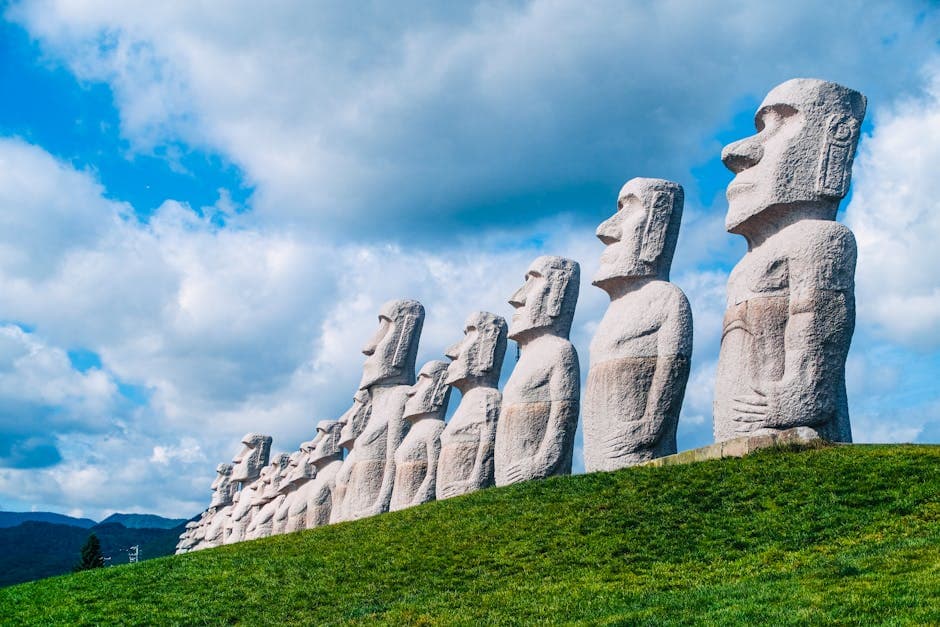
Easter Island's Moai: How Did an Isolated Civilization Move 900 Giant Statues?
Nearly 900 massive stone statues stand on one of Earth's most remote islands. How the Rapa Nui people carved and moved them remains one of archaeology's greatest puzzles.
On a volcanic speck of land in the southeastern Pacific, more than 2,000 miles from the nearest continent, nearly 900 stone giants stand with their backs to the sea. Some are 30 feet tall and weigh over 80 tons. One unfinished colossus, still attached to the quarry rock, would have stood 70 feet tall and weighed roughly 270 tons if completed. The people who carved them had no metal tools, no wheels, no draft animals, and no written language that we've been able to decode.
This is Rapa Nui, known to most of the world as Easter Island. And the question that's obsessed archaeologists, engineers, and adventurers for three centuries is deceptively simple: how did they do it?
The answer, it turns out, involves walking statues, a disputed ecological catastrophe, rats, and a civilization that was far more sophisticated than early European visitors gave it credit for.
What You'll Learn
- •Who Were the Rapa Nui People?
- •What Are the Moai and Why Were They Built?
- •How Were the Moai Carved?
- •How Did the Rapa Nui Move the Moai?
- •What Happened to Easter Island's Trees?
- •Did the Rapa Nui Civilization Really Collapse?
- •What Happened When Europeans Arrived?
- •What's Happening on Easter Island Today?
- •Frequently Asked Questions
Who Were the Rapa Nui People?
The Rapa Nui were Polynesian voyagers who reached the island after sailing thousands of miles across open ocean in double-hulled canoes. Exactly when they arrived is debated. Earlier estimates placed first settlement around 400 to 800 CE, but a landmark 2007 study by archaeologist Terry Hunt provided compelling evidence that colonization didn't happen until around 1200 CE.

That later date matters because it compresses the timeline dramatically. If the Rapa Nui arrived around 1200 and European contact happened in 1722, that gives them roughly 500 years to develop their culture, carve and transport nearly 900 statues, and build the elaborate stone platforms (called ahu) that supported them. That's an extraordinary amount of engineering in a very short time for a population that probably never exceeded 10,000 to 15,000 people.
The island they found was small: just 63 square miles, roughly the size of Washington, D.C. It was volcanic, treeless hilltops aside, with forests of the now-extinct Rapa Nui palm covering much of the landscape. There were no native mammals except bats, no large rivers, and limited fresh water. It was, by most measures, one of the least hospitable places in the Pacific to build a civilization.
They built one anyway.
What Are the Moai and Why Were They Built?
The moai are monolithic stone statues, most carved from compressed volcanic ash (tuff) from the Rano Raraku quarry on the island's eastern side. They depict human figures from the waist up, with oversized heads that make up about three-eighths of the total statue height. Many have elongated features, heavy brows, and long noses.
The statues weren't generic. Researchers believe each moai represented a specific deceased ancestor, a chief or important figure whose spiritual power (called mana) could protect and benefit the living community. The Rapa Nui word "moai" itself roughly translates to "so that he can exist." By carving a physical form, the people believed they were creating a vessel for the ancestor's mana, allowing the dead to continue watching over their descendants.

Most finished moai were erected on ahu, stone platforms built along the coastline. The statues always faced inland, toward the villages they protected, with their backs to the sea. Some ahu held a single moai; others supported up to 15 in a row. Many moai also wore pukao, cylindrical red stone topknots carved from a different quarry at Puna Pau, adding several additional tons to statues that already weighed dozens of tons.
Some moai also had eyes made of white coral with red scoria or obsidian pupils. Archaeologists believe the eyes were inserted during ceremonies to "activate" the statue's mana, essentially bringing the ancestor's spirit to life.
There are 887 known moai on Easter Island. About 397 are still at Rano Raraku, the main quarry, in various stages of completion. The rest were transported to ahu around the island's perimeter, some traveling more than 11 miles from the quarry.
How Were the Moai Carved?
The carving process, at least, is relatively well understood. The Rapa Nui used toki, basalt hand picks, to chip away at the compressed volcanic tuff of Rano Raraku. The stone is relatively soft when first exposed but hardens with weathering, making it ideal for carving.
Workers carved the front and sides of each statue while it was still attached to the bedrock, working the moai's features in detail before cutting the back free. The statue was then slid down the quarry slope to a temporary pit where the back could be finished.
Thousands of discarded toki have been found at Rano Raraku. Based on experimental archaeology, researchers estimate that a team of five to six carvers could complete a medium-sized moai in about 12 to 18 months.
The real mystery isn't the carving. It's what happened next.
How Did the Rapa Nui Move the Moai?
This is the question that's launched a thousand theories. How do you move an 80-ton statue 11 miles across rough volcanic terrain without wheels, cranes, or animals?
The "walking" theory (currently the leading hypothesis): When asked by early European visitors how the statues moved, the Rapa Nui consistently said the moai "walked." For decades, researchers dismissed this as myth. Then, in 2011, archaeologists Carl Lipo and Terry Hunt proposed that the islanders literally walked the statues to their destinations.
Their idea: teams of people using ropes could rock a standing moai from side to side, tilting it forward with each movement, essentially waddling it along the road. In 2012, they built a 4.35-ton concrete replica and demonstrated that just 18 people using three ropes could "walk" the statue 100 meters in about 40 minutes.

A 2025 study analyzing all 962 known moai using 3D modeling confirmed that the statues' proportions, specifically their forward-leaning center of gravity and wide bases, were engineered to facilitate this rocking motion. The fallen moai scattered along ancient roads between Rano Raraku and the ahu platforms overwhelmingly fell face-first, exactly what you'd expect if they toppled while being walked forward.
The wooden sled/roller theory: Norwegian explorer Thor Heyerdahl proposed in the 1950s that the moai were placed on wooden sleds or log rollers and dragged to their destinations. Czech engineer Pavel Pavel tested a version of this in 1986. The problem: this would have required enormous quantities of wood on an island that eventually had none. It's possible this method was used early on when trees were still available.
The rope drag theory: Archaeologist Jo Anne Van Tilburg argued that moai were laid on their backs on wooden cradles and dragged along prepared roads using rope teams of 50 to 500 people, depending on the statue's size. Her team successfully moved a replica this way in 1998.
The alien theory: Ancient astronaut proponents have suggested the statues were moved with extraterrestrial technology. There's no evidence for this. The Rapa Nui had the engineering knowledge, the workforce, and the motivation to do it themselves. The "walking" experiments prove it was physically possible with stone-age technology.
The walking theory is elegant because it explains several puzzles at once: why many road moai fell face-down, why the statues have a specific center of gravity, and why the Rapa Nui themselves said the moai walked.
What Happened to Easter Island's Trees?
When Polynesian settlers arrived, Easter Island was covered in forests, including a species of giant palm related to the Chilean wine palm that grew up to 50 feet tall. By the time Europeans arrived in 1722, the island was almost entirely treeless. What happened?
The traditional narrative, popularized by Jared Diamond's 2005 book "Collapse," tells a story of ecocide. The Rapa Nui, obsessed with building ever-larger moai, cut down the forests for rollers, sleds, and ropes to transport the statues. As trees disappeared, so did the ability to build canoes for fishing, leading to food shortages, warfare, and civilizational collapse. Diamond presented Easter Island as a cautionary tale for modern environmental destruction.
It's a compelling story. But recent research indicates it's too simple, and possibly wrong.
In 2007, Terry Hunt proposed a different villain: the Polynesian rat (Rattus exulans). The rats, which arrived with the first settlers, had no predators on the island and multiplied explosively. They ate palm seeds, preventing forest regeneration. Hunt's analysis of palm nut remains found that nearly every seed showed rat gnaw marks.
A 2024 study from the University of Arizona went further, arguing that the Rapa Nui population never actually spiraled to unsustainable levels. Using archaeological evidence and population modeling, researchers concluded that the island may have supported a relatively stable population that adapted to deforestation through rock gardening and other agricultural innovations, rather than collapsing under its own weight.
The truth likely involves multiple factors: rats eating seeds, humans clearing land for agriculture, and natural climate variation all contributing to deforestation. But the image of a civilization that recklessly destroyed itself? That's looking increasingly like a myth.
Did the Rapa Nui Civilization Really Collapse?
This is where the Easter Island story gets politically and scientifically contentious.
The "collapse" narrative says the Rapa Nui destroyed their environment, ran out of resources, descended into warfare, and toppled each other's moai in clan conflicts. By this telling, the small, impoverished population that Europeans found in 1722 was the remnant of a once-great civilization that had eaten itself alive.

But Carl Lipo, Terry Hunt, and other researchers argue that the evidence doesn't support a pre-contact collapse. They point out that:
- •Population estimates vary wildly. Claims of 15,000 to 20,000 people are based on carrying-capacity models, not archaeological evidence. The actual population may never have exceeded a few thousand.
- •The moai toppling happened after European contact. Most statues were knocked down between the 1770s and 1860s, a period of devastating European disease, slave raids, and social disruption.
- •Agricultural adaptation was sophisticated. The Rapa Nui developed lithic mulching, placing rocks in garden plots to retain moisture and nutrients. This allowed farming without trees.
- •Warfare evidence is ambiguous. The obsidian spearpoints (mata'a) long cited as weapons may actually have been agricultural and craft tools.
The "ecocide" narrative, critics argue, is a European projection. It assumes the Rapa Nui were primitive people who couldn't manage their resources, when the evidence actually shows remarkable adaptation to a challenging environment.
This isn't a settled debate. But the trend in recent scholarship is away from "collapse" and toward "resilience."
What Happened When Europeans Arrived?
Dutch explorer Jacob Roggeveen reached the island on Easter Sunday, April 5, 1722, and named it accordingly. His expedition reported a population of perhaps 2,000 to 3,000 people and noted that many moai were still standing on their platforms.
What followed was catastrophic, and it had nothing to do with moai or deforestation.
Spanish explorers arrived in 1770 and claimed the island for Spain. British captain James Cook visited in 1774 and noted that some statues had been toppled since Roggeveen's visit. French explorer La Perouse arrived in 1786.
The real devastation came in the 1860s. Peruvian slave raiders abducted approximately 1,500 islanders, roughly half the population, and shipped them to work in guano mines. Most died of disease and overwork. When international pressure forced Peru to repatriate the survivors, only 15 made it back to the island. They brought smallpox with them, triggering an epidemic that killed most of the remaining population.
By 1877, just 111 Rapa Nui remained on the island.
Chile annexed Easter Island in 1888. For most of the next century, the island was essentially run as a sheep ranch, with the Rapa Nui confined to the town of Hanga Roa while the rest of the island was leased to a Scottish-Chilean wool company. The Rapa Nui weren't granted Chilean citizenship until 1966.
This history matters because it reframes the "mystery" of Easter Island. The civilization didn't mysteriously vanish. It was systematically destroyed by colonialism, slavery, and disease, the same forces that devastated indigenous populations across the Pacific and the Americas.
What's Happening on Easter Island Today?
Easter Island is a UNESCO World Heritage Site (designated in 1995) and a major tourist destination. About 7,750 people live there as of the 2017 census, with about 45% identifying as Rapa Nui.
The island faces real challenges. Tourism, which brings roughly 100,000 visitors annually, strains limited infrastructure and water resources. In 2018, Chile restricted tourist visits to 30 days maximum to reduce pressure on the island. The COVID-19 pandemic closed the island to visitors for over two years (2020 to 2022).
There's also an ongoing movement for greater Rapa Nui self-determination. In 2017, the Rapa Nui Parliament (an indigenous governing body) called for more local control over the island's resources and archaeological sites. Questions about repatriation of moai held in foreign museums, including the British Museum's Hoa Hakananai'a, remain contentious.
Meanwhile, archaeological research continues to reveal new insights. Ground-penetrating radar has shown that the "buried heads" at Rano Raraku actually have full bodies extending deep underground, some with detailed carvings on their backs that were hidden for centuries. The moai still have secrets to share.
If you're interested in other ancient construction mysteries, check out our articles on the Nazca Lines and Stonehenge. For another island mystery, read about the Bermuda Triangle and the strange disappearances in the Mary Celeste case.
Timeline of Key Events
| Year | Event |
|---|---|
| ~1200 CE | Polynesian settlers arrive on Rapa Nui (revised estimate) |
| ~1250-1500 | Peak period of moai carving and transport |
| 1722 | Dutch explorer Jacob Roggeveen becomes first European visitor |
| 1770 | Spanish expedition claims island for Spain |
| 1774 | Captain James Cook visits; notes some toppled moai |
| 1786 | French explorer La Perouse arrives |
| 1860s | Peruvian slave raids abduct ~1,500 islanders |
| 1877 | Population drops to just 111 people |
| 1888 | Chile annexes Easter Island |
| 1966 | Rapa Nui granted Chilean citizenship |
| 1995 | UNESCO designates island a World Heritage Site |
| 2007 | Terry Hunt's study revises settlement date to ~1200 CE |
| 2011 | Lipo and Hunt propose "walking moai" theory |
| 2025 | 3D analysis of all 962 moai confirms walking transport method |
Frequently Asked Questions
How many moai are on Easter Island?
There are 887 known moai on Easter Island. About 397 remain at or near the Rano Raraku quarry where they were carved, in various stages of completion. The rest were transported to ahu (stone platforms) around the island's coastline. The largest standing moai, called Paro, is about 33 feet tall and weighs approximately 82 tons.
Why do some moai have red hats?
Those aren't hats. They're called pukao, and they represent hair knots or headdresses. They're carved from red scoria, a different volcanic rock found at the Puna Pau quarry. Each pukao weighs several tons and was somehow placed on top of the already-erected moai. Researchers believe they may have been rolled up ramps made of piled stones.
Were the moai's bodies always buried?
No. The moai at Rano Raraku were gradually buried by sediment washing down the quarry slopes over centuries. When they were first erected, their full bodies were visible. Excavations have revealed detailed carvings on the buried backs of many statues, including petroglyphs of canoes and other symbols.
Did Easter Islanders really cause their own collapse?
This is hotly debated. The traditional "ecocide" narrative, popularized by Jared Diamond, says the Rapa Nui destroyed their forests and collapsed their own civilization. But recent research indicates the population was never as large as assumed, rats played a major role in deforestation, and the real population crash happened after European contact through slavery and disease. The scholarly trend is moving away from the collapse theory.
Can you visit Easter Island?
Yes, but with restrictions. Easter Island is accessible by air from Santiago, Chile (about a 5-hour flight). Since 2018, tourists are limited to 30-day stays. You'll need to register with CONAF (Chile's national forest corporation) to visit Rapa Nui National Park, which covers about 40% of the island. The island reopened to tourism in August 2022 after a pandemic closure.
Further Reading
This article contains affiliate links. If you buy through them we may earn a small commission at no extra cost to you.
Want to explore more mysteries?
We've got plenty more rabbit holes to go down.