The Nazca Lines: Ancient Drawings Only Visible from the Sky
Etched into Peru's desert over 2,000 years ago, the Nazca Lines depict giant animals and shapes only visible from the air. Who made them, and why?
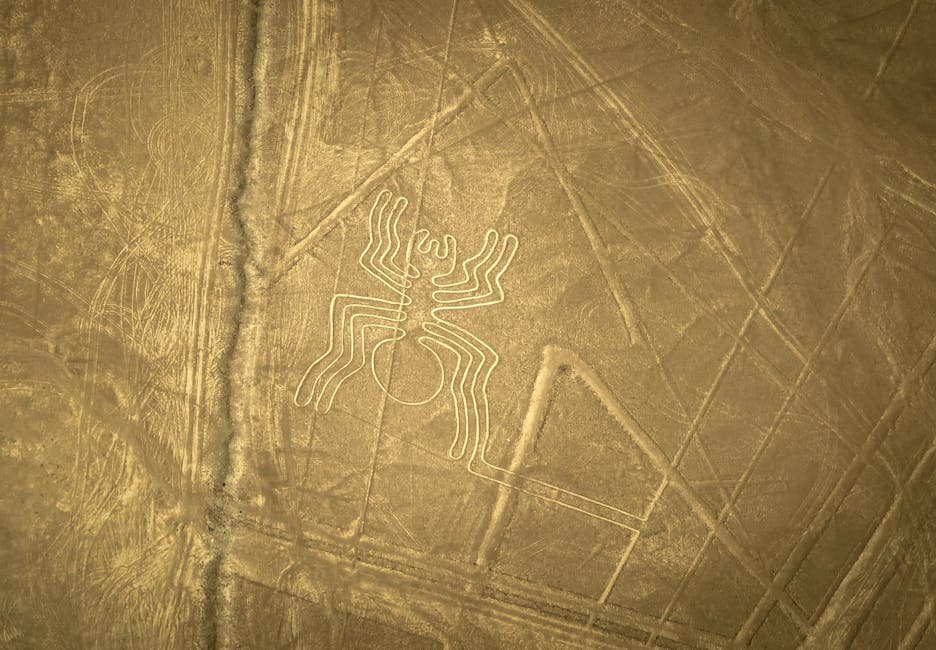
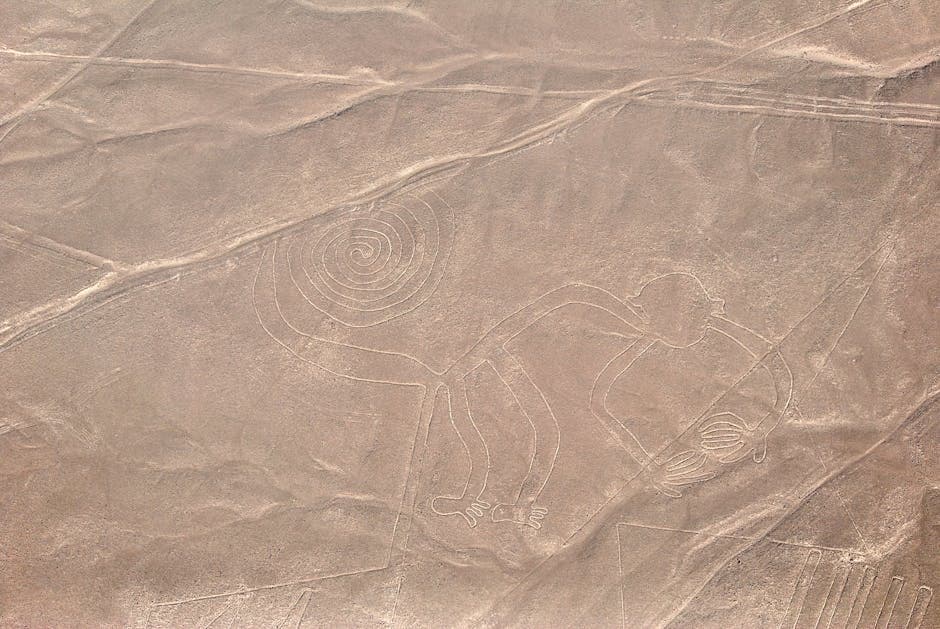
From 500 feet up, the Peruvian desert transforms. What looks like barren, reddish-brown earth from ground level suddenly reveals enormous drawings: a spider with legs stretching 150 feet, a hummingbird the size of a jumbo jet, a monkey with a spiraling tail. These are the Nazca Lines, and they've been sitting in the desert for over 2,000 years, waiting for someone to fly high enough to see them.
The Nazca people didn't have aircraft. They didn't have hot air balloons. Yet they created hundreds of enormous geoglyphs across 190 square miles of desert, figures so large and so precise that they only make sense from an aerial perspective. The question that's haunted archaeologists since pilots first spotted the lines in the 1920s is deceptively simple: why would an ancient civilization create art that they themselves couldn't fully see?
What You'll Learn
- •What Are the Nazca Lines?
- •How Were the Nazca Lines Made?
- •The Astronomical Calendar Theory
- •Were the Nazca Lines Connected to Water Rituals?
- •The Ancient Astronaut Theory
- •Ceremonial Pathways: Walking the Lines
- •AI Discovers 303 New Geoglyphs in 2024
- •Why Can't We Just Ask What They Mean?
- •Frequently Asked Questions
What Are the Nazca Lines?
The Nazca Lines are a collection of geoglyphs, basically giant drawings made in the ground, spread across the Nazca Desert in southern Peru, roughly 250 miles southeast of Lima. They were created between approximately 500 BC and 500 AD by two successive cultures: the Paracas culture (roughly 400 to 200 BC) and the Nazca culture (200 BC to 500 AD).
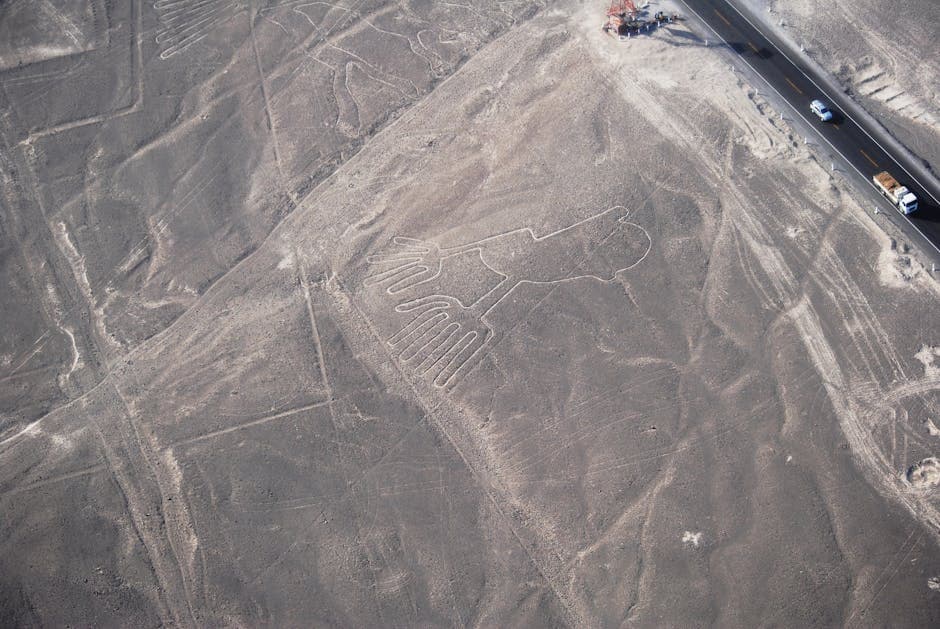
The figures fall into two broad categories. There are hundreds of straight lines and geometric shapes, some running for miles across the plateau. Then there are the figurative designs, the ones that get all the attention: more than 70 zoomorphic figures depicting animals like hummingbirds, spiders, monkeys, condors, lizards, fish, and what appears to be a human figure. There are also trees, flowers, and abstract shapes that don't correspond to anything immediately recognizable.
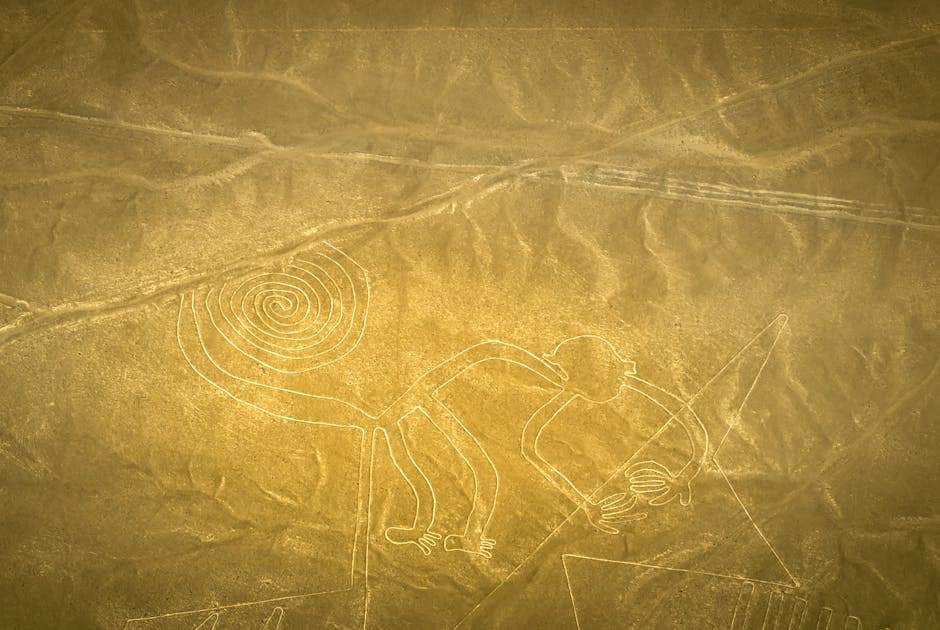
The scale is staggering. The largest figures stretch nearly 1,200 feet long. The combined length of all the lines exceeds 800 miles. The whole complex covers roughly 19 square miles of desert, though the wider area with scattered geoglyphs extends much further. UNESCO designated the Nazca Lines as a World Heritage Site in 1994, calling them "one of the most impressive-looking archaeological areas in the world."
What makes the plateau ideal for preservation is its climate. The Nazca Desert is one of the driest places on Earth. It gets less than an inch of rainfall per year. There's virtually no wind at ground level. The stable, arid conditions have kept these shallow etchings intact for millennia, a stroke of geological luck that's preserved one of humanity's strangest creative achievements.
How Were the Nazca Lines Made?
Here's what isn't a mystery: the technique. The Nazca people made the lines by removing the top layer of reddish-brown, iron oxide-coated pebbles from the desert surface, revealing the lighter yellowish-gray ground beneath. The lines are typically only 4 to 6 inches deep. Most are about 13 inches wide, though some reach up to 6 feet across.
It's surprisingly low-tech. No alien technology required. American investigator Joe Nickell demonstrated in the early 2000s that the figures could be reproduced using attributed to wooden stakes, cord, and basic planning. Archaeological surveys have actually found wooden stakes in the ground at the ends of some lines, which supports this. One stake was carbon-dated and helped establish the timeline for when the figures were created.
The process likely worked something like this: designers would create a small-scale drawing, then use a grid system with stakes and cords to scale it up on the desert floor. Teams of workers would then clear the pebbles along the marked paths. Each figure was typically drawn with a single continuous line, meaning you could theoretically walk the entire design without retracing your steps.
The real question was never "how" but "why." The Nazca people had the tools, the labor force, and clearly the organizational skill to execute massive construction projects. Their aqueduct system, called puquios, was an engineering marvel that some researchers believe is connected to the lines themselves. What they didn't have, as far as we know, was any way to see their finished work from above.
Or did they? Some researchers have proposed that the Nazca could have constructed simple hot air balloons using available materials. In 1975, members of the International Explorers Society built a balloon using fabric and construction methods consistent with Nazca-era technology and briefly got it airborne. It's an interesting experiment, but there's zero archaeological evidence that the Nazca actually built or used such devices.
The Astronomical Calendar Theory
The first serious scientific study of the Nazca Lines came from Paul Kosok, an American historian who flew over them in 1941 while studying ancient irrigation systems. He noticed that some lines appeared to point toward the horizon at the winter solstice. He called the plateau "the largest astronomy book in the world."
His colleague Maria Reiche, a German mathematician who would dedicate her entire life to studying the lines, expanded on this idea. She proposed that the figures were an enormous astronomical calendar. The animal figures might represent constellations. The straight lines could mark the positions where the sun, moon, and stars rose and set on significant dates, solstices, equinoxes, and planting seasons.
Reiche's theory was elegant and compelling. It also didn't hold up to rigorous testing. In 1968, American astronomer Gerald Hawkins (who had famously decoded Stonehenge as an astronomical observatory) fed the positions of the Nazca Lines into a computer and checked them against known astronomical alignments. His conclusion: the lines showed no more correlation with celestial events than you'd expect from random chance.
That doesn't mean Reiche was entirely wrong. Some individual lines do align with astronomical events. The problem is that with hundreds of lines running in every direction, some alignments are statistically inevitable. You'd find similar "correlations" in any sufficiently large collection of random lines. The astronomical calendar theory hasn't been completely abandoned, but most researchers now view it as, at best, only a partial explanation.
Were the Nazca Lines Connected to Water Rituals?
In a desert where rain almost never falls, water isn't just important. It's everything. And this is where one of the most compelling theories about the Nazca Lines comes in.
Anthropologist Johan Reinhard proposed in the 1980s that the lines and figures were part of religious practices centered on water worship. The Nazca people's survival depended entirely on water flowing down from the Andes through underground aquifers. Their elaborate puquio aqueduct system tapped into these subterranean water sources, and Reinhard argued that the geoglyphs were essentially prayers etched into the earth, appeals to mountain deities for continued water flow.

This theory got a boost from independent researcher David Johnson, who noticed something intriguing: many of the Nazca Lines appeared to map the locations of underground water sources. Trapezoidal figures, he argued, sat directly above aquifers. Zigzag lines followed the paths of fault lines where water flowed. If Johnson is right, the Nazca Lines weren't just religious symbols. They were a functional water map overlaid with spiritual significance.
The water theory also connects to the animal figures. Many of the creatures depicted, like the hummingbird, spider, and monkey, hold symbolic associations with water and fertility in Andean cultures. The Bermuda Triangle has its own ocean-related mysteries, but the Nazca people's relationship with water was grounded in desperate, daily survival.
Archaeological evidence from Nazca-era sites supports the connection to ritual. Researchers have found broken pottery at the intersections of lines, suggesting that ceramics were deliberately smashed as offerings. Seashells, likely brought from the Pacific coast, have also been found along the lines. These artifacts point to ceremonial use, people walking the lines as part of religious processions, leaving offerings at designated points.
The Ancient Astronaut Theory
No discussion of the Nazca Lines is complete without addressing the elephant in the room, or rather, the alien spacecraft. In 1968, Swiss author Erich von Däniken published "Chariots of the Gods?", which proposed that the Nazca Lines were landing strips for extraterrestrial visitors. The straight lines were runways. The figures were signals to the sky gods. The Nazca people couldn't have created them alone because, in von Däniken's view, ancient humans weren't clever enough.
Let's be direct: there's no widely accepted evidence supporting this theory, and quite a bit working against it. The lines are shallow grooves in desert gravel. They wouldn't support the weight of a bicycle, let alone a spacecraft. The figures, as Joe Nickell demonstrated, are entirely achievable with Stone Age technology. And the premise that ancient peoples couldn't plan and execute large-scale projects is contradicted by, well, every other ancient civilization. The Egyptians built the pyramids. The Romans built aqueducts spanning continents. The Nazca built underground water channels that still function today.
Maria Reiche spent decades pushing back against the ancient astronaut narrative, pointing out that the geoglyph designs match motifs found on Nazca pottery, textiles, and other artifacts. These weren't alien blueprints. They were expressions of a rich artistic and religious tradition that shows up consistently across Nazca material culture.
The ancient astronaut theory persists not because of evidence but because it taps into something genuinely mysterious: the feeling that these figures were "meant" to be seen from above. That's a real puzzle. It just doesn't require extraterrestrials to explain.
Ceremonial Pathways: Walking the Lines
One theory that's gained traction in recent decades reframes how we think about the lines entirely. What if they weren't meant to be looked at from above? What if they were meant to be walked?
Many of the Nazca figures are drawn with a single continuous line, creating a path that starts at one point, traces the entire figure, and ends back near where it began. This isn't a coincidence. It's a deliberate design choice that makes each figure a walkable circuit.
Researcher Anthony Aveni and his colleagues studied the lines extensively and proposed that they functioned as ceremonial pathways. Groups of people would walk the lines as part of religious processions, possibly related to water rituals, harvest celebrations, or ancestor worship. The act of walking itself was the point, not the aerial view.
This connects to broader patterns in Andean culture. Ritual walking, or pilgrimage along designated paths, is a well-documented practice throughout South American indigenous traditions. The Dyatlov Pass incident involved a very different kind of mountain trek, but the Nazca processions were deliberate, organized, and deeply spiritual.
The walking theory also explains the straight lines, which are harder to account for than the animal figures. Aveni found that many converge at specific points, creating what he calls "ray centers." These convergence points might have been gathering spots where different groups or clans met for communal ceremonies, each arriving along their designated line from their section of the landscape.
If this theory is correct, the Nazca Lines were less like a picture gallery and more like a cathedral, a sacred space defined by movement and ritual rather than static observation.
AI Discovers 303 New Geoglyphs in 2024
Just when it seemed like we'd cataloged all the Nazca Lines, artificial intelligence proved us wrong. In September 2024, a team led by Masato Sakai from Japan's Yamagata University, working with IBM Research, announced the discovery of 303 previously unknown geoglyphs near the known Nazca Lines. The find nearly doubled the total number of documented figures.
The AI system was trained on aerial and satellite imagery to recognize the subtle ground disturbances that mark geoglyphs. It could spot patterns that human eyes would miss, especially for smaller, more eroded figures. What would've taken researchers decades to find through traditional fieldwork, the AI accomplished in months.
The newly discovered geoglyphs are different from the famous large-scale figures. Many are smaller, depicting scenes rather than single animals: people interacting, groups of animals, and what appear to be narrative compositions. Some show decapitated heads, a motif connected to Nazca religious practices involving trophy heads. Others depict knife-wielding orcas, cats, and parrots.
This discovery is reshaping our understanding in a essential way. The large, famous geoglyphs, your hummingbirds and monkeys, appear to have been communal projects visible from distance. But the smaller, newly discovered figures seem more personal or local, possibly created by individual groups for their own ritual purposes. There may have been two distinct traditions of geoglyph-making happening simultaneously, one public and monumental, the other private and intimate.
Why Can't We Just Ask What They Mean?
Here's the fundamental problem: the Nazca culture left no written records. Everything we know about their intentions comes from inference, archaeology, comparisons with other Andean cultures, and analysis of the lines themselves. The Lost Colony of Roanoke left us a cryptic word carved in wood. The Nazca left us 800 miles of lines and not a single sentence explaining why.
We can say with reasonable confidence that the lines had religious and ceremonial significance. The archaeological evidence, broken pottery, seashells, ritual objects found along the lines, points strongly in this direction. We can say the water connection is likely, given how central water was to Nazca survival and how many cultural artifacts reference water deities.
But the specific meaning of each figure? Whether the monkey represents a constellation or a water god or a clan symbol? Whether the spider was a prayer for rain or a map of an aquifer or something we haven't thought of yet? We're guessing. Educated guessing, informed by decades of serious research, but guessing nonetheless.
And that's okay. The Nazca Lines remind us that some ancient people thought in ways we can't fully reconstruct. They organized labor forces of hundreds or thousands to create art on a scale that staggers the imagination, art that served purposes we can partially understand but never completely recover. That gap between what we know and what we don't is what makes the Nazca Lines one of the most fascinating mysteries on Earth.
The lines are still there, still sharp after two millennia, still waiting. And with AI finding hundreds of new figures we didn't even know existed, it's clear we haven't finished listening to what the Nazca people were trying to say.
Frequently Asked Questions
Can you see the Nazca Lines from space?
You can't see the Nazca Lines with the naked eye from orbit. They're visible in satellite imagery and high-resolution aerial photography, but they're best viewed from about 500 to 1,500 feet up. Tourist flights over the Nazca plateau typically fly at around 1,000 feet, though some figures are also visible from observation towers and nearby hillsides.
How old are the Nazca Lines?
The Nazca Lines were created over roughly a thousand-year period, from about 500 BC to 500 AD. The earlier figures, attributed to the Paracas culture, tend to be smaller and depict human forms. The later Nazca-phase figures are the famous large-scale animal and geometric designs. Carbon dating of wooden stakes found at line endpoints helped establish this timeline.
Are the Nazca Lines in danger?
Yes. While the desert's extreme aridity has preserved them for millennia, modern threats include squatters settling on the plateau, off-road vehicles damaging the fragile surface, and occasional flooding events linked to climate change. In 2014, Greenpeace activists damaged the area near the hummingbird figure during a protest, leaving footprints visible from the air. Peru has increased protection efforts, but the site's enormous size makes complete preservation difficult.
How many Nazca Lines are there?
Before the 2024 AI discovery, researchers had documented roughly 350 geoglyphs. The Yamagata University team's AI-assisted survey added 303 more, bringing the total to over 650 known figures. Researchers believe there are likely more still waiting to be found, particularly smaller, more eroded designs that are difficult to spot even with aerial photography.
Did the Nazca people know what their drawings looked like from above?
This is one of the central mysteries. They by some interpretations understood the general shapes since they used small-scale models to plan the designs. Whether they ever saw the completed figures from a high vantage point is unknown. Some figures are partially visible from nearby hills, which may have been enough. Others argue that seeing the complete design wasn't the point, that the act of creating and walking the lines held the real significance.
Further Reading
This article contains affiliate links. If you buy through them we may earn a small commission at no extra cost to you.
Want to explore more mysteries?
We've got plenty more rabbit holes to go down.