The Plain of Jars: Who Carved Laos's Stone Vessels?
Thousands of giant stone jars sit scattered across the highlands of Laos. No one knows who made them, how, or why. The mystery has survived two millennia and a secret war.
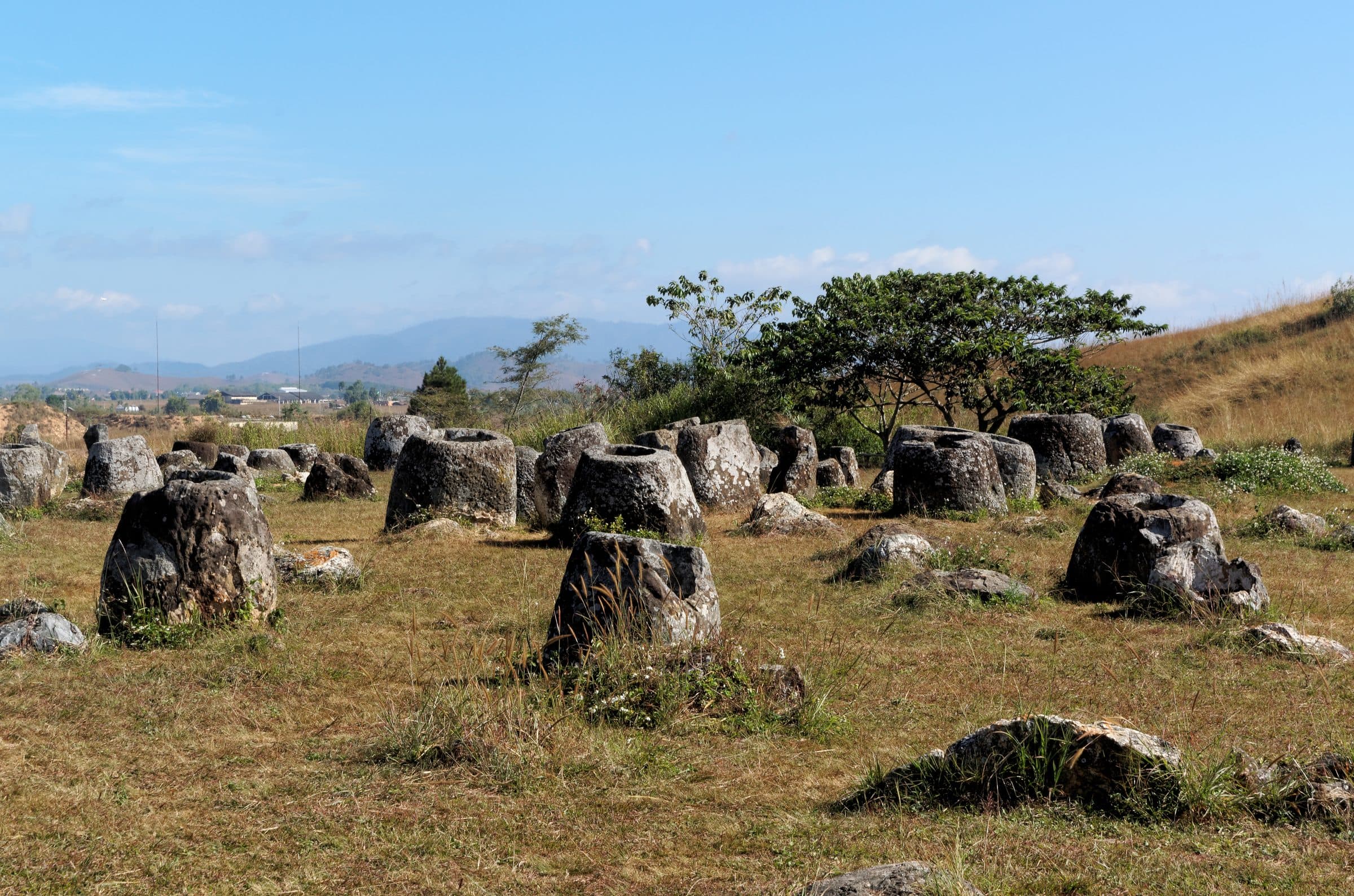
High on a windswept plateau in central Laos, the grass gives way to stone. Not walls, not statues, not the broken columns of a forgotten temple. Jars. Thousands of them, squat and heavy, hewn from solid rock, some barely reaching the knee and others tall enough to swallow a grown adult whole. They sit in loose clusters across the rolling highlands of Xieng Khouang Province, tipped at odd angles, lids scattered nearby or missing altogether, as though some enormous unseen hand set them down and walked away.
No one living knows who carved them. No one knows how the makers moved blocks weighing several tons across miles of difficult terrain, or why they chose to leave them here, in these particular fields, facing in no particular direction. There are no inscriptions. There are no surviving records. There is not even a confident name for the people who made them.
The jars have outlasted the civilization that produced them by roughly two thousand years. They outlasted the kingdoms that rose and fell around them. In the twentieth century they survived one of the most intense bombing campaigns in human history, and many of them still do, ringed by craters and unexploded ordnance, keeping their silence. The question that lingers is the simplest and the hardest: what were they for?
What You'll Learn
- •What Is the Plain of Jars?
- •How Old Are the Jars?
- •Who Carved Them, and How?
- •The Cremation Theory
- •The Legend of the Giants
- •The Stone Discs and Hidden Burials
- •Why the Jars Were Placed Where They Were
- •The Secret War and the Bombs Among the Jars
- •What We Still Don't Know
- •Frequently Asked Questions
What Is the Plain of Jars?
The Plain of Jars is not a single field but a scattered network of sites spread across the Xieng Khouang Plateau in northern Laos. Archaeologists have catalogued more than ninety distinct jar sites, ranging from small clusters of a handful of vessels to sprawling fields holding hundreds. In total, surveyors have counted well over two thousand jars, and new sites continue to turn up in the remote, forested hills where few people have ever had reason to look.
The jars themselves are carved from stone, mostly sandstone, but also granite, conglomerate, and limestone. The largest stand around three meters tall and weigh in the neighborhood of several tons. Most are cylindrical or gently barrel-shaped, tapering slightly toward the mouth. A small number have rims cut to hold a lid, and a handful of stone discs found nearby may be exactly that, though very few jars are capped today.
What strikes nearly everyone who visits is how deliberate and how plain they are at the same time. These are not crude troughs hacked from boulders. They are shaped, hollowed, and finished with real skill. Yet almost none carry decoration. In the entire field, only one known jar bears a carved figure, a relief of what appears to be a human form sometimes called the "frogman." Everything else is bare stone, which means the makers left us almost nothing to read.
In 2019 the Plain of Jars was inscribed as a UNESCO World Heritage Site, a recognition of its importance and its strangeness. Yet that status came with an unusual caveat. Many of the sites still cannot be safely visited, because the ground around the jars is seeded with explosives.
How Old Are the Jars?
For most of the twentieth century, the age of the jars was guesswork. The breakthrough came from the work of French archaeologist Madeleine Colani in the 1930s, and later from radiocarbon and luminescence dating carried out by Lao and international teams in recent decades.
The current understanding places the carving and use of the jars in the Iron Age, roughly between 1240 BCE and 660 CE, with the most active period falling somewhere around 500 BCE to 500 CE. That is an enormous span. It suggests the jars were not the work of a single generation or a single ruler, but a tradition that persisted across many centuries, possibly handed down through cultures that came and went on the plateau.
This long timeline only deepens the puzzle. A tradition that endures for a thousand years usually leaves a trail: settlements, pottery styles, tools, trade goods, written marks, the ordinary debris of people living their lives. The Plain of Jars has produced some of this, but little given how many jars exist and how long they were apparently in use. The people who carved them seem to have invested staggering effort in these stone vessels while leaving the rest of their world almost invisible to us.
Who Carved Them, and How?
This is where the honest answer is the most unsatisfying one: we do not know who they were. There is no surviving name, no language, no king or culture we can point to and say, these were the jar people. The makers are defined entirely by what they left behind, and what they left behind is silent.
The "how" is only slightly less mysterious. The nearest known quarries sit several kilometers from some of the major jar fields, which means quarried blocks weighing several tons had to be moved across hilly, often soft terrain without the wheel as it is usually imagined and without any draft animal evidence that survives at the sites. Researchers have proposed log rollers, sledges, ropes, and the simple coordinated muscle of many people. Each of these is plausible. None has been demonstrated at the scale required, and no abandoned half-moved jar has ever been found in transit to settle the question.
The carving itself implies iron tools, which fits the Iron Age dating. But the precision of the hollowing, achieved on hard stone, with the interiors ground smooth and the walls kept even, speaks to a level of organized craft that does not square easily with our otherwise thin picture of the society that produced it. Someone fed these workers. Someone organized the quarrying, the transport, the carving, and the placement. That kind of coordination usually is a structured society with leaders and surplus, and yet the structured society itself has largely vanished from the record.
The Cremation Theory
The leading explanation, and the one most archaeologists lean toward, is that the jars were connected to the dead.
Madeleine Colani championed this idea after her 1930s fieldwork. Excavating around the jars, she found human bone, teeth, glass beads, bronze and iron objects, and ceramic fragments. She also identified a nearby cave at one of the main sites with holes in its roof that could have served as natural chimneys, and proposed that it functioned as a crematorium. Her conclusion was that the jars were part of a funerary process: bodies placed inside to decompose or be exposed, the remains later collected, cremated, and buried.
Modern excavations have lent the theory real support. Teams working in the 2010s and beyond have uncovered burials directly around and beneath the jars, including bones interred in pits and remains placed inside ceramic vessels set into the ground. The pattern points to the jar fields as ritual grounds for handling the dead over many generations.
But here the voice of caution speaks up, because the cremation theory, as compelling as it is, does not fully account for the jars themselves. Why carve a three-ton stone vessel, an object that takes immense labor to make and move, if the actual remains were buried in the soil beside it? Smaller, simpler containers would do. The jars seem extravagantly overbuilt for the role assigned to them. And the sheer number of jars, set against the comparatively modest amount of human remains recovered, leaves an awkward gap. If every jar held a body, where did all the bodies go? If only some did, what were the rest for?
The Legend of the Giants
The people who live on the plateau today have their own answer, and it is older than any excavation.
Local Lao tradition tells of a race of giants who once ruled the highlands, led by a king named Khun Cheung. After a great victory in war, the king is said to have ordered the jars made to brew and store enormous quantities of rice wine, or lao hai, for a celebration that would match the scale of his triumph. In this telling, the jars are not coffins at all. They are drinking vessels for beings far larger than us, the leftover party supplies of a vanished age of giants.
It is easy to set such a story aside as folklore. But folklore on the plateau has a way of preserving fragments of truth that the written record lost. The name lao hai, jar wine, survives in the region to this day, attached to fermented rice drink served from large jars. The legend at minimum tells us that the people who have lived alongside these stones for centuries never doubted that the jars were containers meant to hold something. Whether that something was wine, water, the dead, or something we have not guessed, the tradition insists the jars were full once.
The Stone Discs and Hidden Burials
Scattered among the jars are flat stone discs, and their role has its own quiet puzzle. Some clearly fit the rims of jars and may have been lids. But many of the discs are not sitting on jars at all. They lie flat on the ground, and excavations have repeatedly found human burials directly beneath them, marking graves rather than capping vessels.
This suggests the jar fields worked on more than one level at once. Above ground stood the great carved jars, visible monuments in the open air. Below ground lay the dead, marked by stone discs that doubled as grave covers. The relationship between the two, the towering jars and the buried bodies they overlooked, is one of the most intriguing and least understood features of the whole complex.
Some of the discs carry faint carved markings, including concentric circles and what may be human or animal figures, weathered now almost to nothing. They hint at a symbolic system, a way of marking certain graves as special, that we can see the edges of but cannot read. Whatever those carvers meant to communicate, the message has worn away.
Why the Jars Were Placed Where They Were
Look at a map of the jar sites and a faint pattern begins to suggest itself. Many of the fields sit along elevated ground, on slopes and plateau edges with commanding views, and several researchers have noted that the sites appear to cluster along what may have been ancient overland trade routes. Xieng Khouang sits at a natural crossroads of the Southeast Asian highlands, linking the lowlands of what is now Laos, Vietnam, and Thailand. Salt and metal moved through these hills in antiquity.
This has led to a quieter theory that sits alongside the funerary one: that the jar fields marked the route, that they were waypoints, boundary markers, or ceremonial stations placed by people who controlled or traveled the trade in this region. A field of stone jars on a ridge would be visible for a great distance and impossible to mistake for anything natural. They would announce, in stone, that this place mattered and that someone claimed it.
The two ideas, trade markers and burial grounds, need not contradict each other. People often bury their dead along the paths they walk and the boundaries they hold. But the placement, like everything else about the jars, refuses to fully explain itself. There is order in where the jars sit, an order just clear enough to notice and just vague enough that no one has cracked it.
The Secret War and the Bombs Among the Jars
The strangest chapter in the jars' long history is the most recent, and it nearly erased them.
Between 1964 and 1973, during the conflict in neighboring Vietnam, Laos became the target of a covert American bombing campaign so intense that it remains one of the heaviest in history. The Plain of Jars sat in contested territory and took the full weight of it. Over those years, more than two million tons of ordnance fell on Laos, much of it on Xieng Khouang. By some counts a planeload of bombs was dropped on the country every eight minutes, around the clock, for nearly a decade.
The jars endured what the people often could not. Some fields were cratered and scattered, jars shattered or knocked from their footings by blasts. And then, when the bombing stopped, a slower danger remained. A large share of the cluster munitions dropped on Laos failed to detonate on impact and stayed in the soil, live, for decades. To this day, vast areas of the plateau remain seeded with unexploded ordnance, and the painstaking work of clearing the ground around the jars, parcel by parcel, is the reason most sites stay closed to visitors.
There is something almost unbearable in the image. The oldest unsolved mystery on the plateau, two thousand years of carved stone that survived everything, ringed and threaded by the newest deadly mystery, bombs that may or may not still be live, waiting in the grass. The jars kept their secret through it all.
What We Still Don't Know
Decades of careful work have given us a rough shape of the answer. The jars are Iron Age. They are bound up with the treatment of the dead. They were made by a society organized enough to quarry, move, and carve stone on a massive scale across many centuries. That is real progress, hard won.
And yet stand among the jars and the basic questions return, undimmed. Who were these people, that they could leave thousands of tons of shaped stone and almost nothing else of themselves? Why pour such effort into vessels so plain, so unmarked, so silent? How did they move them, and why to these exact fields and no others? What filled the jars when they were full, and where did it go?
The Plain of Jars has not been solved. It has been narrowed, carefully and respectfully, by people working around live bombs in remote hills. But the heart of it, the why, sits exactly where the carvers left it, out in the open, in plain sight, and still beyond our reach.
Frequently Asked Questions
What were the Plain of Jars actually used for?
The leading view connects the jars to funerary practices, with bodies placed inside as part of a process of decomposition and later burial of the remains. Excavated bones, burials, and grave goods support this. But the theory leaves a real gap: the jars are far larger and more labor-intensive than the task seems to require, and there are far more jars than recovered remains. Local tradition, meanwhile, insists they held rice wine for a king of giants. No single explanation has closed the case.
How old are the stone jars?
Dating places their carving and use in the Iron Age, broadly from around 1240 BCE to 660 CE, with peak activity somewhere around 500 BCE to 500 CE. That long span suggests an enduring tradition rather than a single moment of construction, which only makes the absence of records about the makers more striking.
Who built the Plain of Jars?
We genuinely do not know. There is no surviving name for the culture, no written language tied to the site, no clear successor people who claim them. The makers are known only through the jars themselves, and the jars carry almost no decoration or inscription to speak for them.
Why can't all the jar sites be visited?
Much of the Xieng Khouang Plateau was heavily bombed during the conflict in Southeast Asia in the 1960s and early 1970s, and large quantities of unexploded ordnance still lie in the ground. Clearance is slow and dangerous, so only a portion of the sites have been made safe for visitors. Many jars still sit in fields that have not been cleared.
How were such heavy jars moved without modern machinery?
The nearest quarries are kilometers from some of the fields, and the jars weigh several tons each, so the makers had to move enormous blocks across hilly terrain. Proposals include log rollers, sledges, ropes, and large coordinated work crews. All are plausible, but none has been proven at the site, and no jar has ever been found abandoned mid-journey to show us the method.
Are there other sites like the Plain of Jars?
Megalithic jar sites have been reported elsewhere in Southeast Asia and as far afield as India and Indonesia, raising the question of whether a shared tradition once stretched across a wide region. Whether these are related cultures, independent inventions, or echoes of a common practice carried along ancient routes is one more thread that no one has yet followed to its end.
The jars are still out there tonight, on their cold high plateau, lids gone, mouths open to the sky. Whatever they were meant to hold, they have been empty for a very long time. And they are still waiting, in plain sight, for someone to finally explain them.
Further Reading
This article contains affiliate links. If you buy through them we may earn a small commission at no extra cost to you.
Want to explore more mysteries?
We've got plenty more rabbit holes to go down.