The Antikythera Mechanism: A Computer Built 2,000 Years Too Early
Discovered in a Roman-era shipwreck, the Antikythera Mechanism is an analog computer of staggering complexity - and no one can explain how ancient Greeks built it. Explore the mystery of this impossible artifact.
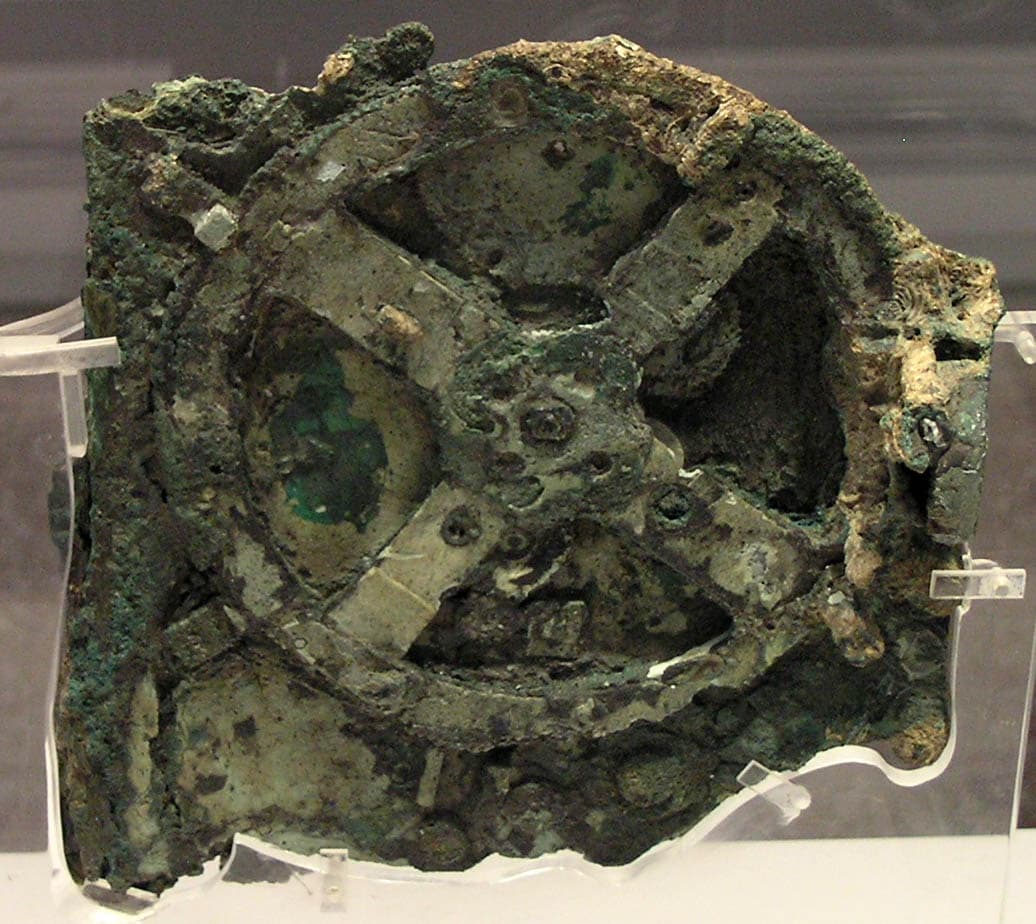
In 1901, a group of Greek sponge divers sheltering from a storm near the tiny island of Antikythera pulled something impossible from the sea floor. Among the bronze statues and marble sculptures of a first-century BC Roman shipwreck, they found a corroded lump of bronze and wood no bigger than a shoebox. It would take another century for anyone to understand what it was - and when they did, it rewrote everything we thought we knew about the ancient world.
The Antikythera Mechanism is the most sophisticated piece of technology known to exist from the ancient world. It contained at least 30 interlocking bronze gears, could predict solar and lunar eclipses decades in advance, tracked the movements of the five planets known to the Greeks, and even calculated the dates of the ancient Olympic Games. Nothing remotely like it would appear again for over a thousand years.
The question that lingers: How did someone build a precision analog computer in an age we associate with clay pots and hand-copied scrolls? And what happened to the knowledge that created it?
What You'll Learn
- •What Is the Antikythera Mechanism?
- •How Was It Discovered?
- •What Could It Actually Do?
- •Why Is the Gear Work So Remarkable?
- •Who Built It?
- •Why Did This Technology Disappear?
- •Could There Have Been Others?
- •What Don't We Know?
- •Frequently Asked Questions
What Is the Antikythera Mechanism?
The Antikythera Mechanism is a hand-powered mechanical device roughly the size of a large dictionary. Its front face displayed a dial tracking the positions of the Sun and Moon through the zodiac, day by day. The back featured two spiral dial systems - one predicting eclipses using the 223-month Saros cycle, the other tracking the Metonic cycle, the 19-year period after which the Moon's phases repeat on the same calendar dates.
Inside, a web of precisely cut bronze gears translated a single input - a hand-turned knob - into multiple simultaneous astronomical outputs. One gear train reproduced the Moon's elliptical orbit using a pin-and-slot mechanism that varied the lunar velocity exactly as it appears from Earth. Another set of gears tracked the synodic cycles of Mercury, Venus, Mars, Jupiter, and Saturn.
It is, by every meaningful definition, an analog computer.
How Was It Discovered?
In the spring of 1900, Captain Dimitrios Kontos and his crew of sponge divers were returning from the North African coast when rough weather forced them to anchor near Antikythera, a speck of rock between Crete and mainland Greece. When the storm passed, diver Elias Stadiatis descended to explore the sea floor. He surfaced, white-faced, babbling about a heap of dead bodies on the bottom.
What he'd found was one of the richest ancient shipwrecks ever discovered - a Roman vessel from roughly 70-60 BC, laden with Greek luxury goods being transported to Rome. Among the haul: life-sized bronze statues, glass vessels, jewelry, and coins. And one corroded, unassuming lump that spent months ignored in a storage room at the National Archaeological Museum in Athens.
It wasn't until archaeologist Valerios Stais noticed a gear wheel embedded in the fragment in May 1902 that anyone looked twice. His suggestion that it was some kind of astronomical calculator was dismissed. The prevailing view was that ancient Greeks simply couldn't have built anything so complex. The mechanism was set aside for decades.
What Could It Actually Do?
Modern imaging technology - particularly the high-resolution X-ray computed tomography scans conducted in 2005 by the Antikythera Mechanism Research Project - revealed the full staggering scope of what this device could calculate:
Solar and lunar positions: The front dial tracked the Sun and Moon's positions through the twelve signs of the zodiac, accurate to within about one degree.
Lunar phase display: A small sphere, half silver and half black, rotated to show the Moon's current phase.
Eclipse prediction: The rear Saros dial could predict both solar and lunar eclipses, noting the time of day, direction, and even color characteristics of each predicted eclipse. Some inscriptions describe eclipses as "like fire" or "with rays."
Planetary motion: The mechanism tracked all five planets visible to the naked eye. recent research indicates it modeled their apparent retrograde motion - the periods when planets seem to reverse direction against the stars - through a series of nested gear trains of extraordinary ingenuity.
Calendar functions: It reconciled the Egyptian civil calendar with the Greek lunar calendar, and a subsidiary dial marked the four-year cycle of Panhellenic games, including the Olympics.
All of this from a device you could hold in your hands.
Why Is the Gear Work So Remarkable?
The gears themselves are what make researchers lose sleep. The teeth were cut in precise equilateral triangles, with a consistency that implies either extraordinary hand skill or tools we haven't found. Some gears are barely a millimeter thick. The smallest has just 15 teeth. The largest, over 200.
But it's the conceptual engineering that defies expectation. The pin-and-slot mechanism used to model the Moon's variable speed is a solution of profound mechanical elegance. It converts uniform circular motion into variable circular motion - the same principle used in much later differential gears. Nothing in the known Greek technical literature describes anything close to this.
The gear ratios themselves encode astronomical knowledge of remarkable precision. The 53-tooth and 127-tooth gears, for instance, produce the exact ratio needed to track the Metonic cycle. The 223-tooth gear maps to the Saros eclipse cycle. Whoever designed this understood both the astronomy and the mechanical engineering needed to physically model it.
No other geared mechanism of comparable complexity appears in the historical record until the astronomical clocks of medieval Europe - more than 1,400 years later.
Who Built It?
This is where certainty dissolves. The inscriptions on the mechanism are in Koine Greek. The calendar on the back appears to correspond to Corinth or one of its colonies, possibly Syracuse. That detail has led many researchers to connect the device to the tradition of Archimedes, who was from Syracuse and was known to have built mechanical models of the heavens.
Cicero, writing in the first century BC, described seeing two devices built by Archimedes that modeled the motions of the Sun, Moon, and planets. One was a bronze sphere. The other, he wrote, showed "the same movements of the Sun and Moon and five wandering stars as are produced in the heavens each day and night." If Cicero's account is accurate, the Antikythera Mechanism may represent a tradition of instrument-building that stretched back at least to the third century BC.
But Archimedes died in 212 BC, and the ship sank around 60 BC - a gap of 150 years. Was the mechanism an heirloom? A later copy? A product of a workshop tradition that continued after Archimedes?
The astronomer Hipparchus, who lived in the second century BC, is another candidate - his lunar models match the mechanism's calculations closely. Some researchers have proposed the device came from his intellectual circle, possibly from the island of Rhodes, which was a center of astronomical and mechanical innovation.
No one has been able to settle the question. The builder remains unknown.
Why Did This Technology Disappear?
This is perhaps the deepest mystery of the Antikythera Mechanism. If someone in the ancient world could build this, where did all of that knowledge go?
The conventional answer points to the disruptions of the late Roman period, the burning of libraries, the loss of institutional knowledge. And there's truth in that. But it doesn't fully account for the completeness of the disappearance. We're not talking about a gradual decline - we're talking about a technology so advanced that when it resurfaced, 20th-century scholars refused to believe it was real.
Some historians argue that the mechanism was always a rare, perhaps unique creation - the product of a single extraordinary mind or a tiny workshop tradition that never spread widely. If only a handful of people understood how to build it, the loss of those people would mean the loss of the technology.
Others suggest there may have been more devices that simply haven't survived. Bronze was routinely melted down and recast throughout antiquity. How many Antikythera Mechanisms might have been recycled into coins, weapons, or statues?
The sea keeps its secrets. Of the millions of ships that sailed the ancient Mediterranean, we've explored only a fraction of those that sank. What else might be down there, waiting in the silt?
Could There Have Been Others?
The evidence is tantalizing. Cicero mentions multiple such devices. Ancient writers reference automated theaters, self-moving statues, and mechanical birds. Hero of Alexandria, writing in the first century AD, described programmable automata driven by strings, drums, and pegs - essentially programmable robots.
In 2006, researchers discovered that the mechanism's eclipse predictions contained a mathematical pattern matching Babylonian arithmetic methods. This suggests the device drew on a deep well of cross-cultural astronomical knowledge, potentially centuries older than the mechanism itself. It wasn't invented from nothing. It was the product of a tradition.
And yet, the Antikythera Mechanism stands alone. No other surviving artifact from the ancient world comes close to its complexity. Either it was genuinely unique - a one-off miracle of engineering - or its siblings were lost, destroyed, or still lie undiscovered.
What Don't We Know?
Despite decades of study, roughly a third of the mechanism remains missing. The front plate, which likely displayed the planetary outputs, has never been fully reconstructed to everyone's satisfaction. Researchers continue to disagree about how the planetary gears were arranged and whether additional functions await discovery.
The inscriptions, though partially decoded, still hold unread passages. Some fragments are too corroded to image clearly even with current technology. Future advances in scanning may unlock more of the device's secrets.
We don't know who commissioned it, who owned it, or where it was being taken when the ship went down. We don't know if the builder left plans, trained apprentices, or carried the knowledge to the grave. We don't know if the device in the shipwreck was considered remarkable in its own time, or if it was just one of many.
What we do know is this: someone in the ancient world understood gears, astronomy, and mechanical computation at a level that wouldn't be matched again until the Renaissance. That knowledge existed. Then it vanished - leaving behind a single corroded artifact at the bottom of the sea, waiting two thousand years for someone to understand what it was.
To this day, no explanation satisfies everyone. The Antikythera Mechanism remains the most profound out-of-place artifact ever recovered - a window into a past far more sophisticated than we imagined, and a reminder that what we've lost may be greater than what we've found.
Frequently Asked Questions
How old is the Antikythera Mechanism?
The shipwreck it was found in dates to approximately 70-60 BC, but the mechanism itself could be older. Some analyses of its astronomical data suggest it may have been calibrated decades or even a century before the ship sank, placing its construction potentially in the second century BC.
Could ancient Greeks really have built this?
The mechanism is proof that they did. What remains unexplained is the gap between this device and everything else we know about ancient Greek technology. Nothing in the surviving written record fully prepares us for the sophistication of its gear work. It suggests a tradition of mechanical knowledge that was far more advanced than our other sources indicate.
Has anyone built a working replica?
Several researchers and craftspeople have constructed replicas, and they work. The gear ratios accurately predict astronomical events. But building a replica with modern tools and complete knowledge of the design is a very different challenge from creating the original concept from scratch - which is what makes the achievement so extraordinary.
Why wasn't this technology rediscovered sooner?
It nearly was. Islamic astronomers built impressive geared astrolabes in the medieval period, and European clockmakers eventually developed comparable mechanisms. But there's a gap of over a millennium where nothing of this complexity appears in the archaeological record. Whether that represents a true loss of knowledge or simply a gap in what has survived remains an open question.
Could there be more devices waiting to be found?
The Mediterranean sea floor is littered with thousands of ancient shipwrecks, most of them unexplored. Marine archaeology is expensive and slow. If other mechanisms existed - and ancient literary sources suggest they did - some may still lie buried in sand and sediment, waiting for the right storm or the right diver to bring them back to the surface.
Further Reading
This article contains affiliate links. If you buy through them we may earn a small commission at no extra cost to you.
Want to explore more mysteries?
We've got plenty more rabbit holes to go down.