Kryptos: The CIA Code No One Actually Cracked
For 35 years the K4 passage on the CIA's Kryptos sculpture defied every codebreaker. In 2025 its answer surfaced, yet no one had solved it.
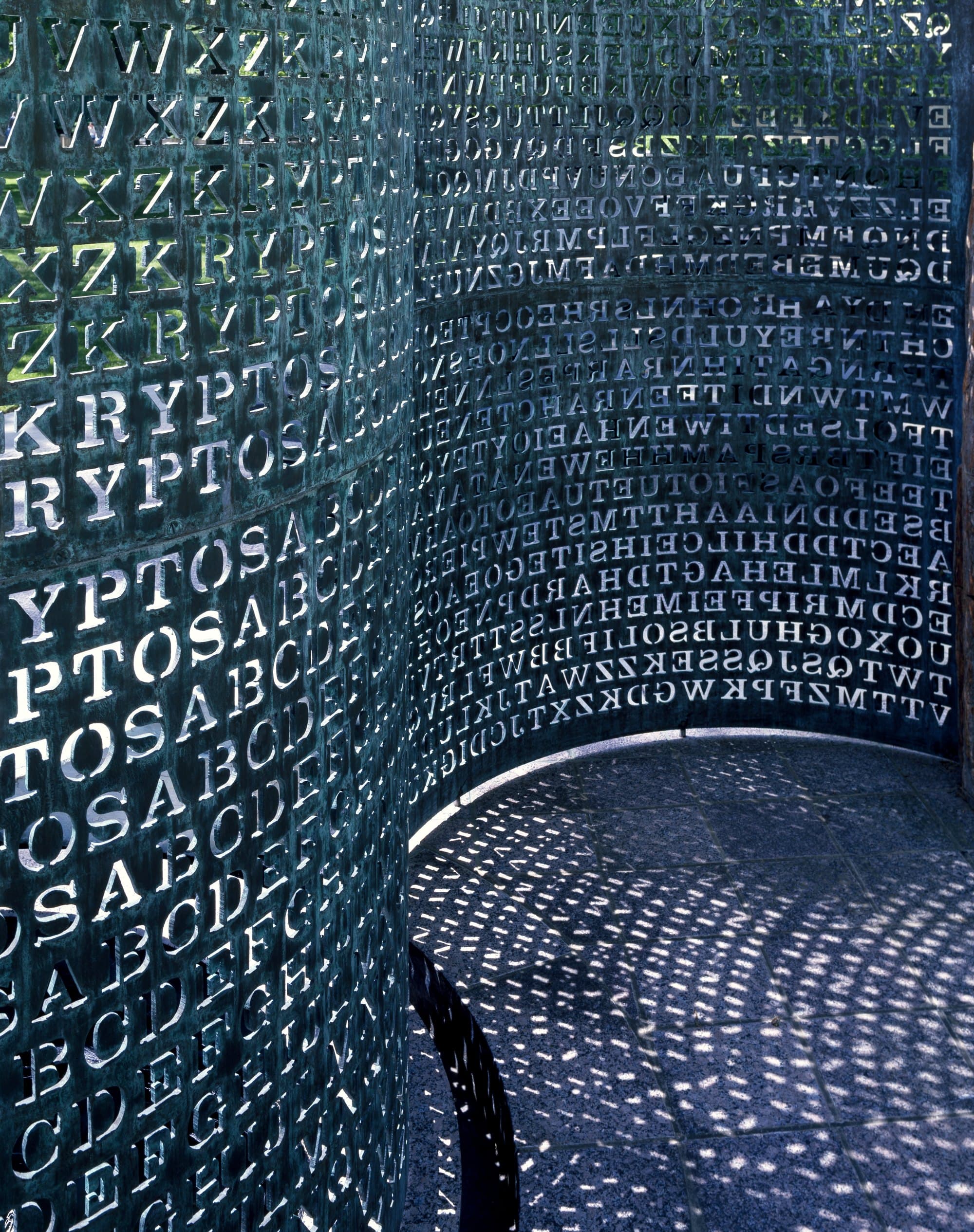
There is a courtyard at the Central Intelligence Agency in Langley, Virginia, that most Americans will never see. Analysts eat lunch there. A small reflecting pool catches the light. And curving up out of the ground, like a scroll caught mid-unfurl, stands a wall of weathered copper punched through with roughly 1,800 letters. It is called Kryptos, the Greek word for hidden, and since the day it was dedicated it has been quietly taunting the most secretive intelligence service on earth.
The people who work a few steps from it decode enemy communications for a living. They have supercomputers, mathematicians, and every tool a national cryptologic budget can buy. And for thirty-five years, one 97-character passage on that copper screen sat there unread, right outside their windows, refusing to give up its meaning.
Then, in the autumn of 2025, the answer finally came to light. It did not come from the CIA. It did not come from a codebreaker. It came from a drawer in a museum, and the man who built the puzzle looked at the headlines and said, flatly, that nobody had solved anything at all.
This article contains affiliate links. If you buy through them we may earn a small commission at no extra cost to you.
What You'll Learn
- •What Is Kryptos?
- •Three Codes Fell. One Would Not.
- •The 97 Characters That Would Not Break
- •The Clues Sanborn Could Not Stop Giving
- •Which Berlin Clock?
- •The Answer Was in a Museum Drawer
- •"They Did Not Solve K4"
- •The 962,500 Dollar Afternoon
- •K5: The Riddle Behind the Riddle
- •What Kryptos Still Will Not Tell Us
- •Frequently Asked Questions
What Is Kryptos?
Kryptos is a sculpture by the American artist Jim Sanborn, dedicated on November 3, 1990, in the courtyard of the CIA's New Headquarters Building at what is now called the George Bush Center for Intelligence. The centerpiece is a tall, S-shaped screen of copper, cut to resemble a sheet of paper emerging from the earth, with about 865 encoded characters stamped through it in neat rows.
Sanborn is an artist, not a cryptographer, so to build the codes he turned to a man who was retiring from exactly the right job. Ed Scheidt had spent his career inside the CIA's Cryptographic Center and was stepping down as its chairman. Colleagues called him the Wizard of Langley. Over a period of months, Scheidt taught Sanborn nineteenth and early twentieth century pencil-and-paper cipher systems, the kind of hand methods that predate computers, and Sanborn wove them into the piece.
The text is divided into four sections that solvers came to call K1, K2, K3, and K4. What makes Kryptos remarkable is that Sanborn built it to be solved in layers, each harder than the last, and he did something almost no puzzle-maker dares to do: he made the final answer depend not just on breaking a code, but on walking out into the world and finding something. The sculpture was never meant to be a wall decoration. It was meant to be a map.
Three Codes Fell. One Would Not.
For the first few years, Kryptos sat unread in public. Then the codes began to fall, though the public would be the last to know.
The earliest crack came quietly from inside the National Security Agency. Around 1992, a small NSA team broke the first three passages. The agency kept it to itself, and the story only surfaced years later. Then, in 1998, a CIA analyst named David Stein solved the same three sections by hand, working with pencil and paper on his own time. His achievement circulated inside the agency and went no further.
The first public solution arrived in 1999, when a California computer scientist named Jim Gillogly announced that he had cracked K1 through K3 using software. Only after Gillogly went public did the CIA acknowledge that its own analyst had beaten him to it a year earlier, and only later still did the NSA's even earlier success come to light.
The three solved passages read like fragments of a strange internal monologue. K1 says: "Between subtle shading and the absence of light lies the nuance of iqlusion." The misspelling of illusion is deliberate. K2 describes something gathered and buried, and ends with a set of latitude and longitude coordinates and the teasing line that only "WW" knows the exact location, a nod widely read as pointing back toward the intelligence world itself. K3 is a near word-for-word paraphrase of archaeologist Howard Carter's account of the moment he first peered into the tomb of Tutankhamun, ending with the question, "Can you see anything?" It too carries a planted error, "desparatly" for desperately.
Those misspellings are not sloppiness. Sanborn and Scheidt salted the plaintext with them on purpose, and codebreakers have argued ever since about whether the errors in the still-unsolved section are clues, traps, or both.
The 97 Characters That Would Not Break
Three down. Then everything stopped.
K4 is the last passage, just 97 characters long, and it broke every method that had opened the others. The techniques that unlocked K1 through K3 were classical ciphers with recoverable keys. K4 was something else. Scheidt has said he deliberately used a harder, layered approach for the finale, a masking technique meant to hide the statistical fingerprints that let cryptanalysts get a foothold.
Ninety-seven characters is a cruel length. It is long enough to be a real message and far too short to attack with the frequency analysis that thrives on bulk text. A shift here, a transposition there, and the letters give up almost nothing. Over the years, professional cryptologists, university teams, hobbyists, and eventually machine-learning models all threw themselves at those 97 letters. A dedicated community formed around the problem, much of it organized by the cryptographer and puzzle expert Elonka Dunin, who has maintained the definitive Kryptos resources for decades and keeps a running list of every serious attempt.
Nothing worked. Not for a very long time.
The Clues Sanborn Could Not Stop Giving
Here is where Kryptos becomes less like a code and more like a relationship. Sanborn is now in his late seventies, and for years he lived with a strange kind of pressure: a steady stream of emails from strangers convinced they had solved K4, each one wrong, each one wanting his confirmation. He once said he would not want the secret to die with him. So, slowly, he began releasing pieces of the answer.
In 2010, twenty years after the dedication, he revealed that characters 64 through 69 of K4 decrypt to the word BERLIN. In 2014 he gave up the next word: characters 70 through 74 spell CLOCK. So the middle of the message, in plain English, reads BERLIN CLOCK. Then in January 2020 he offered a third crib, confirming that characters 26 through 34 spell NORTHEAST, and shortly after clarified that the preceding letters read EAST, making the phrase EAST NORTHEAST.
Each clue was supposed to help. Each one instead deepened the fascination, because knowing four words of a 97-character message and still being unable to derive the cipher that produced them is its own special torment. Solvers now had confirmed plaintext at confirmed positions, a codebreaker's dream, and the system underneath still would not reveal itself.
Which Berlin Clock?
BERLIN CLOCK sent the whole community to Germany, at least in spirit. For eleven years the assumption was that Sanborn meant the Mengenlehreuhr, the famous Set Theory Clock once installed near the Berlin Zoo, a device that tells time in glowing rows of colored lights and set-theory logic. It is exactly the kind of cerebral, cryptic object a puzzle-maker would point to. Whole solving strategies were built on it.
According to accounts that emerged around the 2025 auction of Sanborn's materials, that assumption was wrong. The clock he had in mind was reportedly the Weltzeituhr, the World Clock at Alexanderplatz, a rotating monument that shows the hour in cities around the globe. If that is right, then for over a decade the most careful solvers in the world were quietly staring at the wrong landmark. It is a small detail with a large lesson: even the confirmed clues in Kryptos come with a trapdoor.
The Answer Was in a Museum Drawer
The break, when it finally came, arrived from a direction no cryptanalyst had thought to guard.
Roughly two years before the 2025 reveal, Jim Sanborn had donated a large archive of his papers to the Smithsonian's Archives of American Art in Washington. It is the sort of thing artists do late in their careers. Buried in that donation, apparently by accident, were five pages of documents dating to 1990. Back then, before Kryptos was installed, the CIA had wanted assurance that the encoded text was not something embarrassing or improper. To prove the content was benign without simply handing over the answer, Sanborn had taken his plaintext, cut the sentences into strips, and taped them back together out of order. Officials could confirm the words were harmless while the meaning stayed scrambled.
Those taped strips sat in a public research archive, waiting. In September 2025, two journalists, Jarett Kobek and Richard Byrne, were digging through the collection when they realized what they were looking at. Byrne photographed the pages. Kobek pieced the strips back into their original order, matched them against Sanborn's publicly confirmed cribs of BERLIN, CLOCK, and EAST NORTHEAST, and reconstructed what the plaintext of K4 had to be. On September 3, 2025, they emailed the artist to tell him they had it.
Solver communities working from the same leaked strips soon published a reconstructed reading. It is, fittingly, not a grand revelation at all. The passage reportedly works as one more instruction, describing the Berlin Clock as lying to the northeast, and it carries yet another of Sanborn's planted misspellings. Sanborn has not publicly confirmed the exact wording, and as far as the plaintext of K4 goes, that is the point of the whole affair.
"They Did Not Solve K4"
When the news broke that the Kryptos code had finally been read, Sanborn's reaction was not triumph. It was correction.
He told reporters that words like "solution" and "key" were, in his phrase, "very incorrect terms." Kobek and Byrne had not broken the cipher. They had found the answer sitting in a filing cabinet. "They did not solve K4," Sanborn said. The cryptographic system that Ed Scheidt designed, the actual method that turns those 97 characters into English, was never reverse-engineered. Nobody worked it out. Somebody found the answer key on the teacher's desk.
This distinction matters more than it might seem, and it is the reason Kryptos remains a genuine mystery even now. The plaintext leaking does not explain how the ciphertext was made. Recovering the message is not the same as recovering the algorithm. To this day, no one outside of Sanborn and Scheidt has publicly demonstrated the exact process that encodes K4, which means the sculpture on the CIA lawn is still, technically, an unbroken code. The answer is known. The lock is not.
The 962,500 Dollar Afternoon
Sanborn had already decided, before the archive leak, that he was done carrying the secret alone. Rather than simply publish it, he chose to sell it. The Boston firm RR Auction listed a lot titled "The Complete Secrets of Kryptos: Jim Sanborn's Private Archive," and the sale closed on the evening of November 20, 2025.
The winning bid was 962,500 dollars, paid by an anonymous buyer. For that sum, the buyer did not just get paper. The lot included Sanborn's original CIA "Escort Required" visitor badge from the years he worked on the installation, a signed copper proof-of-concept plate, and archival photographs documenting how the sculpture was built. Most tantalizing of all, the buyer was promised a private afternoon with Sanborn himself, during which the artist would personally walk them through the codes, the charts, and the meaning of K4 and of something the public had barely heard of: K5.
So the great secret of Kryptos now belongs to a person whose name we do not know, who has been asked to keep it, with Sanborn remaining the final authority on what is and is not correct. The most public unsolved code in the world became a private possession, sold to a stranger, for the price of a house.
K5: The Riddle Behind the Riddle
Almost lost in the auction coverage was a single unsettling word. K5.
For thirty-five years the world assumed Kryptos ended at K4. Solve the fourth passage, the thinking went, and the puzzle was complete. But Sanborn has now made clear that reading K4 was never the finish line. The plaintext of K4 is a set of directions. It points onward. There is a further riddle, which Sanborn calls K5, an unpublished continuation he designed as the logical extension of the whole work. K4 tells you where to look. K5 is what you find when you get there, and it has not been revealed.
This is the detail that turns Kryptos from a hard puzzle into something closer to a labyrinth. Every solver who spent years believing that cracking those 97 characters would end the story was, in a sense, only reading the map that leads to the beginning. Whatever K5 is, it has never been publicly stated, and the artist who knows it is nearly eighty years old. The auction did not close the mystery. It relocated it.
What Kryptos Still Will Not Tell Us
Step back and look at what actually happened here. A retired intelligence officer and a sculptor built a code and stood it up in the most surveilled courtyard in America. The NSA broke three quarters of it and said nothing. The CIA broke the same three quarters and said nothing. A hobbyist announced it to the world. And the final quarter held out for thirty-five years, not against a lack of effort, but against the combined attention of professional cryptologists, obsessive amateurs, and eventually artificial intelligence.
When the answer finally surfaced, it did not surface through cleverness. It slipped out through a museum donation, a stack of taped-together strips that were never supposed to be reassembled. The man who made it insists the code itself was never cracked, and he is right. And behind the answer everyone chased sits another puzzle almost no one knew existed, still sealed, now the property of a person who paid nearly a million dollars to be sworn to secrecy.
The question that lingers is not really about the words BERLIN CLOCK or which timepiece in which German square Sanborn had in mind. It is about how a message can be sitting in the open, in plain copper, a few feet from the people whose entire profession is reading the unreadable, and still keep its deepest layer to itself. Kryptos was designed to be solved. Decades later, no explanation of how to solve it satisfies everyone, the algorithm remains unpublished, and the trail runs off into a fifth riddle no one has seen. Whatever Sanborn buried in that courtyard, part of it is still down there, waiting.
For more mysteries built from hidden messages and unbroken codes, explore the Voynich Manuscript, a 15th-century book in an unknown script that has resisted every codebreaker who tried it. Cicada 3301 set the internet's most elaborate cryptographic puzzle and then vanished, leaving its final book of runes only half decrypted. And the Zodiac Killer taunted police with ciphers, one of which held its silence until 2020.
Frequently Asked Questions
Has the Kryptos code been solved?
The first three passages, K1 through K3, were solved in the 1990s. The fourth, K4, is a different story. Its plaintext came to light in 2025 after two journalists found taped strips of the answer in Sanborn's donated archive at the Smithsonian, but the cipher system that produces K4 has never been reverse-engineered by anyone outside its creators. Sanborn insists K4 was not solved, only discovered. The lock, in other words, is still shut even though someone found the answer key.
What does K4 say?
Solver communities working from the leaked archive strips have published a reconstructed reading that works as a set of directions, referencing the Berlin Clock and a heading to the northeast, complete with one of Sanborn's trademark deliberate misspellings. Sanborn has not publicly confirmed the exact wording, and he has been pointed about the fact that reading the words is not the same as breaking the code.
Who made Kryptos and why?
The artist Jim Sanborn created the sculpture, dedicated in 1990 in the courtyard of CIA headquarters. He designed the codes with Ed Scheidt, the retiring chairman of the CIA's Cryptographic Center, using old pencil-and-paper cipher methods. Sanborn has said the piece is about the gathering and concealment of intelligence, and he built it to slowly reveal itself over decades rather than all at once.
What is K5?
K5 is a further puzzle that Sanborn revealed exists only around the time of the 2025 auction. The plaintext of K4 does not conclude the work; it points toward K5, an unpublished continuation. It has never been made public, which means that even with K4's message known, the full mystery of Kryptos is still unfinished.
How much did the Kryptos secret sell for?
At an RR Auction sale closing on November 20, 2025, a lot containing Sanborn's complete Kryptos archive, along with a private session in which he would explain K4 and K5, sold for 962,500 dollars to an anonymous buyer. The most famous unsolved code in the world is now, in effect, privately owned.
Further Reading
Want to explore more mysteries?
We've got plenty more rabbit holes to go down.