Roopkund: The Skeleton Lake DNA Made Stranger
Hundreds of bones sit in a Himalayan lake at 16,470 feet. A 2019 genome study was supposed to end the mystery. Instead it found people who should not be there.
For most of the year there is nothing to see. Roopkund is a shallow bowl of meltwater in the Indian Himalayas, no more than forty meters across at its widest, sitting at 5,020 meters between the summits of Trishul and Nanda Ghunti. It is frozen solid for most of the calendar. Then for a few weeks in late summer the ice retreats, the water drops, and the floor of the lake comes into view.
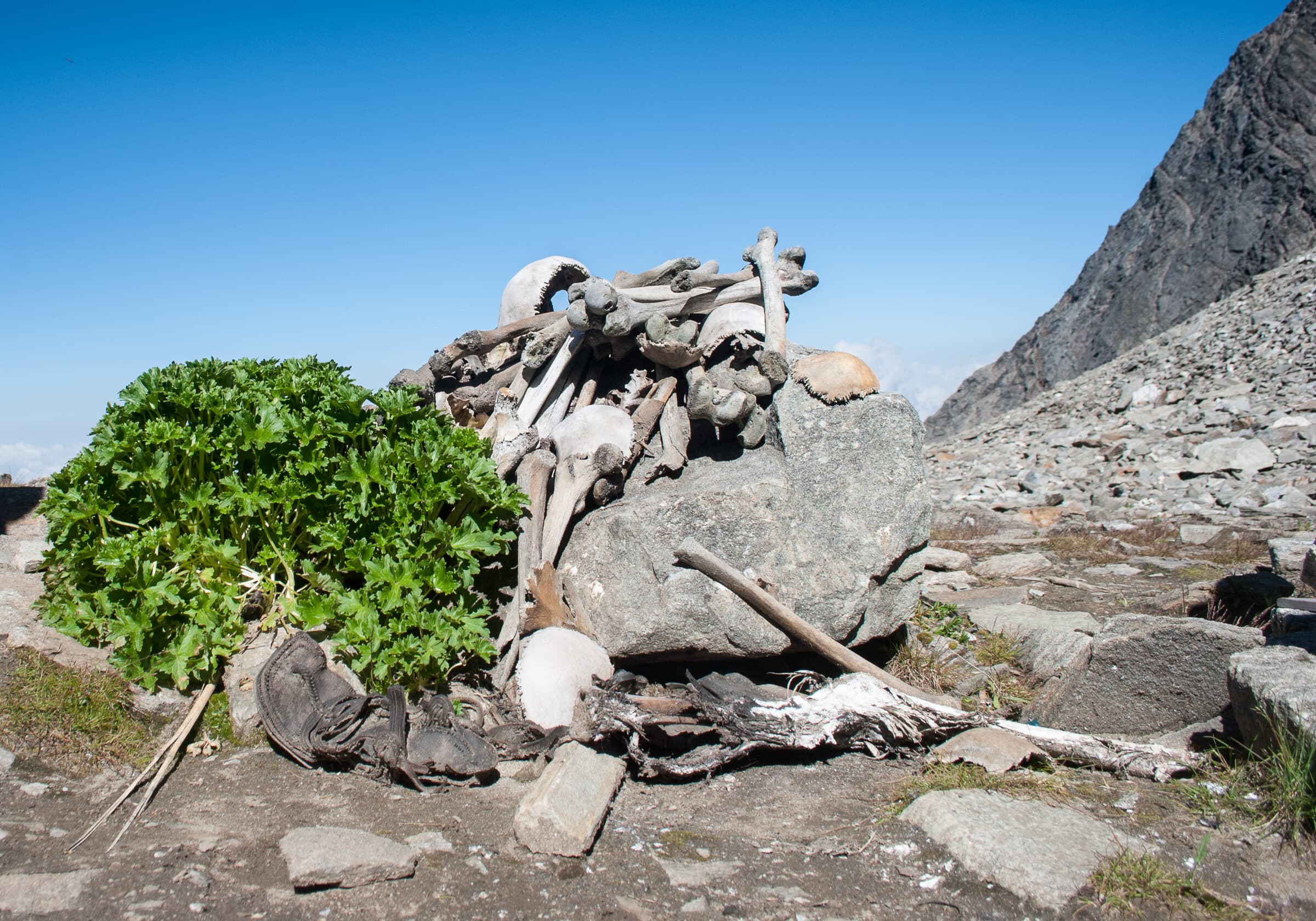
It is full of people. Skulls, femurs, ribcages, whole articulated bodies, the remains of more than three hundred human beings scattered across the shallows and heaped against the shoreline in a place where nobody lives, nothing grows, and no road goes.
This article contains affiliate links. If you buy through them we may earn a small commission at no extra cost to you.
For eighty years the story of Skeleton Lake had a satisfying shape to it. A group of pilgrims, a freak storm, a mass death, a local legend that turned out to be true. In 2019 a team of geneticists pulled DNA from thirty-eight of those individuals expecting to put a name to the disaster. What they found instead broke the single-disaster story apart and left behind a much harder question, one that has not been answered in the seven years since.
What You'll Learn
- •The Lake That Opens for a Few Weeks a Year
- •1942: What the Forest Ranger Found
- •The King, the Queen, and the Angry Goddess
- •The Hailstorm Verdict
- •Thirty-Eight Genomes
- •The Fourteen Who Should Not Be There
- •What They Ate
- •The Silence in the Written Record
- •What the Hailstorm Story Never Explained
- •The Evidence Is Walking Away
- •Frequently Asked Questions
The Lake That Opens for a Few Weeks a Year
Roopkund lies in the Chamoli district of Uttarakhand, in the high country below Nanda Devi, at roughly 30 degrees 15 minutes north and 79 degrees 43 minutes east. Reaching it means several days on foot from the last village, climbing through meadow and scree into terrain where the air holds about half the oxygen of sea level. There is no shelter at the lake. There is no fuel, no forage, and no reason to linger.
That geography matters more than it first appears, because it constrains every explanation anyone has ever offered. Whoever these people were, they did not stumble onto Roopkund. Getting there takes days of deliberate effort and a working knowledge of the route. Nobody arrives at 16,470 feet by accident.
The lake is also small enough to comprehend at a glance. This is not a body of water that could swallow a population over centuries and hide the fact. Stand at the edge in September and the whole story is laid out in front of you at once, which is exactly what made the site so easy to read wrongly for so long.
1942: What the Forest Ranger Found
The bones were rediscovered in the summer of 1942 by Hari Kishan Madhwal, a forest ranger patrolling for the Nanda Devi National Park. Local shepherds and pilgrims had known about them for generations. The British administration had not.
The timing shaped the first theory. It was the middle of the Second World War, the Japanese advance through Southeast Asia was the dominant anxiety of the season, and the initial worry among British authorities was that a hidden Japanese force had died attempting some improbable crossing. That idea did not last long. The bones were plainly far too old.
The Anthropological Survey of India took up the site in the 1950s, collecting samples that ended up in its museum at Dehradun. Along with human remains, the lake gave up objects: wooden artifacts, iron spearheads, leather slippers, and rings. When a National Geographic team retrieved around thirty skeletons in 2003, some still had flesh attached, preserved by the cold and the altitude for what everyone then assumed was around twelve hundred years.
The King, the Queen, and the Angry Goddess
The people who live below the lake have always had an account of what happened, and it is not a vague one.
The story tells of Raja Jasdhaval, a king of Kanauj, who set out toward the shrine of the goddess Nanda Devi with his pregnant wife Rani Balampa and a large retinue. The party traveled the way royalty travels: with dancers, with musicians, with noise and appetite and ceremony, on a route that the goddess requires to be walked in humility. Nanda Devi took offense. She sent down hail like iron, and the whole company died where it stood.
Every twelve years, that route is still walked. The Nanda Devi Raj Jat carries a four-horned ram and an image of the goddess from the lowlands up into the high passes, and it goes right past Roopkund. Temple inscriptions in the region have been dated between the eighth and tenth centuries, which suggests the pilgrimage may be very old, though reliable written descriptions of it only appear in the late nineteenth century.
Two details in the folk account are worth holding on to. It names hail specifically, not avalanche, not cold, not disease. And it describes a group traveling together for a religious purpose, which is one of the very few reasons anyone would ever be at Roopkund in numbers.
The Hailstorm Verdict
In 2004 a National Geographic documentary team brought scientists to the site, including the Heidelberg anthropologist William Sax and Subhash Walimbe, a physical anthropologist at Deccan College in Pune. Walimbe examined the skulls and found something specific.
"We retrieved a number of skulls which showed short, deep cracks," he reported. The pattern did not look like a landslide, which grinds and crushes, or an avalanche, which suffocates and tumbles. It looked like impact from blunt, round objects roughly the size of cricket balls, striking from above, on the head and shoulders. Hail.
It was a genuinely elegant result. A folk legend had preserved the mechanism of a mass death for twelve centuries, and forensic anthropology had confirmed it. That version of Roopkund went everywhere, and it is still the version most people know: a ninth-century pilgrim party, caught above the treeline, killed in an hour by a storm they could not shelter from.
Read the 2019 genetics against it and the whole thing comes apart, not because the hail was disproved, but because the crowd at the lake turned out not to be one crowd.
Thirty-Eight Genomes
In August 2019, a team led by Éadaoin Harney, with Ayushi Nayak, Nick Patterson, and David Reich among the senior authors, published genome-wide data from thirty-eight Roopkund individuals in Nature Communications (volume 10, article 3670). It was the first ancient whole-genome data from India, and it was supposed to describe a single dead pilgrimage.
The thirty-eight did not cluster as one population. They fell into three groups.
Roopkund_A: twenty-three individuals whose ancestry sits within the range of present-day South Asians. Radiocarbon dates put them around 800 CE, which fits the legend nicely, except for one detail the paper is careful to state. Even within this group, the dates show evidence of deposition in more than one event. The ninth-century dead at Roopkund were not necessarily a single party either.
Roopkund_C: one individual with Southeast Asian-related ancestry.
Roopkund_B: fourteen individuals with ancestry typical of the eastern Mediterranean.
And both Roopkund_B and Roopkund_C date to roughly 1800 CE. A thousand years after the others.
The Fourteen Who Should Not Be There
Take a moment with that number, because it is the center of the whole case now.
Fourteen people of eastern Mediterranean ancestry died at a glacial lake at 16,470 feet in the Indian Himalayas, at approximately the turn of the nineteenth century, and were left there.
The genetic detail makes it stranger rather than clearer. Using qpWave analysis, the authors found Roopkund_B consistent with forming a genetic clade only with individuals from present-day Crete, while explicitly cautioning that this does not mean they came from Crete itself. They were not close relatives of one another. The group carried relatively high genetic diversity, the signature of unrelated people rather than an extended family. And the study reported no sign that they had mixed with local South Asian populations, which is what you would expect to see from a community that had lived in the region for generations.
So this was not a settled foreign family. It was a group of unrelated eastern Mediterranean adults, men and women both, who arrived together and died together in one of the least accessible places on the subcontinent, apparently soon after getting there.
The sex composition rules out one tidy possibility straight away. Across the thirty-eight individuals the study identified twenty-three genetic males and fifteen genetic females, distributed across the groups rather than segregated. A military expedition, a mercenary company, a trading caravan of the period: these were male enterprises. Whatever brought the Roopkund_B group up the mountain, they brought women with them.
What They Ate
The isotopes add a quiet, technical detail that is easy to skip past and worth slowing down for.
Stable carbon values for Roopkund_B and Roopkund_C fell in a narrow band, between minus 19.7 and minus 18.2 parts per thousand, consistent with a diet of terrestrial C3 plants: wheat, barley, rice. Roopkund_A, the ninth-century group, showed much more varied values, consistent with millet in the diet or in the fodder of the animals they ate. Millet is a C4 plant, and it was a staple across much of South Asia.
The difference between the two groups was highly significant, with a reported p value of 0.00022.
In other words, the chemistry of their bones agrees with the chemistry of their genomes. The Roopkund_B group had not been eating like people who lived in this part of the world. They ate like people from somewhere else, and then they were dead on a Himalayan ridge.
The Silence in the Written Record
Here is what makes Roopkund a genuinely modern mystery rather than an ancient one.
The year 1800 is not prehistory. It is a period of dense record-keeping in the region and beyond: East India Company correspondence, missionary letters, survey reports, court chronicles, shipping manifests, consular files. A party of fourteen or more foreigners, men and women, moving through the Himalayan foothills toward Nanda Devi, would have been remarkable to almost everyone who saw them pass. They would have needed guides, porters, supplies, and permission. They would have been talked about. And when they failed to come back, somebody should have written it down.
No such account has been produced. The authors of the 2019 study say so plainly, and they turn it into a research proposal, noting that an important direction for future work will be archival research to determine whether there were reports of large foreign traveling parties dying in the region over the last few hundred years.
That is an unusual sentence to find at the end of a genetics paper. The lab had already extracted everything the bones could tell them. The remaining answer, if it exists at all, is sitting in a written record somebody has not searched yet, or in one that was never written.
On what the group was doing there, the paper does not speculate beyond a single line that has stayed with everyone who reads it: whether they were participating in a pilgrimage, or were drawn to Roopkund Lake for other reasons, is a mystery.
What the Hailstorm Story Never Explained
The hail evidence was never as broad as the retelling suggests. Three individuals in the studied set showed unhealed compression fractures, which is consistent with a violent hailstorm and consistent with other things too. Three is not three hundred. And with the bodies at the lake now known to span at least two events a millennium apart, a fracture on any given skull cannot be assigned to any particular disaster without dating that skull first.
The 2019 paper also looked for a pathogen and found no evidence of bacterial infection in the sampled individuals, while noting honestly that detection limits leave room for something to have been missed. Disease was never a strong candidate anyway. It does not typically kill a whole party at once and leave them arranged around a lakeshore.
So the honest state of the case is this. A storm may well have killed the ninth-century group, or part of it, on one of at least two occasions when people died there. Something else killed the eastern Mediterranean group a thousand years later. Nobody knows what that something was, and nobody knows why they were standing at Roopkund to meet it.
There is one further possibility that the multi-event finding forces into the open, and it is the least comfortable one. If people died at this lake in the ninth century, and again around 1800, and possibly more than once in between, then Roopkund is not the site of an accident. It is a place that people kept going to, and kept not returning from, across a thousand years of human history. Whatever the reason for that, the lake has never been asked the right question.
The Evidence Is Walking Away
The trek to Roopkund became popular, and trekkers took souvenirs. Bones have been carried off the mountain for decades, moved, stacked for photographs, and rearranged by people who wanted a better shot. Authorities have raised the alarm that the site could effectively vanish.
That is the quiet tragedy at the end of this. The 2019 study worked with thirty-eight individuals out of more than three hundred. The remaining bones hold the dates that would show how many separate events happened here, the ancestries that would reveal whether the ninth century and the nineteenth are the only chapters, and possibly the one skeleton whose isotopes or artifacts point somewhere specific. Every year, a little less of that archive is left in place.
The lake still opens for a few weeks each summer. Whatever it has to say, it is saying it more quietly than it used to.
Frequently Asked Questions
Was the Roopkund mystery solved by DNA?
It was answered and reopened in the same paper. The 2019 genomes settled that the dead do not belong to one catastrophe, that they represent at least two events a thousand years apart, and that fourteen of them carried eastern Mediterranean ancestry. What none of that explains is what a group of unrelated Mediterranean men and women were doing at a Himalayan lake around 1800, or how they died. The genetics closed the easy question and opened a harder one.
Could the skeletons be victims of a hailstorm after all?
For some of them, quite possibly. Subhash Walimbe documented short, deep cracks in recovered skulls that he attributed to blunt round impacts from above rather than to landslide or avalanche, and the local legend of the goddess Nanda Devi sending down hail like iron describes exactly that. What the hail account cannot do is cover everyone at the lake, because the bodies were not all deposited at the same time, or in the same century.
Why would people from the eastern Mediterranean be in the Himalayas in 1800?
That is the open question, and it currently has no answer that survives contact with the evidence. They were not related to each other, they included both men and women, and they showed no genetic sign of having settled among local populations. Trade, pilgrimage, exploration, and something no one has thought of yet all remain on the table. The researchers themselves called for archival work to find any record of a large foreign party dying in the region.
How many skeletons are actually at Roopkund?
Remains of more than three hundred individuals have been reported, and only thirty-eight have been genetically analyzed. That leaves the overwhelming majority of the site unstudied, which also means the two known events may not be the only two. Trekkers have been removing bones for years, so the number still lying at the lake is smaller than it was and continues to fall.
Is Roopkund connected to any other unexplained site?
Not physically, but the pattern will feel familiar to anyone who has read about the Dyatlov Pass incident: a group in high, cold, remote terrain, dead in circumstances that decades of investigation have failed to resolve. Roopkund is the larger version of the same shape, repeated across centuries, at a place people kept choosing to walk to.
Further Reading
If Roopkund has hold of you, these go deeper than any single article can.
- •Who We Are and How We Got Here by David Reich. Written by the senior author behind the Roopkund genomes, this is the clearest account of how ancient DNA is rewriting human history, and of what these methods can and cannot tell us. Find it on Amazon
- •The Nanda Devi Affair by Bill Aitken. A long, affectionate account of the goddess, the pilgrimage, and the sanctuary country that Roopkund sits inside. The best available guide to why anyone walks this route at all. Find it on Amazon
- •The Ascent of Nanda Devi by H.W. Tilman. The 1936 classic from the first ascent, and the finest description ever written of what this terrain does to people who enter it. Find it on Amazon
Every few years someone announces that Skeleton Lake has finally been explained, and every time the explanation covers a portion of the dead and leaves the rest lying there. The ninth century has a legend that fits it. The nineteenth century has fourteen people from the wrong side of the world, no record of their passing, and no cause of death. They came a very long way to a place that offers nothing, and they arrived close enough together to die together. Until someone finds the page they were written on, the lake keeps them.
Want to explore more mysteries?
We've got plenty more rabbit holes to go down.