Rongorongo: The Easter Island Script No One Can Read
A wooden script covered the most isolated island on Earth, then the island fell silent. The last people who could read rongorongo died without teaching anyone.
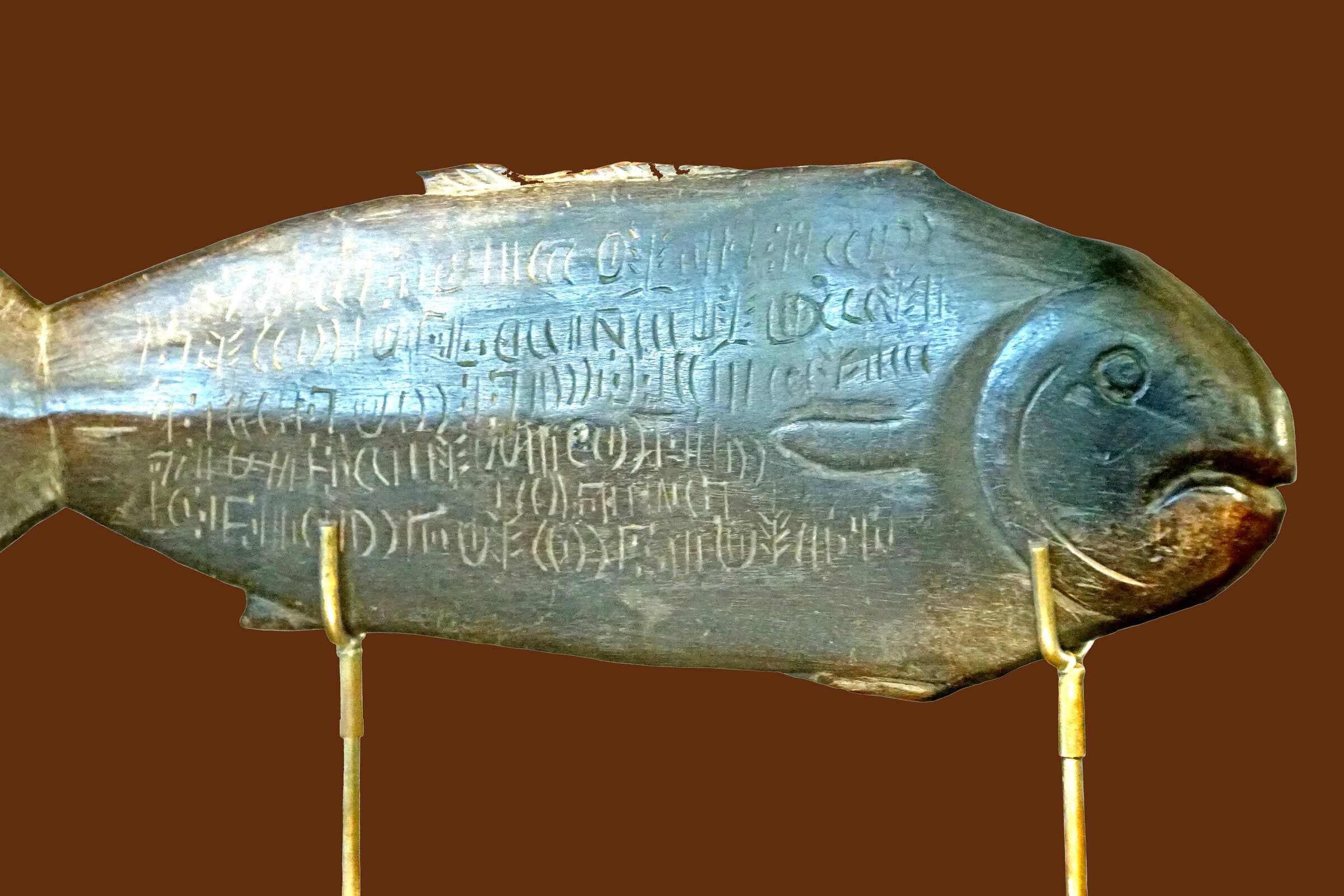
Sometime in the 1860s, on the most remote inhabited island on Earth, people began burning their books. They were not books in any shape we would recognize: they were boards of dark, oiled wood, some the size of a forearm, some carved into the shape of a fish or a human figure, every surface crowded with tiny incised pictures running in neat lines. The Rapa Nui called them kohau rongorongo, and for generations certain trained men had been able to stand before one and chant what it held. By the time the first outsiders thought to ask about them, the boards were being used as fishing floats, as kindling, as spools to wind fishing line around. The people who could read them were dead or dying, taken by slavers and smallpox, and no one left alive could say for certain what the signs meant. More than 150 years later, after the attention of linguists, cryptographers, and computers, that is still true. Easter Island invented, or received, one of the only writing systems ever created in human history, and we cannot read a single sentence of it.
This article contains affiliate links. If you buy through them we may earn a small commission at no extra cost to you.
What You'll Learn
- •The Boards That Became Kindling
- •A Writing That Turns Upside Down
- •The Bishop and the Last Reciters
- •How an Island Loses Its Memory
- •Barthel and the Shape of the Problem
- •The One Passage We Can Almost Read
- •The Men Who Said They Cracked It
- •Counting Signs in the Dark
- •Did Easter Island Invent Writing?
- •What the Boards Might Be Holding
- •Frequently Asked Questions
- •Further Reading
The Boards That Became Kindling
The first European known to have laid eyes on the tablets was a French lay friar named Eugène Eyraud, who landed on Rapa Nui on January 2, 1864, to bring Christianity to a population that had already been gutted. In the houses, he noticed wooden tablets and staffs covered with carved signs, rows of little figures he took for some kind of writing. He mentioned them once, in passing, in an account of his mission, and then said nothing more about them. He did not collect any. He did not ask what they said. Within a few years that incuriosity would look like a tragedy, because the window to ask was already closing and no one knew it.
Eyraud had arrived at the worst possible moment to ignore a living script. The men trained to recite the boards, the tangata rongorongo, belonged to a priestly and chiefly class that was being erased. When missionaries and visitors finally began gathering the tablets a few years later, they found that the Rapa Nui they asked could no longer read them. Some could chant something when a board was placed in their hands. Whether what they chanted was a reading, a half-remembered recitation, or an improvisation to please the questioner, no one could tell then, and no one can tell now.
A Writing That Turns Upside Down
The script the Rapa Nui carved is unlike anything else in Polynesia, and in one respect unlike almost anything else on Earth. The glyphs are small, precise outlines of birds, fish, plants, human and part-human figures, and geometric shapes, incised into the wood with a shark's tooth or a flake of obsidian. They run in lines, and here is the strange part: the lines alternate direction and orientation. You begin at the bottom left corner and read left to right. When you reach the end of the line, you do not sweep back to the start. You rotate the entire tablet 180 degrees and read the next line, which now sits the right way up because you turned it. Scholars call this reverse boustrophedon, and it means that to read a rongorongo board you have to keep flipping it end over end, every line upside down relative to the one before it. It is a reading posture no European script ever demanded.
What survives is heartbreakingly little. Roughly two dozen genuine inscribed objects are scattered through the museums of the world, around twenty-six accepted texts in all, and not one of them is still on Easter Island. Together they carry something over fifteen thousand glyphs. The largest single text is the Santiago Staff, a chief's baton now held in Chile, crowded with roughly 2,900 signs and the only object that appears to use any kind of punctuation, a vertical line that may separate one section from the next. Set all the texts side by side and you have less raw material than a short pamphlet. That scarcity is not a footnote to the mystery. It is close to the whole of it.
The Bishop and the Last Reciters
The effort to save what the boards held fell to Florentin-Étienne Jaussen, the Catholic bishop of Tahiti, usually remembered by his Tahitian name, Tepano. In 1868 he received a gift from Rapa Nui converts: a long cord of human hair wound around a discarded tablet. Jaussen understood at once that the writing mattered and asked that more tablets be collected. Only a handful were recovered. The rest, it seems, had already gone into cooking fires or out onto the water.
Jaussen then did the obvious thing. He found a Rapa Nui man living in Tahiti, a laborer named Metoro Tau'a Ure, and asked him to read the tablets aloud. Metoro took each board, turned it as the reading demanded, and chanted. Jaussen wrote down what he heard and built from it a list pairing glyphs with meanings, a document now called the Jaussen list. For a while it looked like the key. It was not. When later scholars checked Metoro's chants against the actual sequences of signs, the readings did not hold together. Metoro appeared to be naming the pictures he saw, a bird, a fish, a staff, rather than reading words, and sometimes he seemed to be reciting something only loosely attached to the glyphs in front of him. The Jaussen list preserved something precious and something unreliable in the same breath, and no one has ever fully separated the two.
A second chance came in 1886, when the American ship USS Mohican visited and its paymaster, William J. Thomson, found an elderly Rapa Nui man named Ure Va'e Iko who was said to have been able to read in his youth. Ure refused at first, fearing for his soul, then chanted over photographs of tablets after, by one account, a little rum had been involved. He produced long recitations, including a creation chant that names beings who come together and bring forth other beings. The problem repeated itself. When his chants were lined up against the glyphs, the words ran on far longer than the signs could account for, and some of the boards he chanted over were not even the ones his words seemed to describe. These three sources, Metoro, the Jaussen list, and Ure Va'e Iko, are the closest thing the world has to a living testimony about rongorongo. Every one of them is contested.
How an Island Loses Its Memory
To understand why the knowledge vanished so completely, you have to look at what happened to Rapa Nui in a single brutal decade. Beginning in late 1862, Peruvian ships arrived to seize labor for the guano mines and plantations of South America. In a series of raids, slavers carried off a large share of the island's population, and the victims included the ariki and the priestly class, exactly the people who held the training to read the boards. International pressure forced Peru to return the survivors, but by then most had died in captivity, and the few who were sent home carried smallpox with them. The epidemic that followed tore through what remained.
By the early 1870s the population of Easter Island had fallen to barely a hundred people, perhaps fewer. An island that may once have held several thousand had been reduced to a remnant in the space of about ten years. Whatever chain of teaching had carried rongorongo from one generation of reciters to the next was not merely weakened. It was severed. When Eyraud saw the tablets in 1864, the knowledge to read them was already slipping away. Everything collected afterward was gathered from a culture that had survived its own near extinction and lost, somewhere in the dying, the ability to hear its own writing.
Barthel and the Shape of the Problem
The first person to bring real order to the surviving texts was the German ethnologist Thomas Barthel, who spent years tracking down tablets in museums from Rome to Santiago and published his findings in 1958 in a work titled Grundlagen zur Entzifferung der Osterinselschrift, the foundations for deciphering the Easter Island script. Barthel drew careful line copies of almost the entire corpus, labeled the texts with letters of the alphabet, and assigned numeric codes to some six hundred distinct glyphs. His catalog is still the standard reference. Anyone who studies rongorongo starts from Barthel's drawings.
But Barthel also made a claim that has shadowed the field ever since. In 1971 he argued that the six hundred signs could be reduced to about 120 basic elements, with the rest being combinations, variants, or ligatures of those core forms. If true, that would make the system far more tractable, closer in scale to the sign inventory of a real writing system. The trouble is that Barthel never published the full evidence for how he arrived at the figure. So the single most important structural fact about rongorongo, how many fundamental signs it actually uses, rests partly on a count no one has been able to reproduce in detail. It is a strange foundation for a decipherment: a corpus everyone trusts, drawn by a man whose central analysis cannot be fully checked.
The One Passage We Can Almost Read
There is exactly one stretch of rongorongo that a meaningful number of specialists agree they understand, and it sits on a tablet known as Mamari, catalogued by Barthel as text C. One section of Mamari is noticeably more pictographic than the dense sign-rows around it, built around crescents and figures that repeat in a patterned way. Barthel proposed that this passage was a calendar, a sequence tracking the nights of the lunar month, and later work by the French researcher Jacques Guy reinforced the astronomical reading, matching the structure to the way Rapa Nui tradition divided the moon's cycle, including the insertion of nights to keep the count aligned with the real sky.
If that reading is right, and it is the nearest thing rongorongo has to a confirmed one, it tells us something important and something maddening at the same time. It tells us the script could carry real, structured information about the world, in this case the one subject on which an isolated island people would have kept precise records: the moon, the tides, the planting and the fishing. And it tells us that even our single success is a passage built from pictures a modern eye can partly follow. The thousands of other glyphs, the ones that look like true writing rather than a diagram, remain shut. We can read the island's calendar, or something close to it, and nothing else.
The Men Who Said They Cracked It
Every undeciphered script attracts people who announce they have solved it, and rongorongo is no exception. The most serious modern attempt came from the New Zealand linguist Steven Roger Fischer, who in 1995 published a reading in the Journal of the Polynesian Society. Fischer focused on the Santiago Staff and noticed that much of it is built from repeating groups of three glyphs, in which the first sign of each triad carries a small added mark. He read that mark as a phallus and proposed that the texts were procreation chants, following a formula he wrote as X copulated with Y, and there issued forth Z. One of his sample readings of the Staff runs: all the birds copulated with the fish, and there issued forth the sun.
It is a vivid idea, and it drew on a real thread: the creation chant Ure Va'e Iko had recited in 1886 has exactly that shape, beings joining and producing other beings. But the field did not accept it. The French researcher Jacques Guy argued in 1998 that the mark Fischer read as a phallus was better understood another way, perhaps as a marker distinguishing names, which would turn long passages of the Staff into lists of people rather than cosmic couplings. Others have suggested the texts might record genealogies, or battles and their dead. The Dutch researcher Mary de Laat later proposed detailed readings of several tablets as dialogues and named individuals, and those too have met resistance. The pattern is always the same. A reading is proposed. It accounts for some of the signs. It cannot be checked against a second independent text that uses the script in a known way, because no such text exists. And so it remains a hypothesis wearing the clothes of a solution.
Counting Signs in the Dark
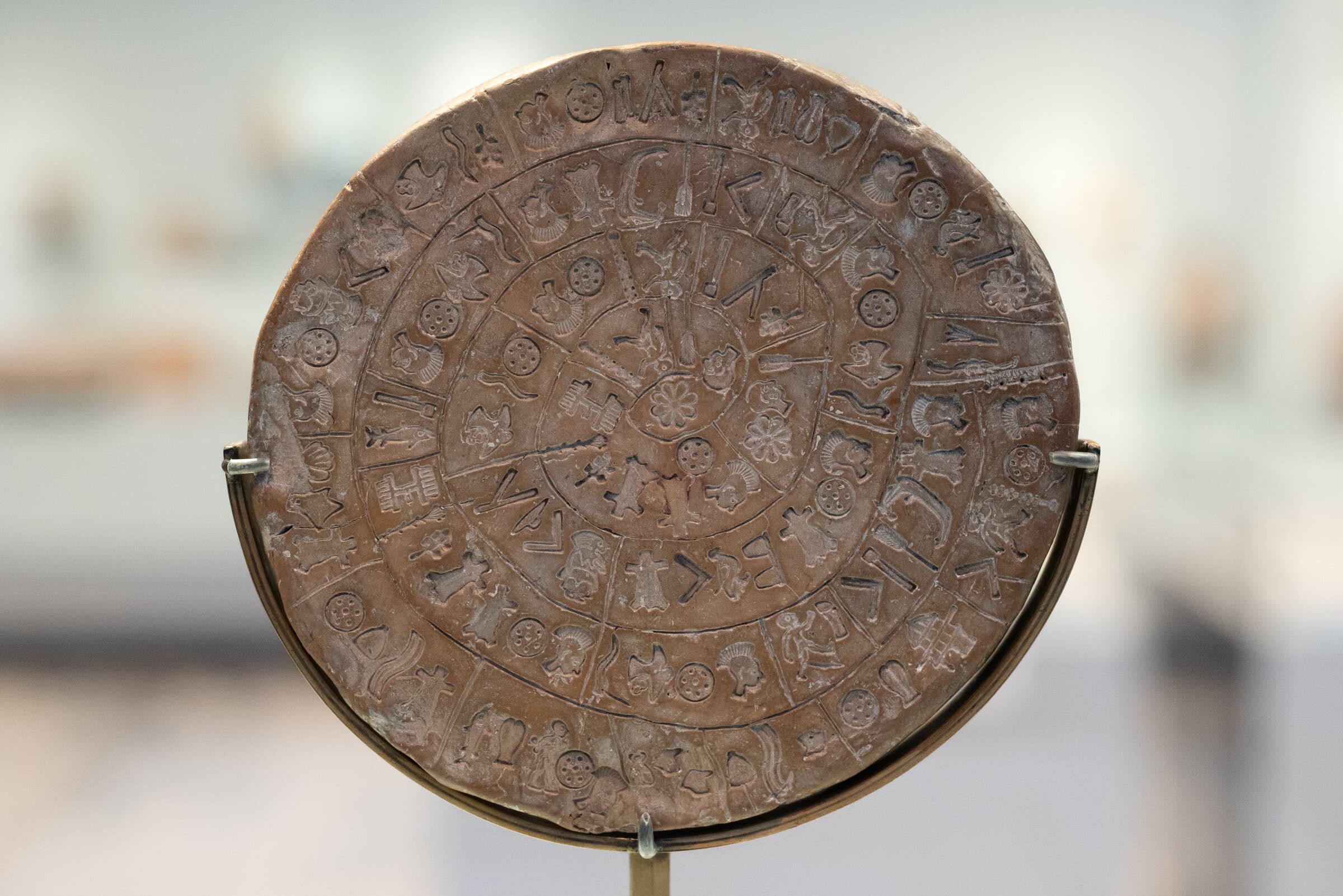
This is the deepest reason rongorongo has not fallen, and it is the same reason the Phaistos Disc has not fallen, and the Voynich Manuscript resists every assault. Decipherment runs on redundancy. Michael Ventris read Linear B in 1952 because he had thousands of tablets to work from, enough repetition for patterns to surface and enough context, the places and goods of Bronze Age Greece, to anchor a guess. The great cracked scripts were cracked because there was enough of them. Rongorongo offers barely fifteen thousand glyphs total, much of it damaged, none of it paired with a translation, written in a language, old Rapa Nui, that itself changed and thinned as the population collapsed.
Researchers have tried to brute-force the structure anyway. The linguist Konstantin Pozdniakov carried out detailed statistical studies of how often each sign appears and which signs cluster together, work that pointed toward a smaller functional set than the raw catalog suggests and hinted the system might encode sounds, syllable by syllable, at least in part. But the same analyses show that rongorongo fits neither the profile of a pure picture-based script, where each sign is a word, nor that of a pure syllabary, where each sign is a sound. It seems to be a mixed system, which is harder, not easier, to break. A machine can generate a thousand plausible readings as fast as a person can generate one, and without a second text to test them against, every one of those readings is worth the same amount, which is nothing. The barrier is not computing power. It is missing information, burned and drowned and buried with the people who carried it.
Did Easter Island Invent Writing?
For a long time the safe scholarly position was that rongorongo was young. The ethnographer Alfred Métraux, who studied the island in the 1930s, doubted the script was ancient at all. The argument ran like this: in November 1770, a Spanish expedition under Felipe González de Ahedo annexed Easter Island for the crown and had island chiefs make marks on a deed of cession. Perhaps, having watched Europeans put meaningful signs on paper, the Rapa Nui were inspired to invent a sign system of their own. Under that view, rongorongo was not a window into deep Polynesian antiquity but a clever local response to first contact, barely a few decades old when Eyraud saw it. Writing systems that appear this way, sparked by the knowledge that writing is possible rather than copied directly, are real, and scholars call the process stimulus diffusion.
Then, in 2024, the question cracked open. A team led by Silvia Ferrara at the University of Bologna published new radiocarbon dates in the journal Scientific Reports, testing the wood of four rongorongo tablets held in Rome. Three were made from trees felled in the nineteenth century, as expected. But one tablet was carved on wood from a tree that died sometime between roughly 1493 and 1509, more than two hundred years before Jacob Roggeveen became the first European to reach the island on Easter Sunday of 1722. The finding does not prove the carving is that old, and the researchers were careful to say so. The wood is not native to the island and may have arrived as driftwood, drifting and sitting for years before anyone cut a glyph into it. But the result does something the old consensus could not survive: it puts a genuine possibility of pre-contact invention back on the table. If even one board was being carved before any European set foot on Rapa Nui, then rongorongo would stand as one of the very few times in the human record that a people invented writing entirely on their own, with no example to copy, on a speck of volcanic rock a thousand miles from the nearest neighbor.
What the Boards Might Be Holding
Picture what we would gain if the signs ever spoke. The surviving texts were carved by a society that built the moai, raised and then toppled nearly nine hundred stone giants, and navigated to and survived on the loneliest patch of habitable land in the Pacific, a story told on the Easter Island itself. A readable rongorongo might hold their genealogies, the chain of chiefs reaching back toward the founding voyage. It might hold creation chants, the names of gods, the record of the catastrophe that stripped the island of its trees. It might hold the ordinary and irreplaceable: who owned what, which clan held which land, what the priests watched for in the sky. The Mamari calendar is a keyhole glimpse of exactly that kind of knowledge, a people keeping careful count of the moon. Everything else is sealed behind a script we can see perfectly and understand not at all.
That is the particular ache of rongorongo, and of the whole family of unread scripts it belongs to. This is not a lost text we are hunting for. We have it. It sits in climate-controlled cases in Santiago and Rome and Washington, photographed in high resolution, traced glyph by glyph, fed through every statistical tool we own. The message was written down on purpose, by people who wanted it kept, in signs careful and consistent enough to carry meaning. The information survived. The key did not. Somewhere in the 1860s, in the space between a slaver's ship and a smallpox fever, the last person who could turn these boards in their hands and hear them speak took the sound of them out of the world. The carving remains. The voice is gone.
Frequently Asked Questions
Has rongorongo ever been deciphered?
No, not in any way that the specialists who study it accept. One short passage on the Mamari tablet is widely read as a lunar calendar, and that is the closest thing to a confirmed reading the script has ever produced. Everything beyond it, the genealogies, the chants, the long dense rows on the Santiago Staff, remains unread. Several researchers have announced full or partial decipherments over the years, and each has been contested for the same reason: there is no second text in the same script with a known meaning to check any solution against.
How many rongorongo texts still exist?
Roughly two dozen genuine inscribed objects survive, about twenty-six accepted texts in total, holding something over fifteen thousand glyphs between them. They are spread across museums in Europe, the Americas, and the Pacific, and not one of them remains on Easter Island. That is a tiny amount of material to work from, less than you would find in a single short booklet, and the scarcity is one of the main reasons the script has resisted every attempt to read it.
Why couldn't the islanders just read their own writing?
Because the people who could were almost all gone. The Peruvian slave raids that began in 1862, followed by a smallpox epidemic, reduced Easter Island's population to barely a hundred within about a decade, and the losses fell heavily on the chiefly and priestly class trained to recite the boards. By the time outsiders thought to ask, the chain of teaching had been broken, and the men later asked to read tablets produced chants that did not reliably match the signs.
Did Easter Island really invent writing on its own?
It is one of the open questions, and it got a lot more interesting in 2024. A radiocarbon study found that one tablet was carved on wood from a tree that died around 1493 to 1509, well before Europeans first reached the island in 1722. The wood may have been driftwood that sat for years before being carved, so this is not proof. But it revived a genuine possibility that had been largely dismissed: that the Rapa Nui created rongorongo themselves, with no outside model, which would make it one of a tiny handful of independent inventions of writing in all of human history.
Could a computer or AI crack it?
Not with what survives. Breaking an unknown script depends on having enough text for patterns to emerge and enough context to anchor a reading. Rongorongo offers barely fifteen thousand often-damaged glyphs, no translation, and a language that was itself thinning as the population collapsed. A machine can produce endless plausible readings, but without a second text to test them against, every one of them carries the same weight, which is none. The obstacle is not processing power. It is lost information.
Further Reading
The essential scholarly treatment is Steven Roger Fischer, Rongorongo: The Easter Island Script: History, Traditions, Texts, which lays out the full history of the boards, the surviving corpus, and the attempts to read them, including Fischer's own contested reading, in more depth than any other single volume. Find it on Amazon.
To place rongorongo among the other scripts the world has never cracked, read Andrew Robinson, Lost Languages: The Enigma of the World's Undeciphered Scripts, which sets the Easter Island boards beside the Phaistos Disc and the rest and explains with real clarity why some ancient scripts fall and others never do. Find it on Amazon.
And for a firsthand view from the era when a few islanders still carried memories of the boards, Katherine Routledge, The Mystery of Easter Island records her 1914 to 1915 expedition, including her interviews with Rapa Nui elders about the script, a primary account written before the last threads were entirely gone. Find it on Amazon.
The boards are still here. We have handled them, scanned them, argued over them in conference halls from Santiago to Rome. We can tell you how they were made, carved with a shark's tooth into dark wood, read by turning them end over end, built from signs careful and repeated enough to carry real meaning. We can read, or nearly read, the island's count of the moon, and not one word of the rest. The message was kept on purpose and it survived the end of the world that wrote it. Only the voice that could lift it off the wood is missing, and on an island that lost almost everything in a single decade, that may be the one loss that can never be undone.
Want to explore more mysteries?
We've got plenty more rabbit holes to go down.