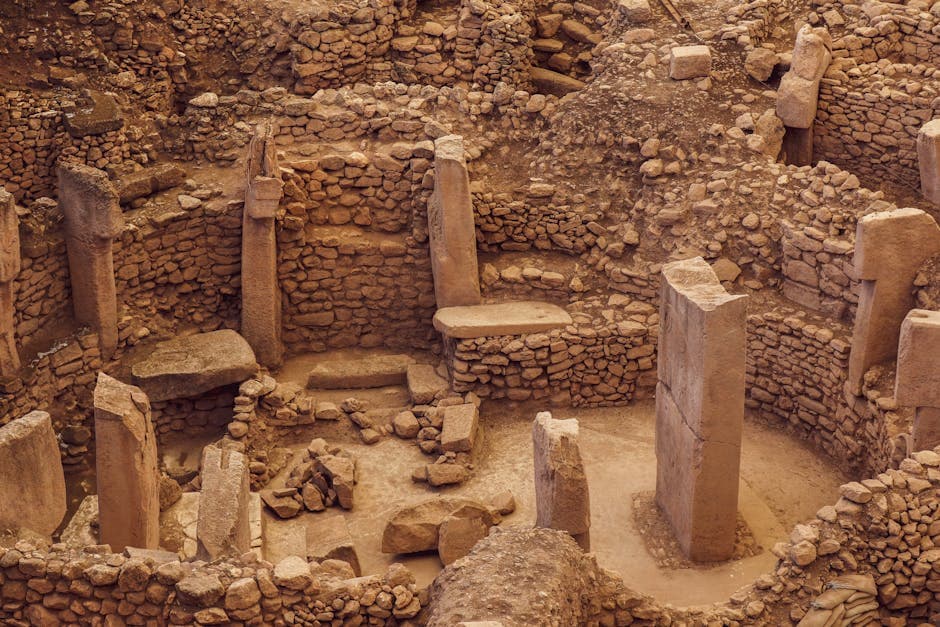
Göbekli Tepe: The 11,000-Year-Old Temple That Rewrote Human History
Built around 9500 BCE by hunter-gatherers who hadn't invented farming, pottery, or metal tools, Göbekli Tepe is the world's oldest known monumental structure. It shouldn't exist.
Eleven thousand years ago, before anyone on Earth had invented the wheel, before the first city was built, before humans figured out how to make pottery or smelt metal, a group of hunter-gatherers in what's now southeastern Turkey carved massive limestone pillars out of bedrock, dragged them up a hill, and arranged them into elaborate circular structures decorated with carvings of animals, abstract symbols, and stylized human figures. Some of these pillars stand 18 feet tall and weigh up to 10 tons.
This is Göbekli Tepe, and it shouldn't exist. Or rather, it shouldn't exist according to the story we used to tell about how civilization developed. That story went like this: first humans learned to farm, then they settled down, then they built villages, then towns, then temples. Göbekli Tepe inverts the sequence entirely. Here is a monumental complex, built with extraordinary skill and coordination, by people who were still hunting gazelles and gathering wild grain. The temple came first. Everything else followed.
When German archaeologist Klaus Schmidt began excavating the site in 1995, he knew he'd found something significant. He probably didn't realize he'd found something that would force archaeologists to rethink the origins of civilization itself.
What You'll Learn
- •What Is Göbekli Tepe?
- •Who Built Göbekli Tepe?
- •What Do the Carvings Mean?
- •Why Was Göbekli Tepe Built?
- •How Does Göbekli Tepe Change Our Understanding of Civilization?
- •Was Göbekli Tepe Deliberately Buried?
- •What's Been Discovered Since Schmidt's Death?
- •Can You Visit Göbekli Tepe?
- •Frequently Asked Questions
What Is Göbekli Tepe?
Göbekli Tepe (Turkish for "Potbelly Hill") is a Neolithic archaeological site on a limestone ridge in the Germuş mountains, about 7.5 miles northeast of the city of Şanlıurfa in southeastern Turkey. It sits at the northern edge of the Fertile Crescent, the arc of land stretching from the Persian Gulf through modern Iraq, Syria, and Turkey where agriculture and some of the earliest civilizations emerged.
The site consists of a 50-foot-high artificial mound (called a tell) covering roughly 20 acres. Geophysical surveys have identified at least 20 large circular or oval enclosures buried within the mound, though as of 2021, only about 10% of the site has been excavated.

The most striking features are the T-shaped limestone pillars. The largest discovered so far stands about 18 feet tall and weighs around 10 tons, though unfinished pillars found in a nearby quarry suggest some were planned to be even larger (one abandoned pillar would have been about 23 feet long and weighed roughly 50 tons). The pillars are arranged in circles, with two larger pillars in the center of each enclosure surrounded by smaller ones set into low stone walls.
Radiocarbon dating places the earliest structures at between 9600 and 8200 BCE, during the Pre-Pottery Neolithic period. That makes Göbekli Tepe roughly 6,000 years older than Stonehenge and about 7,000 years older than the Great Pyramid. It's the oldest known example of monumental architecture anywhere in the world.
Who Built Göbekli Tepe?
This is the part that upends conventional thinking. Göbekli Tepe was built by hunter-gatherers. No domesticated plants or animals have been recovered from the earliest levels of the site. The builders were people who hunted wild gazelles, wild sheep, wild cattle, and wild boar, and who gathered wild einkorn wheat, barley, and other plants from the surrounding steppe.
They had no pottery (the site predates the invention of ceramics by several thousand years). They had no metal tools; everything was built with stone implements, primarily flint picks and chisels. They had no writing, no wheels, and no draft animals.
And yet they coordinated the quarrying, transport, carving, and erection of stone pillars weighing up to 10 tons, placing them in carefully planned circular arrangements with sophisticated stone walls and terrazzo (burnt lime) floors. This required not just technical skill but significant social organization: archaeologists estimate that moving and raising the largest pillars would have required hundreds of people working together.

The question that immediately follows: how did hunter-gatherers, supposedly living in small, mobile bands, organize a construction project of this scale? The traditional model of human development says that settled farming communities came first, creating the food surpluses and population density needed for monumental building projects. Göbekli Tepe says otherwise.
Recent findings have complicated the picture further. Excavations have uncovered domestic structures, extensive cereal processing equipment, carved water cisterns capable of holding at least 150 cubic meters of water, and tools associated with daily life. This suggests that Göbekli Tepe may have been a permanent or semi-permanent settlement, not just a pilgrimage site visited by nomadic groups. The builders may have been further along the path from foraging to farming than originally thought.
What Do the Carvings Mean?
The pillars at Göbekli Tepe are covered with some of the oldest representational art in the world. The carvings include:
Animals: Foxes, snakes, wild boar, aurochs (wild cattle), cranes, vultures, scorpions, spiders, and other creatures. These aren't random decorations; specific animals seem to be associated with specific enclosures, suggesting each structure had its own symbolic identity or clan affiliation.
Human forms: The T-shaped pillars themselves appear to represent stylized human figures. Many have carved arms running down the sides, with hands meeting at the front, and some show belts, loincloths, and fox-pelt accessories. The "T" shape represents a head seen from the side, with the vertical shaft as the body.
Abstract symbols: H-shapes, crescent moons, concentric circles, and other geometric forms appear throughout the site. Their meaning is unknown, though some researchers have speculated they could represent early proto-writing or astronomical observations.
The Vulture Stone (Pillar 43): One of the most discussed carvings shows a vulture holding what appears to be a sphere, a headless human figure, and various other animals. Some researchers have interpreted this as a depiction of a cosmic event, possibly a comet impact, while others see it as a funerary scene related to excarnation (the practice of exposing the dead to vultures). A controversial 2017 paper in Mediterranean Archaeology and Archaeometry argued the carving depicts a specific astronomical alignment from around 10,950 BCE, potentially recording a comet strike associated with the Younger Dryas cooling event. Most mainstream archaeologists are skeptical of this interpretation.
The animals depicted are notably wild, not domesticated. There are no cows, sheep, or goats in the form we'd recognize as livestock. This reinforces the picture of a society that was still firmly in the hunting and gathering phase of development.
Why Was Göbekli Tepe Built?
Klaus Schmidt, who led excavations from 1995 until his death in 2014, interpreted Göbekli Tepe as a primarily ritual or ceremonial site. He described it as "the world's first temple" and suggested it was a gathering place where separate hunter-gatherer groups came together for religious ceremonies, feasting, and social bonding.

Schmidt believed the T-shaped pillars represented ancestors or supernatural beings, and that the enclosures were spaces for rituals connecting the living with the spirit world. He speculated the builders practiced shamanism, with the animal carvings representing spirit creatures or totemic symbols.
More recent research has nuanced this picture:
Settlement, not just sanctuary. Excavations after Schmidt's death have revealed increasing evidence that people lived at or near the site year-round. Domestic buildings, food processing areas, and water infrastructure suggest a functioning community, not just a pilgrimage destination. This doesn't mean the site wasn't sacred; it may have been both a home and a temple.
Feasting center. Large stone vessels found at the site could have held up to 160 liters of liquid. Analysis of residues suggests they were used for preparing food and possibly brewing a fermented grain beverage, essentially early beer. Some archaeologists have proposed that Göbekli Tepe was a feasting center where groups gathered for communal meals that reinforced social bonds and alliances. The construction itself may have been the point: bringing people together for a shared project that built community identity.
Astronomical observatory. Some researchers have suggested that the enclosures were aligned with specific stars or celestial events. The evidence for this is debated, but the site's hilltop location and open-sky setting would have provided excellent conditions for observing the night sky.
Political statement. The sheer scale of the construction would have communicated the power and prestige of whatever group built it. In a world without cities or kings, monumental architecture might have served as a way for communities to establish their importance and attract members.
The honest answer is that we don't know the full purpose. The builders left no writing, and the gap between their world and ours is so vast that interpreting their intentions from stone carvings alone is inherently speculative.
How Does Göbekli Tepe Change Our Understanding of Civilization?
Before Göbekli Tepe, the standard model of human development looked roughly like this: agriculture led to permanent settlements, which led to population growth, which led to social complexity, which eventually led to monumental architecture and organized religion.
Göbekli Tepe scrambles that sequence. Here, monumental architecture appears first, built by people who hadn't yet adopted farming. This suggests that the desire to build communal sacred spaces, or at least to gather in large groups for ritual purposes, may have been a driver of the transition to agriculture, not a consequence of it.
Schmidt famously summarized this idea: "First came the temple, then the city."
There's even a tantalizing connection to the origin of farming itself. Göbekli Tepe sits in the very region where genetic studies indicate einkorn wheat was first domesticated. It's possible that the need to feed large groups of people gathering at or building the site created pressure to cultivate wild grains more intensively, eventually leading to full domestication. This is speculative, but the geographical overlap is striking.
The site also challenges the assumption that hunter-gatherers lived in small, egalitarian bands without the organizational capacity for large projects. Göbekli Tepe required coordinated labor, specialized skills (the carving is detailed and consistent), and some form of leadership or planning authority. Hunter-gatherer societies may have been more complex and capable than the standard model assumed.
Was Göbekli Tepe Deliberately Buried?
One of the most intriguing aspects of the site is that it appears to have been intentionally backfilled. The enclosures were filled with refuse, rubble, and soil, burying them under what became the artificial mound. This happened over a long period as structures were used, collapsed, and were subsequently covered over.
Schmidt initially interpreted this as deliberate ritual burial: the builders intentionally entombed their sacred structures, possibly as part of a cycle where old enclosures were decommissioned and replaced by new ones. The fact that the older, deeper enclosures tend to be larger and more elaborate than the later ones suggests the site may have declined in grandeur over time before being abandoned around 8000 BCE.
More recent analysis suggests the burial process was more complex. Some structures collapsed naturally due to the weight of their (probably wooden) roofs, were damaged by landslides on the steep hilltop, and were then repaired or rebuilt. The line between intentional burial and natural accumulation may not be as clear as originally thought.
What's not disputed is that the burying preserved the site well. Unlike most Neolithic ruins, which have been eroded, looted, or built over for millennia, Göbekli Tepe's pillars and carvings survived largely intact under their protective layer of fill. It's one of the best-preserved prehistoric sites on Earth.
What's Been Discovered Since Schmidt's Death?
Schmidt died of a heart attack in 2014, and excavations continued under Turkish prehistorian Necmi Karul and German archaeologist Lee Clare. Their work has produced several important revisions to Schmidt's original interpretations:
It was a settlement, not just a temple. The discovery of domestic structures, food processing areas, and permanent water infrastructure has shifted the understanding from "sacred pilgrimage site" to "complex settlement with significant ritual architecture."
Karahan Tepe and the Taş Tepeler. Göbekli Tepe is no longer unique. Nearby sites including Karahan Tepe, Sayburç, Harbetsuvan Tepesi, and others (collectively called the Taş Tepeler, or "Stone Hills") have revealed similar T-shaped pillars, circular enclosures, and elaborate carvings from the same period. This suggests a widespread cultural tradition across the region, not an isolated anomaly. Karahan Tepe, excavated extensively since 2019, features remarkable carved pillars including a striking human head emerging from the bedrock.
Only 10% excavated. The vast majority of Göbekli Tepe remains underground, promising decades more of discoveries.
For other ancient construction mysteries, check out our articles on Stonehenge, Easter Island, and the Nazca Lines. The Voynich Manuscript offers another look at a puzzle from the deep past that resists explanation.
Can You Visit Göbekli Tepe?
Yes. Göbekli Tepe was designated a UNESCO World Heritage Site in 2018 and is open to visitors. The site is located about 7.5 miles northeast of Şanlıurfa (often called Urfa), a city in southeastern Turkey accessible by air from Istanbul and Ankara.

A permanent shelter structure protects the main excavated enclosures, and a walkway allows visitors to view the pillars and carvings from above. The nearby Şanlıurfa Archaeology Museum houses many of the artifacts recovered from the site, including the famous "Urfa Man," a life-sized limestone statue considered the oldest known naturalistic sculpture of a human.
The Taş Tepeler region, including Karahan Tepe, is developing additional visitor infrastructure. The Turkish government has designated the area as a priority cultural tourism destination.
Timeline of Key Events
| Year | Event |
|---|---|
| ~9500 BCE | Earliest structures built at Göbekli Tepe |
| ~9000-8200 BCE | Site expanded; multiple enclosures in use simultaneously |
| ~8000 BCE | Site abandoned; structures gradually buried |
| 1963 | Site first noted in archaeological survey by University of Istanbul and University of Chicago |
| 1994 | Klaus Schmidt recognizes the site's significance |
| 1995 | Systematic excavations begin under Schmidt |
| 2014 | Schmidt dies; excavations continue under Karul and Clare |
| 2017 | Controversial paper interprets Vulture Stone as astronomical record |
| 2018 | UNESCO designates Göbekli Tepe a World Heritage Site |
| 2019 | Major excavations begin at nearby Karahan Tepe |
| 2021 | Only ~10% of site excavated; domestic structures identified |
Frequently Asked Questions
How old is Göbekli Tepe?
The oldest structures date to approximately 9500 BCE, making them about 11,500 years old. The site was in use until around 8000 BCE. For context, it's roughly 6,000 years older than Stonehenge, 7,000 years older than the Great Pyramid of Giza, and 5,000 years older than the invention of writing.
Was Göbekli Tepe really built by hunter-gatherers?
Yes, according to the archaeological evidence. No domesticated plants or animals have been found in the earliest levels. The builders used stone tools and hunted wild animals. However, recent research indicates they may have been more settled than the term "hunter-gatherer" implies, with permanent dwellings, stored food, and water infrastructure. They were likely at the very beginning of the transition from foraging to farming.
Why is Göbekli Tepe important?
It challenges the conventional model of how civilization developed. The standard story says agriculture came first, then settlements, then monuments. Göbekli Tepe shows that monumental construction happened before farming, suggesting that the desire for communal ritual spaces may have been a driver of civilization, not a product of it.
Is Göbekli Tepe the oldest building in the world?
It's the oldest known monumental architecture, meaning the oldest large-scale, deliberately designed stone structure. There are older evidence of human habitation (caves, simple shelters) and even some older stone walls, but nothing on the scale or complexity of Göbekli Tepe has been found from an earlier period. The discovery of similar sites nearby (Karahan Tepe, Sayburç) suggests it was part of a wider tradition.
What happened to the people who built Göbekli Tepe?
We don't know exactly why the site was abandoned around 8000 BCE. By that time, agriculture was well established in the region, and people were building permanent farming villages. It's possible that as society changed, the role Göbekli Tepe played in hunter-gatherer ritual life became obsolete. The builders' descendants likely became the farming communities of the Neolithic Fertile Crescent.
Further Reading
This article contains affiliate links. If you buy through them we may earn a small commission at no extra cost to you.
Want to explore more mysteries?
We've got plenty more rabbit holes to go down.