The Yeti: Did DNA Really Solve the Abominable Snowman?
Scientists say DNA proved the abominable snowman is only a bear. But the tests never touched what makes the yeti a mystery, and the bear is a mystery too.
On 8 November 1951, high on the Menlung Glacier on the border between Nepal and Tibet, the mountaineer Eric Shipton stopped and looked down at the snow. He was with the doctor Michael Ward and a Sherpa named Sen Tensing, scouting an approach to Everest at somewhere around 18,000 feet. Running across the glacier in front of them was a line of fresh footprints. They were enormous, clearly impressed, with a broad sole and what looked like a splayed, thumb-like toe. Shipton laid his ice axe beside one print and photographed it. When that picture ran in The Times that December, it did something no yeti story had managed before. It gave the Abominable Snowman a face, or at least a foot, and the world has been arguing about it ever since.
The usual way this story gets told now is that it is over. Headlines from 2014 and 2017 announced that scientists had finally run DNA on the physical evidence and settled the matter: the yeti is a bear. Case closed, legend retired. Except that is not quite what the science said, and it is nowhere near what the science could reach. The tests answered a narrow question about a handful of old relics. They never came close to the thing that makes the yeti a mystery in the first place, and the answer they did give turns out to contain a second mystery folded inside it.
This article contains affiliate links. If you buy through them we may earn a small commission at no extra cost to you.
What You'll Learn
- •A Footprint at Nineteen Thousand Feet
- •The Monster Born From a Mistranslation
- •What the Sherpas Always Knew
- •The Sightings That Would Not Stop
- •The Relics Kept in the Monasteries
- •The Texan, the Mountaineer, and the Bear
- •The DNA That Was Supposed to End It
- •The Study That Said: Only Bears
- •The Bear We Barely Know
- •What a Bear Still Cannot Explain
- •Frequently Asked Questions
- •Further Reading
A Footprint at Nineteen Thousand Feet
Shipton's photograph became what scientists call a type specimen, the reference point everything else is measured against. It is a strange thing to be famous, because a footprint in snow is one of the least reliable objects on Earth. Snow melts at the edges in sunlight, widening a print and blurring its outline, so that a modest track can swell into a monster within an hour. Shipton knew this. He was one of the most respected climbers of his generation and no one accused him of inventing it. What he could not explain was why the toes were arranged the way they were, with a short, offset digit that looked more like a thumb than anything a boot or a bear would leave.
The Smithsonian primatologist John Napier studied the photograph closely for his 1973 book Bigfoot: The Yeti and Sasquatch in Myth and Reality. Napier was no believer. He concluded that most yeti evidence fell apart under examination. Yet he admitted the Shipton print did not sit comfortably with any animal he could name, and he could not reduce it to a simple bear track. More than seventy years later, the single most famous piece of evidence for the yeti has still not been accounted for to everyone's satisfaction. That is where the whole thing begins: not with a legend, but with a photograph taken by a sober witness that nobody has fully explained.
The Monster Born From a Mistranslation
The name "Abominable Snowman" is an accident, and tracing it back reveals how much of the Western yeti story was built on a game of telephone. In 1921, the British soldier and explorer Charles Howard-Bury led the first reconnaissance expedition to the north side of Everest. Crossing the Lhakpa La at around 21,000 feet, his party found large tracks in the snow. His Sherpa porters called the maker metoh-kangmi. Howard-Bury wrote the word down and moved on.
The phrase traveled to Darjeeling, where a journalist for the Calcutta Statesman named Henry Newman interviewed the returning porters. Newman rendered metoh as something like "filthy" or "dirty," then, reaching for a word with more newspaper appeal, printed "abominable." Kangmi means snow-man. And so a Himalayan creature whose local names mostly point toward an animal was handed an English title that made it sound like a horror. Newman later admitted he had leaned into the drama. The monster of a thousand book covers, the roaring white giant of the movies, owes its character in large part to a reporter choosing a punchier adjective in 1921.
What the Sherpas Always Knew
Strip away the Western packaging and you find something older and more careful. In Sherpa and Tibetan tradition the yeti is not a single cartoon beast but a set of distinct creatures, described with the precision of people who share mountains with real animals. The dzu-teh, often translated as "cattle bear," is a large animal blamed for killing livestock, and it corresponds closely to the Himalayan brown bear. The meh-teh is the smaller, reddish, ape-like figure that most resembles the classic yeti of the photographs. Villagers distinguished between them the way a farmer anywhere distinguishes a fox from a wolf.
This matters, because it means the people who live with the mystery were never confused in the way outsiders assumed. They did not lump every track and every shadow into one monster. Some of what they reported was clearly a bear and was named as a bear. Something else, in their telling, was not. The word yeti itself is usually traced to a Sherpa term meaning roughly "that thing" or an animal of the rocks, a cautious, almost superstitious way of naming something you would rather not name directly. The tradition is layered, specific, and far harder to wave away than a single legend would be.
The Sightings That Would Not Stop
The reports did not come only from villagers. In 1925, the Greek photographer N. A. Tombazi, a Fellow of the Royal Geographical Society, was near the Zemu Glacier in Sikkim when he reported watching a figure in the distance, upright and dark against the snow, moving across the slope and stopping now and then to pull at low shrubs. By the time he reached the spot, the figure was gone, but he found footprints in the snow where it had walked. Tombazi was a trained observer who had no interest in folklore and spent the rest of his account trying to talk himself out of what he had seen.
In 1953, on the climb that first put a human being on the summit of Everest, Edmund Hillary and Tenzing Norgay reported finding large tracks. Tenzing, who grew up in these mountains, wrote in his 1955 autobiography Man of Everest that he believed the yeti was a kind of large ape, and that his own father had seen one twice, though Tenzing himself never had. In 1970, the British climber Don Whillans, on the south face of Annapurna, reported watching an ape-like creature move across a moonlit slope near his camp and later photographed tracks in the snow. These were not nervous tourists. They were among the most accomplished high-altitude mountaineers alive, people whose lives depended on reading terrain correctly, and what they consistently described was something that walked upright across snow where nothing should be walking at all.
The Relics Kept in the Monasteries
For a long time the strongest physical evidence was not tracks but relics, kept for generations in Himalayan monasteries as sacred objects. The monastery at Pangboche held a supposed yeti scalp and, separately, a mummified hand. The monastery at Khumjung held another scalp. These were not trophies put out for tourists. They were treated as holy, which is part of why the Western handling of them reads so poorly in hindsight: expedition after expedition arrived to snip samples off objects the monks revered.
In 1954, the Daily Mail mounted a "Snowman Expedition" and took hair from the Pangboche scalp. The anatomist Frederic Wood Jones examined it and concluded it had not come from a scalp at all, but from the shoulder of a coarse-haired hoofed animal. The Pangboche hand took a stranger road. In 1959, the actor James Stewart, passing through India, reportedly helped smuggle it out of the country hidden in his luggage on a flight to London. When Edmund Hillary returned in 1960 and 1961 on a dedicated expedition, he borrowed the Khumjung scalp, carried it to London with the village headman Khumjo Chumbi, and had it tested. The verdict, published by Marca Burns in 1962, was that it had been shaped from the skin of an animal resembling the serow, a Himalayan goat-antelope, but "definitely not identical with it." One by one the famous relics came back as something other than an unknown primate, and yet, each time, the answer carried a small qualification that refused to close the door completely.
The Texan, the Mountaineer, and the Bear
Two men spent real years on the question and arrived at a conclusion the headlines would eventually echo. The first was Tom Slick, a Texas oil heir and adventurer who, beginning in 1957, funded and led a series of expeditions into the Nepal Himalaya. His teams, which at one point included the Harvard anthropologist Carleton Coon, collected tracks, droppings, and testimony. Slick died in a plane crash in 1962 with the matter unresolved, but he had done something important: he treated the yeti as a problem for fieldwork rather than a tall tale.
The second was Reinhold Messner, the first person to climb Everest without supplemental oxygen and one of the greatest mountaineers who ever lived. After a 1986 encounter in eastern Tibet with a large, fast-moving animal he could not identify in the dusk, Messner spent years chasing it across the high country. He concluded, in his book My Quest for the Yeti, that the creature behind the legend was the Himalayan brown bear or the Tibetan blue bear, animals that can rear up and travel upright and that leave tracks easily mistaken for something stranger. Messner did not think he was debunking anything. He thought he had followed the yeti to its den and found a bear waiting there, and he found that no less astonishing than the myth. His conclusion set the stage for the laboratories that came next.
The DNA That Was Supposed to End It
In 2014, a team led by the Oxford geneticist Bryan Sykes published the first peer-reviewed genetic survey of its kind in the Proceedings of the Royal Society B. The paper, titled "Genetic analysis of hair samples attributed to yeti, bigfoot and other anomalous primates," gathered samples from around the world. DNA was recovered from thirty of them. Most matched ordinary animals: horses, cows, bears, a raccoon, a porcupine, a human.
Then came the result that made the papers. Two Himalayan samples, one from Ladakh in India and one from Bhutan, did not match any brown bear living today. They matched a fragment of DNA from an ancient polar bear jawbone recovered in Svalbard, a specimen tens of thousands of years old. Sykes was careful not to claim a yeti. What he suggested was more interesting: that an unknown kind of bear, perhaps a surviving relative or a hybrid of brown and polar bear lineages, might be roaming the high Himalaya, and that this unrecognized animal could be the real body behind some yeti reports. Far from closing the file, the first DNA study had opened a new one, proposing a bear that science did not yet have on its books.
The Study That Said: Only Bears
The polar bear result did not survive contact with a larger study. In 2017, Charlotte Lindqvist of the University at Buffalo led a fuller genetic analysis, also published in the Proceedings of the Royal Society B, under the title "Evolutionary history of enigmatic bears in the Tibetan Plateau-Himalaya region and the identity of the yeti." Her team used much longer stretches of mitochondrial DNA than earlier work and examined nine purported yeti specimens, including bone, tooth, skin, hair, and scat, several of them supplied by a British film company for a documentary.
Eight of the nine were bears: Asian black bears, Himalayan brown bears, and Tibetan brown bears. The ninth was a dog. When Lindqvist's team reanalyzed the kind of sample that had produced Sykes's polar bear match, they found it grouped with the Himalayan brown bear, not with any polar ancestor. On the surface this is the moment the mystery is said to die. Every relic tested, every hair and tooth and dropping that anyone had bothered to collect, came back as an animal already known to live in those mountains. If you wanted a tidy ending, this is it. But look at what the study actually found about the bears themselves, and the ending refuses to stay tidy.
The Bear We Barely Know
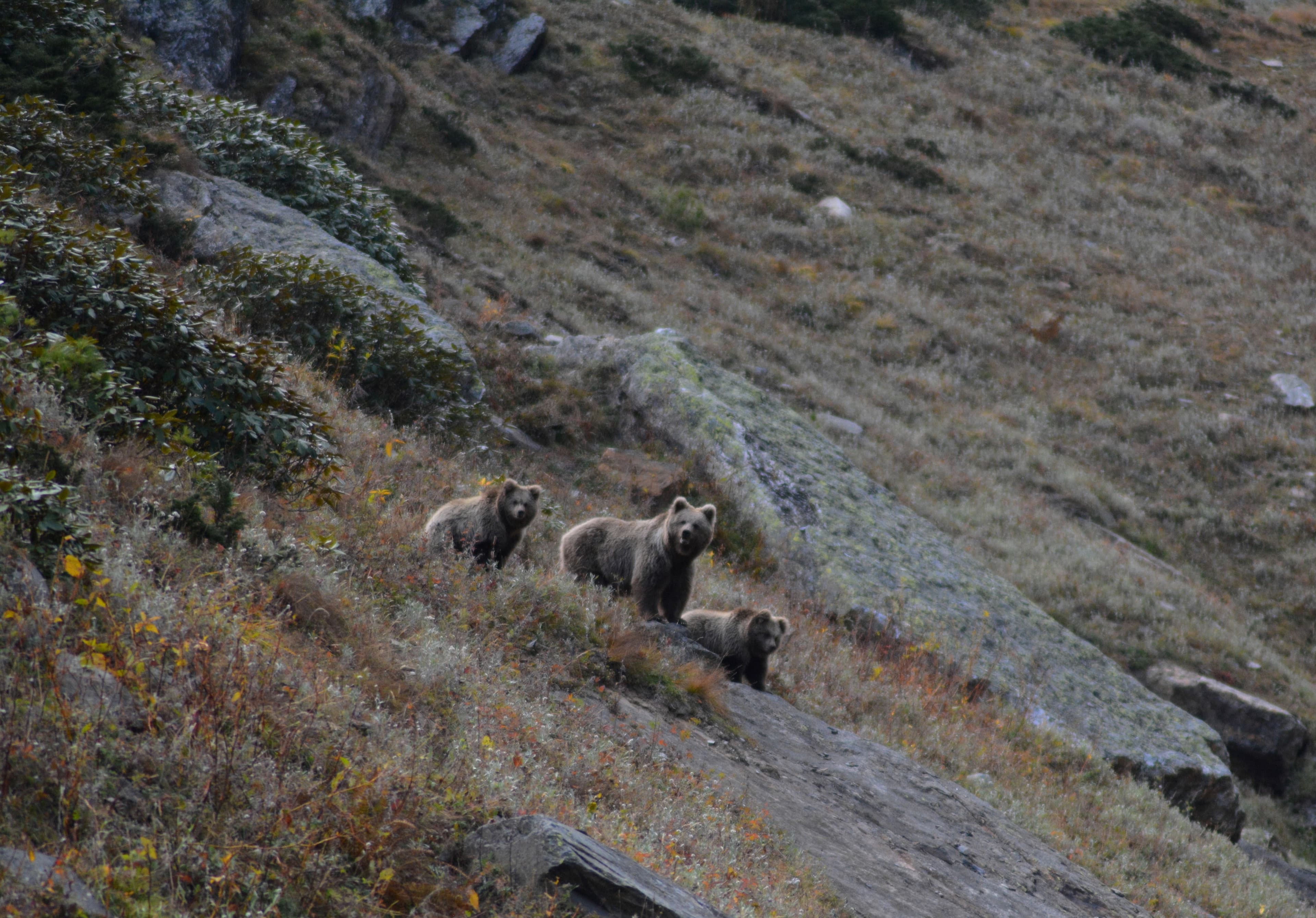
Lindqvist's team discovered that the Himalayan brown bear is not just another brown bear. Its lineage split off from all other brown bears astonishingly early, roughly 650,000 years ago, when glaciers isolated it on the roof of the world and left it to evolve in near-total separation ever since. It is one of the most genetically distinct bears on the planet, a living relic of an ice age that cut it off from its relatives before our own species existed.
And we know almost nothing about it. The Himalayan brown bear is critically endangered, scattered in tiny numbers across the highest and most remote ranges of Pakistan, India, and Nepal, where field biologists rarely reach it. There is no good population count. There are few photographs of wild individuals. Its behavior at extreme altitude is barely documented. So the triumphant headline, the yeti is "just a bear," hides something remarkable: the answer is one of the rarest, oldest, least understood large animals alive, a creature so elusive that we have better genetic data on it than observational data. We traded a legend we could not find for an animal we also cannot find. The mystery did not vanish. It changed its name and stayed exactly as hard to see.
What a Bear Still Cannot Explain
Even granting that bears account for the relics, there is a gap the DNA never reached, and it is the whole point. The tests examined objects people could collect and carry home: hair pulled from a monastery scalp, a tooth, a dried hand, a sample of droppings. Not one of them touched the living thing. The figure Tombazi watched pulling at shrubs in 1925 was never sampled. The creature Whillans reported on the moonlit slope in 1970 left no tissue in a tube. DNA can tell you what a specific old relic is. It cannot tell you what a mountaineer saw move across a glacier, because no one has ever caught that and swabbed it.
There is also the matter of where the tracks appear. Brown bears forage in valleys and alpine meadows, not often on open glaciers and high passes at 16,000 to 19,000 feet, which is exactly where so many of the famous prints, Shipton's included, have turned up. The naturalist Daniel C. Taylor spent decades on this and offered the most careful bear explanation yet: that young Asiatic black bears, which climb trees and can splay an inner claw outward, leave hind feet that overprint their front feet on steep snow, producing a track that looks eerily bipedal and even seems to show a human-like big toe. He laid this out in his 2017 book Yeti: The Ecology of a Mystery and argued it fit Shipton's photograph. It is an ingenious idea, and it explains one kind of footprint. It does not explain the upright figures, the agreement among cultures that never spoke to each other, or a tradition that carefully separates one mountain creature from another. The bear accounts for a great deal. It does not account for everything, and the people who know these mountains best have never once been convinced that it does.
Frequently Asked Questions
Did DNA tests prove the yeti is a bear? The tests proved that the physical relics people submitted, old scalps, a mummified hand, hair and droppings, came from bears and, in one case, a dog. That is a real result. But those tests only examined objects that could be carried to a lab. They never touched the live sightings, the figures witnesses reported watching move across the snow, because none of those has ever been captured or sampled. The relics were bears. What people saw walking remains untested.
What actually made Shipton's famous 1951 footprint? No one has produced an explanation that satisfies everyone. The naturalist Daniel Taylor argues it was a bear track distorted by overprinting hind and front paws on a slope, while the Smithsonian primatologist John Napier, himself a skeptic of most yeti evidence, could not comfortably match it to any animal he knew. More than seventy years on, the single most studied piece of yeti evidence still draws disagreement from serious researchers.
Is the Himalayan brown bear really that mysterious? Yes, and that is the twist in the story. Genetic work in 2017 showed it split from all other brown bears around 650,000 years ago, making it one of the most distinct bear lineages on Earth, and it is now critically endangered and scattered across the remotest high ranges. There is no reliable population count and very little direct study of how it lives at altitude. Calling the yeti "only a bear" swaps one hard-to-find creature for another.
Why do serious mountaineers keep reporting it? That is the question that lingers. The witnesses include a Fellow of the Royal Geographical Society, the first man to summit Everest and his Sherpa partner, and some of the finest high-altitude climbers of the twentieth century, people trained to read terrain accurately under conditions that kill the careless. They consistently described an upright animal crossing snow where no known animal should be. Their reports have never been explained away so much as set aside.
Could an unknown animal still be up there? The Himalaya holds some of the least-traveled high country on the planet, and it has surprised science before. Even the 2014 study usually filed under "yeti debunked" proposed an unrecognized type of bear that no one had catalogued. The mountains are vast, the altitudes are brutal, and the animals that live highest are the ones we have studied least. Whatever walks those glaciers, if anything beyond a rare and ancient bear walks them, has an enormous amount of room to stay hidden.
Further Reading
For the view from the mountaineer who chased the creature to its source and came back convinced it was a bear, Reinhold Messner's My Quest for the Yeti: Confronting the Himalayas' Deepest Mystery is the most personal and surprising account in the literature. For the fullest case that the footprints are explainable and the fullest portrait of the ecology they come from, Daniel C. Taylor's Yeti: The Ecology of a Mystery is the work of a researcher who spent a lifetime in the Barun Valley. And for the story of the Texas adventurer who first treated the yeti as a problem for fieldwork, Loren Coleman's Tom Slick and the Search for the Yeti follows the expeditions that collected the first real samples.
If reading about the tracks on those glaciers makes you want to watch remote high country without disturbing it, a weatherproof trail and game camera is the same tool field biologists use to monitor rare animals in places people rarely go.
Want to explore more mysteries?
We've got plenty more rabbit holes to go down.