The Beast of Gévaudan: What Stalked France for Three Years?
Between 1764 and 1767 something tore through the mountains of south-central France, killing scores of people. The king sent hunters. No one agreed what it was.
In the summer of 1764, a young woman was tending cattle in the high pastures of the Gévaudan, a poor and mountainous corner of south-central France, when something came out of the trees at her. By her own account it was the size of a calf, with a broad chest, a great head, and a russet coat marked by a dark line running down its spine. It went for her throat. She survived only because her bullocks lowered their horns and drove the thing off. She walked home shaken and talking about an animal nobody could name.
A few weeks later, on June 30, 1764, a fourteen-year-old girl named Jeanne Boulet was killed near the village of Les Hubacs, not far from Langogne. She was the first death anyone wrote down. She would not be the last. Over the next three years, the same animal, or something witnesses kept describing in the same impossible terms, would kill again and again across these mountains until the body count climbed past a hundred. The King of France would dispatch professional hunters, then his own gun-bearer, then declare the matter closed, and still the killing went on.
To this day, no one can say with certainty what the Beast of Gévaudan actually was.
This article contains affiliate links. If you buy through them we may earn a small commission at no extra cost to you.
What You'll Learn
- •A Killing Ground in the Mountains
- •The First Victims and the Pattern of Attack
- •What the Witnesses Actually Described
- •The King Takes Notice
- •The Wolf-Hunters of Normandy
- •The Gun-Bearer and the Wolf of Chazes
- •The Beast That Came Back
- •Jean Chastel and the Silver Bullet
- •What Was It? The Theories
- •The Man Behind the Monster
- •The First Media Monster
- •Frequently Asked Questions
- •The Question That Still Runs the Ridgelines
- •Further Reading
A Killing Ground in the Mountains
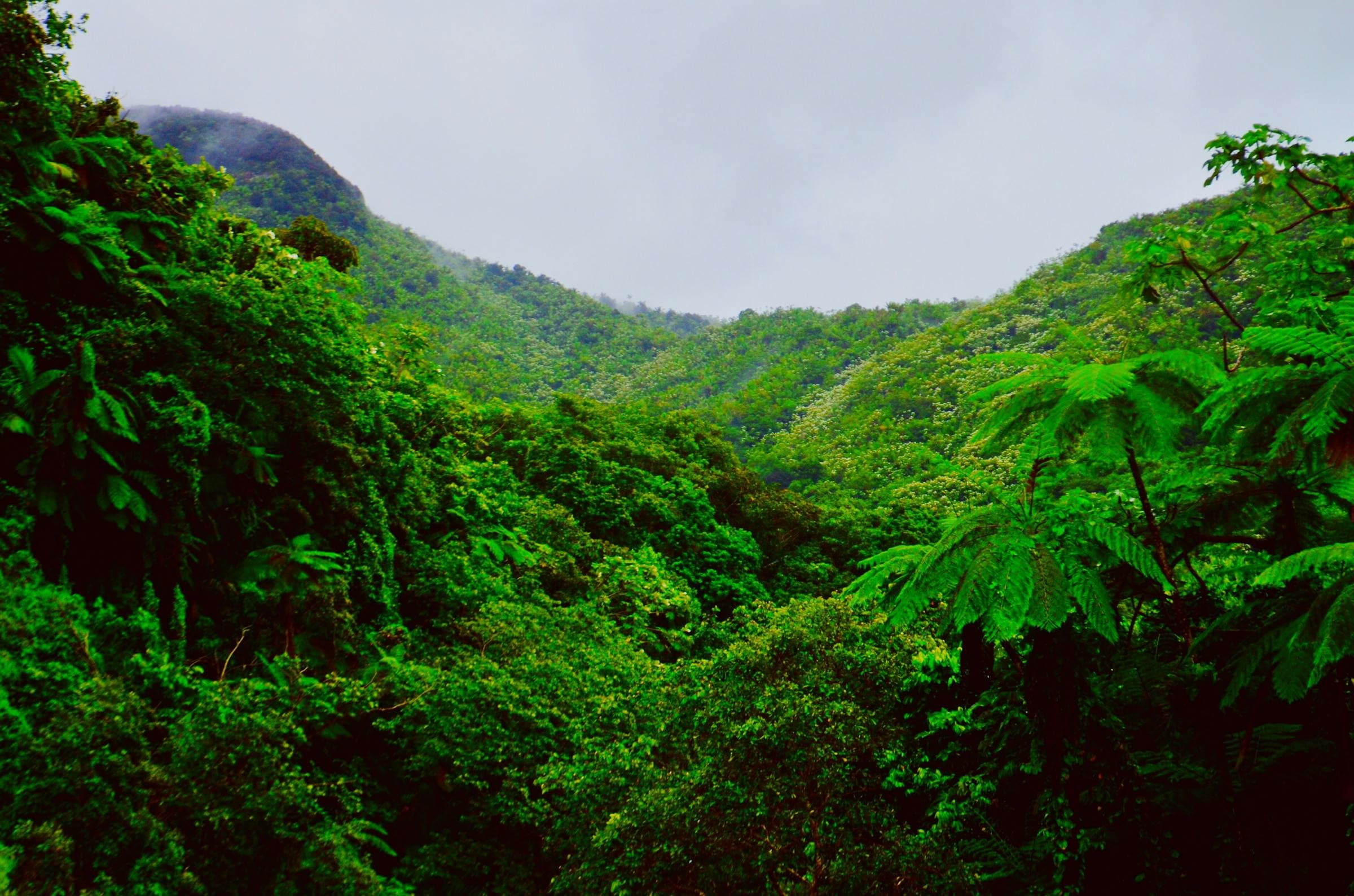
The Gévaudan was, in 1764, one of the most isolated regions in the kingdom. It corresponds today to the department of Lozère and a slice of Haute-Loire, a country of granite ridges, deep forest, and high open grazing land in the Margeride Mountains. People here lived close to the bone. Children and young women spent their days alone on the slopes, minding sheep and cattle, often miles from the nearest house. They were poor, exposed, and almost always unarmed.
This matters, because the Gévaudan already knew wolves. Wolves were a fact of life across rural France in the eighteenth century, and the people of these mountains had been losing the occasional sheep, and very rarely a person, to them for generations. They knew what a wolf was and what a wolf did. That is exactly why what began in 1764 frightened them so badly. The thing in the hills was not behaving like any wolf they recognized, and they said so from the very start.
The First Victims and the Pattern of Attack
After Jeanne Boulet, the killings came in a steady, sickening rhythm. The victims were overwhelmingly the people least able to fight back: children, teenage girls, the occasional grown woman, herders working alone in open country. The animal did not raid barns or kill livestock the way a hungry wolf does. It seemed to hunt people specifically, and it went for the head and neck.
That detail recurs in account after account. The Beast killed by tearing at the throat and the face, and a number of victims were found decapitated or with the head badly mutilated. Some bodies were partly eaten; others were left almost untouched, as if the killing itself had been the point. The historian Jean-Marc Moriceau, who has spent decades cataloguing wolf attacks in French archives, has assembled one of the fullest tallies of the episode, and the numbers that emerge from this kind of careful archival work are grim: somewhere in the range of a hundred people killed, with dozens more attacked and wounded, across roughly three years. Other counts run lower, in the sixty-to-one-hundred range. The exact figure is contested, because parish records from a remote eighteenth-century province are incomplete. What is not contested is that a great many people died.
What the Witnesses Actually Described
Here is where a simple story stops being simple. If the Gévaudan had been plagued by ordinary wolves, the survivors would have said so. They did not.
Witnesses consistently described an animal larger than a wolf, closer in bulk to a calf or a small cow. They spoke of a wide chest, powerful haunches, and a tail so long and thick that some compared it to a panther's. The coat was reddish or tawny, often with a dark stripe down the back and darker markings on the flanks. The head was massive and elongated, the mouth full of large teeth. Several accounts describe the creature rearing up, or moving with strange bounding leaps, or sitting back on its haunches like a dog before it sprang.
Could fear and rumor have inflated these descriptions? Of course. Terrified people exaggerate, and stories grow in the telling. But the descriptions came from many different witnesses, in many different places, who had no way to coordinate their accounts, and they kept landing on the same handful of anomalous details: too big, wrong color, that stripe, that tail. The people of the Gévaudan knew wolves intimately, and they kept insisting this was something else.
The King Takes Notice
By the autumn of 1764 the attacks could no longer be treated as a local misfortune. A captain of dragoons named Jean-Baptiste Duhamel, stationed in the region, organized large-scale hunts, mustering hundreds of men and local volunteers to sweep the forests in great beating lines. They killed wolves. The attacks continued.
The story climbed the social ladder fast. Word reached Versailles, and Louis XV, a king who loved the hunt and could not afford to look powerless against a single animal terrorizing his subjects, decided to involve the crown directly. That decision is part of why we know so much about the Beast. Royal attention generated paperwork, correspondence, rewards, official reports, and a flood of printed images. A regional predator became a national emergency and then a European sensation.
The Wolf-Hunters of Normandy
In February 1765 the king sent professionals. Jean Charles Marc Antoine Vaumesle d'Enneval, a celebrated wolf-hunter from Normandy, arrived with his son Jean-François and a pack of bloodhounds trained specifically to take wolves. The d'Ennevals were confident men. They had killed, by their own reckoning, more than a thousand wolves between them, and they expected to make short work of whatever was loose in the mountains.
They spent months in the Gévaudan and failed. The Beast eluded the dogs, slipped their cordons, and went on killing while the two Normans grew increasingly frustrated and increasingly unpopular. The longer they stayed without a result, the worse it looked for everyone, including the king. By the early summer of 1765, the d'Ennevals were effectively dismissed, replaced by a man with more to lose.
The Gun-Bearer and the Wolf of Chazes
François Antoine, the king's own arquebus-bearer (sometimes recorded under the name Antoine de Beauterne), arrived on June 22, 1765, carrying the authority of the court on his shoulders. He needed a result, and the court needed one too.
On September 20 and 21, 1765, near the Abbey of the Chazes, Antoine and his hunters shot an exceptionally large grey wolf, an animal recorded at around 80 centimeters at the shoulder and roughly 1.7 meters long, far bigger than a typical French wolf of the period. Antoine declared it the Beast. The carcass was prepared, stuffed, and sent in triumph to Versailles, where it was displayed at court. Antoine was rewarded handsomely. The king let it be known that the terror of the Gévaudan was over.
For the court, that was the satisfying ending: a monster, a marksman, a trophy. The wolf of Chazes was genuinely large, and it is entirely possible it had killed people. But the official conclusion ran into one stubborn problem. Within a few months, in the cold of the following winter, people in the Gévaudan started dying again, in exactly the same way.
The Beast That Came Back
This is the contradiction that keeps the case alive, and it is the part that the tidy Versailles version cannot absorb. Antoine had killed his wolf, collected his reward, and gone home. The crown had officially closed the file. And the Beast went on hunting.
Attacks resumed and continued through 1766 and into 1767. Whatever was killing in those later months either was not the wolf of Chazes, or there had always been more than one animal involved. The "two beasts" problem, the strong possibility that the creature Antoine shot was not the creature that killed before and after, is one of the central reasons the Beast of Gévaudan has never been cleanly solved. Either the king's gun-bearer killed the wrong animal, or he killed one of several. Neither answer closes the case.
By now, though, the court had moved on. The renewed killings got far less official attention. The people of the Gévaudan were, in a sense, left to face the thing themselves.
Jean Chastel and the Silver Bullet
The end, when it came, was local. On June 19, 1767, during a large hunt organized by the Marquis d'Apcher on the slopes of Mont Mouchet, a farmer named Jean Chastel shot and killed an animal. After that day, the attacks stopped.
Around this kill grew the most famous legend attached to the whole affair: that Chastel loaded his gun with bullets cast from a blessed silver medal of the Virgin Mary, that he sat reading his prayer book as the Beast approached, and that an ordinary bullet would never have brought it down. It is a wonderful image, and it has fixed itself permanently to the story. It is also, by the best historical reckoning, a later embellishment. The silver-bullet detail appears to have been popularized by the twentieth-century French writer Henri Pourrat, not by the eighteenth-century record. Honesty about the legend does not make the real moment less strange. A local man, on a local hunt, after the King of France had failed, was the one who finally ended it.
There is a further detail repeated in many accounts: that when the animal Chastel killed was cut open, human remains were found inside it. The carcass was supposedly paraded around the region and then sent toward Versailles, but it was high summer, the body decomposed badly on the road, and by the time it reached the court it was too rotten to be of any use. It was reportedly discarded. Whatever the Beast of Gévaudan actually was, no one preserved it for later examination. The single piece of physical evidence that might have settled everything was thrown away.
What Was It? The Theories
Strip away the legend and you are left with a genuine puzzle that has never been resolved to everyone's satisfaction. The leading explanations each account for part of the story and stumble on the rest.
An unusually large wolf, or a pack of them. This is the conventional position, and it has real weight. France had wolves, wolves did occasionally kill people, and the wolf of Chazes was undeniably big. But it struggles with the descriptions, the reddish coat and dark stripe and oversized build that witnesses kept reporting, and with the sheer persistence and apparent boldness of the attacks, which outran what local people, no strangers to wolves, considered normal wolf behavior.
A wolf-dog hybrid. A cross between a wolf and a large mastiff could plausibly grow bigger than a pure wolf, carry unusual coloring, and lose the wariness of humans that keeps wild wolves at a distance. This theory elegantly explains the size and the boldness at once. What it cannot prove is that any such animal existed in the Gévaudan, because none was ever captured and studied.
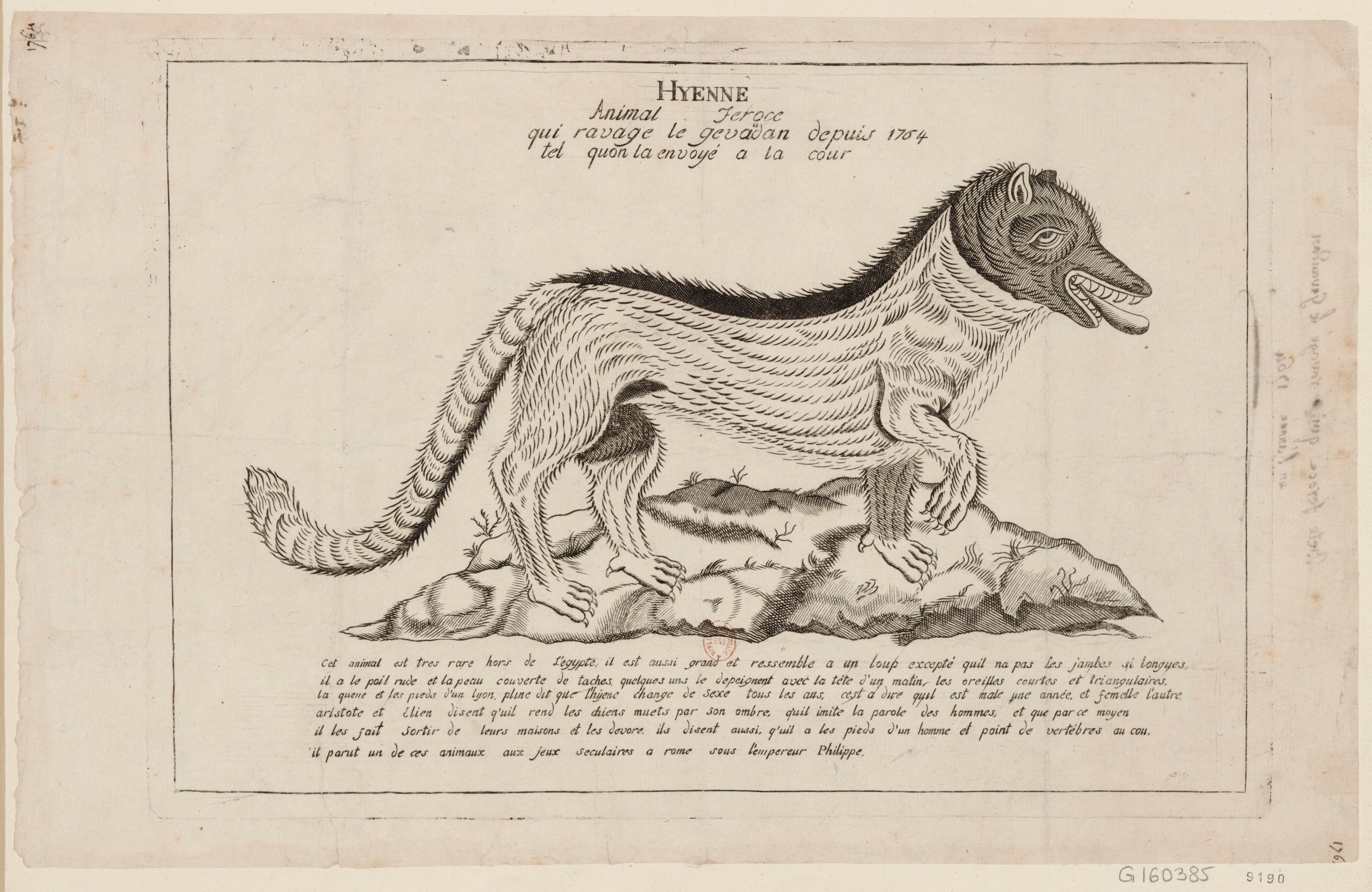
An escaped exotic animal. A striking number of contemporary prints actually labelled the creature a "hyène," a hyena. Some have proposed that a striped hyena, perhaps kept in a private menagerie and escaped or released, could explain the strange profile, the sloping back, and the powerful jaws capable of crushing bone. The trouble is that striped hyenas are not known as habitual man-killers, and getting one into the remote mountains of 1760s France requires its own unlikely chain of events.
More than one animal. Given the three-year span and the wide geography, it is very possible that "the Beast" was never a single creature at all, but a series of dangerous animals whose attacks were stitched together into one monstrous legend by fear, distance, and the printing press.
Each theory explains something. None explains everything. And there is one more idea that refuses to go away, because it addresses the detail the animal theories handle worst of all.
The Man Behind the Monster
The thing that unsettles careful readers of the case is the killing style. The focus on the head and throat, the decapitations, the bodies sometimes stripped of clothing, the apparent selectiveness: these are not the textbook signature of a hungry predator. Some researchers have asked whether a human hand was involved.
The most developed version of this idea belongs to the French writer Michel Louis, who argued that the killings may have been the work of a person using a trained or controlled animal. His suspicion fell on the Chastel family, and in particular on Antoine Chastel, son of the very Jean Chastel who ultimately killed the Beast. Antoine Chastel had reportedly spent time around the Mediterranean and the Barbary coast, was said to have kept animals, and lived a solitary life on Mont Mouchet, the same mountain where the final kill took place. In this telling, the "Beast" was a large, unusual animal, perhaps a hybrid or an exotic creature, conditioned to attack and possibly directed by a human handler. It is the kind of theory that explains the most disturbing details and offers the least proof, and it leans on a haunting coincidence: there are accounts that the attacks slackened during a period in 1765 when Jean Chastel and his sons were briefly imprisoned after clashing with the royal hunters.
It is worth being clear that this remains an interpretation, not a proven fact, and it accuses people who cannot answer for themselves. But it lingers because it grabs hold of the one feature the wolf theories never quite explain: a pattern of killing that, to some who have studied it closely, looks less like hunger and more like intent.
The First Media Monster
There is a way of looking at the Beast of Gévaudan that is too often missed, and it may be the most interesting thing about the whole affair. The Beast was arguably the first monster of the modern media age.
Its years of terror coincided with a boom in cheap print. Engravings of the creature, many of them wildly inaccurate and clearly drawn by artists who had never seen it, were produced in Paris and beyond and sold across the country. Several were sent to court. Newspapers such as the Courrier d'Avignon carried running coverage, feeding a hungry public a serial horror story in installments. People in cities hundreds of miles away who would never set foot in the Gévaudan followed the Beast the way a later age would follow a sensational crime in the headlines.
This is the fresh synthesis that the older retellings tend to skip. The Beast was real, and real people died. But "the Beast," the single named monster with a recognizable face, was also partly a creation of the press and the court, an image assembled from rumor, fear, royal politics, and ink. When the historian Jay M. Smith examined the episode for his book on the subject, this was close to his central point: the events were genuine, yet the monster as we remember it was made, shaped by the anxieties and the appetites of a France standing at the edge of the modern world. That does not explain away the killings. It deepens them. We are left trying to separate the animal in the hills from the legend that grew around it, and after two and a half centuries the two have grown almost impossible to pull apart.
Frequently Asked Questions
Did the Beast of Gévaudan really exist, or is it just a legend?
The killings were entirely real and are documented in parish records, official correspondence, and the reports of the king's hunters. People died, and the crown's response is a matter of historical record. What remains genuinely open is what the Beast was. The events happened; the explanation never settled.
Was it just an ordinary wolf?
That is the conventional answer, and France certainly had wolves capable of killing. But the people of the Gévaudan lived alongside wolves and insisted from the start that this was something different, larger, oddly colored, and behaving in ways they had never seen. The wolf of Chazes that the king's gun-bearer killed was real and unusually big, yet the attacks resumed after it was dead. That single fact is why "ordinary wolf" has never fully satisfied anyone.
Why did the king get so involved?
A monster killing peasants in a far province was, for Louis XV, a test of royal authority. A king who could not protect his own subjects from a single animal looked weak. So the crown sent celebrated hunters and then the king's own arquebus-bearer, and rewarded the man who produced a trophy. The court's hunger for a clean ending is part of why the messy truth was papered over so quickly.
Did Jean Chastel really kill it with a silver bullet?
The silver-bullet story, complete with a blessed medal and a prayer book, is the most famous detail of all, and it appears to be a later literary flourish rather than part of the original record. Chastel does seem to have killed an animal on June 19, 1767, after which the attacks stopped. How he did it, and what exactly he killed, is where history blurs into folklore.
Could it have been a human being?
Some researchers, most notably Michel Louis, have argued that the pattern of the attacks, the focus on heads and throats and the apparent decapitations, points to a human using a trained or controlled animal. The theory is unproven and points fingers at people long dead, but it persists precisely because it addresses the detail the animal explanations handle worst.
Why can't we just test the remains?
Because there are none. The carcass Chastel killed was reportedly paraded around, then sent toward Versailles in high summer, where it rotted on the road and was discarded as useless. The one object that might have answered every question, the body itself, was thrown away. No bones, no preserved hide, no specimen survives for modern analysis.
The Question That Still Runs the Ridgelines
For three years, something hunted people across the mountains of the Gévaudan. It outran a captain of dragoons and his hundreds of beaters, outlasted the most famous wolf-hunters in France, survived the official verdict of the king himself, and was finally brought down by a local farmer on a quiet mountain, after which its body was allowed to rot away to nothing.
We are left with parish records of the dead, the breathless engravings of artists who never saw it, the contradictory testimony of survivors who knew wolves and swore this was not one, and a fistful of theories that each leave something unexplained. Maybe it was an enormous wolf. Maybe a hybrid bred wrong, or an exotic animal a long way from home. Maybe more than one. Maybe, on the darkest reading, a man.
The high pastures of the Margeride are still there, still empty in places, still folding down into the same forests. Whatever came out of those trees in the summer of 1764 to go for a young woman's throat has never been named with certainty. The question it left behind has been waiting in those mountains for over two hundred and fifty years, and it is still waiting now.
Further Reading
Want to explore more mysteries?
We've got plenty more rabbit holes to go down.