The Tully Monster: Why Can't Science Classify This Fossil?
For sixty years, a soft-bodied fossil from an ancient Illinois sea has defied every attempt to place it on the tree of life. Each time science solves it, it slips away.
In 1955, an amateur fossil hunter named Francis Tully was walking the spoil heaps of a strip mine in northern Illinois, cracking open the gray stone nodules that litter that ground, when one of them fell apart in his hands and showed him something that should not have been there. Inside the rock was the impression of an animal, and it was like nothing in any book he owned. It had a long, narrow body. It had a snout that stretched out in front of it and ended in a toothed clamp, as if a slug had been fitted with a grabbing jaw on a stalk. And across the widest part of its body ran a stiff bar, and on each end of that bar sat an eye, so that the creature looked out at the world not from its head but from a crossbeam slung over its back.
Tully took it to the experts at the Field Museum of Natural History in Chicago, certain they would tell him what it was. They could not. Seventy years later, they still cannot. The animal he found has been studied, scanned, argued over, declared solved, and unsolved again, and today the people who know it best are no closer to agreeing on the single most basic fact about any living thing: which branch of the tree of life it belongs to.
This article contains affiliate links. If you buy through them we may earn a small commission at no extra cost to you.
What You'll Learn
- •A Monster Split From a Stone
- •The Beds That Preserve the Impossible
- •Naming a Creature With No Relatives
- •A Body Assembled From the Wrong Parts
- •The Year the Monster Was Solved
- •The Pushback
- •A Clue Written in Chemistry
- •The Monster Slips the Net Again
- •Why One Fossil Will Not Hold Still
- •Frequently Asked Questions
- •Further Reading
A Monster Split From a Stone
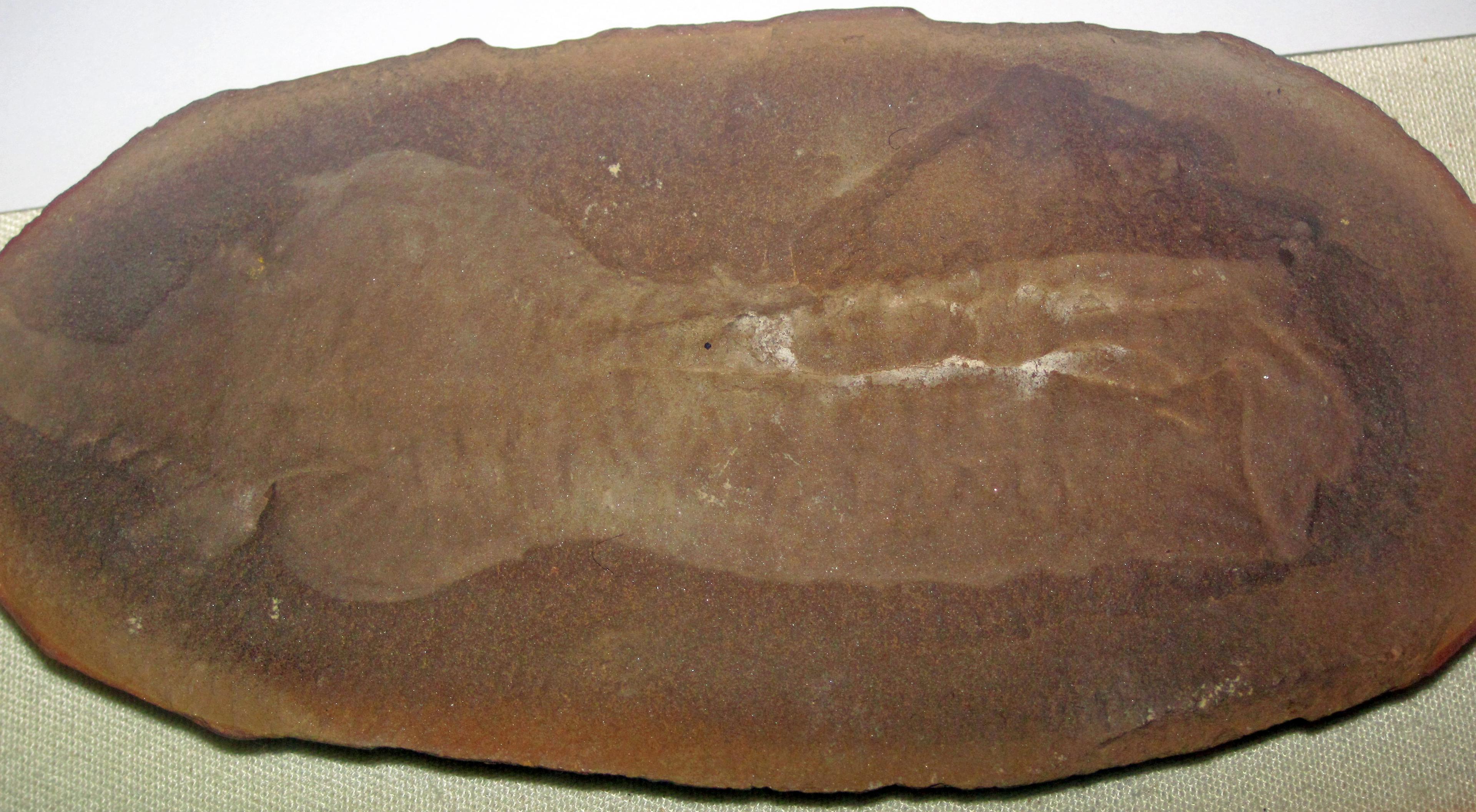
The place Francis Tully was collecting is now famous among fossil hunters by a single name: Mazon Creek. It is a stretch of old coal country southwest of Chicago, and what makes it extraordinary is not the coal but the ironstone nodules that come up with it. Each nodule is a lump of reddish-brown rock about the size of a fist, and when you split one along its seam, it opens like a book. Most are empty. A lucky few hold the ghost of something that was alive roughly three hundred million years ago, printed into the stone in pale relief.
Tully kept finding the same strange animal in those nodules, and he was not the only one. Before long collectors across the region were turning up specimens of it, which is part of why it earned the affectionate nickname it still carries. The thing was not rare. It was common. And yet the people whose entire profession was identifying ancient animals looked at it and came up empty.
That is the first thing that makes the Tully Monster remarkable. It is not a single battered fragment that might be anything. There are thousands of specimens. We have seen it from the top, from the side, large and small, well preserved and poorly preserved, and the more of it we see, the stranger it gets. Abundance usually makes a fossil easier to understand. This one only deepens the puzzle.
The Beds That Preserve the Impossible
To understand why the Tully Monster exists at all, you have to understand what Mazon Creek does to a dead body. Three hundred million years ago this was a warm coastal lowland where rivers met the sea, and when an animal died and sank into the soft mud, something unusual happened fast. Minerals rich in iron gathered around the corpse and hardened into a concretion, sealing the body inside a stone cocoon before it could rot away. The nodule set like plaster around the shape of the animal, soft tissue and all.
This is why Mazon Creek preserves creatures that almost never survive anywhere else: jellyfish, worms, larvae, things with no bones and no shell, the squishy majority of life that the fossil record normally erases. The marine community buried this way even has a name among specialists, the Essex biota, after a nearby town. It is one of the few windows we have into what the soft-bodied ocean of the Carboniferous actually contained.
But that same gift is the root of the problem. A concretion does not preserve an animal the way a block of amber does, in crisp three-dimensional detail. It gives you an impression, a flattened relief where soft structures have been squeezed and chemically altered on their way to becoming stone. The internal features that would normally settle an animal's identity, the ones a scientist reaches for first, are exactly the features most prone to being smeared, collapsed, or left ambiguous. The Tully Monster was preserved well enough to show us it was bizarre. It was not preserved well enough to tell us what the bizarreness means.
Naming a Creature With No Relatives
In 1966, a Field Museum curator named Eugene S. Richardson Jr. finally gave the animal a formal scientific description in the journal Science. He called it Tullimonstrum gregarium. The first word honors Francis Tully. The second means common, or abundant, a nod to how many of them kept turning up. Put together, the name translates to something close to Tully's common monster, and the word monster was not a joke. In zoology a creature that cannot be fitted into any known group is sometimes labeled a problematicum, a problem animal, and that is precisely what Richardson had on his hands.
When a scientist describes a new species, the next move is almost automatic: slot it into the family tree. Is it a mollusk, a worm, an arthropod, a chordate? Richardson could not do it. The Tully Monster had features that pointed in several directions at once and matched nothing cleanly. Over the following decades, researchers proposed that it was a kind of worm, a swimming sea slug, a relative of the arthropods, even a distant cousin of the conodonts. Each idea captured something about the animal. None of them captured all of it. The creature kept one foot outside every box anyone built for it.
For an abundant, well-known fossil to resist classification for that long is unusual. For it to be the official state fossil of Illinois, which Tullimonstrum became in 1989, while still having no agreed place in the animal kingdom, is almost absurd. A state adopted a mascot that science could not identify.
A Body Assembled From the Wrong Parts
Spend time with a good specimen and you begin to see why the arguments never end. The Tully Monster was small, with the largest known individuals reaching about fourteen inches and many far shorter. The body was soft, roughly cigar-shaped, and marked by faint cross-lines that look for all the world like segments, the repeated rings you see in a worm or an insect larva. At the back end it carried a tail fin.
Then there is the front. Instead of a face, the animal extended a long, flexible snout, often described as a proboscis, that reached out well ahead of the body. At the very tip of that snout was a narrow jaw lined with small teeth, as many as eight tiny points on each side, closing like a pair of pincers at the end of a reach. Nothing about that arrangement resembles the mouth of a familiar fish or a familiar worm.
And then there are the eyes. They did not sit in a head. They rode on the ends of a rigid rod that crossed the body from side to side, a transverse bar with an eye bulging at each tip, held out away from the animal like the eyes of a hammerhead shark taken to an extreme no living creature matches. A body that looks like a worm, a mouth on a stalk that looks like nothing, and eyes on a crossbeam. Every part of the Tully Monster seems borrowed from a different animal, and the assembly belongs to no animal we have ever met.
The Year the Monster Was Solved
For fifty years the question sat open. Then, in 2016, it seemed to close. Two separate teams published in the same issue of the journal Nature, and both reached the same startling conclusion: the Tully Monster was a vertebrate. It was, in other words, one of us in the broadest sense, a member of the lineage that includes fish and, eventually, every animal with a backbone.
The first paper, led by Victoria McCoy, carried the blunt title "The 'Tully monster' is a vertebrate." Drawing on a large collection of specimens, the team argued that the pale line running down the animal's length was not a gut or a worm's innards but a notochord, the stiffening rod that is the signature of the chordate body plan and the evolutionary forerunner of the spine. They described features they read as gill structures and teeth built on a vertebrate pattern, and they placed Tullimonstrum on the branch leading toward lampreys, the jawless, eel-like fish that are among the most ancient vertebrates alive.
The second paper, led by Thomas Clements, went after the eyes. Looking closely at those strange organs on the bar, the researchers reported that they contained melanosomes, microscopic pigment granules, arranged in layers like the light-sensitive tissue of a vertebrate eye, complete with evidence of a cup shape and a lens. The headlines wrote themselves. After six decades, the monster had a home. The newspapers announced that the mystery of the Tully Monster was finally solved, and for a little while, it looked true.
The Pushback
Science rarely lets a solution stand unchallenged, and this one did not survive long. In 2017, a group led by Lauren Sallan published a reply in the journal Palaeontology with a title that answered the earlier one head on: "The 'Tully Monster' is not a vertebrate."
Their argument turned the 2016 case inside out. If the Tully Monster were really a vertebrate, they said, then Mazon Creek should preserve it the way it preserves actual fishes, and actual fishes from these beds look different. The team pointed out that among the many hundreds of specimens examined, the animal lacked features you would expect to find in an aquatic vertebrate, structures tied to the ear and to the sensory lines that run along a fish's body. The pigment granules in the eyes were not proof either, they argued, because melanosomes are not unique to vertebrates. Many invertebrates carry them too. What one team had read as the inner architecture of a backbone, the other read as the misread anatomy of something else entirely, or as features that merely resemble a vertebrate's by coincidence rather than kinship.
This is the quiet heart of the Tully Monster problem. The fossils do not come with labels. Every structure in them is an interpretation, a judgment call made on a flattened, mineral-replaced impression hundreds of millions of years old. A smear in the stone can be a notochord to one careful scientist and a gut to another, and both can be reasoning in good faith from the same rock. The animal had slipped out of the vertebrate box almost as quickly as it had been placed in it.
A Clue Written in Chemistry
The vertebrate camp did not concede. In 2020, McCoy and colleagues came back with a different kind of evidence, published in the journal Geobiology. Rather than argue over the shape of a smudge, they turned to chemistry, using a technique called Raman spectroscopy to probe what the preserved tissues were actually made of at the molecular level.
Their reasoning was elegant. If the Tully Monster were an invertebrate like an arthropod or a certain kind of worm, parts of its body would have been built from chitin, the tough material of insect shells and crab armor. If it were a chordate, the chemical fingerprint should instead point to the proteins of soft vertebrate tissue. The team reported that the signatures they found matched the chordate option, not the chitinous one. It was a clever end run around the endless dispute over anatomy, and it tilted the scales back toward a backbone.
For a few years the question hung in that uneasy balance. One team saw a jawless fish. Another saw an impostor wearing a fish's features. The chemistry leaned one way, the anatomy the other, and the single most-studied mystery animal in American paleontology still had no settled address. The reader who went looking for a final answer in 2021 found, instead, two respected groups of scientists politely insisting the other had it wrong.
The Monster Slips the Net Again
Then came 2023, and the pendulum swung once more. A team led by Tomoyuki Mikami, working in Japan, took a fundamentally different approach to the whole problem. Instead of reinterpreting the same flattened impressions, they tried to recover what had been lost in the flattening. Using a three-dimensional scanner, they mapped the fine surface shape of more than one hundred and fifty Tully Monster specimens, pulling faint contours out of the stone that the naked eye tends to miss.
What they found, published again in Palaeontology, undercut the vertebrate case in a new way. The segmentation, those repeated cross-markings along the body, did not stop at the trunk. It appeared to continue up into the head itself. And that is a problem, because no vertebrate is built that way. In animals with backbones, the head and the segmented body are organized on different plans. A creature whose segmentation runs straight through its head, the researchers argued, is telling you it is not a vertebrate at all.
Mikami's team did not then hand the monster to some other tidy group. They left it adrift, suggesting only that it was more likely a non-vertebrate, perhaps a chordate that never developed a backbone, perhaps something from the vast invertebrate half of the animal kingdom, without naming which. After the confident headlines of 2016, this was a return to honest bewilderment. The Tully Monster had been caught, examined, and released back into mystery.
Why One Fossil Will Not Hold Still
Step back from the back and forth, and a deeper question comes into focus. Why should one animal be this hard? We can read the clockwork of a two-thousand-year-old Greek analog computer. We can map the trajectory of an interstellar visitor. But we cannot say whether a common fossil is a fish or a worm.
Part of the answer is the preservation, which gives us the animal's silhouette but blurs its insides. Part of it is that the Tully Monster is marooned in time and space. It is known from Mazon Creek and essentially nowhere else, a single locality and a single narrow slice of the Carboniferous, with no obvious ancestors before it and no clear descendants after. Most fossils can be understood by comparison, by lining them up against relatives above and below them on the tree. This one has no relatives to line up against. It is a sentence written in a language with no other surviving words.
And part of it is that life has tried more shapes than our textbooks contain. The ancient oceans ran experiments in anatomy that left no heirs, body plans that worked for a while and then vanished so completely that when one washes up in the present we have no category ready for it. The Tully Monster may be exactly that: a design that was once common in a warm Illinois sea, printed by the thousands into stone, and belonging to a chapter of the animal story that closed before anyone was around to name its branches. Like the sounds we still cannot source in the deep ocean, it is a reminder that the catalog of life is far from complete, even the part we can hold in our hands.
Frequently Asked Questions
What exactly is the Tully Monster?
That is the entire mystery. It is a soft-bodied marine animal, roughly three hundred million years old, with a long toothed snout, a segmented body, and eyes mounted on a bar across its back. Beyond that description, no one can tell you with confidence whether it was a vertebrate, an invertebrate chordate, or something else, and the leading experts have publicly reversed course more than once.
Didn't scientists prove it was a fish back in 2016?
Two teams argued that year that it was a jawless fish related to lampreys, and the news treated the case as closed. But a 2017 study disputed the evidence, a 2020 chemical study defended the fish idea, and a 2023 three-dimensional scanning study concluded it was probably not a vertebrate at all. Each answer has been genuine, careful science. None has been the last word.
Why is it so hard to classify when there are so many fossils?
Normally more specimens make an animal easier to understand. Here, the Mazon Creek nodules preserve only a flattened impression, so the internal features that would settle its identity are squeezed and chemically altered. On top of that, the Tully Monster is found almost nowhere outside this one site, so there are no close relatives to compare it against. Abundant evidence, no context.
Where can I see one?
Mazon Creek fossils, including Tullimonstrum, are held by institutions such as the Field Museum in Chicago, and specimens still turn up in the hands of hobbyist collectors working the old mine ground in northern Illinois. It remains the official state fossil of Illinois, a creature a whole state adopted before anyone could say what it was.
Will we ever know what it was?
New tools keep arriving, from pigment chemistry to high-resolution scanning, and each one adds something. But the Tully Monster has a habit of answering one question by opening another. Every time researchers announce they have placed it on the tree of life, a later study finds the branch will not hold its weight. For now, it stays exactly where Francis Tully left it: out ahead of us, looking back from those eyes on a bar, unidentified.
Further Reading
- •Richardson's Guide to the Fossil Fauna of Mazon Creek, edited by Charles W. Shabica and Andrew A. Hay. The standard reference to the beds that produced the Tully Monster, named for the curator who first described it. Find it on Amazon.
- •Wonderful Life: The Burgess Shale and the Nature of History by Stephen Jay Gould. The classic account of fossil animals so strange they broke the tree of life, and why that matters. Find it on Amazon.
- •The Crucible of Creation: The Burgess Shale and the Rise of Animals by Simon Conway Morris. A leading paleontologist on the problem of fitting bizarre ancient creatures into the modern animal kingdom. Find it on Amazon.
The Tully Monster has been found by the thousands, named for more than half a century, and adopted by a state. And still, when you crack open one of those gray nodules and the animal looks back at you from the ends of its strange bar, the oldest question in the world is the one no one can answer: what are you?
Want to explore more mysteries?
We've got plenty more rabbit holes to go down.