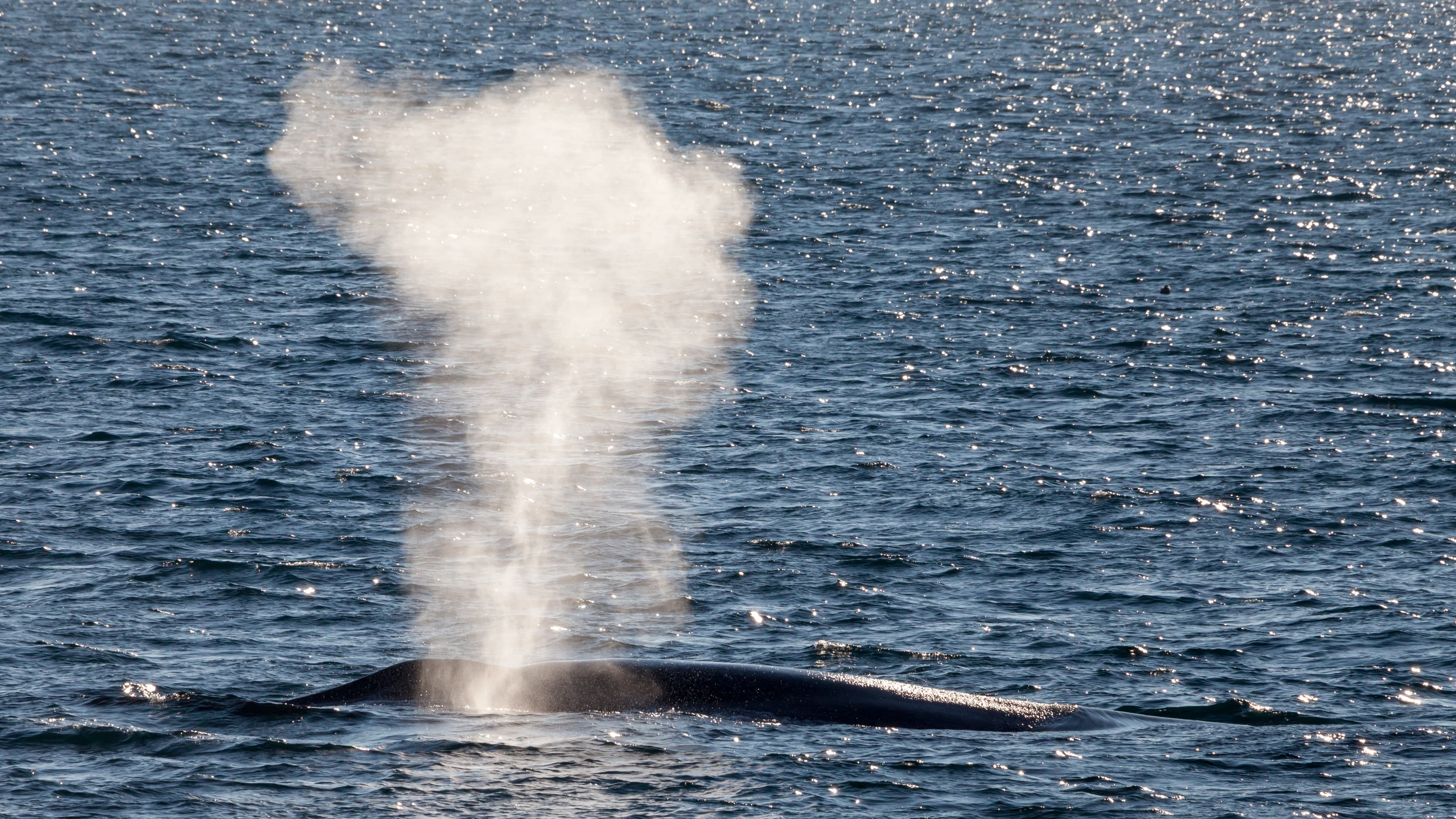
The 52-Hertz Whale: Is the Loneliest Voice in the Sea Alone?
A single whale has sung at the wrong frequency in the North Pacific for decades. Scientists tracked it for twelve years and still cannot say what it is.
Somewhere in the North Pacific, for more than three decades, an animal has been singing in the wrong key. Every year it returns to the same cold waters between the Aleutian Islands and the coast of California, and every year it calls out across the dark in a voice pitched at roughly 52 hertz. That number is the whole mystery. Blue whales call at 10 to 39 hertz. Fin whales sit around 20. Those are sounds so deep that a human standing beside a loudspeaker would feel them in the chest before the ear ever caught them. But 52 hertz is different. It is high enough that you could actually hear it, a low groaning hum near the bottom notes of a tuba, and it belongs to no known whale on Earth.
Because it sings at a frequency no other great whale uses, the animal has been called the loneliest whale in the world. The idea took hold that it drifts through the ocean broadcasting into a silence that never answers, its song too high for any of its own kind to recognize. It has inspired songs, novels, a feature documentary, and an outpouring of letters from strangers who saw something of themselves in a creature calling out to no one. And yet the science underneath the legend is stranger and less settled than the sadness we hung on it. The people who have listened longest are not even sure the whale is alone.
This article contains affiliate links. If you buy through them we may earn a small commission at no extra cost to you.
What You'll Learn
- •A Voice at the Wrong Frequency
- •How the Navy Accidentally Found It
- •Twelve Years of Following a Single Voice
- •The Migration That Fits No Species
- •What Could Possibly Sing at 52 Hertz?
- •The Loneliest Whale That Maybe Isn't
- •The Search for 52
- •Why This One Whale Got Under Our Skin
- •How Much of the Ocean Do We Actually Hear?
- •Frequently Asked Questions
- •Further Reading
A Voice at the Wrong Frequency
To understand why one number has haunted marine biologists for so long, it helps to know how ordinary whale song works. The great baleen whales, the blue and the fin, are among the loudest animals that have ever lived, and their calls are built for distance. Sound carries astonishingly well in seawater, and low frequencies carry the farthest, so these whales evolved voices tuned to the very bottom of the audible range and below it. A blue whale's long moan sits around 10 to 39 hertz. A fin whale pulses at roughly 20. Both are close to infrasound, the region beneath human hearing, which is part of why a person on a boat can float directly above a singing blue whale and hear nothing at all.
The 52-hertz call breaks that pattern in a way that is hard to overstate. It is more than double the pitch of a fin whale and comfortably above the top of a blue whale's range. It has the rhythm and structure of baleen whale song, the same seasonal pattern of a great whale moving through northern waters, but the frequency is simply wrong for every species we have ever cataloged. It is as though a choir of basses had one member singing a full octave higher than the score allowed, hitting every entrance on time, matching every phrase, yet landing on a note none of the others were built to produce.
That single discrepancy is what turned a stray recording into a decades-long question. The call is unmistakably a whale. It is just a whale that, by the numbers, should not exist.
How the Navy Accidentally Found It
The 52-hertz whale was never discovered by whale researchers out on the water. It was found inside a Cold War machine designed to hunt submarines.
Beginning in the 1950s, the United States Navy laid a vast web of underwater microphones across the floor of the world's oceans, a classified network called the Sound Surveillance System, or SOSUS. Its purpose was to catch the low-frequency churn of Soviet submarine propellers from thousands of miles away. To do that well, it had to be exquisitely sensitive to exactly the deep frequencies that great whales also use. For decades the system listened to the sea in secret, and the ocean it heard was full of biology no one outside the Navy could study.
When the Cold War wound down, that changed. In 1992 the Navy partially declassified SOSUS recordings and specifications and opened parts of the network to civilian science. Among the researchers who gained access was William A. Watkins of the Woods Hole Oceanographic Institution, a pioneer of recording marine mammal sound. Sifting through the arrays, Watkins and his colleagues kept finding one signal that did not fit anything in the reference libraries: a repeating call at around 52 hertz, coming from a single source, moving through the North Pacific season after season. The declassified hydrophones had been quietly tracking it since the late 1980s, with detections logged in 1989, 1990, and 1991, before civilian scientists were ever allowed to know it was there.
There is something fitting about that origin. The loneliest voice in the ocean was first overheard by a system built to find things that did not want to be found, a machine that spent forty years learning the sound of the deep sea and stumbled onto a creature no one could name.
Twelve Years of Following a Single Voice
The definitive account of the whale is not a legend or a documentary. It is a scientific paper, and it is worth reading past the myth to what it actually says. In 2004, Watkins, along with Mary Ann Daher, Joseph E. George, and David Rodriguez, published "Twelve years of tracking 52-Hz whale calls from a unique source in the North Pacific" in the journal Deep-Sea Research Part I. Watkins died that same year, and the paper reads in places like the summary of a long, patient acquaintance.
Across those twelve years of recordings, from 1992 through 2004, the team followed the calls each season as the source moved through the northern Pacific. Two details from that tracking matter more than any other, and both tend to get lost when the story is retold as a sad fable.
The first is that the pitch changed. When the tracking began the calls centered near 52 hertz, and over the years they deepened slightly, drifting toward 50 hertz by 2004. That gradual lowering is exactly what you would expect from a single whale growing older and larger, the way a boy's voice drops as he matures. It is a small thing, but it carries enormous weight. It suggests the recordings were not catching a rotating cast of odd animals. They were following one individual across more than a decade of its life, hearing it age.
The second is that the calling was regular, seasonal, and solitary in its signature. The 52-hertz signal never appeared as part of a chorus of matching voices. It arrived on its own schedule and traveled its own path, a single acoustic fingerprint threading through waters full of other whales speaking a different language. The paper does not call the animal lonely. Scientists do not use that word. But the data it lays out is what everyone else turned into loneliness.
The Migration That Fits No Species
If the frequency were the only anomaly, the whale might have been filed away as an oddly pitched blue whale and forgotten. What keeps the case genuinely open is that its movements do not resolve into any known species either.
The tracking showed a source ranging widely through the eastern and central North Pacific, from the Aleutian and Kodiak Islands in the north down toward the California coast, returning year after year. In the broad shape of where it went, its wanderings resembled a blue whale. But in the timing of when it went there, its seasonal rhythm looked more like a fin whale. The animal seemed to borrow the geography of one species and the calendar of another, while sounding like neither. Its track, the researchers noted, was unrelated to the presence or movement of other whales. It was not following the herds. It was going its own way.
This is the part conventional explanations struggle with. It is easy enough to imagine a single blue whale born with an unusual voice. It is much harder to explain an animal whose pitch, whose range, and whose seasonal timing each point toward a different answer, with no single known species accounting for all three at once. Every tidy label you reach for peels away against one of the other facts. That is usually the signature of a real mystery rather than a mislabeled one.
What Could Possibly Sing at 52 Hertz?
Over the years, a handful of explanations have been offered for what the 52-hertz whale might be. Each is reasonable. None of them closes the case.
The most common suggestion is that it is a hybrid, the offspring of a blue whale and a fin whale. Such crossbreeds are known to exist, and a mixed heritage could plausibly produce an unusual anatomy and an unusual voice, which would fit an animal that behaves a bit like each parent species. It is the neatest theory available. But no one has ever seen the animal, so no one has confirmed a hybrid, and a hybrid origin does not by itself explain the specific and stable frequency the whale has held for decades.
A second idea is that the whale is malformed in some way, born with an unusual body or vocal structure that shifts its call upward. A third, raised gently and often, is that the animal might be deaf, singing at a pitch it cannot properly hear and therefore cannot correct. Watkins and his colleagues were contacted repeatedly over the years by deaf people who wondered whether the whale, like them, was moving through the world on the far side of a sound barrier. It is a moving thought. It is also untestable without finding the animal.
And then there is the possibility that lingers longest: that the 52-hertz whale is the last, or nearly the last, of something. That its voice sounds like no other whale because the whales it once answered are simply gone, and it is calling in the dialect of a population that no longer exists to reply. There is no proof of this. There is also, the way the honest researchers put it, no way yet to rule it out.
The Loneliest Whale That Maybe Isn't
Here is the twist the popular story almost never includes, and it may be the most important detail in the entire case.
The whole legend rests on the assumption that there is exactly one 52-hertz whale, a single animal calling into an empty ocean. But the scientists who kept listening after Watkins are not sure that is true. Recordings of what appears to be a second 52-hertz caller, heard at a different location at the same time as the first, have surfaced on and off since around 2010. Two voices detected in two places at one moment cannot be one animal. John Hildebrand of the Scripps Institution of Oceanography, whose lab has continued monitoring whale acoustics in the Pacific, has pointed out that this means more than one animal could be producing the call.
Sit with what that does to the myth. If there are two, or a few, then the loneliest whale in the world was perhaps never alone in the way we imagined. It might belong to a tiny, scattered group of animals that all sing high, a handful of odd voices spread so thinly across the vastness of the Pacific that they rarely, if ever, cross paths. That is a different kind of sadness, and a different kind of mystery. It stops being a story about one broken individual and becomes a question about a hidden population: how many are there, where did they come from, and why do they all sing at a frequency that belongs to no species we have named?
The data that made the whale famous and the data that complicates it come from the same place, the patient listening of scientists who never once used the word lonely. We supplied that part ourselves.
The Search for 52
Given how deeply the story lodged in people, it was probably inevitable that someone would try to go find the animal. In 2021, the filmmaker Joshua Zeman released a feature documentary called The Loneliest Whale: The Search for 52, distributed by Bleecker Street, with the actors Leonardo DiCaprio and Adrian Grenier among its executive producers. The film chronicles an expedition into the North Pacific mounted for the express purpose of recording the 52-hertz whale directly, tracking it in real time, and, if the sea allowed, laying eyes on it at last.
They brought modern hydrophone arrays, drifting sensor buoys, spotter effort, and a team of marine acousticians. They found whales. They recorded calls. They gathered a season of data on the animals moving through those waters. What they did not do, in the end, was pin the 52-hertz whale in front of a camera and settle the question of what it is. The voice that a Cold War listening network caught by accident slipped through a deliberate, well-funded search decades later.
There is a lesson buried in that failure. It is one thing to hear a sound arriving from hundreds of miles away across a medium that carries low frequencies almost forever. It is another to sail to the animal making it, in an ocean where a hundred-foot creature can stay under, stay quiet, and simply not surface where you happen to be looking. The whale had been heard for more than thirty years and seen for none of them, and the search did not change that.
Why This One Whale Got Under Our Skin
It is worth asking why this particular mystery, out of all the unexplained sounds in the sea, became the one people cried over. The ocean is full of calls science cannot fully identify. A rising groan from an empty stretch of the South Pacific once earned the nickname the Bloop and set imaginations running for years. Those cases fascinate. This one wounds.
The difference is the story we could tell about it. A 52-hertz whale calling in a voice no other whale answers is a near-perfect mirror for a very human fear, the fear of speaking and not being heard, of being surrounded and still alone. That is why the legend spread faster than the facts, why the animal ended up in pop songs and novels and message-board confessions, why strangers wrote to Woods Hole to say they understood. We did not fall in love with a data set. We fell in love with a metaphor, and then went looking for the animal to justify it.
None of that makes the whale less real, or the mystery less genuine. But it is worth separating the two. The science gives us a strange, unidentified voice tracked across twelve years, drifting in pitch as it aged, moving on a path that matches no species, possibly not even alone. The loneliness is the part we brought. The whale never said it was lonely. It only ever said 52.
How Much of the Ocean Do We Actually Hear?
The most unsettling thing about the 52-hertz whale is not the whale. It is what its existence implies about everything we are not catching.
This animal was only ever detected because a military system happened to be listening in exactly the frequency range it uses, in exactly the part of the ocean it frequents, over exactly the decades it was calling. Change any of those variables and it vanishes from the record entirely, an animal that would have lived and died without a single human ever knowing it existed. The 52-hertz whale is not evidence of how much we know about the deep. It is evidence of how thin our listening is, and of how much can move through the dark just outside the reach of our microphones.
If a creature the size of a great whale, singing loudly enough to be caught from hundreds of miles away, could go thirty years without being seen and could still hide a possible companion from us, the reasonable conclusion is not that we have the ocean mapped. It is that the sea remains full of voices we have not learned to hear, and full of things that have never once needed our permission to exist. The 52-hertz whale is simply the one that happened to sing where we were listening.
Frequently Asked Questions
Is the 52-hertz whale still alive?
No one knows for certain. The best-documented tracking runs from the late 1980s through 2004, and calls consistent with the animal have been reported since. Great whales can live for many decades, so an individual first heard in 1989 could plausibly still be out there. But because the whale has never been seen, there is no way to confirm whether the same animal is still singing, or whether the voice heard today belongs to it, to a relative, or to a small group we have never counted.
Why does it sing at 52 hertz when other whales don't?
That is the heart of the mystery and it has no confirmed answer. Proposed explanations include that it is a blue and fin whale hybrid, that it is physically malformed, or even that it may be deaf and unable to hear or correct its own pitch. Each idea is plausible and each leaves something unexplained. No one has examined the animal, so every theory remains exactly that.
Is the 52-hertz whale actually alone?
Maybe not. The legend assumes a single animal, but recordings of an apparent second 52-hertz caller, heard in a different location at the same time, have turned up sporadically since around 2010. Two voices in two places at once cannot be one whale. It is possible the animal belongs to a tiny, scattered group of high-pitched callers rather than being the last of its kind, which would make the truth stranger, not simpler.
Can a person actually hear the whale's call?
Yes, and that is part of what makes it unusual. Most great whale calls sit at or below the bottom of human hearing, closer to a felt vibration than a sound. At around 52 hertz, this whale's voice is high enough to register as an audible low hum, near the deepest notes of a tuba or a double bass. In a sense, it is one of the few great whales a human could stand near and actually hear.
Why has no one ever found it despite decades of searching?
The ocean is enormous, deep, and largely dark, and a whale can travel far, dive deep, and stay silent. Sound carries for hundreds of miles underwater, so hearing a call tells you very little about exactly where the animal is at any given moment. A well-equipped 2021 documentary expedition set out specifically to find it and came home without a confirmed sighting, which says less about the effort than about how much room a single whale has to remain unseen.
Further Reading
If the 52-hertz whale pulled you in, the richest way to sit with the mystery is to understand how whales actually communicate and how recently we learned to listen at all. These books are excellent starting points.
- •Thousand Mile Song: Whale Music in a Sea of Sound by David Rothenberg. A musician and philosopher's account of whale song and the long human effort to make sense of it. Find it on Amazon
- •Spying on Whales: The Past, Present, and Future of Earth's Most Awesome Creatures by Nick Pyenson. A Smithsonian paleobiologist on how we study whales and how much about them remains unknown. Find it on Amazon
- •The Sounds of Life: How Digital Technology Is Bringing Us Closer to the Worlds of Animals and Plants by Karen Bakker. A recent look at ocean bioacoustics and the hidden acoustic world the 52-hertz whale belongs to. Find it on Amazon
For anyone who wants to hear the deep for themselves, a consumer hydrophone turns any quiet stretch of water into something you can listen to, which is exactly how this whole story began.
Somewhere out there, a voice pitched at 52 hertz may still be moving through the North Pacific, aging, calling, following a path that matches no map we have. We heard it by accident and lost it on purpose. The question that lingers is not really whether the whale is lonely. It is how many other voices the ocean is holding just beyond the edge of what we have learned to hear.
Want to explore more mysteries?
We've got plenty more rabbit holes to go down.