Bimini Road: The Underwater Stone Formation That Sparked an Atlantis Debate
Discover the Bimini Road, a mysterious half-mile underwater limestone formation near the Bahamas. Explore the theories, science, and Edgar Cayce connection.
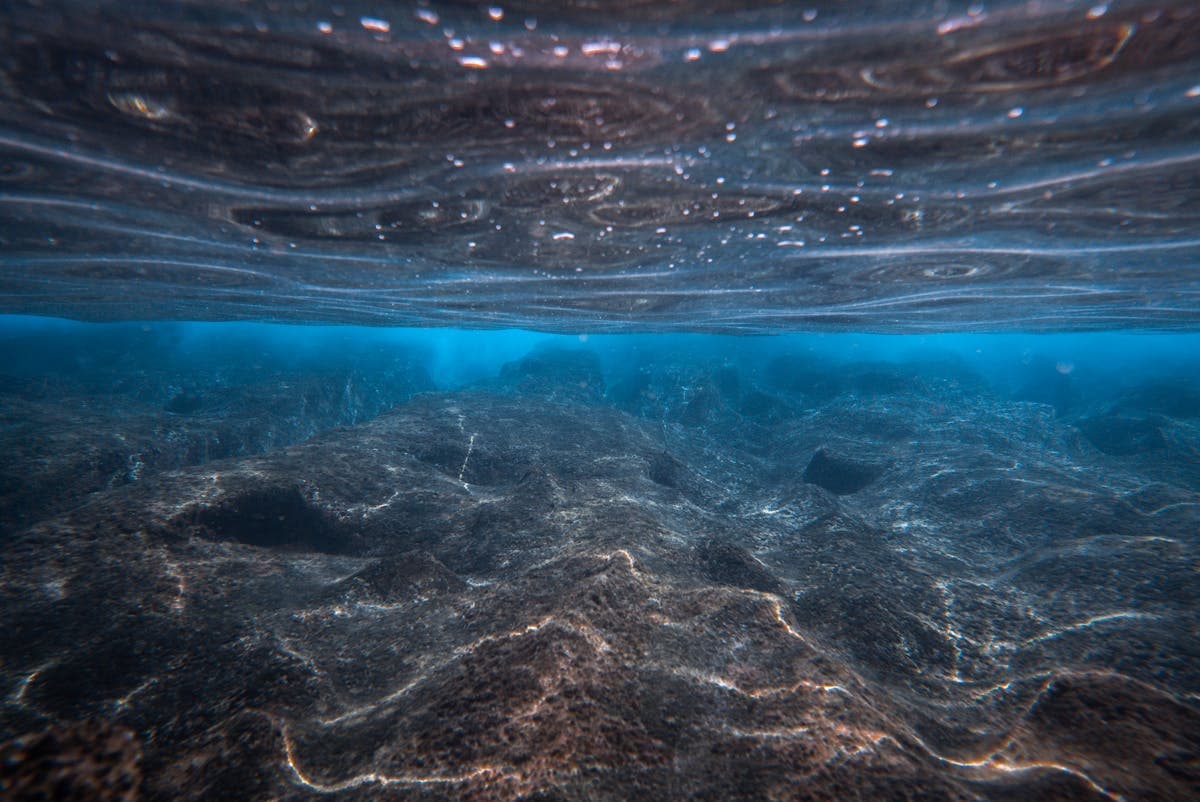
The water off North Bimini is shallow, warm, and impossibly clear. You can see the bottom from the surface. And on September 2, 1968, three divers looked down and saw something that didn't make sense: a half-mile stretch of massive rectangular limestone blocks, arranged in what looked exactly like a paved road, sitting 18 feet below the waves.
The Bimini Road, as it came to be known, has been at the center of one of the most persistent debates in underwater archaeology ever since. Is it a natural geological formation, a product of ordinary beachrock erosion? Or is it something else entirely, a remnant of a lost civilization that once built on land now swallowed by the sea?
What makes this story stranger: a famous American psychic predicted that evidence of Atlantis would surface near Bimini in 1968. The discovery happened that same year.
What You'll Learn
- •How the Bimini Road Was Discovered
- •What Does the Bimini Road Actually Look Like?
- •The Edgar Cayce Connection
- •Is the Bimini Road Natural or Man-Made?
- •The Beachrock Theory Explained
- •Evidence For an Artificial Origin
- •How Old Is the Bimini Road?
- •Could It Really Be Connected to Atlantis?
- •What Other Underwater Structures Exist Near Bimini?
- •Visiting the Bimini Road Today
- •Frequently Asked Questions
How the Bimini Road Was Discovered
On that September day in 1968, Joseph Manson Valentine, an archaeologist and naturalist, was diving with Jacques Mayol (the legendary free diver who'd later inspire the film The Big Blue) and Robert Angove off the northwest coast of North Bimini. They weren't looking for ancient ruins. They were just diving.
What they found was a "pavement" of large, noticeably rounded stones of varying sizes and thicknesses, laid out in a clear northeast-to-southwest linear pattern stretching roughly half a mile (0.8 km). Two smaller parallel features sat closer to shore, running about 160 and 200 feet each.

Valentine described the formation as artificial in nature. His reports drew immediate attention from archaeologists, geologists, and, perhaps most enthusiastically, people who believed in the lost continent of Atlantis.
The timing couldn't have been more dramatic.
The Edgar Cayce Connection
Edgar Cayce, known as the "Sleeping Prophet," was an American mystic who gave thousands of psychic readings between 1901 and 1944. Among his most famous predictions: remnants of Atlantis would be found near Bimini around 1968 or 1969.
Specifically, Cayce spoke of a "temple of the Poseidians" in the Bimini area. He described gold, spar, and iridescent stone at depths of "twelve to fifteen feet below sea level." He predicted that a portion of the lost continent would begin to rise from the ocean floor.
When Valentine's team discovered the Bimini Road in 18 feet of water that same year, Cayce's followers saw direct confirmation. The Association for Research and Enlightenment (ARE), the organization Cayce founded, quickly sent expeditions to investigate.
The timing is hard to ignore. Cayce predicted something would be found near Bimini around 1968-1969. The formation was discovered in 1968. Whether that's prophecy or coincidence depends on where you stand - but the fact remains that the prediction preceded the discovery. Cayce had died in 1945, so he couldn't clarify or elaborate on his readings.
Still, the prophecy gave the Bimini Road a cultural gravity that a simple geological discovery never would've had on its own. It turned a stretch of underwater limestone into a potential gateway to one of humanity's oldest myths.
What Does the Bimini Road Actually Look Like?
The Bimini Road isn't a single neat pathway. It's actually three separate linear features, all running roughly northeast to southwest. The largest, the "road" itself, stretches about half a mile with a pronounced hook at its southwestern end. The two smaller features sit shoreward and run only about 50 to 60 meters.

The blocks composing the formation are mostly flat, tabular, and roughly rectangular or polygonal, though many are irregular. The largest measure 10 to 13 feet across, with most falling in the 7 to 10 foot range. Their corners are heavily rounded, giving them the appearance of "giant loaves of bread," as researchers Gifford and Ball described them in their 1980 study.
Here's what's important: descriptions of the Bimini Road in popular media tend to exaggerate the regularity of the blocks. In person, they're not perfectly cut or symmetrically arranged. They're weathered, rounded, and uneven. That distinction matters when evaluating whether they're natural or artificial.
The blocks sit in about 18 feet of water. Some rest directly on bedrock. Others sit on loose sand. No convincing evidence of a second course (a layer of blocks beneath the visible ones) has been published in any peer-reviewed scientific journal, though some investigators claim to have seen one where sand has washed away between seams.
Is the Bimini Road Natural or Man-Made?
This is the central question, and after more than 50 years of investigation, the scientific community has largely reached a consensus. But "largely" isn't "unanimously," and the debate hasn't fully died.
The geological consensus is that the Bimini Road is a natural formation of beachrock, a common type of coastal rock found throughout the Bahamas and Caribbean. When beachrock fractures along natural joints and gets eroded by tides and biological processes over thousands of years, it can produce regular-looking rectangular blocks.
The alternative view holds that the regularity of the blocks, their linear arrangement, and certain features (like alleged prop stones and what some see as a second course) suggest human construction.
Let's look at both sides.
The Beachrock Theory Explained
Beachrock forms when carbonate-rich groundwater cements loose beach sediment (shells, sand, coral fragments) into solid limestone. This process happens naturally in tropical coastlines worldwide. The Bahamas are full of it.
Studies by E. Davaud and A. Strasser examined Holocene limestones on North Bimini and Joulter Cays and outlined a clear sequence: shallow subtidal, intertidal, and supratidal carbonate sediments accumulate as the shoreline builds seaward. These layers cement into rock, then fracture along natural joint patterns when exposed to wave erosion and tidal forces.
The result? Rectangular-looking slabs separated by straight-line cracks. From above, they look like pavement.

In 1978, geologist Eugene Shinn of the U.S. Geological Survey collected core samples from the Bimini Road. His analysis found that the rock's internal structure, specifically the grain orientation and cementation patterns, was consistent throughout each block. If the blocks had been quarried, transported, and placed by humans, you'd expect the internal grain patterns to be oriented randomly relative to each other. Instead, they matched up, suggesting the blocks had fractured in place from a single, larger formation.
This was, for many geologists, the decisive evidence. Shinn published his findings, and the geological community largely accepted the beachrock explanation.
Evidence For an Artificial Origin
Not everyone was convinced by Shinn's work. Several researchers, including David Zink and Dimitri Rebikoff, conducted their own investigations and pointed to features they believed were inconsistent with natural beachrock.
Alignment and geometry. While individual beachrock formations can crack into rectangular shapes, the half-mile linear arrangement of three parallel features struck some researchers as too orderly for natural processes alone. Beachrock pavements elsewhere in the Bahamas don't typically form such extended, well-defined linear patterns.
Alleged prop stones. Some investigators reported finding smaller stones wedged beneath the larger blocks, as if placed there deliberately to level the surface. However, Gifford and Ball's 1980 study found no evidence of "regular or symmetrical supports beneath any of the blocks."
Complementary edges. The larger blocks show complementary edges, meaning adjacent blocks fit together like puzzle pieces. This could indicate they fractured from a continuous slab (supporting the natural theory) or that they were cut to fit (supporting the artificial theory).
Robert Marx's testimony. Professional diver Robert Marx reported that Carl H. Holm, president of Global Oceanic, stated there was "little doubt" the blocks were cut by people. However, Holm was a ship designer and retired naval officer, not a geologist, and his assessment has been questioned.
The challenge for proponents of an artificial origin: no tool marks, inscriptions, or artifacts have ever been found at the site. Given the degree of erosion the blocks have experienced, supporters argue that any such evidence would've been worn away over millennia. Critics counter that the absence of evidence still weighs against the claim.
How Old Is the Bimini Road?
Dating the Bimini Road has been attempted through multiple methods, and the results have fueled more debate than they've resolved.
Radiocarbon dating of core samples from the blocks yielded ages of roughly 2,000 to 4,000 years for the cemented shell material. However, this dates when the beachrock formed, not necessarily when the blocks were arranged in their current pattern.
Uranium-thorium dating of the marine limestone underlying the Bimini Road produced older ages, suggesting the bedrock beneath the formation is significantly older than the blocks themselves.
Most studies converge on an age range of roughly 3,000 to 5,000 years for the beachrock. This places the formation's origin in a period when sea levels in the Bahamas were lower, meaning the site would've been at or near the shoreline rather than submerged.
That timeline is interesting. It overlaps with early human activity in the Caribbean, though there's no archaeological evidence of a civilization in the Bimini area with the technological capability to construct a half-mile stone roadway during that period.
Could It Really Be Connected to Atlantis?
Plato's account of Atlantis, written around 360 BCE in the dialogues Timaeus and Critias, places the lost civilization beyond the "Pillars of Hercules" (the Strait of Gibraltar) in the Atlantic Ocean. Plato described a powerful island nation that sank "in a single day and night of misfortune" roughly 9,000 years before his time.

The geographic connection to Bimini is loose at best. The Bahamas sit in the western Atlantic, far from where Plato's account would place Atlantis. And most classical scholars consider Plato's story to be an allegory about hubris and divine punishment, not a literal historical account.
That said, the Atlantis theory persists around Bimini for several reasons:
- •Edgar Cayce's prophecy specifically named the Bimini area
- •The timing of the 1968 discovery aligned with Cayce's prediction
- •The visual appearance of the formation genuinely resembles a constructed road
- •New Age spiritual communities adopted Bimini as a pilgrimage site, with some visitors claiming to feel "energy vortexes" near the formation
Geologist Eugene Shinn recalled arriving at the site to find sailboats already gathered, with visitors asking, "Can't you feel the force field?" The Bimini Road became less a scientific question and more a cultural phenomenon.
For what it's worth, no widely accepted evidence links the Bimini Road to Atlantis or any other lost civilization. But the formation's existence, combined with Cayce's eerily timed prediction, ensures the conversation won't end anytime soon.
What Other Underwater Structures Exist Near Bimini?
The Bimini Road isn't the only unusual underwater feature in the area. Several other formations have been reported:
- •The "Bimini Wall" is sometimes used interchangeably with "Bimini Road," but some researchers distinguish between the main linear feature and a shorter, more wall-like formation nearby.
- •Paradise Point features additional limestone formations that some investigators have called "harbor works."
- •Moselle Shoal contains rectangular blocks that some have compared to the Bimini Road, though they've received less attention.
The broader Bahamas region contains numerous underwater formations that look striking but are generally accepted as natural beachrock features. The Caribbean's warm, carbonate-rich waters are ideal for producing these kinds of formations.
For those fascinated by underwater anomalies, the Baltic Sea Anomaly presents a similar puzzle, discovered decades later by sonar. And the Yonaguni Monument off Japan's coast sparks the same natural-vs-artificial debate with its stepped, terraced underwater rock formations. The SS Ourang Medan adds to the ocean's long list of unsolved riddles.
Visiting the Bimini Road Today
The Bimini Road sits in just 18 feet of water off the northwest coast of North Bimini, making it accessible to snorkelers and beginner divers alike. Several dive operators on Bimini offer trips to the site, and the clear Bahamian waters provide excellent visibility.

North Bimini is about 50 miles east of Miami, reachable by a short flight or ferry. The island has a small but growing tourism infrastructure, and the Bimini Road is its most famous attraction after its legendary big-game fishing.
Whether you visit as a skeptic or a believer, seeing the formation in person is genuinely impressive. The blocks are massive, the arrangement is striking, and floating above them in that warm, clear water, it's easy to understand why people have been arguing about this place for nearly 60 years.
Frequently Asked Questions
Is the Bimini Road man-made or natural?
The scientific consensus holds that it's a natural beachrock formation. Core samples show consistent internal grain patterns, suggesting the blocks fractured in place from a larger slab rather than being quarried and transported. However, some researchers continue to argue that its linear arrangement and geometric regularity suggest human construction.
Who discovered the Bimini Road?
Joseph Manson Valentine, Jacques Mayol, and Robert Angove discovered the formation on September 2, 1968, while diving in 18 feet of water off the northwest coast of North Bimini in the Bahamas.
Did Edgar Cayce predict the discovery of the Bimini Road?
Cayce predicted that evidence of Atlantis would surface near Bimini around 1968 or 1969. The Bimini Road was discovered in September 1968. Whether this constitutes a fulfilled prophecy depends on your perspective. Others have noted that Cayce's readings were vague enough to be applied to various discoveries after the fact.
How old is the Bimini Road?
Radiocarbon dating of the beachrock places it at roughly 3,000 to 5,000 years old. This dates when the limestone cemented, not necessarily when the blocks assumed their current arrangement. The underlying bedrock is significantly older.
Can you visit the Bimini Road?
Yes. It's located in shallow water (about 18 feet deep) off North Bimini and is accessible to both snorkelers and divers. Multiple dive operators on the island offer guided trips to the site. North Bimini is about 50 miles east of Miami, reachable by flight or ferry.
The Bimini Road sits at the intersection of geology, archaeology, mysticism, and one very well-timed prophecy. The science points strongly toward a natural origin. But science doesn't always get the last word in the public imagination, especially when a formation this striking sits in water this clear, just 18 feet from the surface, looking for all the world like someone built a road and the ocean swallowed it.
Maybe the most honest thing we can say is this: we understand how beachrock forms and fractures. We understand the geology. But understanding something and fully explaining it aren't always the same thing. The Bimini Road doesn't need to be Atlantis to be genuinely mysterious, and genuinely worth seeing for yourself.
For more ocean mysteries, explore the Bermuda Triangle, which sits just a few hundred miles to the east, or the Mary Celeste, one of history's greatest maritime enigmas.
Further Reading
This article contains affiliate links. If you buy through them we may earn a small commission at no extra cost to you.
Want to explore more mysteries?
We've got plenty more rabbit holes to go down.