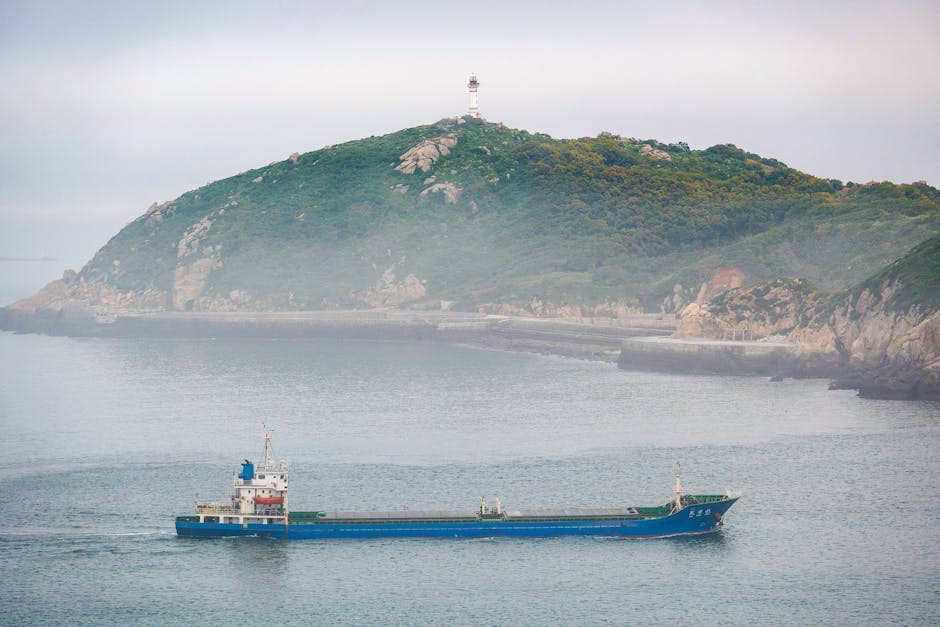
The SS Ourang Medan: The Ghost Ship That May Never Have Existed
A distress call. A crew found dead with faces frozen in terror. A ship that exploded and sank before anyone could investigate. The story of the SS Ourang Medan is one of the sea's most chilling mysteries, but did any of it actually happen?
The distress call came through in Morse code, picked up by ships and listening stations across the Strait of Malacca: "S.O.S. from Ourang Medan. We float. All officers including the captain, dead in chartroom and on the bridge. Probably whole of crew dead." A pause, a few incoherent dots and dashes, and then two final words: "I die."
When rescuers boarded the drifting Dutch freighter, they found exactly what the message described. The entire crew was dead, their bodies sprawled on their backs across the decks, in the chartroom, on the bridge. Their eyes were open, their mouths gaping, their faces frozen in expressions of apparent terror. Even the ship's dog was dead, teeth bared in a snarl at something no one could see. There were no visible injuries. No signs of violence. No explanation.
As the rescue crew prepared to tow the Ourang Medan to port, a fire erupted from the hold. The boarding party barely escaped before the ship exploded and sank, taking every body and every clue to the bottom of the sea.
It's one of the most terrifying maritime stories ever told. There's just one problem: it might not be true.
What You'll Learn
- •What Is the Story of the SS Ourang Medan?
- •Did the Ship Actually Exist?
- •Where Did the Story Come From?
- •What Are the Proposed Explanations?
- •The Chemical Cargo Theory
- •The Carbon Monoxide Theory
- •Is the Ourang Medan an Urban Legend?
- •Frequently Asked Questions
What Is the Story of the SS Ourang Medan?
The standard version of the story, as it's most commonly told, goes like this:
In June 1947 (or February 1948, depending on the source), two American vessels navigating the Strait of Malacca, the City of Baltimore and the Silver Star, picked up a series of distress messages from a nearby Dutch merchant ship. The messages were frantic, describing officers and crew dead at their posts.
The Silver Star located the Ourang Medan and sent a boarding party. What they found was a floating charnel house. Every member of the crew was dead, lying on their backs with arms outstretched and faces contorted in horror. The radio operator was slumped over his telegraph key, the message still half-sent. The ship's dog lay dead as well, its body frozen mid-snarl.
The boarding party reported that the ship felt unnaturally cold despite the tropical heat of the strait. Before they could investigate further, smoke began pouring from the Number 4 hold. The rescue team evacuated, and shortly after, the Ourang Medan exploded violently and sank.

The name "Ourang Medan" (sometimes spelled "Orang Medan") translates roughly from Malay or Indonesian as "Man of Medan," with Medan being the largest city on the Indonesian island of Sumatra.
The story has appeared in numerous books, magazines, and television shows about maritime mysteries. It's been featured in Fortean Times, referenced in books by Vincent Gaddis and other mystery writers, and inspired the 2019 video game "Man of Medan" by Supermassive Games.
Did the Ship Actually Exist?
This is the fundamental question, and the answer is troubling for anyone who wants the story to be true: there's no verified evidence that a ship called the SS Ourang Medan ever existed.
Lloyd's Register: The most complete registry of merchant vessels in the world, maintained since 1764, has no record of a ship named Ourang Medan. Researchers have searched registers from the 1940s and surrounding years without finding any match.
Dutch shipping records: The Netherlands, which controlled the Dutch East Indies and maintained detailed records of vessels registered in its territories, has no record of the ship.
Insurance and accident records: No insurance claim, accident report, or salvage record related to the Ourang Medan has been found in any maritime database.
The rescue ships: The Silver Star and City of Baltimore are sometimes named as the vessels that responded to the SOS. While ships by those names did exist, no log entries or crew accounts corroborating the Ourang Medan encounter have been located.

No photographs, no physical evidence, no official investigation. For a maritime disaster involving an entire crew's death and a ship's destruction by explosion, the complete absence of any official documentation is remarkable. Maritime authorities in the 1940s kept detailed records of shipping incidents, especially ones involving explosions and loss of life.
As HowStuffWorks notes: "No conclusive evidence has emerged that a ship named the Ourang Medan ever existed."
Where Did the Story Come From?
Tracing the story to its origins reveals a trail that makes the mystery more interesting, not less.
The earliest known version appeared in October 1940, in the Italian newspaper Il Piccolo, based in Trieste. A series of articles called "I drammi del mare" (Dramas of the Sea), written by Silvio Scherli, a maritime radio operator and freelance journalist, told the story of the Ourang Medan. In this version, the events took place near the Solomon Islands, not the Strait of Malacca.
A month later, in November 1940, the story appeared in British newspapers including the Daily Mirror and the Yorkshire Evening Post. These reports were attributed to the Associated Press, sourced from Trieste.
In 1948, a series of three articles appeared in the Dutch-Indonesian newspaper De locomotief, published in Semarang, Java. These articles added new details and shifted the location to the Strait of Malacca. They included photographs that were duplicated from the earlier Il Piccolo article.
In 1952, the story appeared in the Proceedings of the Merchant Marine Council, a publication of the US Coast Guard. This gave it an air of official credibility, though the article was presented as an unsolved mystery, not a confirmed incident.

The progression is revealing. The story started in an Italian local newspaper in 1940, seven years before the events supposedly happened. The details changed with each retelling: the location shifted, the rescue ships were named or unnamed, and the descriptions of the dead crew became more vivid. This is the pattern of a story that grows in the telling, not one based on a documented event.
Researcher Bainton has noted that the 1940 articles, appearing years before the alleged incident date, effectively kill the standard timeline. Either the incident happened much earlier than commonly claimed, or the story was fictional from the beginning.
What Are the Proposed Explanations?
Even if the story is fictional or heavily embellished, the question of what could cause such a scenario has generated serious speculation. These theories assume, for the sake of argument, that something like the described events actually occurred.
The Chemical Cargo Theory
The most plausible theory for the crew's death (if it happened) involves hazardous chemical cargo. Several researchers, including Bainton, have proposed that the Ourang Medan was involved in smuggling operations, carrying illegal chemical substances such as potassium cyanide, nitroglycerin, or even wartime nerve agents.
The scenario: The ship was carrying poorly secured containers of toxic chemicals. Sea water entered the hold, reacted with the cargo, and released lethal gas (hydrogen cyanide from potassium cyanide, or nerve agent vapor). The gas killed the crew quickly, possibly explaining the agonized expressions (cyanide poisoning causes painful convulsions). Later, further water intrusion reacted with nitroglycerin in the hold, causing the explosion and fire.
A variation suggests the ship was transporting Japanese nerve gas stockpiles from China, being moved covertly after World War II. A non-registered ship would have been used specifically to avoid a paper trail, which would explain why the vessel doesn't appear in Lloyd's Register. The cargo's illegality and military sensitivity would also explain why no government claimed the ship or investigated the incident publicly.
Evidence for: This theory neatly explains the deaths (toxic gas), the expressions (painful poisoning), the explosion (chemical reaction), and the missing records (illegal cargo on an unregistered ship).
Evidence against: It's entirely speculative. No physical or documentary evidence supports it.
The Carbon Monoxide Theory
Vincent Gaddis, one of the first mystery writers to popularize the story, proposed a simpler explanation: a smoldering fire or malfunction in the ship's boiler system released carbon monoxide that killed the crew.
Carbon monoxide is odorless and colorless. In an enclosed space, it can kill quickly without victims necessarily realizing what's happening. A CO leak from a faulty boiler system could have spread through the ship's ventilation and killed everyone aboard.
The fire that later consumed the ship could have been the same smoldering source that produced the CO, eventually breaking through to open flame.
Evidence for: Carbon monoxide poisoning is a real and documented cause of shipboard deaths. The theory requires no exotic chemicals or smuggling operations.
Evidence against: CO poisoning doesn't typically cause the extreme facial expressions described in the story (the "frozen terror" is more characteristic of cyanide or nerve agent exposure). Also, the story describes bodies on the open deck, which would be inconsistent with CO poisoning from a below-decks source, as the gas would dissipate in open air.
Is the Ourang Medan an Urban Legend?
The evidence strongly suggests that the Ourang Medan story is either entirely fictional or so heavily mythologized that the original event (if any) is unrecoverable.

The hallmarks of an urban legend are present:
- •No verifiable source. The ship doesn't appear in any registry, and no official investigation was ever conducted.
- •Shifting details. The date, location, rescue ships, and descriptions of the dead change from version to version.
- •The evidence conveniently destroys itself. The ship exploding and sinking before investigation is a narrative device that explains why there's no physical evidence, exactly the kind of detail that protects a fictional story from scrutiny.
- •The story predates the alleged event. The 1940 newspaper articles describe events that supposedly happened in 1947 or 1948.
- •Embellishment over time. Each retelling adds more dramatic details (the frozen expressions, the dog, the supernatural cold).
That said, the story could have a kernel of truth. Ships did carry hazardous materials through the Strait of Malacca. Crews did die from toxic exposure. Ships did sink in that era without leaving detailed records. The post-war chaos in Southeast Asia meant that smuggling operations using unregistered vessels were real. It's possible that a real maritime disaster was embroidered into the legend we know today.
The honest conclusion: we don't know if the Ourang Medan was real, and we probably never will. The ship and its crew, whether real or imagined, are at the bottom of the sea.
For other maritime mysteries, see our articles on the Mary Celeste, the Bermuda Triangle, and the Flannan Isles Lighthouse. For another case where the evidence conveniently vanished, the Roswell Incident provides an interesting parallel.
Timeline of Story Appearances
| Year | Event |
|---|---|
| Oct 1940 | First known version appears in Il Piccolo (Trieste, Italy) |
| Nov 1940 | Story reported in Daily Mirror and Yorkshire Evening Post (UK) |
| 1947 or 1948 | Date commonly attributed to the alleged incident |
| Feb-Mar 1948 | Three articles in De locomotief (Dutch-Indonesian newspaper) |
| 1952 | Story appears in US Coast Guard Proceedings |
| 1965 | Vincent Gaddis includes the story in "Invisible Horizons" |
| 2019 | Supermassive Games releases "Man of Medan" video game |
Frequently Asked Questions
Did the SS Ourang Medan really exist?
There's no verified evidence that it did. The ship doesn't appear in Lloyd's Register, Dutch shipping records, or any maritime database. No photographs, insurance records, accident reports, or official investigations have been found. Some researchers believe it may have been an unregistered vessel used for smuggling, which would explain the absent paperwork. Others believe the entire story is an urban legend.
What killed the crew of the Ourang Medan?
If the story is based on a real event, the leading theory is toxic chemical exposure, either from poorly secured cargo (potassium cyanide, nitroglycerin, or nerve agents) or from carbon monoxide leaking from the ship's boiler system. The chemical cargo theory best explains both the crew's deaths and the subsequent explosion.
Where is the wreck of the Ourang Medan?
If the ship existed and sank as described, it would be somewhere in the Strait of Malacca (according to the most common version) or near the Solomon Islands (according to the 1940 version). No wreckage has ever been located, which is one of the reasons many researchers doubt the ship existed.
Why does the 1940 newspaper predate the alleged 1947/1948 incident?
This is one of the strongest arguments that the story is fictional. The first known published version appeared in an Italian newspaper in October 1940, at least seven years before the events are supposed to have occurred. Either the real event happened much earlier than commonly believed, the dates were changed in later retellings, or the story was invented.
Has any government investigated the Ourang Medan?
No government has acknowledged the incident or conducted an official investigation. The US Coast Guard published the story in 1952 as an unsolved mystery, not as a confirmed event. The Dutch government, which administered the region where the incident allegedly occurred, has no records of the ship or the disaster. The absence of any official response to what would have been a major maritime incident is one of the strongest indicators that the event didn't happen as described.
Further Reading
This article contains affiliate links. If you buy through them we may earn a small commission at no extra cost to you.
Want to explore more mysteries?
We've got plenty more rabbit holes to go down.