The Roswell Incident: Flying Disc, Weather Balloon, or Something Else?
In July 1947, the US military announced it recovered a 'flying disc' near Roswell, New Mexico, then retracted the claim within 24 hours. Here's what actually happened.
On the morning of July 8, 1947, the public information officer at Roswell Army Air Field in New Mexico issued a press release that made headlines around the world. The military, he announced, had recovered a "flying disc" from a ranch near Roswell. Within 24 hours, the story changed completely. Officials at Fort Worth Army Air Field held a press conference, displayed some metallic debris, and told reporters it was all a proposed weather balloon. The flying disc story was dead.
For 30 years, that's where it stayed. Then, in 1978, a retired Air Force officer named Jesse Marcel told a UFO researcher that the weather balloon explanation had been a cover story. The debris he'd handled at that ranch, Marcel said, was like nothing he'd ever seen. The Roswell incident was reborn, and it hasn't stopped growing since.
Today, Roswell is the most famous UFO case in history. It's also one of the most investigated, most debated, and most misrepresented. The truth involves Cold War espionage, government secrecy, unreliable memories, and a question that still hasn't been answered to everyone's satisfaction: if it was just a balloon, why did the cover-up last so long?
What You'll Learn
- •What Was Found on the Brazel Ranch?
- •Why Did the Military Call It a Flying Disc?
- •What Was Project Mogul?
- •How Did Roswell Become a UFO Case?
- •What Did the Government Investigations Find?
- •Were There Really Alien Bodies?
- •What Gets Overlooked in the Debate?
- •What's Roswell Like Today?
- •Frequently Asked Questions
What Was Found on the Brazel Ranch?
In early June 1947, rancher W.W. "Mac" Brazel discovered a field of debris scattered across several acres of his ranch near Corona, New Mexico, about 75 miles northwest of Roswell. The debris included tinfoil, rubber strips, tape, and thin wooden beams.
Brazel didn't have a phone or radio, so he didn't initially connect his find to the wave of "flying saucer" reports sweeping the country that summer. The first widely reported sighting had come on June 24, when pilot Kenneth Arnold described nine bright objects skipping across the sky near Mount Rainier, Washington. By early July, over 800 similar sightings had been reported nationwide, and newspapers were running daily stories about the mystery.
When Brazel visited the town of Corona on July 5, his uncle Hollis Wilson suggested the debris might be from one of those flying discs everyone was talking about. Rewards of up to $3,000 (roughly $43,000 in today's money) had been offered for physical proof of the mysterious objects. The next day, Brazel drove to Roswell and told Sheriff George Wilcox about his find.
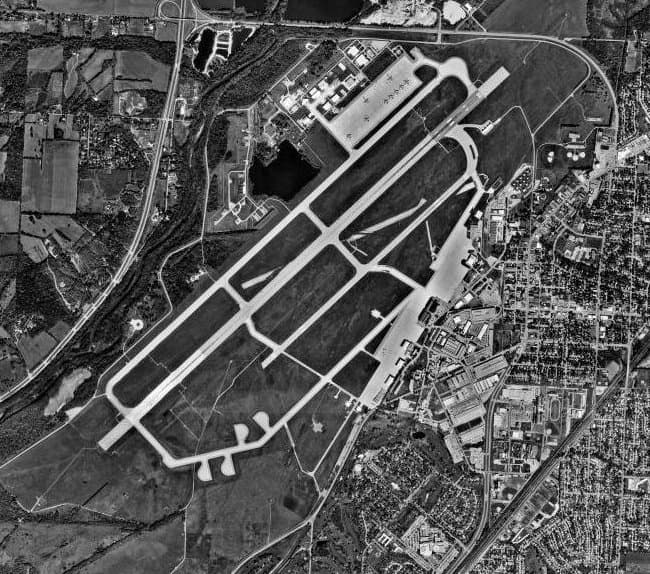
Wilcox called Roswell Army Air Field (RAAF), home of the 509th Bomb Group, the only military unit in the world capable of delivering nuclear weapons at that time. The base sent Major Jesse Marcel, the group's intelligence officer, and Captain Sheridan Cavitt to accompany Brazel back to his ranch to collect the material.
What Marcel and Cavitt found was a debris field but no intact craft, no bodies, no engine parts. Marcel later described the material as including metallic foil that couldn't be dented with a sledgehammer, lightweight I-beam structures with purple symbols on them, and material that couldn't be burned. These descriptions came decades after the event, and their accuracy is disputed.
Why Did the Military Call It a Flying Disc?
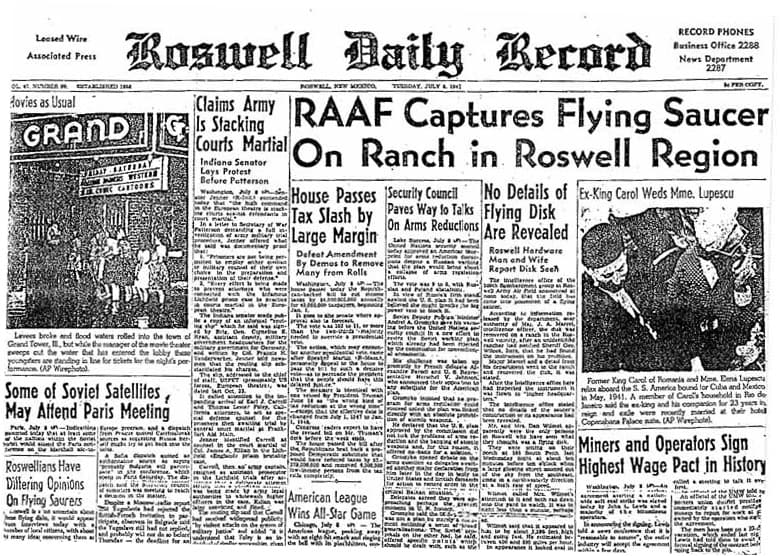
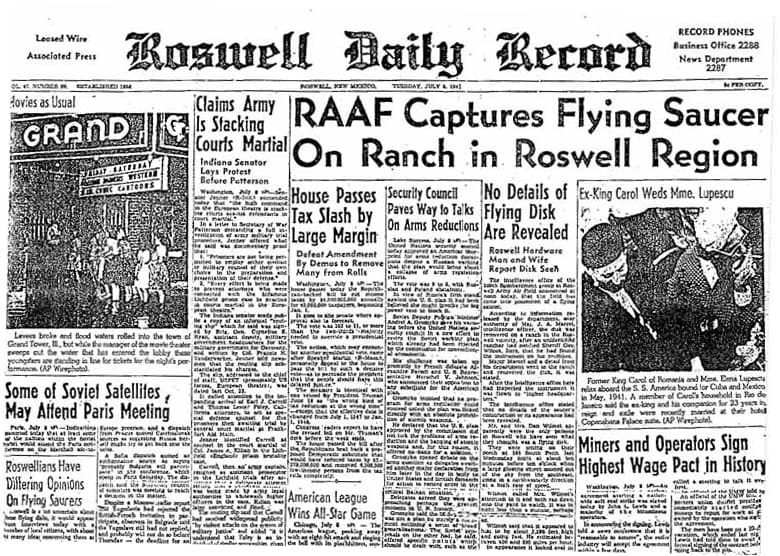
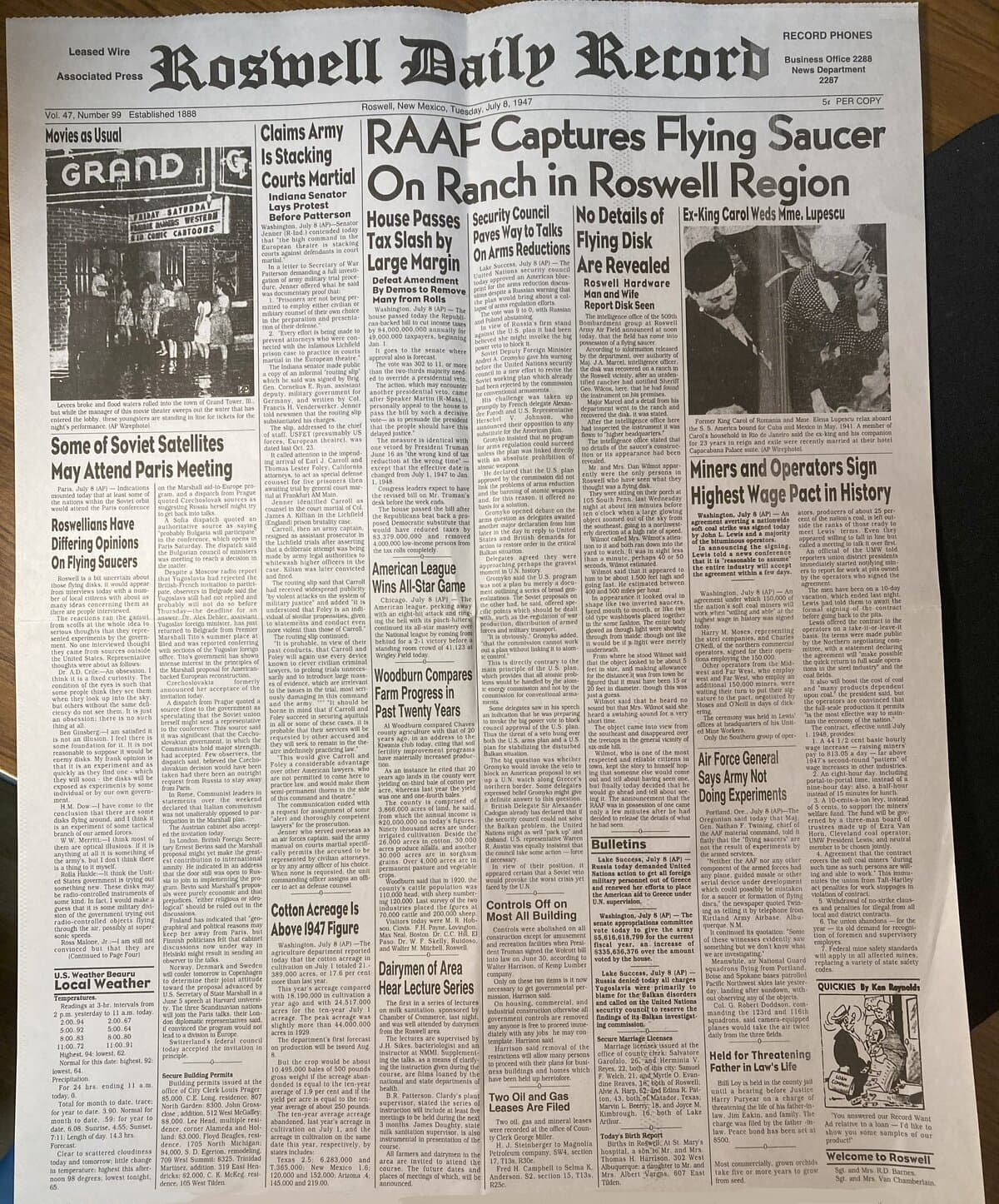
This is one of the strangest parts of the story. On July 8, 1947, RAAF public information officer Walter Haut issued a press release, approved by base commander Colonel William Blanchard, announcing that the military had recovered a "flying disc."
The press release read in part: "The many rumors regarding the flying disc became a reality yesterday when the intelligence office of the 509th Bomb Group of the Eighth Air Force, Roswell Army Air Field, was fortunate enough to gain possession of a disc through the cooperation of one of the local ranchers and the sheriff's office."
This wasn't a leak or a mistake by a low-level officer. It was an official military announcement. The story went out over the Associated Press wire and made headlines worldwide. ABC News broadcast it on radio that evening.
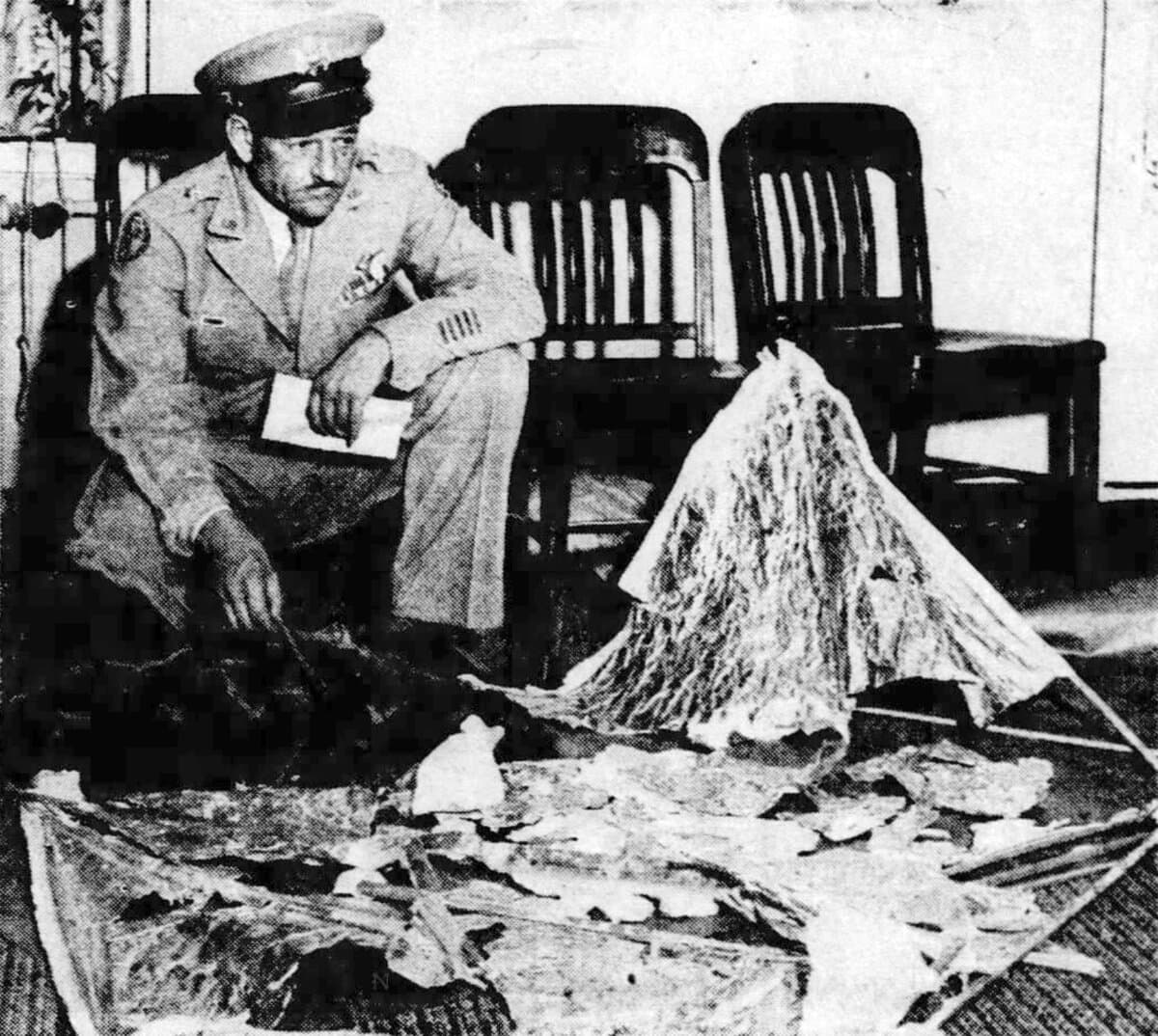
Then, within hours, the story reversed. Brigadier General Roger Ramey at Fort Worth Army Air Field held a press conference where he and weather officer Irving Newton displayed debris and identified it as a standard weather balloon with a radar reflector. Newspapers ran the correction on July 9. The Roswell Daily Record quoted Brazel describing the debris as "rubber strips, tinfoil, paper, tape, and sticks."
Why did Blanchard authorize the "flying disc" press release in the first place? Supporters of the UFO theory say he was telling the truth before being ordered to cover it up. Some have proposed the term "flying disc" was loosely used in 1947 and didn't necessarily imply an alien spacecraft; Blanchard may have simply meant they'd found physical wreckage related to the saucer reports. The military was genuinely trying to figure out what people were seeing, and finding physical debris seemed like a breakthrough.
There's a third possibility: the "flying disc" announcement may have been a deliberate distraction. By generating excitement about a disc and then quickly debunking it, the military could divert attention from the actual classified program the debris came from.
What Was Project Mogul?
In 1994, the Air Force revealed that the Roswell debris was from Project Mogul, a top-secret Cold War program designed to detect Soviet nuclear tests using high-altitude balloon trains.
Project Mogul launched long chains of weather balloons carrying specialized acoustic sensors to high altitudes. The idea was that these sensors could pick up the sound waves from a nuclear explosion on the other side of the world. The program was so secret that even the scientists working on the balloons didn't know the full purpose of the project.
On June 4, 1947, researchers at Alamogordo Army Air Field launched Mogul Flight #4, a train of over 20 balloons carrying radar reflectors and acoustic equipment. They lost contact with the balloons within 17 miles of Brazel's ranch. No recovery was ever recorded.
The materials used in Mogul balloon trains match the debris descriptions from 1947: rubber balloon material, tinfoil from radar reflectors, balsa wood beams reinforced with tape, and string. The radar reflectors were made from foil-covered balsa wood with tape that had decorative symbols printed on it, a detail that could explain Marcel's later descriptions of "strange symbols" on I-beam structures.
The weather balloon explanation given in 1947 was technically a cover story, but not for aliens. It was covering for Project Mogul. The Air Force didn't want to reveal a classified acoustic detection program to the Soviets, so they said "weather balloon" instead of "spy balloon."
How Did Roswell Become a UFO Case?
Here's an important fact that often gets lost: from 1947 to 1978, nobody thought Roswell had anything to do with aliens. The story was dead. It appeared in no UFO literature, no conspiracy theories, no government investigations. It was a non-event.
That changed in February 1978 when UFO researcher Stanton Friedman interviewed Jesse Marcel, now retired from the Air Force. Marcel told Friedman that the weather balloon explanation from the 1947 press conference had been a cover story. He said the debris he'd handled at the ranch was extraordinary, materials that couldn't be cut, burned, or dented. Marcel believed it was extraterrestrial.
Marcel's interview led to the 1980 book "The Roswell Incident" by Charles Berlitz and William Moore, which launched the modern Roswell mythology. Over the following decade, researchers tracked down dozens of people who claimed involvement in or knowledge of the 1947 events. Each new witness seemed to add details: multiple crash sites, alien bodies, intimidation of witnesses, a massive government cover-up.
The problem is that these accounts came 30 to 40 years after the event. Memory is unreliable over such spans, and the stories grew more dramatic over time. Early witnesses described unusual debris. Later witnesses described intact alien spacecraft and small humanoid bodies. The narrative expanded well beyond what any contemporary 1947 source described.
Marcel himself had credibility issues that emerged later. Researchers found he'd exaggerated his military record, claiming to have been a pilot and to have shot down five enemy aircraft when his service file showed neither claim was true. This doesn't necessarily mean he was lying about the debris, but it undermined his reliability.
What Did the Government Investigations Find?
The Roswell incident prompted two major official investigations:
The 1994 Air Force Report: "The Roswell Report: Fact vs. Fiction in the New Mexico Desert" concluded that the debris was from a Project Mogul balloon train, specifically Flight #4. The report detailed how Mogul materials matched witness descriptions and explained why the "weather balloon" cover story was used instead of revealing the classified program.
The 1997 Air Force Report: "The Roswell Report: Case Closed" addressed the alien body claims specifically. It concluded that witness accounts of small bodies being recovered were likely confused memories of two separate programs: Project High Dive, which dropped anthropomorphic test dummies from high-altitude balloons in the 1950s, and a 1956 aircraft accident at Walker Air Force Base (formerly RAAF) that injured 11 airmen. The report argued that witnesses had conflated these later events with the 1947 debris recovery.
The Government Accountability Office (GAO) also investigated in 1995 at the request of Congressman Steven Schiff of New Mexico. The GAO found that all administrative records from Roswell Army Air Field covering the period from March 1945 to December 1949 had been destroyed. The destruction wasn't specifically suspicious; it was consistent with routine records management. But the missing records meant that certain questions couldn't be answered definitively.
President Bill Clinton's administration looked into it as well. Clinton later said his people "did an exhaustive search" and found no evidence of alien contact. President Barack Obama, asked about classified information, quipped in 2015: "I gotta tell you, it's a little disappointing. People always ask me about Roswell and the aliens and UFOs, and it turns out the stuff going on that's top secret isn't nearly as exciting as you expect."
Were There Really Alien Bodies?
The alien body claims are the most dramatic part of the Roswell story, and they're also the most problematic.
No contemporary 1947 account mentions alien bodies. The first body claims didn't surface until the early 1990s, more than 40 years after the event. The main sources include:
- •
Glenn Dennis, a mortician who claimed the base called him asking about small caskets and child-sized hermetically sealed containers. He also said a nurse described alien autopsies to him. Researchers later found significant inconsistencies in his account, and he admitted the nurse he named didn't exist (he said he'd used a pseudonym to protect her identity, but no matching person was ever found).
- •
Walter Haut's sealed affidavit, released after his death in 2005, claimed he saw alien bodies and a craft in a hangar at RAAF. However, Haut had given multiple interviews over the years that contradicted this account, and some researchers believe the affidavit was influenced by others.
- •
The Alien Autopsy film, released in 1995 by Ray Santilli, claimed to show the dissection of an alien recovered from Roswell. Santilli admitted in 2006 that it was a staged recreation, though he maintained it was based on genuine footage he'd seen that had deteriorated.
The Air Force's 1997 explanation, that witnesses were remembering crash test dummies from the 1950s, was widely ridiculed because the dummy drops happened years after 1947. But the broader point stands: the body claims came very late, from a small number of witnesses, with significant credibility issues.
What Gets Overlooked in the Debate?
The Roswell debate tends to be polarized, and both sides have blind spots.
What often gets missed: The government genuinely did cover something up in 1947. The "weather balloon" explanation was a lie, even if the truth (Project Mogul) was conventional rather than extraterrestrial. This established a documented pattern of military dishonesty about the Roswell debris that feeds legitimate distrust. When the government lies once and gets caught, people reasonably wonder what else they're hiding.
The destruction of RAAF administrative records, while likely routine, makes it impossible to prove the negative. You can't demonstrate that nothing unusual happened when the records that might confirm or deny it no longer exist.
What believers often overlook: The Roswell story grew dramatically over decades, with each retelling adding new details that weren't in any contemporary account. The original 1947 reports describe a field of lightweight debris: foil, rubber, sticks, tape. There's no mention of intact craft, bodies, or exotic materials in any document or interview from that period. The extraordinary claims all emerged 30+ years later, well within the range where memory contamination is expected.
Jesse Marcel's credibility issues are real. Stanton Friedman and other pro-UFO researchers did important work bringing the case to light, but they also had a vested interest in a particular conclusion.
What both sides miss: Roswell doesn't exist in a vacuum. The broader context of recent UAP disclosures, including the 2023 congressional testimony from whistleblower David Grusch claiming the US possesses "non-human" craft and biological materials, has changed the landscape. Grusch's claims haven't been publicly verified, but they come from within the intelligence community, not from decades-old memories. Whether they connect to Roswell specifically is unknown.
The Rendlesham Forest incident in Britain, the Tic Tac UFO encounter, and the Navy's confirmed UAP videos all suggest the UFO question is more complex than "it was all balloons." But complexity isn't proof, and Roswell's specific evidence remains thin compared to its cultural footprint.
For more on America's most secretive military installation, read our article on Area 51, which has its own deep connections to UFO mythology. The Skinwalker Ranch and Wow! Signal offer very different kinds of evidence for unexplained phenomena.
What's Roswell Like Today?
Roswell has fully embraced its UFO identity. The town of about 48,000 people features alien-themed streetlights, an International UFO Museum and Research Center (opened in 1991), and an annual UFO Festival held each July that draws tens of thousands of visitors.
The economy benefits significantly from UFO tourism. Hotels, restaurants, and shops cater to visitors fascinated by the 1947 story. The museum receives about 200,000 visitors per year and houses an extensive collection of documents, photographs, and witness testimonies related to the incident.
The actual crash site on the former Brazel ranch is on private property and not easily accessible, though some tour companies offer guided visits to the area.
Timeline of Key Events
| Year | Event |
|---|---|
| June 4, 1947 | Project Mogul Flight #4 launched from Alamogordo; contact lost near Brazel ranch |
| June 14, 1947 | Mac Brazel discovers debris field on his ranch (approximate date) |
| July 5, 1947 | Brazel hears about "flying disc" reports; visits Corona |
| July 6, 1947 | Brazel reports debris to Roswell sheriff; RAAF sends Marcel and Cavitt |
| July 8, 1947 | RAAF announces recovery of a "flying disc"; story goes worldwide |
| July 8, 1947 | General Ramey holds press conference identifying debris as weather balloon |
| July 9, 1947 | Roswell Daily Record runs Brazel interview; story fades |
| 1978 | Jesse Marcel tells Stanton Friedman the weather balloon was a cover story |
| 1980 | "The Roswell Incident" book published; modern mythology begins |
| 1991 | International UFO Museum opens in Roswell |
| 1994 | Air Force report identifies debris as Project Mogul balloon |
| 1995 | GAO finds RAAF administrative records from 1945-1949 destroyed |
| 1995 | "Alien Autopsy" film released (admitted as hoax in 2006) |
| 1997 | Air Force "Case Closed" report addresses alien body claims |
| 2023 | Congressional UAP hearings renew broader interest in government UFO programs |
Frequently Asked Questions
What did the Roswell debris actually look like?
Contemporary 1947 descriptions from Brazel and Marcel describe rubber strips, tinfoil, paper or parchment-like material, tape with decorative symbols, and lightweight wooden or balsa sticks. Brazel told reporters the debris filled "about two bushels" worth of material. Later accounts from Marcel (given in 1978 and after) described more exotic properties like materials that couldn't be cut or burned, but these descriptions aren't corroborated by 1947 sources.
Was there really a government cover-up at Roswell?
Yes, but not the kind most people imagine. The government's 1947 "weather balloon" explanation was a cover story for Project Mogul, a classified program to detect Soviet nuclear tests. The Air Force admitted this in 1994. Whether the cover-up concealed anything beyond Project Mogul is the question that remains unresolved.
Why were the Roswell Army Air Field records destroyed?
The GAO investigation found that administrative records from RAAF covering March 1945 through December 1949 had been destroyed. The destruction wasn't flagged as unusual at the time and was consistent with standard records management practices. No specific person or authorization for the destruction was identified. Critics see it as suspicious; the military says it was routine.
How reliable are the Roswell witnesses?
This varies considerably. The 1947 contemporary accounts (newspaper interviews with Brazel and Marcel) describe ordinary debris. Accounts given decades later tend to be more dramatic, which is consistent with how human memory works. Key witnesses like Jesse Marcel had documented credibility issues, including exaggerations on his military record. Glenn Dennis's alien body claims had verifiable inaccuracies. The strongest testimony comes from those who described the debris itself rather than alien craft or bodies.
Could Roswell be connected to recent UAP disclosures?
Possibly, but there's no direct evidence linking recent government UAP investigations to the 1947 Roswell incident specifically. Congressional hearings in 2023 included testimony from intelligence community whistleblower David Grusch, who claimed the US possesses "non-human" craft, but he didn't specifically cite Roswell. The connection remains speculative.
Further Reading
This article contains affiliate links. If you buy through them we may earn a small commission at no extra cost to you.
Want to explore more mysteries?
We've got plenty more rabbit holes to go down.