Milky Seas: The Glowing Ocean We Can See From Space But Can't Reach
For 400 years sailors reported seas that turned white to the horizon. Satellites finally proved them real, yet almost no one has ever sampled one.
On the night of 25 January 1995, the British merchant ship SS Lima was steaming through the northwest Indian Ocean, about 150 nautical miles off the coast of Somalia, when the horizon began to turn pale. Within roughly fifteen minutes the whole sea around the vessel had taken on a steady whitish glow, bright enough that the officer on watch wrote in the log that it felt as though the ship were sailing over a field of snow. The glow did not flash or sparkle in the wake the way a glowing sea usually does. It simply lay there, even and luminous, stretching off into the dark in every direction. The Lima held that course for hours, and the light did not fade.
What the crew of the Lima sailed into has a name that is almost as old as oceangoing itself: a milky sea. Mariners have reported these events for at least four centuries, vast stretches of ocean that glow a soft, uniform white or green at night, cool and continuous, visible from one horizon to the other. For most of that time the milky sea was treated as a sailor's tale, the kind of thing you heard in port and politely disbelieved, because no scientist had ever been inside one to measure it and no ship could prove what it had seen. Then satellites changed the story. We can now watch a milky sea from orbit, confirm its size, and track it for weeks. And yet, in all of recorded history, only a tiny handful of people have ever stood on the water inside one with the means to look closely. That is the strange shape of this mystery. We can see it from five hundred miles up. We almost never reach it from a boat.
This article contains affiliate links. If you buy through them we may earn a small commission at no extra cost to you.
What You'll Learn
- •What a Milky Sea Actually Is
- •Four Centuries of Sailors Who Saw It
- •Catching the Glow From Orbit
- •The Day-Night Band and the Java Event
- •The Yacht That Sailed Into a Satellite Photo
- •The Bucket That Glowed the Wrong Way
- •The Bacteria That Decide Together
- •What Still Has No Answer
- •Seen From Space, Never From a Boat
- •Frequently Asked Questions
- •Further Reading
What a Milky Sea Actually Is
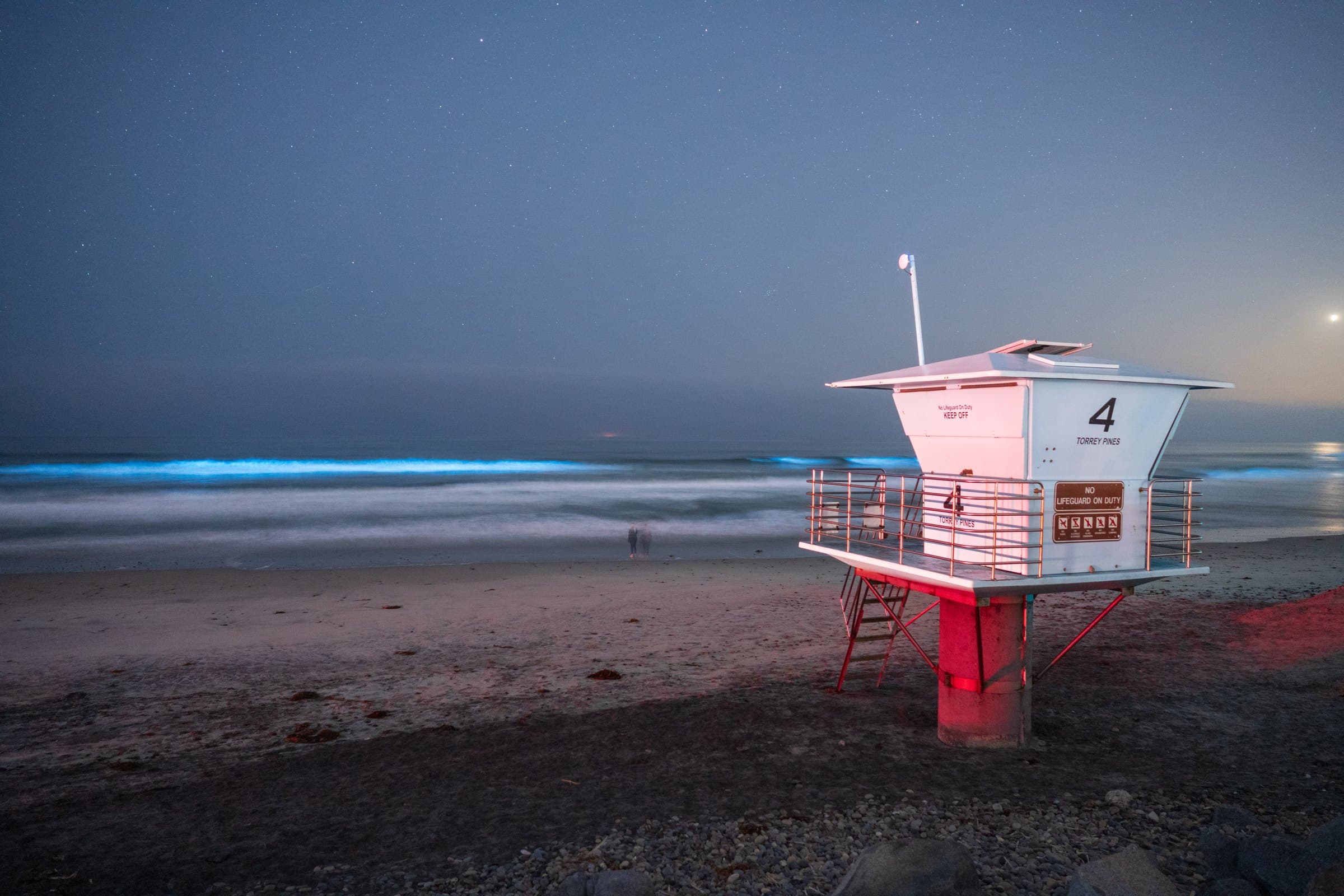
The first thing to understand about a milky sea is that it is not the glowing surf you have probably seen in photographs. Those images, the electric-blue waves breaking on a beach in California or the Maldives, come from dinoflagellates, single-celled plankton that flash when they are jostled. Drag your hand through that water and it sparkles. Stir it and it lights up. The light is a startle response, a defensive burst that lasts a fraction of a second, and it appears only where the water is physically disturbed, which is why it traces the edge of a wave or the line of a wake.
A milky sea is the opposite in almost every way. It does not flash, it glows, steadily and without interruption, often for nights on end. It is not blue but a pale white or faint green. It does not appear in the wake or where the water is churned; it fills the open sea evenly, out past the reach of any ship's movement, to the horizon and beyond. Witnesses describe it as calm, uniform, and oddly gentle, a light that seems to rise from within the water rather than skip across its surface. Sailors have compared it to a snowfield, to a glass of milk, to a cloud glowing from beneath. It is one of the few natural events on Earth large enough and bright enough to be seen from space, and for most of human history it was also one of the least understood.
Four Centuries of Sailors Who Saw It
Written accounts of milky seas reach back into the age of sail, with a cluster of detailed reports from the early 1800s. In 1832 the crew of a ship called the Clive, sailing between Bombay and the Arabian Gulf, found themselves surrounded by a huge expanse of glowing white water and believed for a time that they were in real danger, as though the sea itself had turned to something unnatural. Reports like this accumulated in ships' logs over the following century, most of them concentrated in the same two regions: the northwest Indian Ocean near the Horn of Africa, and the waters of Southeast Asia.
The phenomenon was famous enough to reach literature. In Jules Verne's Twenty Thousand Leagues Under the Seas, the Nautilus crosses a vast luminous white sea in the Indian Ocean, and Verne, drawing on the mariners' reports of his day, has his characters attribute the glow to countless tiny organisms. By the twentieth century a few scientists had begun collecting the sightings seriously. The British marine biologist Peter Herring spent years assembling a catalogue of milky sea reports from across the historical record, the most thorough effort of its kind for a long time. Even so, the whole field rested on eyewitness description. Not a single milky sea had ever been studied by a research vessel in the act. The subject sat in that uncomfortable place between folklore and science, too consistently reported to dismiss, too rarely encountered to examine.
Catching the Glow From Orbit
The breakthrough came not from a ship but from a satellite archive, and the key was that someone finally had a verified eyewitness event to match against the data. The SS Lima's 1995 encounter had been logged precisely: the date, the position, the hours the glow persisted. In 2005, a team led by Steven D. Miller of the Naval Research Laboratory, working with Steven Haddock, Christopher Elvidge, and Thomas Lee, went back to the archived imagery from a United States military weather satellite, the Defense Meteorological Satellite Program, whose Operational Linescan System was sensitive enough to pick up extremely faint light at night.
When they pulled the imagery for the Lima's position on those January nights, the glow was there. A faint luminous patch, invisible against the general brightness of the globe until you knew exactly where and when to look, covered more than 15,000 square kilometers of ocean, an area larger than Connecticut. It matched the ship's log almost exactly. Their paper, published in the Proceedings of the National Academy of Sciences, was the first time a milky sea had ever been detected from space. After four hundred years, a sailor's tale had a data point. But the detection also sharpened the mystery rather than solving it, because the satellite could show that the glow was real and enormous and could not say what was producing it or why.
The Day-Night Band and the Java Event
The 2005 detection had been a painstaking act of hindsight, squeezing a signal out of a sensor never designed to find it. The next generation of satellites made the search far more powerful. A newer instrument, the Day/Night Band aboard the Suomi NPP and NOAA weather satellites, was built to measure light far fainter than sunlight, the sort of low glow that comes from city lights, moonlit clouds, and, as it turned out, the sea itself.
In a 2021 paper in Scientific Reports, Miller and his colleagues used the Day/Night Band to comb through nearly a decade of nighttime imagery and identified a series of milky sea candidates around the world. One of them dwarfed the rest. South of the Indonesian island of Java, beginning in late July 2019, a milky sea bloomed across more than 100,000 square kilometers of ocean, roughly the size of Iceland, and it glowed, on and off through the moonless nights, well into September. It was the largest milky sea ever documented. From orbit the researchers could trace its shape, watch it drift and persist, and estimate its brightness. What they could not do was get anyone onto the water to confirm what the satellite was seeing. The event came and went, observed only from space, a country-sized glow with no witness on its surface. Or so it seemed at the time.
The Yacht That Sailed Into a Satellite Photo
More than two years later, a message reached Steven Miller that turned the Java event from a satellite curiosity into something close to proof. A crew member named Naomi McKinnon had read about the 2019 detection in the news and realized, with a jolt, that she had been there.
She had been aboard the Ganesha, a 16-meter private yacht on a circumnavigation, captained by Johan Lemmens with six other people aboard, crossing from Lombok in Indonesia toward the remote Cocos (Keeling) Islands. On the night of 2 August 2019, somewhere in the southern reaches of that enormous glow, the sea around them changed. The ship's log, written at the time with no idea that a satellite was watching the same water, recorded the moment near 2200 hours in plain words: the sea was white. The crew described a glow much brighter than the night sky, steady and uniform in every direction, and they had the eerie impression of sailing across snow. One detail stood out against the familiar picture of a glowing ocean: the bow wave, the water the hull pushed up and broke, looked black against the pale sea, the reverse of the sparkling wake a boat normally leaves in bioluminescent water.
Miller worked the crew's account against his data and published the result in the Proceedings of the National Academy of Sciences in 2022. The Ganesha's position, the date, the hours of the encounter, and the crew's photographs all lined up with the satellite imagery of the Java milky sea. On the night in question the Day/Night Band had captured an anvil-shaped feature in that patch of ocean, and the yacht had passed along its southern edge, where the glow was dimmer; the brightest water, the satellite showed, lay about 200 kilometers to the north, four or five times more radiant than what the Ganesha saw. For the first time, a milky sea observed from space and a milky sea observed from the water were confirmed to be the same event. The crew's images are regarded as the first genuine photographs of the phenomenon ever taken. A tale that had resisted verification for four centuries had finally been caught from both directions at once, and the people inside it had very nearly sailed through without ever knowing what they had seen.
The Bucket That Glowed the Wrong Way
The single most revealing thing the Ganesha crew did was simple and almost casual. They lowered a bucket over the side and hauled up a sample of the glowing water to look at it.
What they found overturns the intuition most of us carry about a glowing sea. The water in the bucket held tiny, steady points of light, and when the crew stirred it, the light dimmed rather than flaring. That is the exact inverse of the dinoflagellate flash that makes beach waves sparkle, where agitation triggers the glow. Here, disturbance seemed to suppress it. The captain estimated that the main source of the light was not at the surface at all but around ten meters below it, rising up through the water column. A milky sea, in other words, is not a film of glowing scum riding on top of the ocean. It is something diffused through the water itself, glowing from within, undisturbed by the churn of a passing hull. This is also why milky seas persist through wind and rough weather that would scatter any surface slick. The light is coming from too deep and is spread too evenly to be broken up.
That inversion, glow that steadies in stillness and fades when stirred, is one of the clearest fingerprints that a milky sea is not made by the plankton behind ordinary ocean sparkle. Something else is at work, something that lights up not as a startle but as a sustained, collective state.
The Bacteria That Decide Together
The leading explanation points to bacteria, and it is strange enough to be worth sitting with. Luminous marine bacteria, with Vibrio harveyi the usual suspect, can produce a soft continuous glow, nothing like the flash of a dinoflagellate. But a single bacterium's light is far too faint to matter. These bacteria only switch on their luminescence when they sense that enough of their own kind are packed around them, a behavior called quorum sensing. Each cell releases a signaling molecule into the water; when the concentration of that molecule climbs high enough, meaning the population has grown dense enough, the whole community turns its lights on more or less at once. Estimates of the threshold are staggering, on the order of ten million to a hundred million bacteria in every milliliter of seawater, sustained across tens of thousands of square kilometers. A milky sea, on this reading, is a single act of coordination carried out by an almost unimaginable number of microscopic organisms agreeing, chemically, to glow together.
The one time a research vessel managed to sample a milky sea directly supports the idea. In 1985, a Naval team led by Dave Lapota, aboard the USNS Wilkes, sailed into a milky sea east of the island of Socotra, the only research ship known to have done so. They found luminous bacteria associated with a bloom of microscopic algae, and they recorded something else telling: a sharp boundary where the glowing water met the normal dark sea, as if an oceanic front had drawn a line between the two. That single successful sampling, now four decades old, remains the backbone of the bacterial hypothesis. It is a remarkably thin foundation for a phenomenon this large, and everyone who studies milky seas knows it.
What Still Has No Answer
Calling milky seas a bacterial glow describes the how in the loosest sense and leaves almost every real question open. Why do these blooms ignite in a few specific places and almost nowhere else? Why do they appear in some years and not others? What assembles a bacterial population dense enough to light an area the size of a small country, holds it together for weeks, and then lets it dissolve? And what is the glow for, if it is for anything at all, from the point of view of the bacteria themselves?
Researchers have started to find patterns without yet finding causes. A 2025 study by Justin Hudson and Steven Miller assembled a curated database of milky sea sightings stretching from the year 1600 to the present, combining the centuries of eyewitness logs with the modern satellite record. The events cluster heavily in the northwest Indian Ocean and the seas of Southeast Asia, and they appear to be statistically linked to large climate cycles, the Indian Ocean Dipole and the El Nino Southern Oscillation, as well as to the monsoon-driven upwelling that pushes nutrients toward the surface. There are hints that milky seas may be tied to the health or the stress of an entire marine ecosystem, a glowing signal of something happening on a scale we are only beginning to read. But the links are correlations, not explanations, and they rest on a record that is still mostly made of sailors writing down what they saw.
Hudson put the core problem in a single sentence: it is hard to study something you cannot find. A milky sea can appear anywhere across a huge stretch of remote ocean, on a timescale no research vessel can plan around, and by the time a satellite flags one and a ship could be dispatched, the glow may already be gone. He also noted a curious rhythm in the science itself. Roughly every forty years, someone becomes fascinated by milky seas, assembles the best record they can, and then the thread goes quiet again. Peter Herring's earlier catalogue, Hudson has said, may now sit forgotten in a storage room somewhere in Britain. The phenomenon keeps being rediscovered because it keeps slipping away.
Seen From Space, Never From a Boat
Here is the contradiction at the center of the milky sea, and the reason it belongs among the genuinely unexplained rather than the merely difficult. We have reached a point where we can detect one of these events from orbit, map its shape, measure its light, and follow it for a month. By the standards of most ocean mysteries, that is an extraordinary amount of information. And yet the number of times a human being has stood inside a milky sea with the tools to examine it can be counted on one hand. One research vessel, in 1985. One yacht crew with a bucket and a couple of cameras, in 2019, who only learned years later that they had been inside the largest one ever recorded.
Everything we think we know about what a milky sea is made of rests on those few encounters. The satellites give us the where and the how big; they cannot give us the what or the why. It is the inverse of almost every other frontier in science, where the hard part is seeing the thing at all. With milky seas we can see them plainly from space and still cannot get close enough, often enough, to answer the simplest questions about them. Like the unexplained sound once called the Bloop or the single strange voice of the 52-hertz whale, a milky sea is a reminder that the ocean can be fully visible and completely out of reach at the same time.
Somewhere tonight, there is a reasonable chance that a patch of sea is glowing white under the stars, steady and silent, spread across an area larger than some countries, with not a single person on it. A satellite may even record it. And unless a ship happens to wander through, that glow will rise and hold and fade with no one to tell us what it was.
Frequently Asked Questions
Are milky seas the same as the glowing blue waves people post from the beach?
No, and the difference is the whole point. Beach bioluminescence comes from dinoflagellates that flash bright blue for a fraction of a second when the water is disturbed, which is why it traces breaking waves and wakes. A milky sea is a steady, pale white or green glow that fills the open ocean evenly, does not flash, and can last for nights. In a sample from a milky sea, stirring the water makes the light dim rather than flare, the reverse of the beach effect.
Can you see a milky sea with your own eyes, or only from satellites?
You can absolutely see one from the deck of a ship; sailors have been describing them for four hundred years, and crews report a glow bright enough to read the sea by. The catch is finding one. Milky seas appear unpredictably across vast, remote stretches of ocean, mostly in the northwest Indian Ocean and around Southeast Asia, and they are rare enough that most mariners sail their whole careers without encountering one. Satellites have simply given us a second way to spot them, from above.
What causes the glow?
The leading explanation is an immense population of luminous bacteria, often pointing to Vibrio harveyi, that produce a continuous glow once their numbers grow dense enough to trigger a coordinated response called quorum sensing. The trouble is that this has only ever been confirmed by direct sampling once, in 1985, so while the bacterial idea is well supported, the details of how a glow this large assembles and sustains itself remain unsettled.
How big can a milky sea get?
Very big. The event detected south of Java in 2019 covered more than 100,000 square kilometers, roughly the size of Iceland, and persisted on and off for weeks. The 1995 event off Somalia, confirmed later from satellite imagery, spanned more than 15,000 square kilometers, larger than Connecticut. These are among the largest luminous displays produced by life anywhere on Earth.
Why is it so hard to study something that can be seen from space?
Because seeing where a milky sea is and getting a research ship into it are two very different problems. The glow can appear anywhere across an enormous, remote area, on no schedule, and often for only a few weeks. By the time a satellite flags one and confirms it, a vessel capable of sampling it may be thousands of miles away, and the event may dissolve before anyone can arrive. The ocean is simply too large, and the phenomenon too fleeting, to intercept on demand.
Further Reading
If the milky sea pulled you in, the richest way to sit with it is to understand how living light works and how much of the glowing ocean we still have not touched. These books are strong places to start.
- •Below the Edge of Darkness: A Memoir of Exploring Light and Life in the Deep Sea by Edith Widder. A leading bioluminescence scientist on a life spent chasing living light through the ocean, and on how much of it remains unexplained. Find it on Amazon
- •Bioluminescence: Living Lights, Lights for Living by Therese Wilson and J. Woodland Hastings. The authoritative overview of how and why living things glow, from the researchers at the heart of the field. Find it on Amazon
- •Twenty Thousand Leagues Under the Seas by Jules Verne. The classic in which the Nautilus crosses a vast luminous white sea in the Indian Ocean, drawn from the real mariners' reports of Verne's time. Find it on Amazon
For four centuries we called the milky sea a story. Now we can photograph it from orbit and still cannot say, with any confidence, what lights it or why. The question that lingers is not whether these glowing oceans are real; the satellites settled that. It is how something large enough to see from space can remain, after all this time, almost entirely beyond our reach.
Want to explore more mysteries?
We've got plenty more rabbit holes to go down.