The Bloop: What Made the Loudest Sound in the Ocean?
In 1997, NOAA hydrophones caught a sound louder than a blue whale from an empty stretch of the South Pacific. The ice theory answered part of it.
In the summer of 1997, in a part of the ocean so remote that the nearest human beings were often astronauts passing overhead on the space station, something made a noise. It was picked up by underwater microphones moored thousands of miles apart, all at once, which meant the sound had traveled an enormous distance without fading. When scientists at the National Oceanic and Atmospheric Administration sped up the recording sixteen times so human ears could register it, it came out as a single rising note, a kind of watery groan that swelled and then vanished in about a minute. They called it the Bloop.
It was, by some measures, the loudest sound ever recorded in the deep ocean. Louder than a blue whale, which is the loudest known animal on Earth. And for years, no one could say what had made it. The Bloop became one of those rare mysteries that lived in the gap between marine biology and pure imagination, a sound with no confirmed source, coming from the emptiest place on the planet.
This article contains affiliate links. If you buy through them we may earn a small commission at no extra cost to you.
What You'll Learn
- •What Exactly Was the Bloop?
- •How Do You Even Listen to the Whole Ocean?
- •Where the Sound Came From
- •Louder Than the Loudest Animal on Earth
- •Why Biologists Couldn't Look Away
- •The Icequake Explanation
- •What the Ice Theory Leaves Open
- •The Bloop's Stranger Siblings
- •R'lyeh and the Coincidence of Coordinates
- •How Much of the Ocean Have We Actually Heard?
- •Frequently Asked Questions
- •Further Reading
What Exactly Was the Bloop?
The Bloop was an ultra-low-frequency sound, so low that a person standing next to a speaker playing it in real time would feel it more than hear it. It was captured several times during the summer of 1997 by the Pacific Marine Environmental Laboratory (PMEL), a NOAA research division based in Newport, Oregon that had spent the decade turning the deep ocean into something you could listen to.
On a spectrogram, which is a visual chart of sound across time and frequency, the Bloop traced a clean, steep upward curve. The frequency climbed rapidly over roughly a minute and then stopped. That shape mattered. A ship's engine, a distant earthquake, the churn of a storm, each of these leaves its own fingerprint on a spectrogram, and none of them look like the Bloop. What the Bloop's rising sweep most resembled, to the scientists who first stared at it, was the call of a large animal.
That resemblance is where the story either becomes ordinary or becomes strange, and for a long time it refused to become ordinary.
How Do You Even Listen to the Whole Ocean?
The Bloop exists as data at all because of the Cold War. During the standoff with the Soviet Union, the U.S. Navy built a secret network of undersea microphones called SOSUS, the Sound Surveillance System, designed to catch the faint acoustic signatures of enemy submarines crossing the deep. Those hydrophones sat on the seafloor, wired back to shore, listening to the ocean around the clock for decades.
When the Cold War thawed, the Navy began quietly sharing parts of that system with civilian oceanographers. NOAA's acoustic monitoring program, led in its early years by researcher Christopher Fox, gained the ability to eavesdrop on undersea earthquakes, erupting seamounts, and the songs of migrating whales across entire ocean basins. In 1996, PMEL added its own array of autonomous hydrophones in the equatorial Pacific, instruments that recorded on their own and were recovered periodically for analysis.
This is the part most retellings skip, and it is worth sitting with. Sound behaves strangely underwater. It travels roughly four times faster than in air, and in a layer of the ocean called the SOFAR channel it can carry for thousands of miles with almost no loss. A whale calling off the coast of Antarctica can, in principle, be heard by an instrument near the equator. So when the Bloop lit up sensors more than 3,000 miles apart, the network was doing exactly what it was built to do. The question was never whether the sound was real. It was, and the recordings survive. The question was what had been loud enough, and strange enough, to shout across an entire ocean.
Where the Sound Came From
By comparing the arrival times of the Bloop at different hydrophones, PMEL triangulated a rough origin: a point in the South Pacific at roughly 50 degrees south, 100 degrees west. That places it in the far southern ocean, west of the southern tip of South America, in one of the least visited regions of water on Earth.
To understand how empty this area is, consider Point Nemo. Also called the oceanic pole of inaccessibility, Point Nemo is the spot in the world ocean farthest from any land, sitting near 48 degrees south, 123 degrees west. If you are floating at Point Nemo, the closest solid ground is roughly 1,600 miles away in every direction, and the nearest humans are frequently the crew of the International Space Station orbiting overhead. The Bloop came from this same broad quadrant of nothing, a stretch of sea where no research vessels loiter and no shipping lanes cross.
That isolation is part of why the mystery endured. There were no ships nearby to report what they saw. There was no follow-up expedition steaming to the coordinates the next morning. There was only the recording, and a set of numbers pointing at a blank patch of the map.
Louder Than the Loudest Animal on Earth
Here is the detail that turned a technical curiosity into a legend. The Bloop was picked up clearly on hydrophones separated by thousands of miles. For that to happen, the source had to be extraordinarily loud, louder than any noise a living creature is known to make.
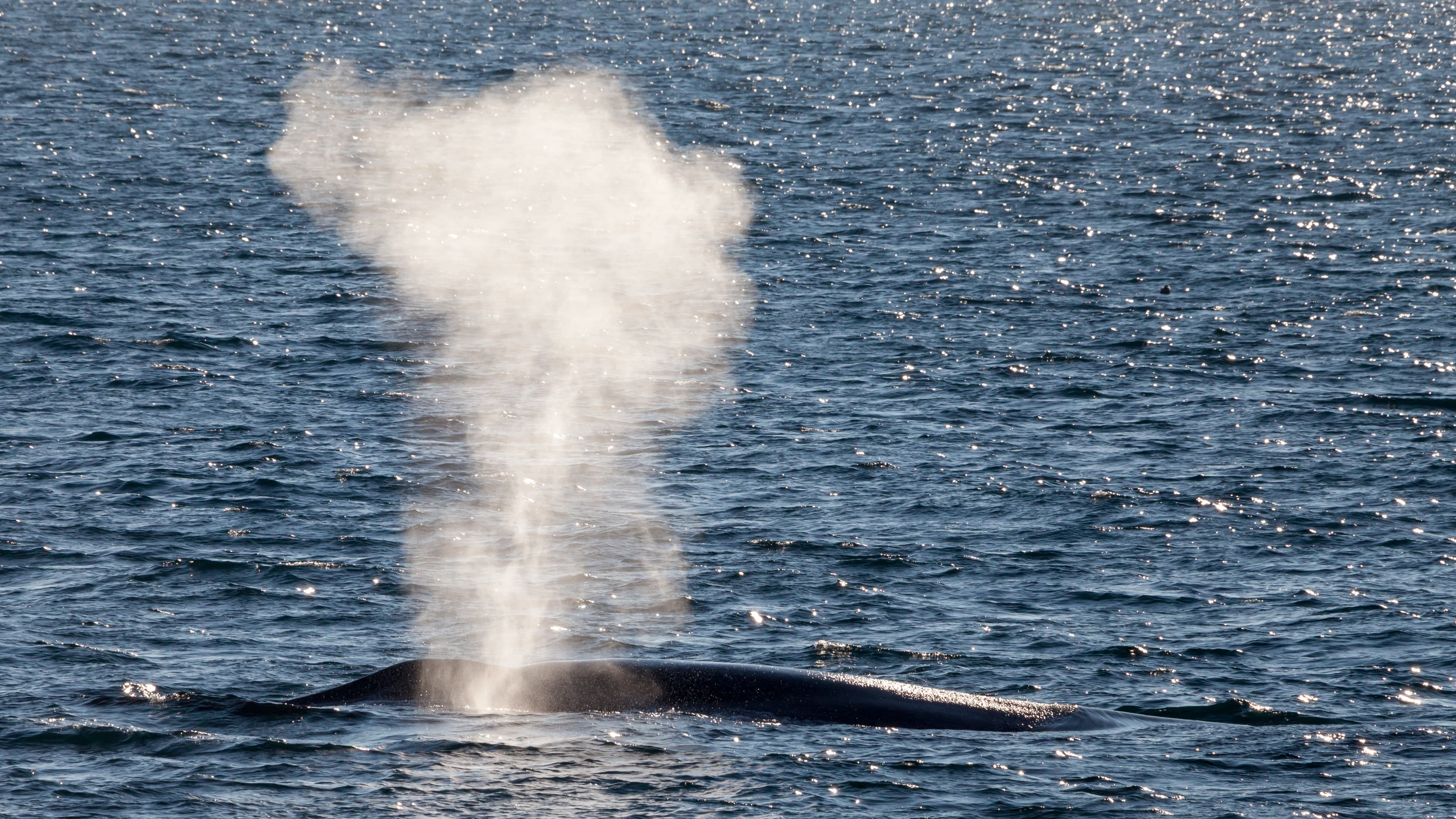
The blue whale holds the record for the loudest documented animal, its calls reaching around 188 decibels and traveling great distances through the SOFAR channel. The Bloop appeared to exceed even that. Whatever produced it out-shouted the largest animal that has ever lived, from the emptiest place on the planet, and did so in a pattern that looked biological.
This is the collision at the heart of the case. The shape of the sound said "animal." The volume of the sound said "nothing we know of." Both statements came from the same careful reading of the same spectrogram, and for a while there was no way to reconcile them.
Why Biologists Couldn't Look Away
Christopher Fox, who led much of the early analysis, was measured in public about what the Bloop could be. He noted that its acoustic profile was consistent with a marine animal of some kind, while adding the obvious and unsettling caveat: there was no known animal capable of producing a sound that powerful. He did not claim a monster. He simply declined to rule out biology, and that restraint was more provocative than any wild assertion could have been.
Think about what "consistent with an animal, but louder than any animal we know" actually implies if you take it at face value. It suggests, at minimum, a creature far larger or far more powerful than anything catalogued, living in a region we almost never observe. The deep sea has a long habit of producing exactly that kind of surprise. The giant squid was dismissed as sailors' myth until carcasses proved otherwise. The colossal squid, larger still, was not photographed alive in its habitat until the twenty-first century. When a serious NOAA scientist says the door to an unknown animal is not fully closed, the deep ocean's track record makes that door feel wider than it should.
The Icequake Explanation
Over the following years, the answer that took hold was not biological at all. It was ice.
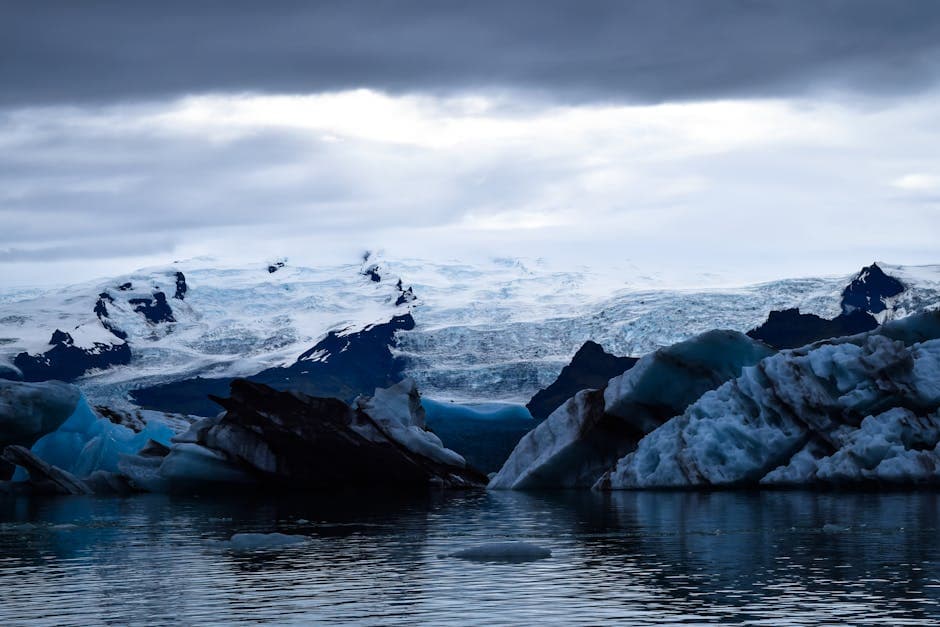
As NOAA extended its hydrophone coverage toward Antarctica in the 2000s, researchers recorded thousands of sounds from the Southern Ocean, and a family of them looked familiar. When massive icebergs crack, fracture, calve from an ice shelf, or grind along the seafloor, they release enormous bursts of sound. These cryogenic events, sometimes called icequakes, can rival the loudest natural noises in the sea. By 2012, a team led by NOAA marine geophysicist Robert Dziak had concluded that the Bloop's rising, sweeping signature matched the acoustic profile of an icequake, the kind of sound a large iceberg makes as it cracks apart somewhere in the Antarctic ice.
It is a satisfying explanation in many ways. It solves the volume problem, because breaking ice really is loud enough to cross an ocean. It fits the geography, since the Bloop came from the far southern Pacific within reach of Antarctic ice. And it fits the shape of the sound, because icequakes recorded elsewhere trace similar frequency sweeps. For most people, this is where the story ends: the Bloop was ice, the monster was never there, move along.
What the Ice Theory Leaves Open
Except the ending is quieter than the headlines suggest.
NOAA never matched the Bloop to a specific, dated, located iceberg the way you might expect from a closed case. There was no expedition that found the shattered berg, no single event pinned to a moment and a coordinate. What the researchers established is that the Bloop's signature is consistent with the class of sounds that icequakes make. That is a strong, reasonable conclusion, and it is also a category match rather than a smoking gun. The Bloop was filed under ice because it looks like ice, not because anyone watched the ice that made it.
There is also the matter of scale. Even granting the iceberg, the Bloop still stands out as one of the most powerful transient sounds in the entire catalogue, a single crack loud enough to be heard across a third of an ocean. Ice explains the kind of sound. It explains less easily why this particular one was such an outlier, or why, in all the years of listening since, nothing quite like it has been logged again in the same way.
None of this makes the Bloop a creature. Following the voice of the evidence rather than the voice of our hopes, ice is the most concrete lead we have. But "consistent with an icequake" and "definitively identified" are not the same sentence, and the space between them is where the Bloop still lives.
The Bloop's Stranger Siblings
The Bloop is famous. Its relatives are not, and they are arguably the better mystery.
The same NOAA listening program logged a small menagerie of unusual sounds, each given a plain nickname, and several remain genuinely unexplained today:
- •Upsweep, a seasonal sound present since PMEL began recording in 1991, rising and falling in intensity around spring and autumn. It was traced to a region of the South Pacific near volcanic seafloor activity, but the exact source has never been nailed down.
- •Slow Down, recorded on May 19, 1997, a sound that gradually descends in frequency over about seven minutes. NOAA leans toward an iceberg grinding to a stop along the seabed, though the identification is not certain.
- •Julia, recorded March 1, 1999, lasting roughly fifteen seconds and heard across the entire equatorial Pacific array, thought to be a large iceberg run aground.
- •Whistle, recorded July 7, 1997, caught by only a single hydrophone, which makes it impossible to triangulate and therefore impossible to source.
Notice the pattern. Some of these have plausible ice or geologic explanations; others, especially Upsweep, are still open questions decades later. The Bloop got the fame and, eventually, the tidy answer. Its siblings quietly kept their secrets while the internet moved on. If you want a sound the deep ocean has genuinely refused to explain, Upsweep has been humming through the South Pacific, unidentified, since before the Bloop was ever recorded.
R'lyeh and the Coincidence of Coordinates
No account of the Bloop is complete without the coincidence that made it a cult legend.
In his 1928 story "The Call of Cthulhu," the horror writer H.P. Lovecraft placed the sunken city of R'lyeh, where the monstrous entity Cthulhu lies dreaming beneath the waves, at 47 degrees 9 minutes south, 126 degrees 43 minutes west. Lovecraft picked those numbers decades before hydrophones existed, choosing the loneliest water he could imagine for his sleeping god. When the Bloop was traced to roughly 50 degrees south, 100 degrees west, readers noticed that a real, unexplained, animal-shaped roar had come from the same desolate corner of the South Pacific as a fictional monster's tomb.
The two points are not identical. They sit more than a thousand miles apart, with Lovecraft's coordinates lying closer to Point Nemo and the Bloop's origin further east. It is a coincidence, and a loose one. But it is the kind of coincidence that gives a mystery its second life. A writer of cosmic horror pointed at an empty patch of sea and said, here, this is where the unknowable sleeps. Seventy years later, our instruments pointed at nearly the same patch and recorded something we could not name. You do not have to believe in Cthulhu to feel the pull of that.
How Much of the Ocean Have We Actually Heard?
Step back from the Bloop and the real mystery comes into focus, and it is larger than any single sound.
The ocean covers most of the planet, and its deep waters are the least explored environment humans have access to. We have mapped the surface of Mars in finer detail than the floor of our own sea. Our hydrophone coverage, even at its best, has been a scattering of ears across an ocean the size of the sky, listening to a fraction of a fraction of the water at any moment. The sounds we happened to catch, the Bloop, Upsweep, Julia, Whistle, are not the strange exceptions in a well-documented sea. They are the handful of things we managed to overhear in a place we almost never listen to.
That is the frame that keeps the Bloop alive even after the ice explanation. The point was never only "what made this one sound." The point is that our ears in the deep are so few, and the deep is so vast, that we catch these voices by accident and often cannot say what they are. Somewhere out past Point Nemo, in water miles deep and thousands of miles from anyone, the ocean is still making sounds. Most of them, no one is recording. Some of the ones we did record, we still cannot explain. The Bloop is not the end of that story. It is the small, loud reminder that the story is barely begun.
Frequently Asked Questions
Was the Bloop really an animal?
Nobody proved it was, and nobody proved it was not, which is exactly why it lingered. The scientist who first studied it said its rising, sweeping shape was consistent with a marine animal, while noting that no known animal could produce a sound that loud. The later ice explanation moved the case away from biology, but it never had to disprove a specific creature, because no creature was ever confirmed in the first place. The door was left ajar rather than slammed.
Did NOAA definitively solve the Bloop?
NOAA concluded that the Bloop's acoustic signature is consistent with an icequake, the signature of a large iceberg fracturing near Antarctica. That is the leading explanation and a reasonable one. It is worth being precise, though: researchers matched the Bloop to the general class of ice sounds, not to a single identified iceberg at a known place and time. It is a strong lead, not a signed confession.
Where did the Bloop come from?
It was triangulated to roughly 50 degrees south, 100 degrees west, in the remote southern Pacific west of the tip of South America. This is near the broad region containing Point Nemo, the point in the ocean farthest from any land, one of the emptiest places on the entire planet.
Why does the Bloop get connected to Cthulhu?
The coordinates. H.P. Lovecraft set the sunken city of R'lyeh, home of the sleeping monster Cthulhu, in the same lonely stretch of the South Pacific back in 1928, and the Bloop was later traced to nearly the same neighborhood. The two points are over a thousand miles apart, so it is a coincidence rather than a clue, but it is the kind of coincidence that is hard to forget once you have heard it.
Are there other unexplained ocean sounds?
Yes, and some are stranger than the Bloop. NOAA's hydrophones also captured Upsweep, Slow Down, Julia, and Whistle. Several have plausible ice or geologic explanations, but Upsweep in particular, a seasonal sound humming through the South Pacific since 1991, has never been fully pinned to a source. It is arguably the deep ocean's most stubborn open question.
Could a sound like the Bloop happen again without anyone knowing?
Yes, in all likelihood. Our hydrophone coverage listens to only a small slice of an enormous ocean, and the deep sea is the least monitored environment on Earth. A sound as loud as the Bloop could occur in unmonitored water and simply never be recorded. We caught the original by luck. How many we have missed is anyone's guess.
Closing Thoughts
The tidy version of the Bloop story ends with the word "ice," and there is real evidence behind that word. But the mystery was never really about whether a monster lived at the bottom of the South Pacific. It was about how little we hear of a world that is mostly water, and how the few sounds we do catch can be loud enough to cross an ocean and still leave us guessing.
The Bloop rose, swept upward, and fell silent in about a minute in the summer of 1997. We gave it a name, argued about it for years, and eventually filed it under a reasonable explanation. And still, out past the edge of every shipping lane, in water no one is watching, the ocean keeps making sounds we were never meant to hear. Some of them, we will never explain. That is not a failure. That is the deep, doing what it has always done, keeping most of itself to itself.
Further Reading
- •The Brilliant Abyss: Exploring the Majestic Hidden Life of the Deep Ocean by Helen Scales
- •The Underworld: Journeys to the Depths of the Ocean by Susan Casey
- •Thousand-Mile Song: Whale Music in a Sea of Sound by David Rothenberg
If reading about the sounds of the deep makes you want to listen for yourself, an affordable waterproof hydrophone will let you drop a microphone off a dock or a boat and hear the surprising amount of noise hiding just below the surface.
Want to explore more mysteries?
We've got plenty more rabbit holes to go down.