Teotihuacan: The Mysterious City of 125,000 People That Nobody Can Explain
Teotihuacan was the largest city in the Americas for centuries. It had apartment complexes, massive pyramids, and a population of 125,000. We still don't know who built it or why it collapsed.
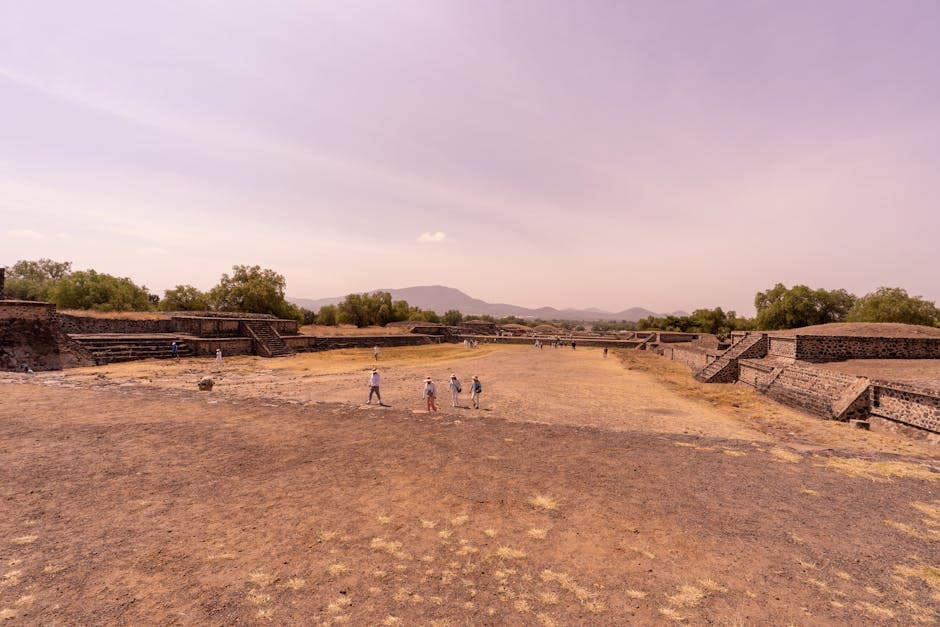
About 30 miles northeast of Mexico City, a grid of ancient streets stretches across eight square miles of high plateau. At its center, a broad avenue runs for nearly 2.5 miles, flanked by the ruins of temples, platforms, and residential compounds. At one end stands a pyramid 216 feet tall, the third-largest pyramid on Earth. At the other end, a slightly smaller pyramid faces it across the ancient boulevard. Between and around them, the remains of over 2,000 apartment complexes once housed a population that may have reached 125,000 people, making Teotihuacan the largest city in the Western Hemisphere and one of the largest in the world during the first centuries of the Common Era.
And we don't know who built it.
The city has no founding myth that survived, no king list, no deciphered writing system. Its original name is lost; "Teotihuacan" is an Aztec word meaning "birthplace of the gods" or possibly "City of the Sun," applied centuries after the city had already fallen. The people who lived here left behind stunning murals, sophisticated engineering, and a trade network spanning Mesoamerica. What they didn't leave behind was an explanation.
What You'll Learn
- •How Big Was Teotihuacan?
- •Who Built Teotihuacan?
- •What Were the Pyramids For?
- •How Was the City Organized?
- •What Was Found Beneath the Pyramids?
- •Why Did Teotihuacan Collapse?
- •What Did the Aztecs Think of Teotihuacan?
- •Can You Visit Teotihuacan?
- •Frequently Asked Questions
How Big Was Teotihuacan?
Teotihuacan wasn't just a temple complex or a royal capital. It was a full-scale metropolis, and its scale is hard to overstate for its era.
The city was established around 100 BCE and grew steadily for several centuries. By 200 to 450 CE, during what archaeologists call its "Classic" period, Teotihuacan covered approximately 8 square miles (21 square kilometers). Population estimates vary, but most scholars place the number between 100,000 and 200,000 residents, with 125,000 being a commonly cited middle estimate. At its peak, 80 to 90 percent of the entire population of the Valley of Mexico lived within the city.

For context, Rome at the height of its empire had about 1 million inhabitants. Constantinople had perhaps 500,000. London in 500 CE had maybe 10,000. Teotihuacan, sitting in a volcanic valley in central Mexico, was a genuine world-class city at a time when most of Europe was still in the early medieval period.
The city had a planned grid layout, something unusual for the ancient world. Streets ran at consistent angles, buildings were aligned to a shared orientation, and the central Avenue of the Dead (another Aztec name; we don't know what the original builders called it) served as the city's main axis. This level of urban planning suggests a powerful central authority directing the city's growth.
Who Built Teotihuacan?
This is the central mystery. The builders of Teotihuacan left no deciphered writing system, no named rulers, and no historical records that survive in a form we can read. Unlike the Maya, who left detailed inscriptions naming kings and recording wars, the Teotihuacanos are anonymous.
Several ethnic groups have been proposed:
The Nahua (ancestors of the Aztecs) were once the leading candidates, largely because the Aztecs claimed cultural kinship with the site. But the timeline doesn't work; Nahua speakers likely didn't arrive in central Mexico until centuries after Teotihuacan's founding.
The Totonac people of the Gulf Coast region have been suggested based on some colonial-era accounts, but archaeological evidence is mixed.
The Otomi, one of the oldest ethnic groups in central Mexico, are another possibility, though the evidence is largely circumstantial.
A multi-ethnic city is now the favored interpretation among many archaeologists. Excavations have identified distinct neighborhoods that appear to be associated with different cultural groups, including a Oaxacan barrio (with Zapotec-style pottery and burial practices), a Gulf Coast merchants' quarter, and areas showing Maya influence. Teotihuacan may not have been built by a single people at all but by a diverse population drawn from across Mesoamerica.

There's also the question of governance. Most Mesoamerican cities were ruled by identifiable kings or dynasties, but Teotihuacan shows surprisingly little evidence of individual rulers. No royal tombs with lavish burials have been definitively identified. No inscriptions celebrate a king's conquests. Some scholars have suggested the city was governed by a collective or corporate system of rule, perhaps a council of powerful families or priestly groups, rather than a single monarch. Others argue that we simply haven't found the royal burials yet.
What Were the Pyramids For?
Teotihuacan's three major pyramids dominate the skyline and remain its most recognizable features.
The Pyramid of the Sun is the largest structure at the site and the third-largest pyramid in the world by volume (after the Great Pyramid of Cholula and the Great Pyramid of Giza). It stands about 216 feet tall with a base measuring roughly 720 by 760 feet. It was built in two phases, with the bulk of construction completed by around 200 CE. A natural cave beneath the pyramid, discovered in the 1970s, may have been the original reason for the pyramid's placement; caves held deep spiritual significance in Mesoamerican cosmology, often associated with the underworld and the origin of creation.
The Pyramid of the Moon sits at the north end of the Avenue of the Dead and was built in at least seven stages between 100 and 450 CE. Excavations have revealed a series of dedicatory burials at its core, including sacrificed humans (some with their hands bound behind their backs), animals (jaguars, pumas, eagles, serpents), obsidian blades, greenstone figurines, and pyrite mirrors. These offerings suggest the pyramid served as a focus for state-sponsored ritual that involved human sacrifice.
The Temple of the Feathered Serpent (Quetzalcoatl) is the smallest of the three but arguably the most revealing. Its facades are decorated with dramatic carvings of feathered serpents and a figure sometimes identified as the rain god Tlaloc. Beneath and around the temple, archaeologists have found the remains of over 200 sacrificed individuals, many of them apparently warriors, buried in groups with their hands tied. This is some of the strongest evidence of large-scale human sacrifice at Teotihuacan.
The pyramids weren't tombs (unlike Egyptian pyramids). They were platforms for temples built on their summits, used for religious ceremonies. The temples themselves, made of perishable materials, are long gone.
How Was the City Organized?
One of Teotihuacan's most distinctive features is its residential architecture. Unlike many ancient cities where most people lived in simple dwellings while elites occupied palaces, Teotihuacan's residents lived in multi-family apartment compounds.
Over 2,000 of these compounds have been identified. They were typically square or rectangular, built of stone and plastered with lime, with windowless exterior walls and interior courtyards. Each compound housed between 60 and 100 people, apparently extended families or craft guilds. Many feature elaborate murals on their interior walls depicting gods, animals, processions, and abstract designs in vivid reds, greens, blues, and yellows.

The city also had a sophisticated water management system with canals, drainage channels, and possibly reservoirs. Obsidian workshops produced tools and weapons that were traded across Mesoamerica. Teotihuacan controlled the most important obsidian sources in central Mexico and appears to have been a major economic hub.
The uniform grid layout and standardized apartment compounds suggest strong central planning. Someone was in charge, even if we can't name them. The city wasn't a random accumulation of buildings; it was designed.
What Was Found Beneath the Pyramids?
Some of Teotihuacan's most extraordinary discoveries have come from underground.
The tunnel beneath the Temple of the Feathered Serpent was discovered accidentally in 2003 when heavy rains opened a sinkhole near the pyramid. Archaeologist Sergio Gómez spent over a decade excavating the tunnel, which extends roughly 340 feet beneath the temple and hadn't been entered in nearly 1,800 years.
Inside, Gómez's team found an extraordinary collection of offerings: thousands of objects including pyrite mirrors, jade ornaments, rubber balls, shells, pottery, and animal bones. The walls and ceiling were embedded with metallic minerals that sparkled in the light, and the floor was scattered with iron pyrite that would have glittered like stars when illuminated by torchlight. The tunnel appeared to be a recreation of the underworld.
Most startling: large quantities of liquid mercury were found pooled in chambers at the end of the tunnel. Mercury has been found at a small number of other Mesoamerican sites and is thought to have held ritual significance, perhaps representing an underworld river or the reflective surface of standing water. The mercury find made international headlines and raised the possibility that further sealed chambers, possibly containing elite burials, might still lie beneath the temple.
The cave beneath the Pyramid of the Sun is a natural lava tube that was artificially enlarged and modified. It runs about 300 feet and ends in a multi-lobed chamber. Thousands of obsidian artifacts and pottery fragments were found inside. The cave may have been the original sacred feature around which the entire city was built.
Why Did Teotihuacan Collapse?
Around 550 CE, Teotihuacan's major monuments were deliberately burned and destroyed. This wasn't gradual decline; it was targeted violence. The temples along the Avenue of the Dead, the administrative buildings, and the elite residential compounds all show evidence of systematic burning. Sculptures were smashed. Some buildings were pulled apart.
But here's the strange part: the residential neighborhoods, where ordinary people lived, were largely spared. This suggests an internal uprising rather than a foreign invasion. The targets were symbols of power and authority, not the general population.
Internal revolt theory: The most widely accepted explanation is that the city's common residents, or perhaps a faction of its elites, rose up against the ruling class. The selective targeting of ceremonial and administrative structures, while leaving housing intact, strongly suggests an internal social collapse. Grievances could have included excessive taxation, demands for labor or sacrifice, or a legitimacy crisis among the leadership.
Climate and environmental theory: The collapse roughly coincides with the extreme weather events of 535-536 CE, a period of global cooling possibly caused by volcanic eruptions that disrupted agriculture worldwide. Crop failures could have destabilized a city that was already feeding over 100,000 people from its surrounding farmland. Environmental stress might have triggered the social unrest that led to the burning.
External pressure: Some scholars have suggested that neighboring states or nomadic groups from the north played a role, though the evidence for foreign involvement is limited.

After the burning, the city was never fully reoccupied at its previous scale. Smaller populations continued to live in parts of the site for centuries, but the great city was effectively dead. Central Mexico fragmented into smaller, competing states.
What Did the Aztecs Think of Teotihuacan?
When the Aztecs arrived in the Valley of Mexico in the 13th century, Teotihuacan had been abandoned for roughly 700 years. But its ruins were still visible and awe-inspiring. The Aztecs incorporated the site into their own mythology, believing it was the place where the gods had created the current world (the "Fifth Sun") in an act of divine self-sacrifice.
The Aztec name "Teotihuacan" reflects this: it means either "birthplace of the gods" or "place of those who have the road of the gods." They named the central boulevard the "Avenue of the Dead," believing the mounds lining it were tombs of ancient kings.
The Aztecs made pilgrimages to Teotihuacan and buried offerings at the site. They also adopted elements of Teotihuacano art and architecture into their own culture. But they didn't know who had actually built the city; it was ancient even to them.
For other mysteries about lost civilizations and ancient construction, explore our articles on Göbekli Tepe, Easter Island, Stonehenge, and the Nazca Lines. The Lost Colony of Roanoke offers a different kind of vanished settlement mystery.
Timeline of Key Events
| Year | Event |
|---|---|
| ~100 BCE | Earliest settlement established at Teotihuacan |
| ~1-150 CE | Construction of the Pyramid of the Sun and Avenue of the Dead |
| ~100-250 CE | Construction of the Pyramid of the Moon (seven stages) |
| ~150-200 CE | Temple of the Feathered Serpent built; mass sacrificial burials |
| ~200-450 CE | City reaches peak population (~125,000); influence extends across Mesoamerica |
| ~535-536 CE | Global climate event causes widespread crop failures |
| ~550 CE | Major monuments systematically burned and destroyed |
| ~600-900 CE | Small populations continue to inhabit parts of the site |
| ~1300s CE | Aztecs arrive in Valley of Mexico; begin pilgrimages to ruins |
| 1905 | Major modern excavations begin under Leopoldo Batres |
| 1987 | UNESCO designates Teotihuacan a World Heritage Site |
| 2003 | Tunnel discovered beneath Temple of the Feathered Serpent |
| 2015 | Liquid mercury found in tunnel chambers |
Frequently Asked Questions
Did the Aztecs build Teotihuacan?
No. Teotihuacan was already abandoned for roughly 700 years before the Aztecs arrived in central Mexico. The Aztecs found the ruins, incorporated them into their mythology as the "birthplace of the gods," and made pilgrimages there. But they didn't know who had actually built the city.
Why don't we know who built Teotihuacan?
The builders left no deciphered writing system and no named rulers in any form we can read. Unlike the Maya, who carved detailed inscriptions into their monuments, the Teotihuacanos apparently relied on murals and symbols that haven't been fully decoded. The city was also deliberately destroyed around 550 CE, which may have included the destruction of any records that existed.
How were the pyramids at Teotihuacan built?
Through massive organized labor. The Pyramid of the Sun alone contains roughly 1.2 million cubic meters of material. Workers quarried volcanic stone (tezontle) and transported it to the site, then built the pyramid in layers using a talud-tablero architectural style (alternating sloped and vertical surfaces). The construction required a coordinated workforce that implies strong central authority.
What's the significance of the mercury found in the tunnel?
Liquid mercury has been found at only a handful of Mesoamerican sites. It may have held ritual significance, possibly representing reflective surfaces of water or the supernatural realm. In the tunnel beneath the Temple of the Feathered Serpent, mercury was found pooled in chambers that appear to recreate an underworld landscape. Some archaeologists speculate the mercury chambers may lead to undiscovered royal burials.
Is Teotihuacan still being excavated?
Yes. Active archaeological work continues at the site, particularly in the tunnel beneath the Temple of the Feathered Serpent and in residential neighborhoods that haven't been fully explored. New technologies including ground-penetrating radar, lidar scanning, and muon tomography (using cosmic rays to detect hidden chambers inside pyramids) are revealing previously unknown structures.
Further Reading
This article contains affiliate links. If you buy through them we may earn a small commission at no extra cost to you.
Want to explore more mysteries?
We've got plenty more rabbit holes to go down.