The Hubble Tension: Why the Universe Expands Too Fast to Explain
Measure how fast the universe is expanding two ways and you get two different answers, each precise to a percent, and the gap between them refuses to close.
There is a number that tells you how fast the universe is flying apart. It has a name, the Hubble constant, and a letter, H naught, and for a hundred years getting it right has been one of the quiet obsessions of astronomy. Pin it down and you can read off the age of everything, the size of the observable cosmos, the fate of all of it. For most of the last century the trouble was that nobody could measure it well. The answers wandered by a factor of two, and astronomers argued in conference halls like people arguing about the length of a road none of them could see the end of.
Then, over the past two decades, that changed. Two completely different ways of measuring the expansion each became exquisitely precise, each narrowing its answer to within a percent or two. The dream had always been that precision would make the arguing stop. Instead, the two methods settled on two different numbers. One says the universe expands at about 67. The other says about 73. Each is sure of itself. The gap between them has not closed with better data. It has widened. This is the Hubble tension, and it has quietly become one of the largest unsolved problems in physics, a crack running straight through our best description of the cosmos.
This article contains affiliate links. If you buy through them we may earn a small commission at no extra cost to you.
Table of Contents
- •Two numbers for one universe
- •A century of not knowing
- •The answer written in the oldest light
- •The answer climbed rung by rung
- •The disagreement that got more certain
- •The telescope that was supposed to settle it
- •The dissenter in the room
- •What would have to be wrong
- •The candidates no one can confirm
- •The edge of the map
- •Frequently asked questions
- •Further reading
Two numbers for one universe
The Hubble constant is a rate. It describes how quickly the space between galaxies stretches, usually quoted in the odd-looking units of kilometers per second per megaparsec. A value of 70 means that for every megaparsec of distance, roughly 3.26 million light-years, a galaxy recedes about 70 kilometers per second faster. It sounds like bookkeeping. It is anything but. That single number sets the scale of the entire visible universe and, run backward, tells you how long ago all of it was packed into a single point.
There are two honest ways to arrive at it. One looks far back in time, at the faint afterglow of the Big Bang, and uses the physics of the infant cosmos to predict how fast it should be expanding now. The other looks out into the nearby universe and simply watches galaxies recede, building a chain of distance measurements from our own backyard outward. The first method, the early-universe approach, keeps returning a value near 67 kilometers per second per megaparsec. The second, the local approach, keeps returning a value near 73. Both camps have spent years hunting for the mistake that would make the other side's number collapse into agreement. Neither has found it.
A century of not knowing
The expansion itself was the first shock. In 1929 Edwin Hubble, working at Mount Wilson, showed that the more distant a galaxy was, the faster it appeared to be moving away, a relationship the Belgian priest and physicist Georges Lemaitre had already derived from theory two years earlier. The universe was not a static stage. It was getting bigger. The constant of proportionality in that relationship is the number that now bears Hubble's name, and his own first estimate of it was wildly too high, implying a universe younger than the Earth.
What followed was decades of disagreement that makes today's tension look polite. Through the 1970s and 1980s two camps dug in. Allan Sandage, Hubble's intellectual heir, and his collaborator Gustav Tammann argued for a slow expansion, a Hubble constant near 50. Gerard de Vaucouleurs and his colleagues argued for roughly 100, twice as fast. Each quoted errors of around ten percent. Each thought the other was making basic mistakes. The scatter in published values showed no sign of converging, and the argument became almost a running joke in the field.
The telescope named for Hubble was built in part to end it. One of its flagship efforts, the Hubble Space Telescope Key Project, set out to measure distances to galaxies using Cepheid variable stars, pulsing stars whose rhythm reveals their true brightness and therefore their distance. In 2001, Wendy Freedman and her collaborators published the result in the Astrophysical Journal: a Hubble constant of 72, give or take 8. For a while it felt like closure. The factor-of-two war was over. The number was about 70, and everyone could move on. No one yet realized that a far stranger disagreement was waiting on the other side of that precision.
The answer written in the oldest light
To understand where the trouble came from, you have to look at the cosmic microwave background, the subject of its own strange cold patch that we covered in the CMB Cold Spot. It is the oldest light there is, released about 380,000 years after the Big Bang, when the cooling universe first became transparent. That glow fills the whole sky, and frozen into its faint ripples is a detailed snapshot of the infant cosmos: how much ordinary matter it held, how much dark matter, how the pressure waves rang through the primordial plasma before they fell silent.
Those sound waves are the key. Before the universe became transparent, it behaved like a fluid, and waves traveled through it at a known speed until they froze in place. The distance they covered, called the sound horizon, is a ruler of known length laid down at the dawn of time. Measure how large that ruler looks in the sky today and, feeding it through the standard model of cosmology, you can calculate how fast the universe has been expanding ever since.
The European Space Agency's Planck satellite mapped that ancient light with extraordinary care, and in its 2018 analysis the Planck Collaboration reported the answer: a Hubble constant of 67.4, with an uncertainty of just half a unit. It is a beautiful measurement. But it carries a quiet assumption. It is not a direct observation of galaxies flying apart. It is a prediction of today's expansion rate, derived from the early universe on the assumption that our model of everything in between, with its dark matter and its dark energy, is correct. Change the physics of that early era, and the predicted number changes with it.
The answer climbed rung by rung
The other method asks nothing about the early universe. It simply measures distances, directly, one careful step at a time, building what astronomers call the cosmic distance ladder. The bottom rung uses geometry: the tiny apparent shift of a nearby star as the Earth swings around the Sun gives its distance by pure trigonometry. The next rung uses Cepheid variable stars, calibrated against those geometric distances, to reach into other galaxies. The top rung uses Type Ia supernovae, the exploding white dwarfs that all detonate at nearly the same brightness, as beacons visible across billions of light-years. Calibrate the supernovae with the Cepheids, watch how fast their host galaxies recede, and you read the expansion rate straight off the sky.
The team that has pushed this method hardest is called SH0ES, led by Adam Riess of Johns Hopkins, one of the astronomers who shared the 2011 Nobel Prize for discovering that the expansion is accelerating in the first place. In 2022, using about 300 supernovae anchored to Cepheid distances, the SH0ES team reported a Hubble constant of 73.04, with an uncertainty near one unit. There is no cosmological model buried in that number. It is a measurement of how the real, nearby universe is behaving right now.
And it does not match Planck. Not by a little. The two most careful measurements ever made of the same quantity disagree by about five standard deviations, a level that in physics is normally the threshold for calling something a discovery rather than a fluke. One method says 67. The other says 73. Both are, as far as anyone can tell, done correctly.
The disagreement that got more certain
Here is the part that unsettles the people who work on it. For most anomalies in science, the story is the same: a strange result appears, better instruments arrive, and the strangeness dissolves into a measurement error or a once-hidden effect. The Hubble tension has done the opposite.
The Planck team itself noted the trajectory. Back in 2013, the gap between the early-universe and local values sat at a modest 2.5 standard deviations, the kind of mismatch that usually melts away. The central numbers barely moved over the following years. What changed was the error bars. As both methods got more precise, the uncertainties shrank, and the same gap grew to 3.5 standard deviations, then past 5, and in some combined analyses toward 6. Precision was supposed to be the solvent. Instead it was the developing fluid, bringing a faint smudge into sharp, stubborn focus.
That is the genuine strangeness at the heart of this. A blurry disagreement can be dismissed as two teams who have not yet nailed down their numbers. A disagreement that sharpens as the data improve is telling you something else. Either one of these heroic, cross-checked, decades-long measurement campaigns hides a flaw that has survived every test thrown at it, or the universe really is expanding faster, in the here and now, than the physics of its infancy says it should be.
The telescope that was supposed to settle it
For years there was a comfortable escape hatch. The local measurement leans on Cepheid stars, and Cepheids in distant galaxies are seen crowded together, their light blended with neighbors in the Hubble telescope's images. Maybe, critics suggested, that crowding was subtly inflating the brightness measurements, pushing the distance ladder and its Hubble constant too high. If so, the tension was an artifact, and a sharper telescope would expose it.
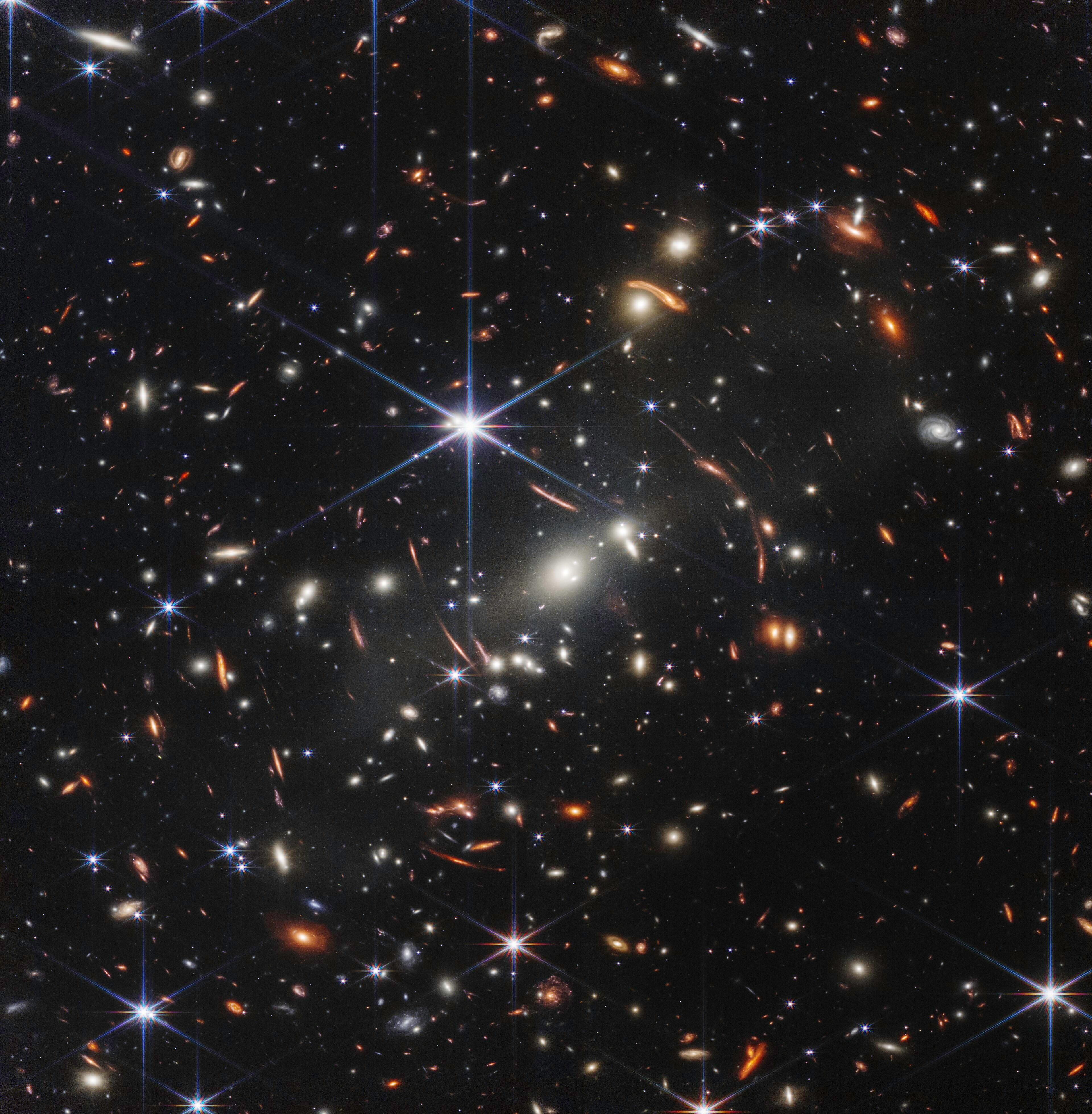
In 2022 that sharper telescope arrived. The James Webb Space Telescope sees in the infrared with several times Hubble's resolution, enough to pick individual Cepheids cleanly out of the crowd. Its very first public image, the deep field at the top of this page, showed thousands of galaxies in a patch of sky you could cover with a grain of sand, several of them smeared into arcs by the gravity of closer galaxies bending their light. It was built, among other things, to re-measure the rungs of the distance ladder and reveal the crowding error everyone half expected.
The error was not there. When the SH0ES team, in work led by Louise Breuval and Adam Riess, compared Webb's crisp Cepheid distances against the old Hubble ones, they agreed to within about 0.03 magnitudes, against a tension that amounts to roughly 0.18 magnitudes. The crowding could account for almost none of the gap. Webb's own expanding sample of supernova host galaxies kept returning high values, near 73.5, and a combined Hubble-and-Webb analysis across 55 supernovae landed at 73.18, holding the disagreement with Planck at close to six standard deviations. The telescope built to catch the mistake instead confirmed the measurement. The easiest way out had quietly closed.
The dissenter in the room
It would be dishonest to tell you the whole field agrees the tension is even real, because it does not. The sharpest challenge comes from Wendy Freedman, the same astronomer who delivered the Key Project's reassuring 72 back in 2001. Her Chicago-Carnegie Hubble Program deliberately avoids leaning on Cepheids, worried about exactly the crowding and calibration questions that dog them. Instead it climbs the ladder using the tip of the red giant branch, a sharp cutoff in the brightness of aging stars, and a second method based on carbon-rich stars called the JAGB technique.
Using Webb data alone across ten galaxies, Freedman's team reported in 2025 a Hubble constant of 68.8 from the red giant method and 67.8 from the carbon stars, numbers that sit comfortably close to Planck's early-universe value and show no dramatic tension at all. Her argument is pointed: measure the local universe without Cepheids, with their own independent set of possible pitfalls, and the crisis softens toward a normal, livable disagreement.
The SH0ES camp counters that the red giant method carries subtleties of its own and that their Cepheid-and-supernova ladder is the better understood of the two. The two groups have examined each other's work in detail and still come away with different numbers. That is its own kind of eerie result. The debate is no longer only about what the universe is doing. It is about whether two of the most careful teams in astronomy, looking at the same nearby galaxies, can agree on how far away they are.
What would have to be wrong
Strip the problem down and it forks into two possibilities, and neither is comfortable.
The first is that one of the measurements is wrong in a way no one has yet found. Perhaps the distance ladder has an undiscovered flaw hiding in the supernovae or the stellar calibrations. Perhaps the early-universe calculation leans on an assumption about the primordial plasma that is subtly off. This is the conservative hope, the one that keeps our model of the cosmos intact. The trouble is that both campaigns have been audited, re-audited, and cross-checked for years, and the Webb results stripped away the most promising candidate for a hidden error. A flaw that survives that much scrutiny is itself a strange thing to believe in.
The second possibility is the one that makes cosmologists lower their voices. It is that both measurements are right, and the fault lies in the model that connects them, the standard picture called Lambda Cold Dark Matter. In that case the early universe really did expand in a way that, run forward through our known physics, produces 67 today, and the local universe really is running at 73, and the only way to reconcile them is to add something new to the story of how the cosmos evolved. Something we have not yet discovered. The same unease haunts other active puzzles in this field, from the impossible energy of the Oh-My-God particle to the hidden mass dragging on us in the Great Attractor: each is a place where the standard account works almost everywhere, and then quietly fails.
The candidates no one can confirm
If the model is what needs fixing, there is no shortage of ideas, and the honest truth is that not one of them has been confirmed. Each solves the tension at the cost of introducing something else we cannot yet see.
The most discussed is early dark energy. In 2019, Vivian Poulin, Tristan Smith, Tanvi Karwal, and Marc Kamionkowski proposed that a brief, strange burst of a dark-energy-like substance acted in the first fraction of the universe's existence and then vanished. Such a burst would have shrunk that primordial sound-wave ruler, which would raise the Hubble constant you infer from the early universe, nudging 67 up toward 73. It works on paper. No one has found independent evidence that this early dark energy existed.
Then there is the possibility that dark energy, the mysterious push accelerating the expansion today, is not the steady constant the standard model assumes. The international DESI collaboration, mapping millions of galaxies, reported in its 2024 and 2025 analyses faint hints that dark energy's strength may have changed over cosmic history. If true, it would rewrite the recent expansion story. Yet the same data pull in frustrating ways: some analyses find the evolving dark energy eases the Hubble tension, others find the tension survives every variation they try, and the two preferred fixes tend to work against each other.
A third idea is almost cozy by comparison. Perhaps we simply live in an unusually empty patch of the cosmos. In 2013, Ryan Keenan, Amy Barger, and Lennox Cowie found evidence from infrared galaxy counts for a large local underdensity, now called the KBC void, a region roughly 20 percent below the cosmic average stretching perhaps two billion light-years across. Galaxies would flow outward from the thin center of such a void, and that extra local motion could make our neighborhood appear to expand faster than the universe as a whole. In 2025, Indranil Banik and a colleague tested the idea against decades of sound-wave measurements and reported that a void model fit the data far better than a universe without one, cutting the tension sharply. The catch is severe: a void that large and that deep sits uneasily with one of the standard model's founding assumptions, that on the largest scales the universe is smooth and the same in every direction. To accept the void, you may have to give up the uniformity.
Others have proposed extra species of ghostly radiation in the early universe, or outright modifications to gravity itself. Every one of these is a real idea in real journals. Every one buys agreement on the Hubble constant by spending it somewhere else.
The edge of the map
What makes the Hubble tension so quietly remarkable is that it is not a blurry photograph or a signal heard once and never again. It is the opposite. It is two of the most precise measurements human beings have ever made, of the single number that scales the whole universe, and they will not agree. We built better telescopes specifically to break the deadlock, and the deadlock held. We checked the obvious error, and the error was not there.
Sit with what that means. If the measurements are sound, then the universe around us is expanding faster than the physics of its own birth permits, and the resolution waits somewhere we have not yet thought to look: in the first trillionth of a second, in the nature of dark energy, in the shape of the space immediately around us, or in gravity itself. The gap between 67 and 73 is small. The thing hiding inside it may not be. For a hundred years the question was whether we could measure the expansion of the universe at all. We can now, beautifully, from two directions. The question that lingers is why the universe gives us two different answers, and to this day no explanation satisfies everyone who has looked.
Frequently asked questions
What exactly is the Hubble tension? It is the persistent, growing disagreement between two precise ways of measuring the Hubble constant, the rate at which the universe is expanding. Measurements based on the early universe, chiefly the cosmic microwave background, give a value near 67 kilometers per second per megaparsec. Measurements based on the nearby universe, using stars and supernovae as distance markers, give a value near 73. The two differ by about five to six standard deviations, far beyond their stated uncertainties.
Why can't scientists just take the average and move on? Because an average would hide the real message. These are not two sloppy guesses straddling a true value. They are two careful measurements of the same quantity that are each internally consistent and reproducible, and that have grown further apart, in statistical terms, as the data improved. Splitting the difference would paper over whatever is actually causing them to disagree, which is the thing worth understanding.
Didn't the James Webb Space Telescope solve it? It settled one question and deepened the larger one. Webb's sharper vision tested whether crowded, blended star images were inflating the local measurement, long the favored explanation for the gap. The new images confirmed the older distances almost exactly, ruling that explanation out. Far from closing the tension, Webb removed the most comfortable way of dismissing it.
Could this mean our understanding of the universe is wrong? It could mean our current model is incomplete. If both measurements are correct, something is missing from the standard account of cosmic history, perhaps an early burst of dark energy, perhaps a dark energy that changes over time, perhaps a large void around us, perhaps new physics entirely. Each proposed fix solves the Hubble tension only by introducing something else we have not independently confirmed.
Will we know the answer soon? New data arrive constantly, from Webb's expanding supernova sample to the DESI galaxy survey to gravitational-wave events that offer a wholly independent ruler. Any of them could tip the balance. But the tension has already outlasted years of improved measurements and the arrival of a telescope built to resolve it. Whatever is causing it has proven very good at staying hidden in a gap only a few percent wide.
Further reading
If this pulled you in, these books go deeper into the measurement, the people, and the stakes:
- •The Last Stargazers by Emily Levesque, a vivid account of how astronomers actually wring numbers like this out of the night sky. Search on Amazon
- •The 4% Universe by Richard Panek, on the discovery of dark matter and dark energy, the very ingredients the Hubble tension may be testing. Search on Amazon
- •The First Three Minutes by Steven Weinberg, the classic account of the early universe whose physics the tension puts under strain. Search on Amazon
If you would rather look up than read, a pair of astronomy binoculars will show you the Andromeda Galaxy, one of the rare large galaxies close enough that its own motion toward us briefly wins out over the expansion carrying everything else away. Browse astronomy binoculars on Amazon
Want to explore more mysteries?
We've got plenty more rabbit holes to go down.