The Great Attractor: What Is Pulling Us Toward a Sky We Can't See?
Our galaxy and a million others are streaming toward a mass hidden behind the Milky Way. Each time astronomers find its source, we keep falling past it.
Right now, as you read this, you are moving. Not around the Earth's axis, not around the Sun, not even on the slow carousel of the Milky Way turning once every quarter billion years. Underneath all of that, our entire galaxy and every galaxy near it are being swept in one direction at roughly 2.2 million kilometers per hour, about 1.4 million miles per hour, relative to the oldest light in the universe. We are falling. We have been falling for as long as there has been an us to fall, and we are falling toward a single region of the sky.
The strangest part is where that region sits. The thing drawing us in lies almost directly behind the bright, dusty band of our own galaxy, in the one stretch of sky our telescopes can barely see through. Astronomers gave it a blunt, honest name for something they could feel but not look at: the Great Attractor. Decades of work have gone into peering past the glare of the Milky Way to find out what is there, and every answer that comes back has the same unsettling shape. We find a great mass. It is never quite enough. We keep falling past it toward something farther out.
This article contains affiliate links. If you buy through them we may earn a small commission at no extra cost to you.
Table of Contents
- •A current in the galaxies
- •The seven who found the flow
- •The one patch of sky we cannot read
- •What the dust was hiding
- •The attractor that wasn't enough
- •Drawing the shoreline: Laniakea
- •The push we mistook for a pull
- •The flow that may not stop at the horizon
- •A current too fast for the model
- •What it would mean
- •Frequently asked questions
- •Further reading
A current in the galaxies
For most of the twentieth century, astronomers thought they understood the broad motion of the galaxies. Everything is flying apart as space itself expands, a discovery tied to Edwin Hubble in the 1920s, and the farther away a galaxy is, the faster it recedes. On top of that smooth outward drift, each galaxy has a smaller, personal motion of its own, nudged this way and that by the gravity of its neighbors. These extra motions, called peculiar velocities, were supposed to be modest and more or less random, a little local jostling against the orderly expansion.
The cosmic microwave background, the faint afterglow of the Big Bang that fills the whole sky, gave the first hint that something larger was going on. That glow is not perfectly even. One half of the sky is very slightly warmer than the other, a lopsidedness called the dipole, and the cleanest way to read it is as motion. We are moving toward the warm side and away from the cool one, and the speed that fits the measurement is about 630 kilometers per second for our Local Group of galaxies. That is not a little jostle. Something was pulling a whole neighborhood of galaxies in a single, coherent direction, and no one could say what.
The seven who found the flow
In the 1980s, a group of astronomers set out to map those motions directly. Donald Lynden-Bell, Alan Dressler, Sandra Faber, David Burstein, Roger Davies, Roberto Terlevich, and Gary Wegner measured the distances and velocities of around 400 elliptical galaxies, a painstaking effort that earned them the half-joking nickname the Seven Samurai. Their idea was to compare how fast each galaxy appeared to be receding with how far away it actually was, and to see whether the leftover motions pointed anywhere in particular.
They did. In a 1988 paper in The Astrophysical Journal, Lynden-Bell and his colleagues reported that a vast collection of galaxies, our own among them, was streaming coherently toward a point in the direction of the southern constellations Centaurus and Hydra. The flow was too large and too organized to be local noise. Something with the mass of tens of thousands of galaxies, later estimated at around 50 quadrillion times the mass of the Sun, had to be sitting out there, somewhere between 150 and 250 million light years away, reeling everything in. Dressler gave the unseen thing a name that stuck. He called it the Great Attractor, and the name has carried its central frustration ever since. We named it for what it does to us, because we could not see what it is.
The one patch of sky we cannot read
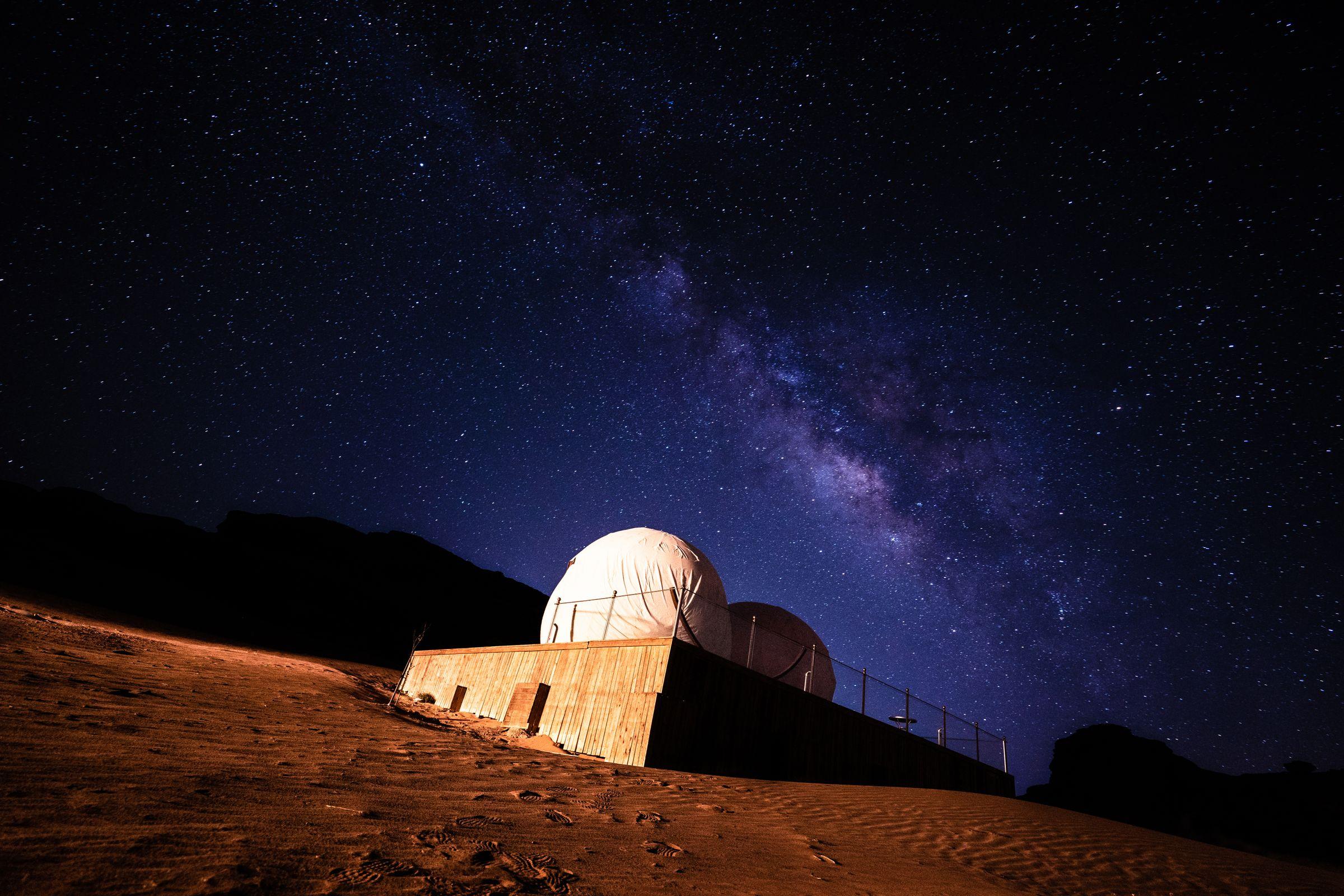
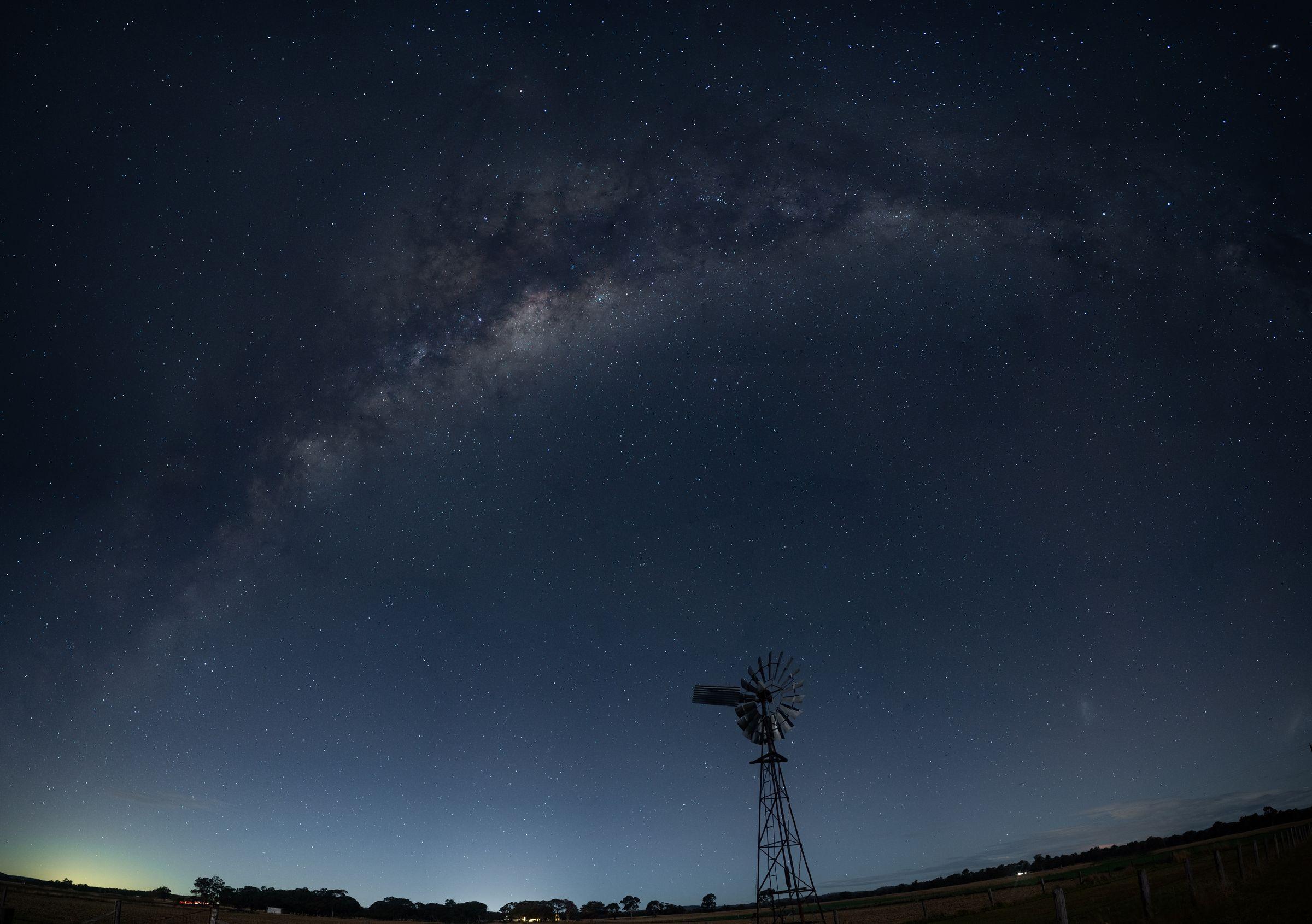
Here is the detail that turns a hard astronomy problem into something closer to a cruel joke. The Great Attractor lies low against the plane of the Milky Way, in a region astronomers call the Zone of Avoidance. Our galaxy is a flat disk of several hundred billion stars laced with clouds of gas and dust, and from our seat inside it, that disk wraps the sky in a broad, glowing band. It is beautiful to look at on a dark night. It is also nearly opaque. Behind that band, the stars and dust of our own galaxy drown out the faint light of anything beyond, and about a fifth of the entire sky is effectively curtained off.
The center of the Great Attractor sits deep behind that curtain. Of all the directions the pull could have come from, it came from the one place we are least able to look. For years this left the field in a genuinely odd position: astronomers could measure the motion of hundreds of galaxies being dragged toward the Attractor, could triangulate roughly where it had to be, and yet could not take a clear census of what was actually there. The mass announced itself only through its grip. To find out what it was made of, someone had to find a way to see through the Milky Way itself.
What the dust was hiding
Dust blocks visible light, but it is far more transparent to other wavelengths, and that opened a path. Through the 1990s and 2000s, astronomers went after the Zone of Avoidance with radio telescopes tuned to the 21-centimeter line that neutral hydrogen emits, with infrared surveys, and with X-ray satellites that pick out the hot gas pooled in large galaxy clusters. Renee Kraan-Korteweg and her collaborators led deep searches straight into the obscured band, patiently pulling galaxies out from behind the glare.
What emerged was a real structure, the Norma Cluster, catalogued as Abell 3627, a massive swarm of galaxies sitting close to the predicted heart of the Great Attractor. It is one of the most massive clusters known in the nearby universe, rushing along with the general expansion at nearly 4,900 kilometers per second, and it anchors a broader sprawl of galaxies known as the Hydra-Centaurus Supercluster. For a while it looked like the case might close. There was the Attractor, more or less where the Seven Samurai said it would be, hiding in plain sight behind our galaxy. A great mass, found at last.
Then the astronomers added up the mass they could see, compared it to the pull they could measure, and the numbers would not meet.
The attractor that wasn't enough
The Norma Cluster and its surrounding supercluster are enormous, but they are not enough to produce all the streaming the Seven Samurai had found. When researchers modeled the gravity of everything they could identify around the Great Attractor, it accounted for only part of the motion. The galaxies were being pulled harder, and farther, than the visible mass could explain. Something beyond the Attractor was adding to the drag.
That something has a name too. Far past Norma, roughly 650 million light years away in the same broad patch of sky, lies the Shapley Supercluster, the largest concentration of mass in the local universe, a dense knot of more than twenty galaxy clusters. The picture that took shape was unsettling in a quiet way. The Great Attractor is not so much a destination as a way station. We are being pulled toward it, yes, but we and the Great Attractor together are being pulled onward toward Shapley, and the flow does not obviously stop there. Every time the mystery seemed to resolve into a single object, the object turned out to be riding a larger current. The pull kept outrunning the mass.
Drawing the shoreline: Laniakea
In 2014, a team led by R. Brent Tully, with Helene Courtois, Yehuda Hoffman, and Daniel Pomarede, offered a way to see the whole current at once. Writing in Nature, they used the measured motions of about 8,000 galaxies to map not where matter sits but which way everything is flowing. Imagine rain falling across a continent. You can define a watershed by asking, for every drop, which basin it eventually drains into. Tully's team did the same thing with galaxies, tracing the flow lines of cosmic motion and drawing a boundary around every galaxy whose path bends inward toward the same great basin.
The basin they mapped is immense, about 500 million light years across, holding something like 100,000 galaxies and a hundred quadrillion solar masses. They named it Laniakea, a Hawaiian phrase meaning immense heaven. The Milky Way sits out near its far edge. And the point where all those flow lines converge, the bottom of the valley toward which our entire supercluster drains, is the Great Attractor. In Laniakea, the Attractor finally had a role that made sense. It was not a lone object to be weighed and dismissed but the focal point of a flow pattern spanning a half billion light years of space.
Yet even Laniakea does not close the question. The supercluster is not gravitationally bound. It is not destined to collapse together into a single object. It is a feature in a flow, and that flow is still tipping outward, toward Shapley and beyond. Tully himself noted that our immense heaven is itself being drawn toward the greater mass of the Shapley Concentration. We had drawn a magnificent map and found our home on it, and the map still had an arrow leading off its own edge.
The push we mistook for a pull
Then came an inversion that few saw coming. In 2017, Hoffman, Pomarede, Tully, and Courtois published a result in Nature Astronomy that reframed the entire question of what moves us. For decades, everyone had assumed the Local Group's motion came from attraction, from overdense regions reaching out across space and pulling us toward them. But gravity, in the expanding universe, has a second face. A region emptier than average does not pull as hard as its surroundings, and relative to everything else, that under-pull acts exactly like a push. Emptiness shoves.
Mapping the flows carefully, the team found that our motion is caused in roughly equal parts by two things on opposite sides of the sky. On one side, the attraction of the Great Attractor and the Shapley Supercluster draws us in. On the other side sits a vast, barren region nearly empty of galaxies, and because it is so empty it repels. They called it the Dipole Repeller. Half of what we had spent thirty years calling a pull toward something turned out to be a push away from nothing, from a hole in the cosmic web so devoid of matter it had gone unnoticed precisely because there was so little light there to see. The thing steering our galaxy was, in part, an absence.
The flow that may not stop at the horizon
The deeper you follow the motion outward, the stranger the accounting becomes, and here the story reaches its most contested edge. In 2008, Alexander Kashlinsky and his collaborators reported something that, if real, would be among the most radical findings in cosmology. Studying hundreds of distant galaxy clusters, they measured a faint imprint the clusters leave on the microwave background as they move, and read from it a coherent flow of hundreds of kilometers per second, all streaming toward a patch of sky near the Centaurus and Hydra region, the same direction as the Great Attractor. They called it dark flow.
What made the claim electric was its reach. The standard model of cosmology allows for local tugs like the Great Attractor, but it predicts that on the largest scales the pulls from all directions should roughly cancel, leaving the deep flow quiet. Kashlinsky's dark flow did not quiet down. It appeared to extend across much of the observable universe and to point beyond it, which would mean that something outside everything we can ever see, perhaps a feature imprinted on space before the great expansion of the early universe, was tilting the whole visible cosmos in one direction.
The claim has been fiercely disputed. When the European Space Agency's Planck satellite examined the same kind of signal in 2013, it reported no detection of such a flow, setting a limit far below Kashlinsky's figure, and much of the field concluded the dark flow was not real. Kashlinsky's group pushed back, arguing the dipole was still present in the data and the disagreement lay in how it was measured, and they continued to report a signal in later work. The question has never been cleanly settled. The mainstream reading is that the dark flow does not exist. But it sits in the record as a measurement, taken in the direction we are already known to be falling, that no one has fully put to rest.
A current too fast for the model
If the dark flow were the only loose thread, it might be easy to set aside. It is not. The more ordinary, better-measured cousin of that signal, the bulk flow of galaxies in our own cosmic neighborhood, has been making trouble of its own. In 2023, Richard Watkins, Hume Feldman, Brent Tully, and colleagues used Cosmicflows-4, the largest catalog of galaxy distances and motions yet assembled, to measure how fast a large sphere of the nearby universe is drifting as a whole. Out to a radius of about a billion light years, they clocked a bulk flow of roughly 420 kilometers per second.
That is faster than the standard model of cosmology comfortably allows. In their analysis, a flow that large over a volume that big should be extraordinarily rare in a universe that obeys the usual rules, with the original work placing the tension at more than four standard deviations and a companion estimate putting the odds at well under one in a thousand. Later studies, using different methods and correcting for how surveys are shaped, have softened the number, placing the disagreement anywhere from under two to around three standard deviations, and some find it can be reconciled with the standard picture after all. The debate is live as of this writing. A 2025 analysis of where the flow comes from concluded that much of it is driven by mass concentrations beyond the surveyed sphere, by something large and distant still tugging from farther out, which is the same refrain the Great Attractor has sung since 1988. The farther we look, the more of the motion seems to originate past the edge of what we have mapped.
What it would mean
Strip the technical layers away and a single pattern runs through all of it. Our corner of the universe is in motion, that motion is large and organized, and the mass we can find in the direction we are heading has never been quite enough to explain it. Each discovery fills in part of the gap and reveals that the rest of the gap lies even farther out. The Great Attractor gave way to Hydra-Centaurus, which gave way to Shapley, which Laniakea folded into a single flow still tipping off the edge of its own map, shadowed by a repelling void and, at the most speculative extreme, by a flow that may reach past the horizon.
The reason cosmologists care goes to the foundation of modern cosmology. The whole edifice rests on an assumption called the cosmological principle: that on the largest scales the universe is smooth, the same in every direction, with no preferred place and no preferred way to fall. A bulk flow too large to fit that picture, or a dark flow reaching beyond the visible cosmos, would mean the assumption is not quite true, that space carries a grain or a lean built in from its earliest moments. It would not overturn the Big Bang. It would mean the recipe is missing an ingredient, the same quiet suspicion raised by other stubborn anomalies in the deep sky, from the unexplained chill of the CMB Cold Spot to the impossible energy of the Oh-My-God particle. For now, the motion is simply there, measured and real, aimed at a sky we still cannot clearly see.
Frequently asked questions
Where exactly is the Great Attractor? It lies in the direction of the southern constellations Centaurus and Norma, somewhere between about 150 and 250 million light years away, with the massive Norma Cluster marking the neighborhood of its core. The trouble is that this direction falls almost directly behind the dense, dusty band of the Milky Way, in the stretch of sky astronomers call the Zone of Avoidance. We can pinpoint roughly where the pull comes from with far more confidence than we can see what is actually sitting there.
Is the Great Attractor going to swallow the Milky Way? No, and this is one of the gentler facts in the whole story. The universe is expanding, and over the largest distances that expansion is accelerating, which steadily works against any infall. We are drifting toward the Great Attractor at a few hundred kilometers per second, but it is hundreds of millions of light years away, and the expansion of space between here and there means we will never arrive. The pull is real and measurable. The destination keeps receding.
Didn't scientists already explain it with the Norma Cluster and Laniakea? They explained a great deal of it, which is not the same as all of it. The Norma Cluster and the surrounding Hydra-Centaurus Supercluster are genuinely there and genuinely massive, and the 2014 Laniakea map beautifully placed the Great Attractor as the focal point of our home supercluster's flow. But the visible mass has never fully accounted for the motion, and Laniakea itself is still being drawn toward the even larger Shapley Supercluster beyond it. Every solution has left a remainder pointing farther out.
What is the difference between the Great Attractor and dark flow? The Great Attractor is a well-established feature of our local universe, a direction and a mass we can study, even if imperfectly. Dark flow is a far more controversial claim: that galaxy clusters across a huge span of the cosmos are all drifting the same way, toward a similar region of sky, in a manner the standard model says should not happen, possibly driven by something beyond the observable universe. One is a mapped, if hidden, piece of our cosmic backyard. The other, if it exists at all, would be a fingerprint of something outside everything we can ever see.
Could the whole thing just be a measurement error? Every part of it has been challenged, and that scrutiny is exactly why it still matters. The original streaming has held up for nearly four decades across many independent surveys. The dark flow is widely doubted, with Planck finding no sign of it, though its discoverers still defend it. The large bulk flow sits in between, strong in some analyses and softer in others, argued over right now in the current literature. What has never happened is the clean moment where the anomaly dissolves and the motion turns out to match the simple prediction. The current is there. The argument is only about how far it reaches and what it means.
Further reading
- •Voyage to the Great Attractor: Exploring Intergalactic Space by Alan Dressler, written by one of the Seven Samurai who found the flow, the closest thing there is to a firsthand account of the discovery. Find it on Amazon.
- •The Cosmic Web: Mysterious Architecture of the Universe by J. Richard Gott, a clear tour of the vast filaments, walls, and voids whose gravity sets galaxies like ours in motion. Find it on Amazon.
- •The 4% Universe by Richard Panek, on the hunt for the dark matter and dark energy that shape, and complicate, every attempt to weigh what is pulling us. Find it on Amazon.
If the real sky calls to you more than the page, a good pair of astronomy binoculars will carry you into the rich star fields of Centaurus, the southern direction the Great Attractor lies toward, even though the Attractor itself hides forever behind the dust of our own galaxy. Browse astronomy binoculars on Amazon.
Want to explore more mysteries?
We've got plenty more rabbit holes to go down.