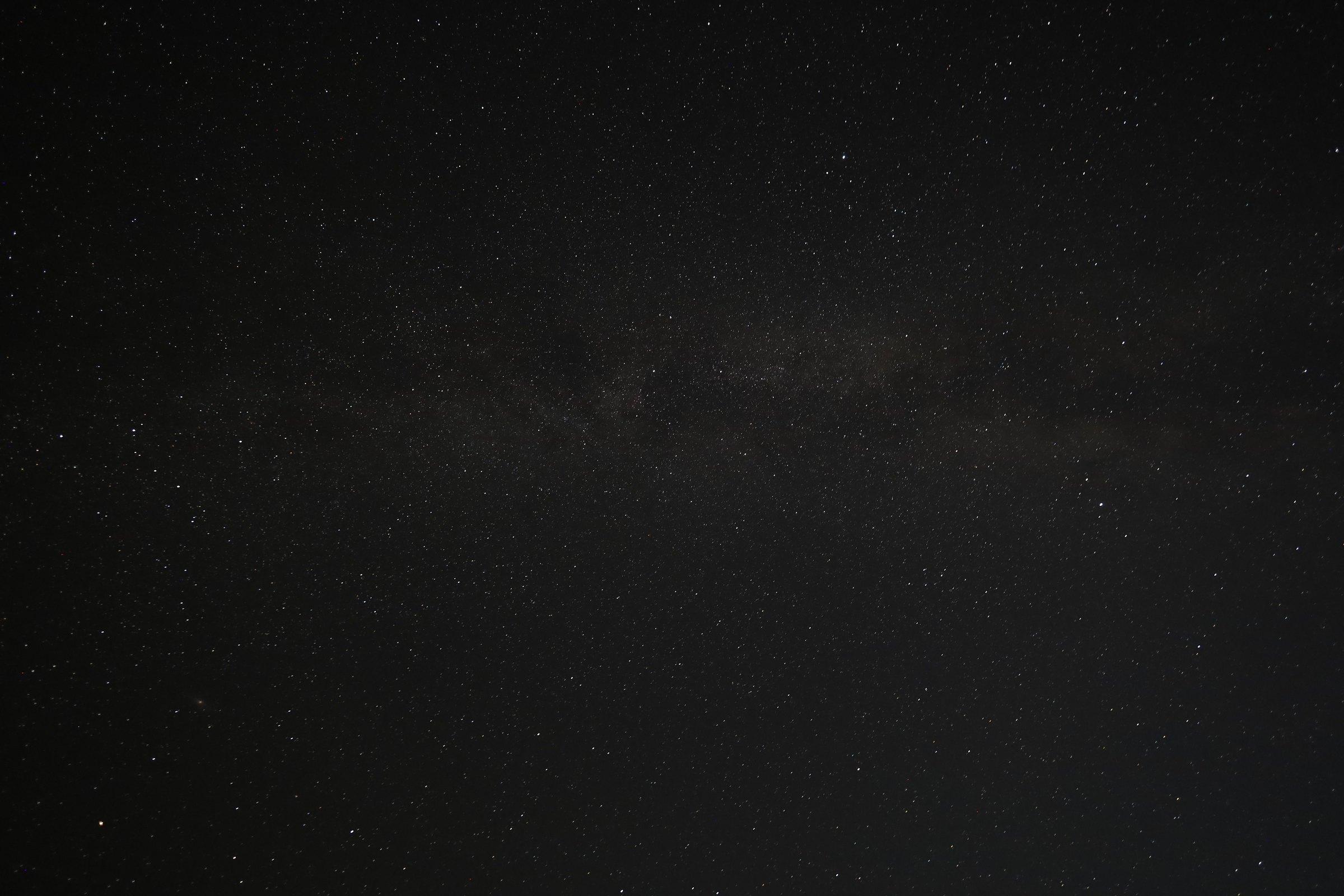
The CMB Cold Spot: A Hole in the Sky Too Cold to Explain
Two satellites found a vast cold patch in the afterglow of the Big Bang. A giant void was supposed to explain it, and the numbers still fall short.
Everywhere you point a microwave telescope, the sky glows with the same faint warmth. It is the oldest light there is, released when the universe was about 380,000 years old and cooled just enough for atoms to form, stretched now by 13.8 billion years of expansion into a whisper of microwaves filling all of space. The temperature of that glow is remarkably even. Measure it in one direction and then another, and the two readings agree to better than one part in ten thousand. The tiny differences that remain, a hundred-thousandth of a degree here, a hundred-thousandth there, are the seeds from which every galaxy grew. This is the cosmic microwave background, and it is the most precisely mapped thing in all of astronomy.
Then there is the spot in the constellation Eridanus. Down in the southern sky, in a patch about five degrees across, the ancient light runs cold. Not dramatically, not in a way any eye could ever see, but by the standards of a map this smooth it is a chasm. The region sits roughly 70 millionths of a degree below the average, dipping to around 140 millionths at its heart, when the typical ripple across the rest of the sky is only about 18 millionths. It is the single largest, coldest feature in the afterglow of the Big Bang, and more than twenty years after it was found, no one has produced an explanation that everyone accepts.
This article contains affiliate links. If you buy through them we may earn a small commission at no extra cost to you.
The strangest part is not that the Cold Spot is cold. It is that the obvious way to explain it, a colossal empty region of space draining the light of its energy, turns out not to be big enough, and the explanations that would be big enough sound like they belong in a different kind of article entirely.
Table of Contents
- •A patch of sky colder than it should be
- •The afterglow and its gentle ripples
- •Finding the spot in the noise
- •Not a glitch: a second satellite agrees
- •The void that was supposed to be the answer
- •The void that isn't cold enough
- •A knot left over from the beginning
- •A bruise from another universe
- •Why it refuses to close
- •Frequently asked questions
- •Further reading
A patch of sky colder than it should be
To understand why a faint cool patch has occupied cosmologists for two decades, you have to understand how boring the cosmic microwave background is supposed to be, and how boring it almost entirely is. The standard model of cosmology predicts that the hot and cold specks sprinkled across the ancient sky should be random, like the hiss of static, with no single feature standing far above the crowd. The ripples should follow a bell curve. Most should be small. A few should be larger. None should be enormous.
The Cold Spot is enormous. Spread across roughly ten degrees of sky, about twenty times the width of the full Moon, it is a smooth, round depression far deeper and far wider than the random hiss should ever produce in one place. When researchers compared it to tens of thousands of simulated skies built on the standard rules, only a sliver of those fake universes ever grew a feature so extreme. In the careful language of a 2007 analysis by Marcos Cruz and his colleagues, fewer than two simulated skies in a hundred produced a cold region like the real one. That is not quite the airtight certainty physicists prize, but it is persistent, and it has not gone away as the measurements have improved. It has only grown harder to dismiss.
The afterglow and its gentle ripples
The light we are talking about has a strange and beautiful history. For the first few hundred thousand years after the Big Bang, the universe was too hot for atoms to hold together. Electrons roamed free, and light could not travel far before scattering off them, so the cosmos was an opaque, glowing fog. Then expansion cooled everything below a critical temperature, the electrons paired up with nuclei into neutral atoms, and in a geologically sudden moment the fog cleared. The light that was flying around at that instant has been traveling ever since, unimpeded, slowly reddening as space stretched beneath it. That light is the cosmic microwave background, and when a microwave telescope records it, it is quite literally photographing the edge of the observable past.
The map it produces is almost perfectly uniform, which was itself a puzzle for an earlier generation of cosmologists. But almost is the important word. Laid over the smooth glow are faint temperature ripples, hotter and colder patches a few hundred-thousandths of a degree apart, and those ripples are precious. They are the fossilized sound waves of the infant universe, the slight overdensities that gravity would later pull into galaxies and clusters and the great cobwebbed structure of the cosmos. Cosmologists have spent decades measuring the statistics of those ripples, the sizes and spacings and proportions, because packed inside them is the recipe of the whole universe. By and large the ripples behave exactly as the theory says they should. The Cold Spot is one of the handful of places where they do not.
Finding the spot in the noise
NASA launched the Wilkinson Microwave Anisotropy Probe, WMAP for short, in 2001, and parked it well beyond the Moon to map the ancient light with a sharpness no prior mission had reached. When the first year of data came down, a team led by the Spanish cosmologist Patricio Vielva went looking for anything in the map that broke the rules of randomness. Their tool was a mathematical lens called a wavelet, tuned to flag features of a particular size. At a scale of about five degrees, the wavelet lit up. Something in the southern sky was more extreme than pure chance allowed.
The following year, Marcos Cruz, working with Vielva and others, pinned the feature down and gave it its plain, enduring name. In a 2005 paper titled simply "Detection of a non-Gaussian Spot in WMAP," they located it toward the constellation Eridanus, a long faint river of stars winding through the southern celestial hemisphere, and measured its depth and reach. The word non-Gaussian is the technical heart of the claim. Gaussian is the shape of pure randomness, the bell curve, and the standard universe is supposed to be Gaussian all the way down. A non-Gaussian spot is a place where the dice came up in a pattern the dice are not supposed to be able to make. Everything that has happened since has been an argument about what loaded them.
Not a glitch: a second satellite agrees
The first and most deflating possibility for any anomaly is that the instrument invented it. Telescopes have quirks. The faint light of our own Milky Way, lying across the foreground, can smear and contaminate a map of something far beyond it. If the Cold Spot were an artifact of WMAP's detectors or a trick of galactic dust, it would be a footnote, not a mystery.
That escape route closed in 2013. The European Space Agency's Planck satellite, a wholly separate spacecraft with different detectors, different optics, and far finer resolution, finished its own map of the ancient light. The Cold Spot was still there, in the same place, at the same depth, with the same stubborn significance. Two independent observatories, built by different space agencies on different continents, had photographed the same cold wound in the sky. Whatever it is, it is really out there, imprinted on the oldest light in existence. The question stopped being whether the Cold Spot is real and became what could have made it.
The void that was supposed to be the answer
The most grounded explanation does not require any new physics, only a very large absence. It leans on a subtle effect with an unwieldy name, the integrated Sachs-Wolfe effect, which describes what happens to a background photon when it passes through a huge region that is emptier than average.
Picture the ancient light crossing an enormous void, a stretch of space with fewer galaxies and less matter than its surroundings. Falling into the void's gravitational dip, the photon gains a little energy, like a ball rolling into a valley. Climbing back out the far side, it should give that energy back, like the ball rolling up the opposite slope, and the two effects should cancel. In a static universe they would. But our universe is not static. Dark energy is stretching it, and stretching it faster all the time, so during the millions of years the photon spends inside the void, the void itself grows shallower. The far slope is lower than the near one was. The photon cannot quite repay what it borrowed, and it exits a touch colder than it went in. Line enough empty space up along one sightline, and the light that reaches us from behind it carries a chill.
In 2007 the radio astronomer Lawrence Rudnick and colleagues reported a dip in the count of distant galaxies in the direction of the Cold Spot, the first hint that a real emptiness might lie along that line. Then, in 2015, a team led by Istvan Szapudi at the University of Hawaii announced something far larger. Mapping galaxies with the Pan-STARRS and WISE surveys, they found a genuine supervoid in front of the Cold Spot, a region where galaxies thin out dramatically, centered roughly three billion light years away and spanning about 1.8 billion light years. At the time it was described as possibly the largest single structure ever identified by human beings. It sat right where the cold patch was, and it looked, for a while, like a solution.
The void that isn't cold enough
The trouble is arithmetic. A void can chill the background light through the integrated Sachs-Wolfe effect, but only by so much, and when cosmologists work out how much, the number falls far short of what the Cold Spot needs. By the standard reckoning, even the Eridanus supervoid, enormous as it is, can account for only a fraction of the chill, something like a third at most. To do the whole job, a void would need to be hundreds or even a thousand times larger in volume than any that should exist in the standard universe. The emptiness is real, and it is still not nearly empty enough.
A 2017 study drove the point home. Ruari Mackenzie, Tom Shanks, and their colleagues at Durham University surveyed more than seven thousand galaxies along the sightline toward the Cold Spot, mapping the emptiness in three dimensions rather than flattening it onto the sky. What they found was not one monstrous continuous void but a line of smaller voids separated by walls of galaxies, which weakens the cooling effect further. More tellingly, they measured a control region of sky far from the Cold Spot and found a similar scattering of voids there, in a direction where the ancient light is not unusually cold. If voids like these caused cold spots, there should have been one in the control field too. There was not. The team concluded that no foreground void can explain the Cold Spot within the standard cosmology, and that the alignment of the void and the cold patch may be coincidence, leaving the door open to what they carefully called more exotic explanations.
The void camp has not conceded. Szapudi has said that if he had to bet on the cause, he would still bet on the supervoid, and later work has kept the idea breathing. A 2021 analysis led by Andras Kovacs, using the Dark Energy Survey, found that supervoids across the sky do seem to stamp a cold imprint on the background light that is stronger than the standard theory predicts. That is a fascinating result, but notice what it does. It does not rescue the tidy explanation. It replaces one anomaly with another, trading a cold spot we cannot explain for a cooling effect that is itself too strong to explain. The emptiness may be part of the story. It does not appear to be the whole of it.
A knot left over from the beginning
If no ordinary structure in front of the Cold Spot can produce it, perhaps the cold is not stamped on the light during its long crossing at all. Perhaps it was there from almost the beginning, a flaw woven into the fabric of space in the universe's first instant.
This is the cosmic texture idea, and it comes with real pedigree. In 2007, the same year the void debate was heating up, Marcos Cruz teamed with the cosmologist Neil Turok, among others, to publish a paper in the journal Science arguing that the Cold Spot is consistent with a cosmic texture. A texture is a kind of topological defect, a knot or snarl left over from a phase transition in the extremely early universe, the cosmic equivalent of a flaw that freezes into a crystal as it forms. Such a defect, slowly unwinding and releasing its energy, would leave behind exactly the sort of smooth, round cold imprint the data shows. It is an elegant proposal, because it turns the Cold Spot from an accident of foreground geography into a genuine relic, a direct fingerprint of physics from the first fraction of a second.
It also makes a testable promise, which is both its strength and its vulnerability. If one texture made the Cold Spot, there should be others scattered across the sky, and the unwinding knot should leave a particular gravitational signature in the way it bends the light around it, detectable in the polarization of the background or in the subtle lensing of galaxies behind it. So far, searches have not turned up the tell-tale population or the clinching signature. The texture remains a candidate, not a verdict, a beautiful idea still waiting for the evidence that would confirm or kill it.
A bruise from another universe
And then there is the explanation that sounds like fiction and is, nonetheless, printed in peer-reviewed journals. What if the Cold Spot is a mark left on our universe by another one.
The cosmologist Laura Mersini-Houghton has argued for years that certain features of the sky, the Cold Spot among them, could be imprints of our universe's entanglement with other universes before inflation stretched everything smooth. In a cosmos where ours is one bubble among many, neighboring bubbles can touch. In 2009, the physicists Spencer Chang, Matthew Kleban, and Thomas Levi worked out what such a collision would look like from the inside. When two bubble universes brush against each other in the eternal froth of the multiverse, the contact would press a round, disk-shaped bruise into the cosmic microwave background, a region of altered temperature with a characteristic edge. Other researchers, including Stephen Feeney and colleagues, have gone hunting through the WMAP data for exactly these collision signatures, flagging candidate features without ever confirming one.
It is worth being honest about where this sits. The multiverse collision idea is the least supported of the three, closer to speculation than to established physics, and most cosmologists do not think the Cold Spot is a scar from a cosmic sideswipe. But the reason it keeps coming up is instructive. A feature this extreme, confirmed by two satellites, resisting the ordinary void explanation, invites extraordinary ones. When the boring answer runs out of room, the exotic answers get a hearing they would otherwise never receive. The Cold Spot is one of the few places in modern cosmology where the phrase "an imprint of another universe" can appear in a serious paper and not be laughed out of the room.
Why it refuses to close
Strip away the competing stories and what remains is a simple, uncomfortable fact. There is a large, cold, round region in the oldest light in the universe, bigger and deeper than the standard model of cosmology says the sky should be able to grow in one spot, and every attempt to explain it leaves something over. The void is real but too shallow. The texture is elegant but unconfirmed. The collision is bold but unsupported. Each idea accounts for part of the picture and stumbles on the rest.
The Cold Spot does not sit entirely alone, either. Cosmologists have catalogued a small family of large-scale oddities in the ancient light, including an unexpected alignment of the biggest ripples that some have nicknamed the "axis of evil," hints that the two halves of the sky are not quite as identical as the theory expects. On their own, each of these can be waved off as the kind of fluke a vast universe is bound to throw up now and then. Together they nag. They may be nothing, a handful of coincidences in a map so large that rare patterns are guaranteed to appear somewhere. Or they may be the first faint edges of something the standard model does not yet contain, a clue that the recipe of the universe is missing an ingredient.
That is the quiet weight of a cold patch in Eridanus. We have mapped the beginning of time to a precision earlier astronomers could not have dreamed of, and across almost the entire sky the map matches the theory with uncanny fidelity. In one round, cold region, it does not. Something pressed a chill into the first light, and we have measured it twice, from two spacecraft, beyond any doubt that it is there. We simply cannot yet say what did it, or whether the answer is a hole in space, a knot from the dawn of everything, or a touch from a universe we will never see.
For other signals from deep space that arrived carrying more questions than answers, there is the Oh-My-God particle, a cosmic ray so energetic it should not have survived its trip, and the Wow! Signal, a radio burst from Sagittarius that has never repeated. For a star whose dimming has outlasted every tidy explanation, see Tabby's Star, and for the fleeting flashes crossing billions of light years, the fast radio bursts.
Frequently asked questions
How cold is the Cold Spot, really? In human terms, barely cold at all. The whole cosmic microwave background sits at about 2.7 degrees above absolute zero, and the Cold Spot is only around 70 millionths of a degree below the average, dropping to roughly 140 millionths at its coldest. What makes it startling is not the size of the chill but the size of the patch and the smoothness of everything around it. Against a sky whose ordinary ripples are about 18 millionths of a degree, a cold region this broad and this deep is a genuine outlier, not a rounding error.
Could it just be a flaw in the telescope? That was the first thing cosmologists checked, and it is the explanation that has been most firmly ruled out. The WMAP satellite found the spot, and years later the European Space Agency's Planck satellite, an entirely separate spacecraft with different instruments, mapped the same light and found the same feature in the same place at the same depth. Two independent observatories agreeing this closely is about as strong as evidence gets that the Cold Spot is a real feature of the sky and not a quirk of any one detector.
Didn't scientists find a giant void that explains it? They found a giant void, which is not quite the same thing. A supervoid about 1.8 billion light years across does sit in front of the Cold Spot, and a void can chill passing light through the integrated Sachs-Wolfe effect. But when researchers calculate how much cooling that void can produce, it comes out to only a fraction of what the Cold Spot shows, and a 2017 survey found similar voids in a region of sky that is not unusually cold. The emptiness may contribute. By the standard physics, it cannot do the whole job.
What is a cosmic texture? It is a hypothetical flaw frozen into space during a phase change in the universe's first instant, a bit like the crack that forms as water freezes into ice. A texture slowly unwinding would release energy and leave a smooth, round cold imprint on the background light, which fits the Cold Spot well. The idea, put forward in 2007 by a team including Neil Turok, is attractive because it would make the spot a true relic of the early universe. It also predicts other such spots and a specific gravitational signature, and those have not yet been found, so it stays a live possibility rather than a confirmed cause.
Is the "other universe" explanation taken seriously? It is taken seriously enough to be published and searched for, and not seriously enough to be the leading answer. The notion that the Cold Spot is a bruise left by a collision with a neighboring bubble universe has appeared in peer-reviewed work, and researchers have combed the data for the disk-shaped mark such a collision would leave. Nothing conclusive has turned up. Most cosmologists regard it as the long shot among the options. That it is on the table at all is a measure of how stubbornly the Cold Spot has resisted every ordinary explanation.
Further reading
- •The First Three Minutes by Steven Weinberg, the classic account of the hot early universe and the birth of the light we now see as the cosmic microwave background. Find it on Amazon.
- •The 4% Universe by Richard Panek, on the discovery of dark energy and dark matter, the invisible ingredients behind the very effect that is supposed to make voids cold. Find it on Amazon.
- •Our Mathematical Universe by Max Tegmark, a serious physicist's tour of the multiverse ideas that let the Cold Spot be read, by some, as a mark from another cosmos. Find it on Amazon.
If looking up at the real sky appeals more than reading about it, a good pair of astronomy binoculars will carry you deep into the faint stars of Eridanus, the southern constellation the Cold Spot lies toward, though the spot itself hides in microwaves no optical instrument can show. Browse astronomy binoculars on Amazon.
Want to explore more mysteries?
We've got plenty more rabbit holes to go down.