The Oh-My-God Particle: One Subatomic Blow From an Empty Sky
In 1991 a single particle hit Utah with the energy of a thrown baseball. It should not exist, and when we trace it back, the sky is empty.
On the night of October 15, 1991, in the high desert west of Salt Lake City, a cluster of mirrors pointed at the dark sky caught a flicker of ultraviolet light that lasted a few millionths of a second. The mirrors belonged to an instrument called the Fly's Eye, run by the University of Utah at Dugway Proving Ground, and what they recorded was the faint glow of air molecules lighting up as something tore through the upper atmosphere far overhead. By itself a flash like that is routine. Cosmic rays rain down on the planet constantly, and the Fly's Eye existed precisely to count them.
This one was different. When the physicists reconstructed the energy of the particle that had caused the cascade, the number was so large that they did not believe it. They held the result back, checked it, rechecked it, and sat on it for more than a year before they were willing to publish. The particle carried an energy of roughly 3.2 times ten to the twentieth electronvolts. That figure means almost nothing on its own, so here is the translation that made it famous: a single subatomic particle, something unimaginably smaller than a speck of dust, had struck the sky over Utah carrying about the same kinetic energy as a baseball thrown at sixty miles an hour. Physicists started calling it the Oh-My-God particle, and the name stuck.
This article contains affiliate links. If you buy through them we may earn a small commission at no extra cost to you.
More than three decades later, no one has fully accounted for where it came from. Worse, the rules of physics as we understand them say a particle like that, arriving from deep space, should not have been able to reach us at all.
Table of Contents
- •A baseball compressed into a single particle
- •The eye that watches the desert sky
- •The speed limit of the universe
- •Tracing it back to nothing
- •Thirty-two years later, it happened again
- •The explanations, and the holes in them
- •A warm spot near the Big Dipper
- •Why physicists cannot let it go
- •Frequently asked questions
- •Further reading
A baseball compressed into a single particle
It is worth sitting with the numbers for a moment, because they are what make this case feel less like astronomy and more like a riddle. The Oh-My-God particle carried about fifty joules of energy. Fifty joules is nothing dramatic at human scale. It is roughly the energy of a brick lifted to the height of your shoulder, or that sixty-mile-an-hour baseball leaving a pitcher's hand. You could absorb it without noticing.
The strangeness is that all of it was bound up in one particle, most likely a single atomic nucleus. Everyday particles do not behave this way. The most powerful proton beams ever created on Earth, inside the Large Hadron Collider near Geneva, reach energies about forty million times smaller than what arrived over Utah that night. To accelerate a particle to that speed by human means, you would need a machine far larger than the solar system. Nature did it somewhere out in the dark, and we have never found the machine.
The velocity is almost beyond writing down. The particle was traveling so close to the speed of light that if it had set off in a race with a beam of light across a distance of millions of light years, the light would have won by a fraction of a second at most. In the particle's own warped sense of time, the entire width of our galaxy would pass in moments. It was, for all practical purposes, a piece of matter moving at the absolute edge of what the universe permits.
The eye that watches the desert sky
The Fly's Eye did not see the particle directly. Nothing can. An ultra-high-energy cosmic ray that strikes the top of the atmosphere never reaches the ground as a single object. Instead it slams into an air molecule miles up and shatters into a spray of secondary particles, which strike more molecules and shatter again, multiplying downward into a cascade called an air shower. By the time it nears the surface, that one original particle has become billions of fragments spread across a wide footprint.
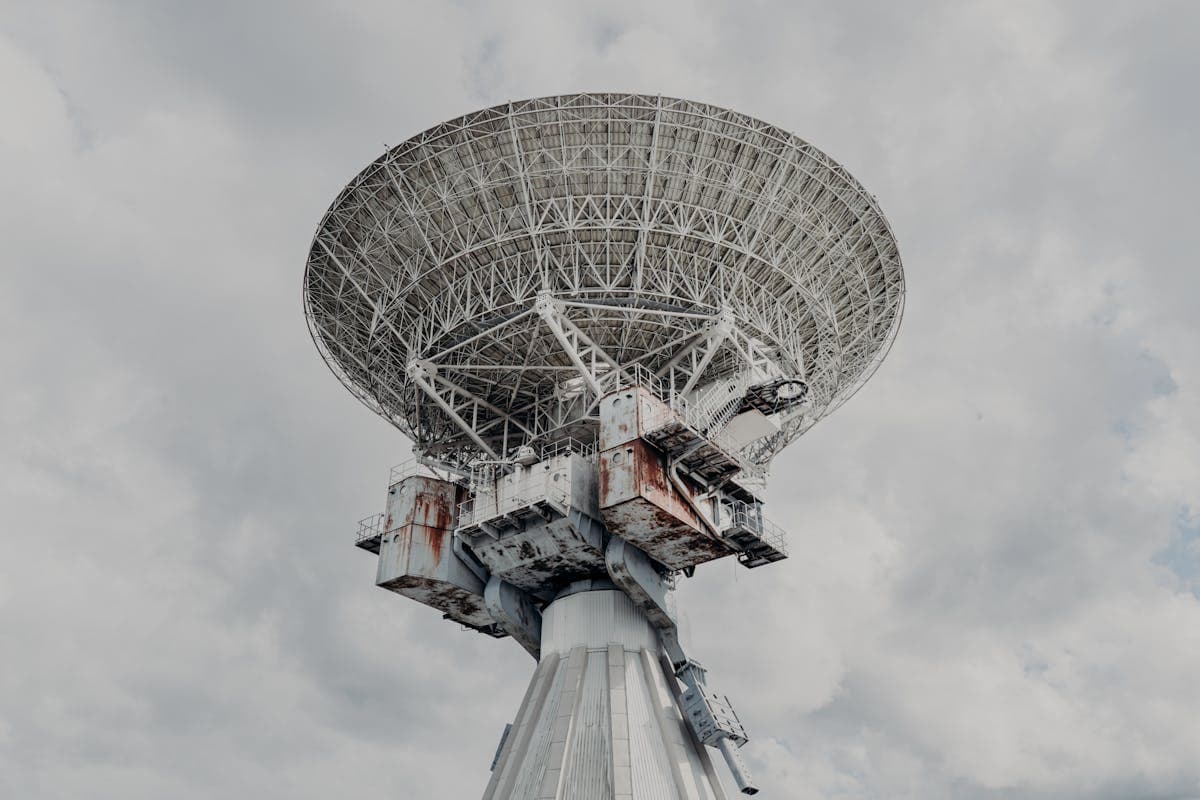
As the shower rips through the air, it excites nitrogen molecules, and the nitrogen gives off a dim ultraviolet glow. The Fly's Eye was a field of mirrors and light sensors built to watch for exactly that glow on clear, moonless nights, reading the brightness and shape of the streak to work backward to the energy of whatever had started it. It was patient work. A detector like that might wait years for a single event at the very top of the energy scale, because the most powerful cosmic rays are staggeringly rare, arriving at a rate of something like one particle per square kilometer per century.
The team, led by researchers at the University of Utah, published the detection in 1995 in The Astrophysical Journal under a title that says the quiet part plainly: a cosmic ray with measured energy well beyond the expected cutoff. That expected cutoff is the heart of the mystery, and to understand why the particle unsettled physics, you have to understand the wall it was not supposed to be able to cross.
The speed limit of the universe
In 1966, within months of each other, three physicists working on opposite sides of the Cold War reached the same conclusion. Kenneth Greisen at Cornell, and Georgiy Zatsepin and Vadim Kuzmin in Moscow, each realized that the universe is not actually empty. Space is filled with the cosmic microwave background, the faint afterglow of the Big Bang, a bath of low-energy photons spread evenly through all of space.
To us those photons are harmless. To a proton moving at the energies of the Oh-My-God particle, they are not. When a particle is moving that fast, even a feeble microwave photon hits it like a wall. Above a certain threshold, around five times ten to the nineteenth electronvolts, a traveling proton starts colliding with these background photons and bleeding off energy, shedding it in bursts of new particles called pions. Each collision costs it a slice of its momentum. The faster it goes above the threshold, the more aggressively the universe drags it back down.
The consequence has a name, the GZK limit, after its three discoverers. It does not forbid a particle from having enormous energy. It says that such a particle cannot keep that energy across long distances. Run the numbers and a proton above the cutoff can travel only so far before friction with the background light wears it down, a range of roughly 160 million light years. On the scale of the cosmos, that is the neighborhood. It means any particle we catch above the GZK limit must have been fired from something relatively close to us, cosmically speaking. It could not have come from across the universe, because it would have arrived exhausted.
The Oh-My-God particle sat far above that limit, still carrying its full, absurd energy when it reached Earth. So the source had to be nearby. And that is where the trouble begins.
Tracing it back to nothing
A charged particle does not travel in a straight line through space. Magnetic fields, threading through our galaxy and the space between galaxies, bend its path the way a current bends a swimmer. For most cosmic rays this makes the question of origin hopeless, because by the time they reach us their direction has been scrambled beyond recovery.
But the highest-energy particles are different. They are so powerful that magnetic fields barely nudge them. A particle like the Oh-My-God event should fly nearly straight, which means that when you trace its arrival direction backward, you ought to be pointing more or less at the thing that made it. Astronomers did exactly that. They followed the line back into the sky toward the constellation of the night it arrived.
There was nothing obvious there. No nearby galaxy with a violent core, no known cataclysm, no object of the kind that physicists can imagine accelerating matter to such a pitch, sitting within the 160-million-light-year range the GZK limit demands. The particle carried energy that could only survive a short trip, yet it pointed back at a stretch of relatively empty space. For a single event, that could be shrugged off as bad luck or a measurement at the ragged edge of the instrument's ability. One particle is an anecdote. The problem is that it did not stay a single event.
Thirty-two years later, it happened again
The Fly's Eye was eventually succeeded by a far larger instrument built in the same Utah desert, the Telescope Array: 507 detector stations spread across roughly 270 square miles of the West Desert near the town of Delta, each one waiting for the fragments of an air shower to fall on it. On May 27, 2021, 23 of those stations lit up at once. The pattern they recorded traced back to a particle with an energy above 240 times ten to the eighteenth electronvolts, the most powerful cosmic ray seen since 1991.
The team announced it in the journal Science in November 2023, and gave it a name drawn from Japanese mythology: the Amaterasu particle, after the Shinto goddess of the sun. The lead researcher, Toshihiro Fujii of Osaka Metropolitan University, and his colleagues did what the earlier team had done. They traced the arrival direction back into the sky to see what had launched it.
It pointed at the Local Void, one of the emptiest patches of the nearby universe, a vast region next to our own galaxy where there are almost no galaxies at all. Fujii put the discovery in words that could describe the whole mystery: "No promising astronomical object matching the direction from which the cosmic ray arrived has been identified." Two of the most energetic particles ever recorded, found 32 years apart by instruments in the same desert, both arriving with energies that forbid a long journey, and both pointing back at regions of sky where there is nothing capable of sending them. A later reanalysis in 2026 argued that Amaterasu might have come from beyond the void after all, perhaps from nearby galaxies such as NGC 6946 or Messier 82, their fields bending its path more than first assumed. The debate is open and honest. What no one has produced is a confident name for the source.
The explanations, and the holes in them
The physics community has not been idle about this. Several serious ideas compete to explain the particles that break the GZK limit, and each one accounts for part of the picture while leaving a piece unexplained.
The most conservative idea is that we are simply surrounded by hidden engines. Supermassive black holes feeding at the centers of galaxies, the shockwaves of gamma-ray bursts, the magnetic storms of magnetars, or the furious star formation inside starburst galaxies could in principle fling particles to these energies. The difficulty is that when we look toward where the particles come from, the obvious engines are not there, or are too far away to beat the GZK limit. The accelerator and the empty sky refuse to line up.
A bolder family of ideas goes the other way, and is called top-down. Instead of a particle being pushed up to high energy by some cosmic engine, it begins at an unthinkable energy and decays downward. Hypothetical relics from the early universe, superheavy particles or flaws in the fabric of space called topological defects, could be breaking apart now and releasing the fragments we detect. This neatly explains particles that seem to come from nowhere, because the source would be invisible dark matter spread through our own galactic halo rather than a bright object in the sky. The catch is that no such relic has ever been found, and the theory predicts byproducts, floods of high-energy gamma rays, that we do not see in the expected amounts.
A third possibility is the most radical. Perhaps the GZK limit is not quite a limit. The entire calculation rests on the assumption that the laws of physics, in particular the perfect symmetry of relativity, hold exactly even at energies we can never reach in a laboratory. If that symmetry bends by a vanishingly small amount at extreme energies, a possibility some theories of quantum gravity allow, the braking effect of the background light would weaken and the particles could cross the cosmos intact. That would be a genuine rewrite of fundamental physics, which is a heavy price, and the evidence does not yet force anyone to pay it.
There is also the quieter question of what the particle even is. If the Oh-My-God and Amaterasu events were not lone protons but heavier atomic nuclei, iron perhaps, the whole story shifts. Heavier nuclei interact with magnetic fields and background light differently, which could both bend their paths more, erasing the pointing problem, and change how the GZK braking applies. Measurements of the composition at the highest energies remain genuinely uncertain, and that uncertainty is itself part of why the mystery has not closed.
A warm spot near the Big Dipper
If the particles came from random directions all over the sky, that would point toward the top-down and dark-matter ideas. If they clustered toward specific objects, that would point toward real accelerators out in space. So the natural next move is to build a map.
Over years of watching, the Telescope Array found a hint of structure. A region about 20 degrees wide, toward the constellation Ursa Major near the bowl of the Big Dipper, seems to produce more of the highest-energy events than chance would predict. Researchers call it the hotspot. It is not a sharp arrow pointing at a single galaxy. It is a broad smudge, a statistical warmth in one part of the sky, strong enough to be interesting and too diffuse to name a culprit. The much larger Pierre Auger Observatory in Argentina, which watches the southern sky with detectors spread across an area the size of a small country, sees its own faint clustering, correlated loosely with the distribution of nearby galaxies. The two maps, north and south, do not yet tell the same clean story.
So the picture that is forming is genuinely strange. The particles are not perfectly random, which argues for real sources. But the sources we can see do not sit where the particles point, and the single most dramatic events keep arriving from the emptiest directions of all.
Why physicists cannot let it go
It would be easy to file all of this under exotic astrophysics and move on, except for what is at stake. These particles are the highest-energy pieces of matter ever observed anywhere, by a wide margin. They carry energies that our most ambitious machines will never reach. Every one of them is a message from a physical process we cannot reproduce and have not identified, and a test of whether the laws we trust still hold at the far edge of the possible.
That is the quiet thrill underneath the numbers. Somewhere out in the relatively nearby universe, or inside the dark halo of our own galaxy, or in a crack in the rules of relativity itself, something is accelerating matter to within a whisker of the speed of light and firing it across space. We have caught the projectiles twice at the very top of the scale, and more faintly many times below it. We have measured them with instruments the size of counties. And when we follow the line back to the trigger, we find a dark and quiet patch of sky, and the honest answer that no one yet knows what pulled it.
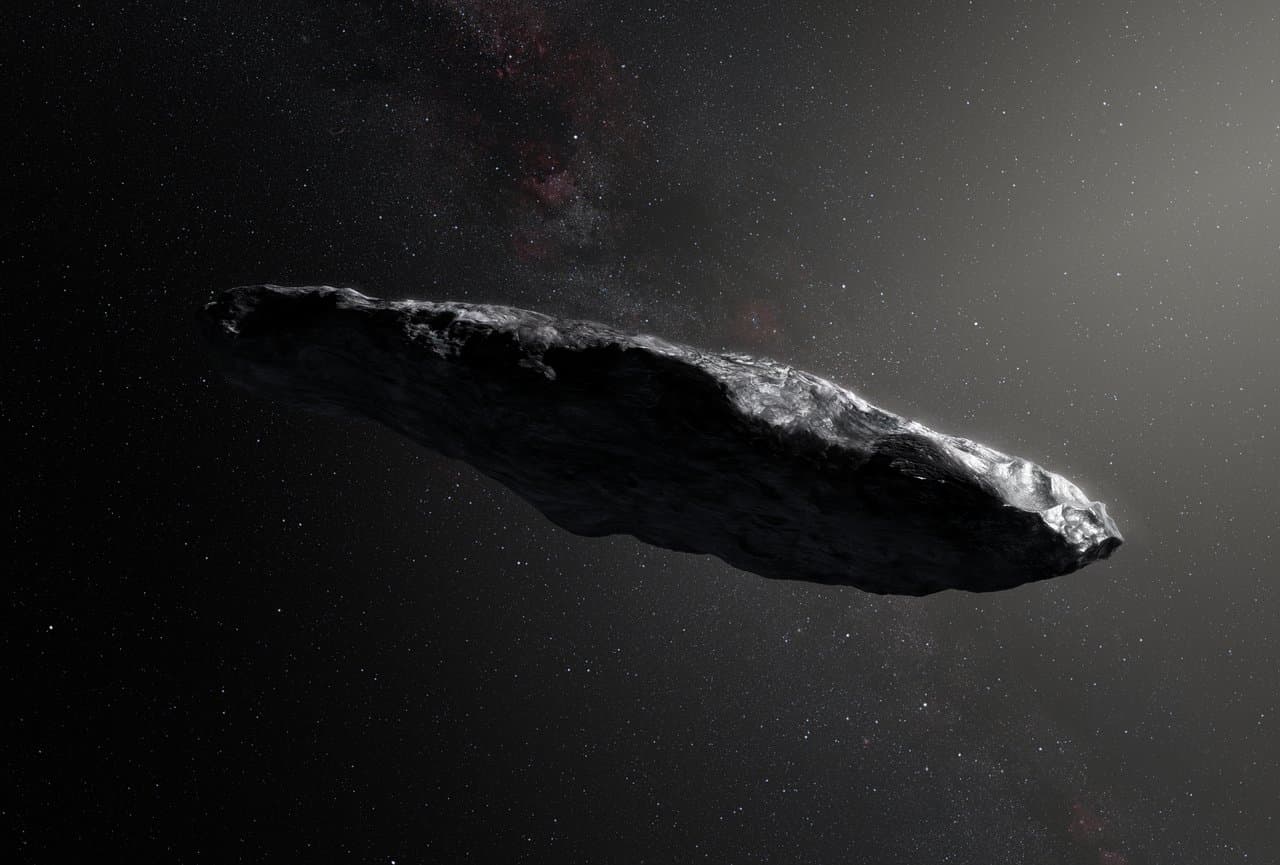
For other cosmic signals that arrived and refused to explain themselves, there is the Wow! Signal, a 72-second radio burst from Sagittarius that has never repeated, and the fast radio bursts whose split-second flashes cross billions of light years. For a visitor to our own solar system that broke the rules, see ʻOumuamua, and for a star whose dimming has resisted every tidy answer, Tabby's Star.
Frequently asked questions
How can one tiny particle carry the energy of a baseball? Energy and size are not the same thing. The Oh-My-God particle was microscopic, but it was moving at very nearly the speed of light, and at those velocities the energy packed into a single particle climbs to values that feel impossible at human scale. The fifty or so joules it carried is real. What remains unexplained is not the arithmetic but the source: what in nature can wind a single particle up that tightly, when our largest machines fall short by a factor of forty million.
Did the particle hurt anyone or damage anything? No. Air showers like this one break apart high in the atmosphere, and the resulting spray of secondary particles is spread thin by the time anything reaches the ground. You are passing through cosmic ray fragments right now. The astonishing part is not the impact, which was harmless, but the origin, which is not accounted for.
Why do scientists say it "shouldn't" have reached us? Because of the GZK limit. A particle above a certain energy, traveling through the microwave glow left over from the Big Bang, should gradually lose that energy and slow below the limit within about 160 million light years. The Oh-My-God particle arrived still carrying its full energy, which means either its source is unexpectedly close by, or something about the rules we use to predict its journey is incomplete.
Has anything like it been seen since? Yes. In May 2021 the Telescope Array in Utah recorded the Amaterasu particle, the most energetic cosmic ray since 1991, and it too traced back toward a nearly empty region of space called the Local Void. Dozens of lower but still extraordinary events have been logged by observatories in both hemispheres. The repetition is exactly what keeps the question alive, because a single reading could be dismissed and a pattern cannot.
Could the source be something we have not discovered yet? That is one of the live possibilities. The particles might come from objects we have not identified, from exotic relics of the early universe decaying in the dark, or from physics that behaves differently at energies we can never test on Earth. Each idea explains part of what we see and stumbles on another part. For now the trail runs back into the dark and stops.
Further reading
- •A Thin Cosmic Rain: Particles from Outer Space by Michael W. Friedlander, a readable history of how we learned to catch the particles falling on us from space. Find it on Amazon.
- •The Edge of Physics by Anil Ananthaswamy, which travels to the remote observatories where researchers chase the universe's hardest questions. Find it on Amazon.
- •The God Particle by Leon Lederman and Dick Teresi, the book that popularized the nickname the Oh-My-God particle plays against, on the deep search for what matter really is. Find it on Amazon.
If you want to see cosmic rays with your own eyes rather than read about them, a home cloud chamber kit reveals the faint tracks of the particles passing through your room. Browse cloud chamber kits on Amazon.
Want to explore more mysteries?
We've got plenty more rabbit holes to go down.