Tabby's Star: The 'Alien Megastructure' Star That Baffled Astronomers
Tabby's Star dims by up to 22% at irregular intervals. Was it an alien megastructure? Dust? A swallowed planet? Here's what we know about KIC 8462852.
In 2015, astronomer Tabetha Boyajian was reviewing data from NASA's Kepler space telescope when she noticed something she couldn't explain. A star designated KIC 8462852, about 1,470 light-years from Earth in the constellation Cygnus, was dimming in ways that no known natural phenomenon could easily account for.
Most stars that dim do so in regular, predictable patterns, usually because a planet passes in front of them. Tabby's Star, as it became known, was different. Its brightness dropped by as much as 22% at irregular, unpredictable intervals. Some dips lasted days. Some lasted weeks. The patterns didn't repeat. And 22% is enormous. For comparison, even a Jupiter-sized planet passing in front of a star this size would block only about 1% of its light.
Whatever was blocking the light from Tabby's Star was massive, irregular, and unlike anything astronomers had catalogued before. When physicist Freeman Dyson's decades-old concept of an "alien megastructure" was floated as a possible explanation, the story exploded. Suddenly a dim star in Cygnus was front-page news worldwide.
What You'll Learn
- •How Was Tabby's Star Discovered?
- •What Makes the Dimming So Unusual?
- •The Alien Megastructure Hypothesis
- •What Is a Dyson Sphere?
- •The Dust Explanation
- •Could a Swallowed Planet Be the Cause?
- •The Exomoon Theory
- •What Do We Know for Sure?
- •Frequently Asked Questions
How Was Tabby's Star Discovered?
Tabby's Star wasn't discovered in a traditional sense. It had been catalogued and observed for years. What was discovered was its bizarre behavior.
NASA's Kepler space telescope was designed to find exoplanets by watching for the tiny, regular dips in starlight that occur when a planet passes between its star and us. Between 2009 and 2013, Kepler continuously monitored over 150,000 stars. The data was massive, and much of the initial analysis was done by citizen scientists through a project called Planet Hunters.

In 2011, several Planet Hunters volunteers flagged KIC 8462852 as unusual. The star was dimming, but not in the smooth, periodic way that planets cause. The dips were deep, irregular, and asymmetric. Tabetha Boyajian, then a postdoctoral researcher at Yale, took the lead on investigating the anomaly.
In September 2015, Boyajian and 50 co-authors published their findings in a paper titled "Where's the Flux?" (The paper's informal name among astronomers was the more colorful "WTF paper.") The paper catalogued the star's strange behavior and systematically evaluated possible explanations. None fully fit the data.
The paper didn't mention aliens. But once the media picked up the story, someone else did.
What Makes the Dimming So Unusual?
Tabby's Star exhibits two distinct types of dimming, and both are strange:
Short-term dips. Kepler recorded dramatic drops in brightness lasting from a few days to a few weeks. The deepest observed dip was approximately 22%. These dips are irregular in depth, duration, and spacing. They don't follow any detectable periodic pattern.
For context: a planet the size of Jupiter, orbiting a star like KIC 8462852, would cause a dip of about 1%. To block 22% of the light from an F-type star (which is larger and brighter than our Sun), you'd need something enormous, roughly half the diameter of the star itself.
Long-term secular dimming. Analysis of historical photographic plates by astronomer Bradley Schaefer showed that the star had dimmed by roughly 20% over the past century. This long-term trend was initially controversial, but subsequent studies using Kepler's full dataset confirmed a gradual dimming of about 3% over the four years of Kepler observations.

The combination of deep, irregular short-term dips and a long-term dimming trend is what makes Tabby's Star so difficult to explain. Most proposed explanations can account for one or the other, but struggling to explain both simultaneously.
The Alien Megastructure Hypothesis
Shortly after Boyajian's paper was published, Penn State astronomer Jason Wright suggested that the dimming pattern was consistent with what you'd expect from a "swarm of megastructures" orbiting the star. He was careful to present this as a speculative hypothesis, not a conclusion.
The idea was rooted in a concept proposed by physicist Freeman Dyson in 1960: a sufficiently advanced civilization might build enormous structures around its star to capture a significant fraction of its energy output. Such structures, often called "Dyson spheres" (though Dyson himself envisioned a swarm of independent objects rather than a solid shell), would block starlight as they orbited, producing exactly the kind of irregular, deep dimming observed at Tabby's Star.
The media loved it. "Has NASA's Kepler Discovered an Alien Megastructure?" ran one headline. The story went global within days.
Within the scientific community, the reaction was more measured. Most astronomers viewed the alien megastructure idea as worth investigating (because it was testable) but unlikely. The general principle of scientific parsimony suggests exhausting natural explanations before invoking artificial ones.
What Is a Dyson Sphere?
Freeman Dyson's 1960 paper "Search for Artificial Stellar Sources of Infrared Radiation" proposed that an advanced civilization's energy needs would eventually exceed what could be captured from its home planet. The logical next step would be to build structures around the civilization's star to capture solar energy on a massive scale.
A "Dyson sphere" isn't necessarily a solid shell (which would be gravitationally unstable). It's more commonly envisioned as:
- •A Dyson swarm: thousands or millions of independent solar collectors orbiting the star
- •A Dyson bubble: lightweight structures held in place by radiation pressure rather than orbital mechanics
- •A Dyson ring: a ring of structures in a single orbital plane

If such structures existed around Tabby's Star, they would block visible light (causing the observed dimming) and re-radiate the absorbed energy as infrared radiation (excess heat). This is a testable prediction: a star surrounded by megastructures should show an infrared excess.
Observations from NASA's WISE and Spitzer space telescopes found no significant excess infrared emission from Tabby's Star. This doesn't definitively rule out megastructures (they could theoretically be designed to minimize waste heat), but it significantly weakens the hypothesis.
SETI researchers at the Allen Telescope Array also searched for deliberate radio transmissions from the star's direction and found nothing.
The Dust Explanation
In January 2018, Boyajian and over 200 collaborators published a landmark paper in The Astrophysical Journal Letters that provided what most astronomers now consider the by one account explanation: dust.
The key evidence came from multi-wavelength observations during a series of dimming events in 2017 (which Boyajian and her team colorfully named "Elsie," "Celeste," "Skara Brae," and "Angkor"). By observing the dimming simultaneously in different wavelengths of light (from ultraviolet through infrared), they could determine the physical properties of whatever was blocking the light.
The critical finding: the dimming was wavelength-dependent. Shorter wavelengths (blue light) were blocked more than longer wavelengths (red light). This is the hallmark of fine dust particles. An opaque solid object (like a planet or a megastructure) would block all wavelengths equally.
This result effectively ruled out any opaque structure, natural or artificial, as the cause of the dimming. The culprit is circumstellar dust: fine particles orbiting the star (or passing between us and the star) that scatter shorter wavelengths more than longer ones.
But identifying dust as the cause doesn't fully close the case, because the question shifts: where did the dust come from? And what explains the specific pattern of deep, irregular dips?
Could a Swallowed Planet Be the Cause?
One of the more dramatic natural hypotheses suggests that Tabby's Star recently consumed a planet.
A 2017 paper in Monthly Notices of the Royal Astronomical Society proposed that if KIC 8462852 had swallowed a planet in the geologically recent past (within the last 10,000 years), the resulting debris and dust could explain both the short-term dips and the long-term dimming trend. The consumed planet's material, now spread into an irregular debris field, would block starlight as it orbited.

The theory accounts for the long-term secular dimming (the star is slowly returning to its normal luminosity after being briefly boosted by the infalling planetary material) and the short-term dips (debris from the consumed planet orbiting in irregular clumps).
It's a tidy explanation, but it requires a somewhat specific set of circumstances, and we have no direct evidence that a planetary consumption event occurred.
The Exomoon Theory
In 2019, researchers proposed that the dimming could be caused by the disintegration of an exomoon orbiting a planet that itself orbits Tabby's Star.
Under this model, a large moon is being slowly torn apart, either by tidal forces or by some other disruption process. Chunks of the moon's dusty outer layers of ice, gas, and carbonaceous rock would accumulate in a debris disk or trail, blocking starlight as they orbit.
This theory explains the irregular, non-periodic nature of the dips (the debris field wouldn't be uniform) and the wavelength-dependent dimming (the particles would be fine enough to scatter blue light preferentially). It also doesn't require any particularly unusual circumstances, just a moon in the process of being destroyed, which is something that could plausibly happen in any planetary system.
What Do We Know for Sure?
After a decade of observation and analysis, here's where the science stands:
Confirmed: The dimming is caused by dust. Multi-wavelength observations prove that fine particles, not opaque objects, are responsible for the short-term dips.
Confirmed: The dimming is real and not an instrument artifact. Multiple independent telescopes and datasets show the same behavior.
Confirmed: The star itself is otherwise normal. KIC 8462852 is a healthy F-type main-sequence star about 1.4 times the mass of the Sun. Its spectrum shows nothing unusual.
Not confirmed: The source of the dust. Cometary debris, a consumed planet, a disintegrating exomoon, and a massive collision in the asteroid belt have all been proposed. None has been definitively proven.
Effectively ruled out: An alien megastructure or any opaque solid object. The wavelength-dependent dimming is inconsistent with anything solid.
Still unexplained: The long-term secular dimming trend. While dust explains the short-term dips, the century-long dimming is harder to account for and remains an active area of research.

Tabby's Star is a reminder that even when the most exciting hypothesis (aliens!) gets ruled out, the real answer can still be genuinely interesting. Something around this star is producing enormous, irregular clouds of dust. That process, whatever it is, represents real astrophysics that we don't fully understand yet.
Boyajian herself has always been measured about the case. Her focus has consistently been on the data and what it tells us, not on the headlines it generates. In a 2016 TED talk, she described the star as "the most mysterious star in the universe" while carefully noting that "aliens should always be the very last hypothesis you consider."
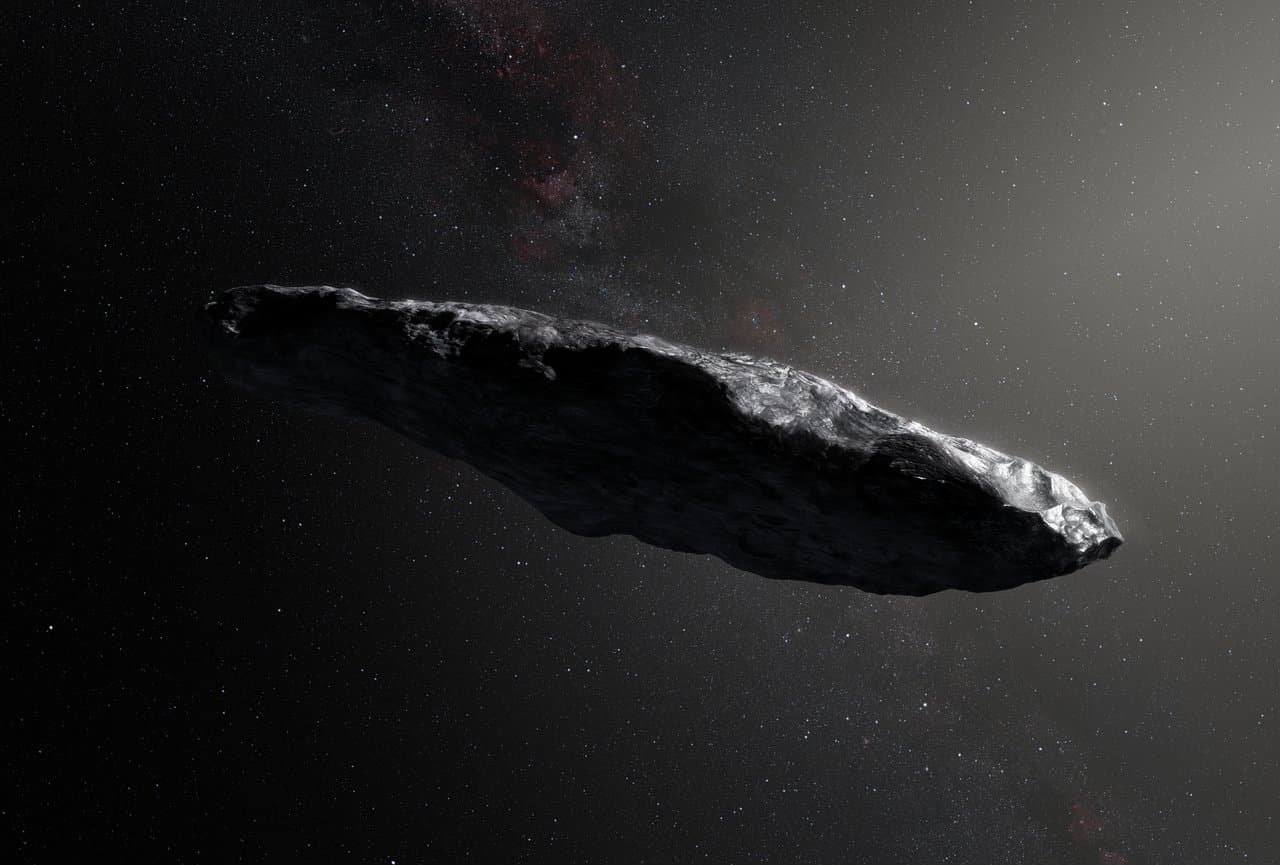
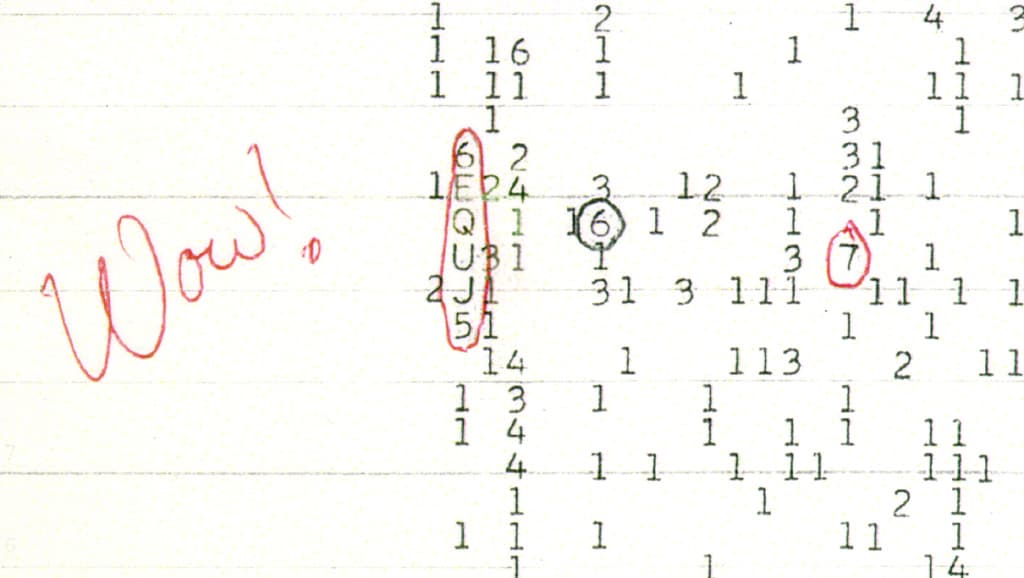
For more space anomalies that challenged our understanding, explore 'Oumuamua, the interstellar object whose unexplained acceleration divided astronomers. The Wow! Signal represents another case where SETI briefly thought it might have found something extraordinary. And for a mystery that's stayed closer to Earth, the Baltic Sea Anomaly offers a "what is this object?" debate at the bottom of the ocean.
Frequently Asked Questions
What is Tabby's Star?
Tabby's Star (officially KIC 8462852, also called Boyajian's Star) is an F-type main-sequence star about 1,470 light-years from Earth in the constellation Cygnus. It became famous in 2015 when astronomer Tabetha Boyajian published data showing it dims by up to 22% at irregular intervals, a pattern unlike any known star.
Is Tabby's Star an alien megastructure?
by some interpretations not. Multi-wavelength observations in 2017-2018 showed that the dimming is wavelength-dependent (blue light is blocked more than red light), which is the signature of fine dust particles. An opaque megastructure would block all wavelengths equally. Also, no excess infrared radiation or radio signals have been detected from the star.
What causes Tabby's Star to dim?
Circumstellar dust is the confirmed cause of the short-term dips. The source of the dust is still debated: proposed explanations include cometary debris, a recently consumed planet, a disintegrating exomoon, or collision debris. The star's longer-term dimming trend over decades remains less well understood.
How much does Tabby's Star dim?
Short-term dips range up to 22% of the star's total brightness, which is extraordinary. For comparison, a Jupiter-sized planet would cause only about a 1% dip. The star also shows a gradual long-term dimming of about 3% over the four years of Kepler observations, and possibly 20% over the past century.
Who discovered Tabby's Star's strange behavior?
Citizen scientists in the Planet Hunters project first flagged the star as unusual in 2011. Astronomer Tabetha Boyajian led the scientific investigation and published the first complete paper on the anomaly in September 2015 with 50 co-authors.
Want to explore more mysteries?
We've got plenty more rabbit holes to go down.