The Shroud of Turin: The Image Science Can't Reproduce
A 1988 test dated the Shroud of Turin to the Middle Ages. It never explained how the image formed, and newer measurements keep pointing somewhere else.
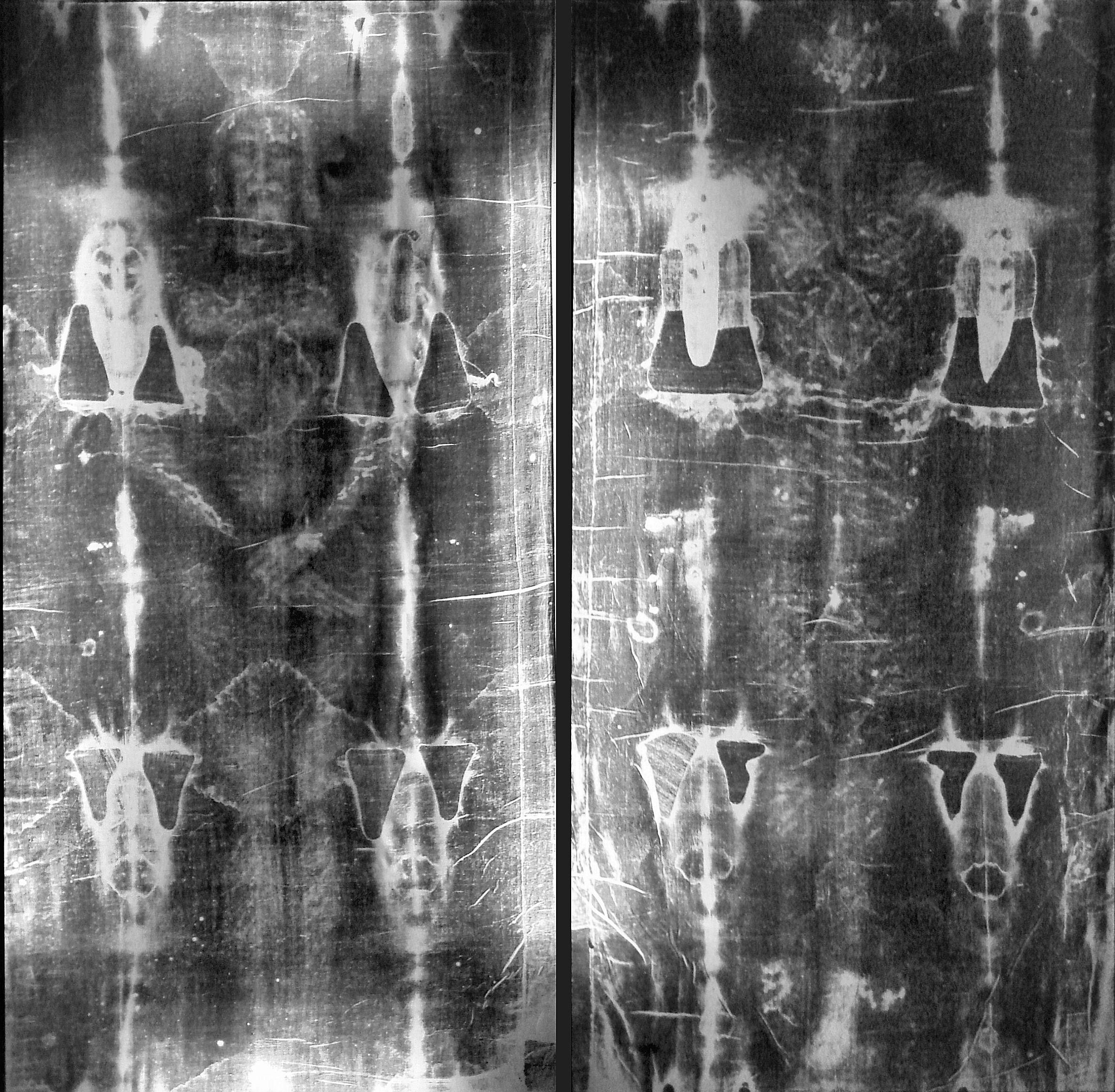
On a May night in 1898, an Italian lawyer named Secondo Pia stood in a darkroom in Turin and nearly dropped the glass plate in his hands. Pia was an amateur photographer, and he had been granted the rare privilege of taking the first official photographs of a long strip of linen kept in the city's cathedral, a cloth that pilgrims believed had wrapped the body of Christ. On the cloth itself the figure was faint, a pale sepia smudge of a bearded man that you had to squint to read. But when Pia developed his negative, the smudge resolved into something that stopped his breath. The negative showed a positive. A face, lifelike and three-dimensional, looked back at him out of the dark glass with the clarity of a photograph taken decades before photography was invented.
That single observation turned a medieval relic into one of the most examined objects in human history. Because if the image on the Shroud of Turin reads as a photographic negative, then whoever or whatever made it was working in a visual language that no one in the Middle Ages, or any age before the 1800s, is known to have understood. For more than a century since, chemists, physicists, art historians, forensic scientists, and radiocarbon labs have taken their best instruments to the cloth. They have produced a mountain of data and a result that keeps getting stranger: the harder the Shroud is measured, the less its measurements agree.
This article contains affiliate links. If you buy through them we may earn a small commission at no extra cost to you.
What You'll Learn
- •The Cloth Itself
- •The Image Nobody Has Reproduced
- •The Three Dimensions Hidden in a Flat Sheet
- •Five Days With the Shroud
- •The Blood That Came First
- •1988: The Verdict That Was Supposed to End It
- •The Corner They Cut
- •A Manuscript Older Than the Date
- •When the Instruments Disagree
- •Frequently Asked Questions
- •Further Reading
The Cloth Itself
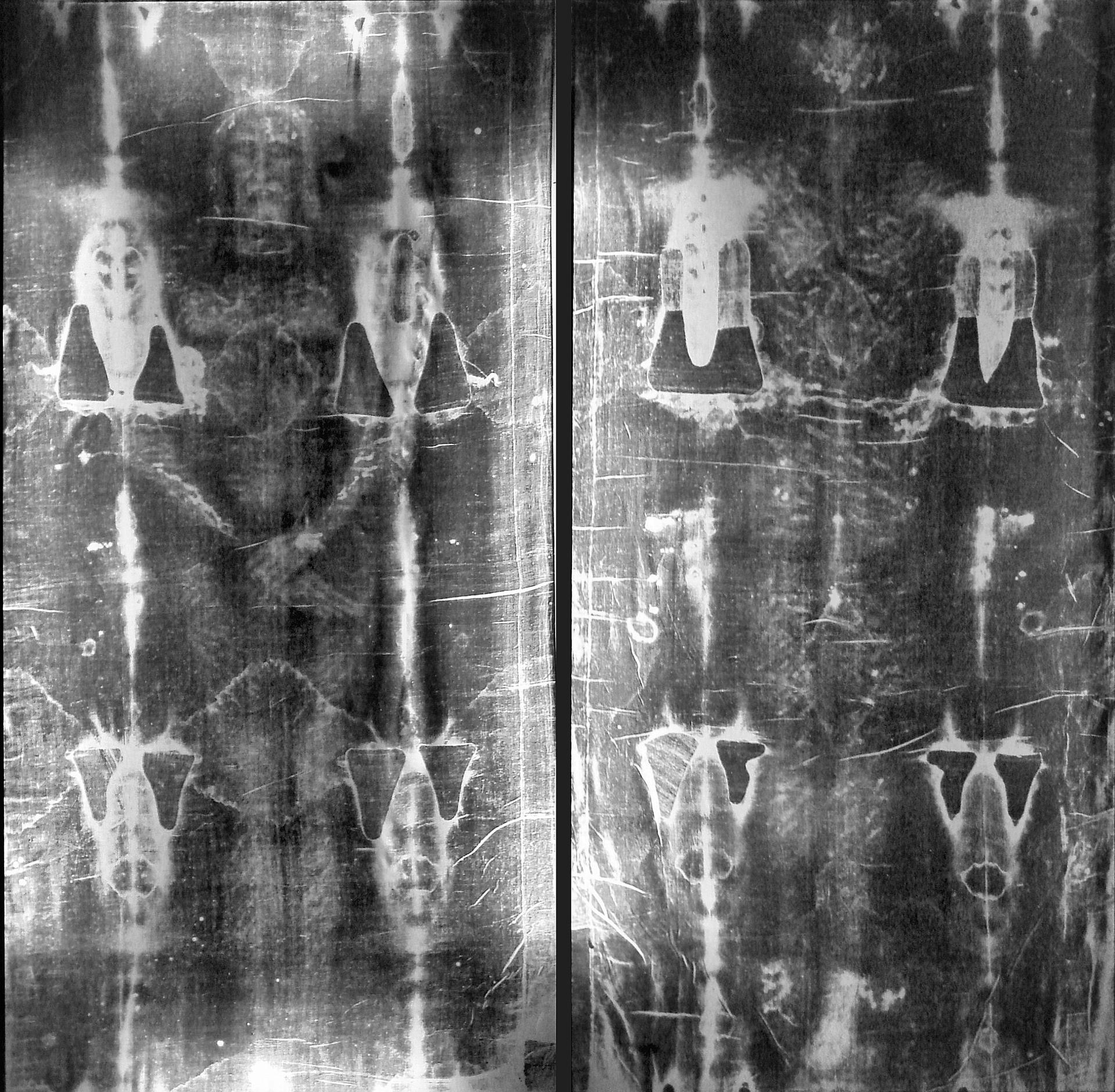
Strip away the arguments for a moment and look at the object. The Shroud is a single piece of linen roughly 4.4 meters long and 1.1 meters wide, about fourteen and a half feet by three and a half, woven in a three-to-one herringbone twill. On it, head to head, are two faint images of a naked man: one as if he lay on his back on the cloth, the other as if the sheet was folded up and over his head to cover the front of his body. The man appears to have been beaten, scourged, and crucified. There are stains the color of old blood at the wrists, the feet, the side, and in a crown-shaped scatter around the scalp.
The cloth lives today in the Cathedral of Saint John the Baptist in Turin, Italy, sealed in a climate-controlled case and shown to the public only on rare occasions. Its documented history begins in the 1350s in the French village of Lirey, where it surfaced in the hands of a knight named Geoffroi de Charny. Almost immediately it caused trouble. In 1389 the local bishop, Pierre d'Arcis, wrote a memorandum to the Avignon pope claiming the cloth was a painted fraud and that an artist had even confessed to making it. That memorandum is the oldest surviving argument that the Shroud is a forgery, and skeptics still point to it as the case's opening and strongest witness.
It is worth holding that fact in one hand. In the other, hold this: in 1532 a fire swept the chapel in Chambéry where the folded Shroud was stored, and molten silver from its reliquary burned a line of holes straight through the layers. Nuns patched the scorches in 1534. Those burns, and the symmetry of their pattern, will matter later, because they let researchers place the cloth at specific moments in time that the famous laboratory test never accounted for.
The Image Nobody Has Reproduced
The bishop's claim of a painting runs into a wall the moment anyone looks at the image closely. There is no paint on the Shroud in any quantity that could form the figure. There is no pigment pooled in the low points of the weave, no binder, no brushstroke, no outline, no sign that a liquid was ever applied and allowed to dry. Under magnification, the image is not sitting on the threads at all. It is a straw-yellow discoloration of the fibers themselves, and only of the topmost fibers, a scorch-like change to a layer so shallow it measures a fraction of the width of a single fiber. Turn the cloth over and the image does not soak through to the back. It stops at the surface.
That is a very specific thing to fake. A painter works by adding material. The Shroud's image was made by changing material that was already there, oxidizing and dehydrating the cellulose of the linen the way a hot iron yellows a shirt, except with no heat deep enough to char and with a resolution fine enough to render the pores of skin. No one has fully reproduced it. Researchers have come close to parts of the effect with ultraviolet light, with scorching, with chemical reactions, with clever rubbing techniques, and each method captures one or two of the image's traits while missing the rest. A technique that gets the shallowness wrong gets the shading right. A technique that gets the negativity right leaves telltale residue the Shroud does not have. More than a century after Secondo Pia, the honest summary is that we can describe the image in exhaustive detail and still cannot say, with confidence, by what process it got onto the cloth.
The Three Dimensions Hidden in a Flat Sheet
In 1976, two U.S. Air Force scientists, John Jackson and Eric Jumper, fed a photograph of the Shroud into a device called the VP-8 Image Analyzer. The VP-8 was built to turn the brightness values in an image into height, so that light areas rise and dark areas fall, a tool originally meant for reading relief out of spacecraft photos. Run an ordinary portrait through it and you get a melted, distorted mess, because in a normal photo brightness tracks light and shadow, not distance.
Run the Shroud through it and something else happens. The image lifts into a coherent, undistorted three-dimensional relief of a human body. The darkness of each point on the cloth corresponds, cleanly, to how far the body would have been from the linen at that spot. The tip of the nose, closest to the cloth, is darkest. The hollows of the eyes, farther away, fade. The image, in other words, encodes distance. No painting does this, because no painter thinks in millimeters of cloth-to-skin gap. No photograph does it either. Whatever marked the Shroud recorded not just a picture of a body but its shape in space, as though the information came off the body in every direction at once and the cloth caught a slice of it. That property, more than the blood or the wounds, is the one that keeps physicists arguing, because it points to a mechanism and no one agrees what the mechanism was.
Five Days With the Shroud
In October 1978, for about 120 hours spread over five days, a team of roughly two dozen American scientists got something almost no one ever gets: direct, hands-on access to the cloth. They called themselves the Shroud of Turin Research Project, STURP for short, and they arrived with pallets of equipment, X-ray gear, spectrometers, microscopes, and ultraviolet and infrared cameras. They were not theologians. Many were physicists and chemists from national laboratories, and their stated goal was to find out what the image was made of.
Their 1981 summary is one of the strangest documents in the file, because it is written by people who plainly expected to find a pigment and did not. They reported no evidence of paints, dyes, or stains that could account for the image. They found the discoloration to be a dehydration and oxidation of the linen's own fibers. They described the image as superficial, chemically stable, and photographically negative. One member, the microscopist Walter McCrone, dissented hard: he reported finding iron oxide and traces of vermilion and argued the thing was painted after all. Other STURP chemists, John Heller and Alan Adler, pushed back, saying the particles McCrone found were sparse, scattered, and nowhere near enough to form an image. That disagreement never fully closed. But the team's central finding held, and it was not a conclusion so much as a confession: whatever made the image, they could not say.
The Blood That Came First
The stains are a separate mystery, and in some ways a sharper one. STURP's chemists tested the reddish marks and reported that they were real blood, identifying the breakdown products you would expect, including heme and bilirubin and markers of blood serum. The blood has been reported as type AB, though like almost everything here that reading has been contested. What is harder to wave away is the relationship between the blood and the image.
Where there is a bloodstain, there is no image underneath it. The blood sits directly on the fibers, and the body-image discoloration simply is not present beneath it. Read that in order and it describes a sequence: the blood went onto the cloth first, and the image formed afterward, around it. That is the opposite of how a forger works. An artist faking a crucified body would paint or print the figure and then add blood on top for effect, because you cannot leave gaps for wounds you have not drawn yet. The Shroud carries its blood as if a wounded body bled into the linen, and only later, by some process no one has named, did the rest of the body print itself around the stains that were already there.
1988: The Verdict That Was Supposed to End It
Then came the test that was meant to settle everything. On the morning of 21 April 1988, in the sacristy of Turin Cathedral, a small strip was cut from one corner of the Shroud and divided among three independent radiocarbon laboratories, at the University of Arizona, Oxford University, and the Swiss Federal Institute of Technology in Zurich. The British Museum coordinated the work and supplied control samples of known age. The labs ran their measurements blind to one another.
The answer came back with unusual confidence. Writing in the journal Nature in 1989, Professor P. E. Damon and twenty other authors reported that the linen dated to between 1260 and 1390, at 95 percent confidence, and called the evidence "conclusive" that the cloth was medieval. The numbers landed almost exactly on the era of the Lirey appearance and the bishop's forgery complaint. For much of the public and press, the case was closed that week: the Shroud was a product of the fourteenth century, and the 1988 date is still the single fact most people know about it.
And yet the result sat uneasily from the start, because it answered the dating question while leaving every other question exactly where it was. A fourteenth-century date tells you nothing about how a medieval hand produced a superficial, negative, distance-encoded, paintless image that the twenty-first century still cannot reproduce. A verdict that solves the calendar and deepens the method is a peculiar kind of verdict.
The Corner They Cut
The first serious crack in the 1988 result came not from a believer but from one of the STURP chemists, Raymond Rogers, who had expected the radiocarbon date to confirm a forgery and set out to put a lingering reweave rumor to rest. Instead, examining threads from the sampled area against threads from the main body of the cloth, he found they were not the same. The corner that was cut for dating contained cotton and traces of a dye and a gum that the rest of the Shroud lacked. He also measured vanillin, a compound that linen slowly loses over centuries. The sampled corner still held vanillin. The main cloth held almost none.
Rogers published this in the journal Thermochimica Acta in 2005. His conclusion was that the radiocarbon sample had been taken from a patch of skillful medieval mending, an "invisible reweave" done so expertly that the labs never knew they were dating a repair rather than the original. By his estimate the main cloth was far older than 1260, somewhere in a range of roughly 1300 to 3000 years. The claim remains disputed, and no one has re-dated the body of the Shroud to check it, because the cloth has not been sampled again. But the uncomfortable fact underneath it is simple and has never been resolved: the 1988 test dated a single corner of a cloth that is known to have been patched, mended, and burned across seven centuries, and it has never been repeated anywhere else on the Shroud. Years later, a 2019 analysis in the journal Archaeometry obtained the labs' raw data and argued that even the original measurements were statistically less uniform than the headline confidence suggested.
A Manuscript Older Than the Date
Here is the detail that most retellings of the carbon date leave out, and it may be the most quietly damaging. If the Shroud was made between 1260 and 1390, then no image of it should exist before 1260. One appears to.
The Hungarian Pray Codex, a manuscript dated to around 1192 to 1195, contains an illustration of the burial of Christ. In it the body is shown nude with the hands crossed over the groin and, strikingly, no thumbs visible, matching the Shroud, where the thumbs are tucked out of sight in a way consistent with a nail through the wrist striking the nerve. The cloth in the drawing carries a herringbone-style pattern. And scattered across it is a set of small circles arranged in an L-shape, the same configuration as a group of burn holes on the Shroud known as the "poker holes," which predate the 1532 fire and whose origin is itself unknown. Many researchers look at that manuscript and see an artist who had seen this exact cloth, roughly seventy years before the earliest date the radiocarbon test allows. Critics answer that the resemblances are coincidental or over-read. But a drawing is a drawing, and it is on the page, dated by its own script and binding to a century the 1988 result says the Shroud could not yet have existed.
When the Instruments Disagree
What makes the Shroud different from almost any other mystery is not that it lacks evidence. It drowns in evidence. The problem is that the evidence does not converge. It diverges, and it does so more sharply the better the instruments get.
The 1988 radiocarbon labs said 1260 to 1390. A 2022 study by Liberato de Caro and colleagues at Italy's Institute of Crystallography, published in the journal Heritage, took a different approach entirely, using Wide-Angle X-ray Scattering to measure the structural breakdown of the linen's cellulose, and reported a result compatible with a cloth roughly 2000 years old, if it had been stored under suitable conditions over the centuries. That finding has been challenged in turn, with skeptics noting it rests on assumptions about temperature history that cannot be verified. Decades earlier the Swiss criminologist Max Frei had tape-lifted pollen from the cloth and claimed to find species native to the region around Jerusalem and Anatolia, a result shadowed by doubts about his methods. Each study is a serious measurement. Each points somewhere the others do not.
Pick any single result and you can build a tidy story. Line them up together and no story survives. A medieval forger who understood photographic negativity and three-dimensional distance encoding, who could change the chemistry of linen fibers to a depth of microns without paint or scorch, who worked around bloodstains he laid down first, and who left a cloth that a modern X-ray study and a twelfth-century manuscript both seem to age centuries beyond his own lifetime, is not a forger anyone has ever described. Neither is there an accepted mechanism by which a real body could have left such a mark. The Shroud sits in that gap, refusing both answers.
Frequently Asked Questions
Didn't carbon dating prove the Shroud is a medieval fake?
It proved that one corner of the cloth, cut in 1988, dates to between 1260 and 1390, and that is a real and careful result published in a serious journal. What it did not do is explain the image, account for the possibility that the sampled area was a later repair, or square itself with a twelfth-century manuscript that appears to depict the cloth. A date is one measurement. The Shroud is a stack of measurements that do not line up, and the carbon date is simply the loudest of them.
Can modern technology reproduce the image?
Not completely. Researchers have reproduced individual traits, the shallowness, the negativity, the shading, using methods from ultraviolet lasers to scorching to chemical baths. What no one has done is reproduce a single image that carries all of the Shroud's properties at once, including its three-dimensional distance encoding and its microscopically thin, paintless discoloration. Until that happens, "a medieval artist did it" names a culprit without naming a method.
What is the deal with the Pray Codex?
It is a Hungarian manuscript from around 1192 to 1195 whose illustration of Christ's burial shows features that line up with the Shroud, including a herringbone-patterned cloth and an L-shaped arrangement of holes matching the Shroud's pre-fire burn marks. If the match is real rather than coincidental, it means someone had seen this cloth decades before the earliest date the 1988 test permits. Researchers disagree about how much weight the drawing can bear, which is itself telling: the evidence keeps pointing in directions that cancel each other out.
Is the blood on the Shroud real?
The chemists who tested it in 1978 reported genuine blood breakdown products, and described the stains as sitting on the fibers beneath an image that does not appear underneath them, suggesting the blood was present before the image formed. The blood type has been reported as AB, though that reading, like much else here, has been questioned. What is not in dispute is that the blood behaves in a way that is awkward for the forgery theory, because forgers paint the wounds last, not first.
Why hasn't the Shroud just been tested again to settle it?
Because the cloth belongs to the Holy See and is treated as a relic of enormous significance, and because the 1988 sampling itself was controversial enough that permission for further destructive testing has not been granted. That leaves the most important claim in the whole affair, Raymond Rogers' argument that the dated corner was a repair, formally unresolved. The one experiment that could check it is the one no one has been allowed to run.
Closing Thoughts
The tidy version of the Shroud's story ends in 1988, with a number and the word "medieval." It is a real number, and it deserves respect. But a mystery is not a single question, and the Shroud only ever answered one of its questions while sharpening all the rest. We know the cloth's weave, its wounds, the chemistry of its stains, the shallowness of its image, and the strange way that image hides a body's shape in its shadows. We do not know how any of it was made, and the better our instruments have become, the more loudly they have contradicted one another.
Secondo Pia saw a positive face emerge from a negative plate in 1898 and spent the rest of his life defending what he had seen against people who said he must have tampered with it. He had not. The cloth really does behave like a photograph taken before photographs existed. More than a century of science later, we can measure that fact to extraordinary precision and still not explain it. The Shroud of Turin hangs in its sealed case in a cathedral in northern Italy, bearing the image of a man no one can account for, dated to a century it may not belong to, carrying blood it should not have, and waiting, patiently, for a question we have not yet learned how to ask.
Further Reading
- •The Blood and the Shroud: New Evidence That the World's Most Sacred Relic Is Real by Ian Wilson
- •Report on the Shroud of Turin by John H. Heller
- •Inquest on the Shroud of Turin by Joe Nickell
If you want to examine the kind of fine surface detail that made the Shroud so hard to explain, an inexpensive handheld USB digital microscope will let you see how fabric, ink, and pigment actually sit on fibers, which is exactly the question that broke the simple forgery theory.
Want to explore more mysteries?
We've got plenty more rabbit holes to go down.