The Kelly-Hopkinsville Encounter: The Night a Farmhouse Fought Back
In August 1955, a Kentucky family fired at glowing creatures for hours, then fled to the police. No one has ever explained what besieged the Sutton farmhouse.
Just before eleven o'clock on the night of August 21, 1955, a car and a truck came tearing into Hopkinsville, Kentucky, and skidded to a stop outside the police station. Eleven people spilled out, five adults and their children, some of them still shaking, and one of the men was clutching a rifle. They told the officers on duty that something had been trying to get into their farmhouse for hours. Small, glowing figures. Creatures with huge eyes and clawed hands that came out of the dark, walked up to the windows, and would not stop coming no matter how many times the men shot them.
The officers who looked at these people did not see pranksters enjoying a joke. They saw a family that was genuinely, deeply frightened. So most of the Hopkinsville night shift, along with state troopers, sheriff's deputies, and military police from the Army base down the road, followed the Suttons back out to the little house near Kelly to see for themselves. What happened next, and what came back after the police left, has never been explained to anyone's satisfaction. Seventy years later the case still sits in the strange country between a UFO landing and a monster story, refusing to belong fully to either.
This article contains affiliate links. If you buy through them we may earn a small commission at no extra cost to you.
What You'll Learn
- •A Water Pump and a Light in the Sky
- •The First Face at the Window
- •Four Hours Under Siege
- •The Bullets That Did Nothing
- •The Drive to Hopkinsville
- •What the Officers Found
- •And Then They Came Back
- •The Owls in the Dark
- •The Green That Was Never There
- •Eleven Witnesses and Nothing to Gain
- •What Kelly Remembers
- •Frequently Asked Questions
- •Further Reading
A Water Pump and a Light in the Sky
Kelly was barely a place at all in 1955. It was a scatter of tobacco farms and small frame houses along the road north of Hopkinsville, in Christian County, close enough to the Tennessee line that the Army's sprawling Fort Campbell sat just to the south. The Sutton family rented a one-story farmhouse there, the kind of house that had a hand pump in the yard because it had no running water inside. On the night everything happened, the house was full. Glennie Lankford, a widow in her fifties, was there with her youngest children, Lonnie, Charlton, and Mary. Her grown sons from a first marriage, Elmer, known to everyone as Lucky, and John Charley, called J.C., were there with their wives, Vera and Alene. Alene's brother, O.P. Baker, was in the house too. And staying with them were friends passing through, Billy Ray Taylor and his young wife, June.
Around seven in the evening, Billy Ray Taylor stepped out the back door to the well for a drink of water. He came back inside wide-eyed and told the others what he had just watched: a bright object, silver and glowing, trailing an exhaust that shimmered in colors, had crossed the sky and come down into a gully in the fields beyond the house. It had not fallen like a meteor and it had not roared like a plane. It had settled.
Nobody believed him. A shooting star, they told him, or his eyes playing tricks in the dusk. Taylor was young and prone to excitement, and the family went back to what they were doing. For the better part of an hour, the strange light in the field was just a story that Billy Ray was telling. Then the dog started barking, and then the dog ran under the house and would not come out, and the story stopped being funny.
The First Face at the Window
It was Lucky Sutton and Billy Ray Taylor who went to the back door to see what had the dog so spooked. What they saw coming across the yard, according to every account they ever gave, was not an animal and not a man. It was a small figure, somewhere between two and four feet tall, glowing with a faint silvery light as though it had been dipped in something luminous. It had an oversized round head, enormous eyes that shone yellow, long thin arms that ended in clawed hands, and large pointed ears that some of the family later compared to an elephant's. Its arms were raised over its head, and it seemed less to walk than to glide, its short legs barely touching the ground.
The two men did not wait to make its acquaintance. They grabbed their guns, a .22 rifle and a shotgun, and when the thing got within twenty feet of the door they opened fire. The creature flipped backward, did a kind of somersault, righted itself, and scrambled away into the dark. It did not appear to be hurt.
That was the beginning. Over the next several hours the figures came again and again, appearing at the windows, at the door, out in the yard, sometimes one at a time and sometimes more, so that the newspaper accounts the next day put the number at a dozen or more. Whether that meant a dozen separate beings or the same few appearing over and over, no one in the house could say. They came from the darkness, faces lit up at the glass, and the family fired at them through the windows and the screens until the floor was littered with spent shells.
Four Hours Under Siege
What makes the Kelly case different from almost every other close-encounter story is its sheer, exhausting duration. This was not a light in the sky that vanished in ninety seconds, or a figure glimpsed once at the edge of a road. The people in that farmhouse described being pinned down for hours, from full dark until nearly eleven at night, with the creatures returning each time they were driven off.
At one point Billy Ray Taylor walked toward the front door and a clawed hand reached down from the porch roof and touched his hair. The others pulled him back inside. One of the figures was seen up in a tree, lit against the branches. Another appeared to be on the roof. When the men fired at the ones in the open, the witnesses said, the creatures would not fall and stay down. They tumbled, they rolled, and they came back. There was no blood, no body, nothing left behind where a shot had struck home except, in one account recorded later by the researcher Jerome Clark, a faint luminous patch glowing along a fence where one of the beings had been hit.
Inside, the terror built on itself. The children were crying. Glennie Lankford, the matriarch, later described lying on the floor and praying. The house had no telephone, and going outside to the vehicles meant crossing open ground where the things were waiting. So the family did the only thing they could do. They waited, and they shot, and they held the line at the windows until they judged there was a gap long enough to run.
The Bullets That Did Nothing
Everyone who has ever tried to explain the Kelly-Hopkinsville encounter has had to reckon with the guns. These were not city people unfamiliar with firearms. Lucky Sutton and Billy Ray Taylor had spent time as carnival workers and knew how to shoot, and they were firing at close range, sometimes at figures only a few feet away, with a rifle and a shotgun. And the witnesses agreed on something remarkable: the shots seemed to have no effect at all.
The most quoted detail is the sound. When a bullet struck one of the creatures, the family said, it did not sound like a bullet hitting flesh. It sounded, in the words passed down through the investigations, like buckshot rattling off a metal bucket or a tin drum. The figures would be knocked over by the impact and then simply get up and move off, unharmed, sometimes floating away into the dark.
Skeptics and believers alike have circled this point for decades, because it cuts both ways. If the creatures were animals, no ordinary bird or beast shrugs off a shotgun blast at close range and walks away with a metallic clang. If they were hallucinations or a shared panic, why did the family behave with such consistent, practical caution, conserving their aim, retreating when a target vanished, holding a defensive position for hours? Whatever the men were shooting at that night, they were convinced it was solid enough to hit and strange enough that hitting it changed nothing.
The Drive to Hopkinsville
By around eleven o'clock the family decided they could not last the night. In a break between appearances they ran for the vehicles, loaded everyone in, and drove the eight miles or so into Hopkinsville, straight to the police station. Eleven people arriving at once, some of them close to hysterical, telling a story about little glowing men who could not be shot, was not something the night desk could easily wave away.
The police response was substantial, and this is one of the details that keeps the case from being dismissed as a single crank's tale. Four Hopkinsville city officers, five Kentucky state troopers, three sheriff's deputies, and four military police from Fort Campbell drove out to the Sutton place. That is a serious convoy, and it went because the officers who first spoke to the family did not think they were lying. The chief who took their statements, Russell Greenwell, came away saying these were people in real fear, not people staging a hoax. Something, in his judgment, had genuinely terrified them.
What the Officers Found
The lawmen swept the property with flashlights and headlights. They found exactly the evidence you would expect from the human side of the story and none of the evidence that would have closed the case. There were bullet holes punched through the window screens and the walls. There were spent shell casings on the floor. There was a house that had plainly been the scene of a great deal of shooting. There was a family too shaken to be performing.
What they did not find was any trace of what had been shot at. No bodies, no blood, no strange tracks that anyone could confidently identify, no craft in the gully where Billy Ray Taylor said the glowing object had come down. One officer reportedly stepped on something out in the yard that glowed, and there were scattered mentions of a luminous residue, but nothing was collected, preserved, or turned into hard evidence that survived. The search wound down after midnight. The officers, finding the immediate danger past and nothing to arrest or shoot, eventually left the family to try to rest.
The story is sometimes told that Air Force investigators arrived the next day to examine the house. That claim has been repeated by author after author, but researchers who went looking for it, including the ones who documented the case most carefully, could find no solid record that it ever happened. What is on the record is stranger and quieter: Project Blue Book, the Air Force's own UFO program, eventually filed the Kelly case under the label "hoax," and added nothing further. No investigation of note. No explanation. Just the word, and then silence.
And Then They Came Back
If the night had ended when the police left, Kelly might be an easier case to file away. It did not end there.
After the officers drove off and the family lay down to try to sleep, the creatures returned. Glennie Lankford, awake in a back room, reported seeing one of the glowing figures at her window again in the small hours, its face lit and its eyes shining, around half past three in the morning. The shooting started once more. The family held out until the first gray light of dawn, when whatever it was finally withdrew and did not come back.
This second wave is what defeats the tidiest explanations. A prank timed for maximum effect would have quit while the police were the audience, not resumed hours after the crowd went home with no one left to fool. A single fright misread in the dark does not usually come back on schedule at three-thirty in the morning to a family lying exhausted in a locked house. Whatever was happening at the Sutton farm was not performing for anyone. It came, the police came, the police left, and then it came again.
The Owls in the Dark
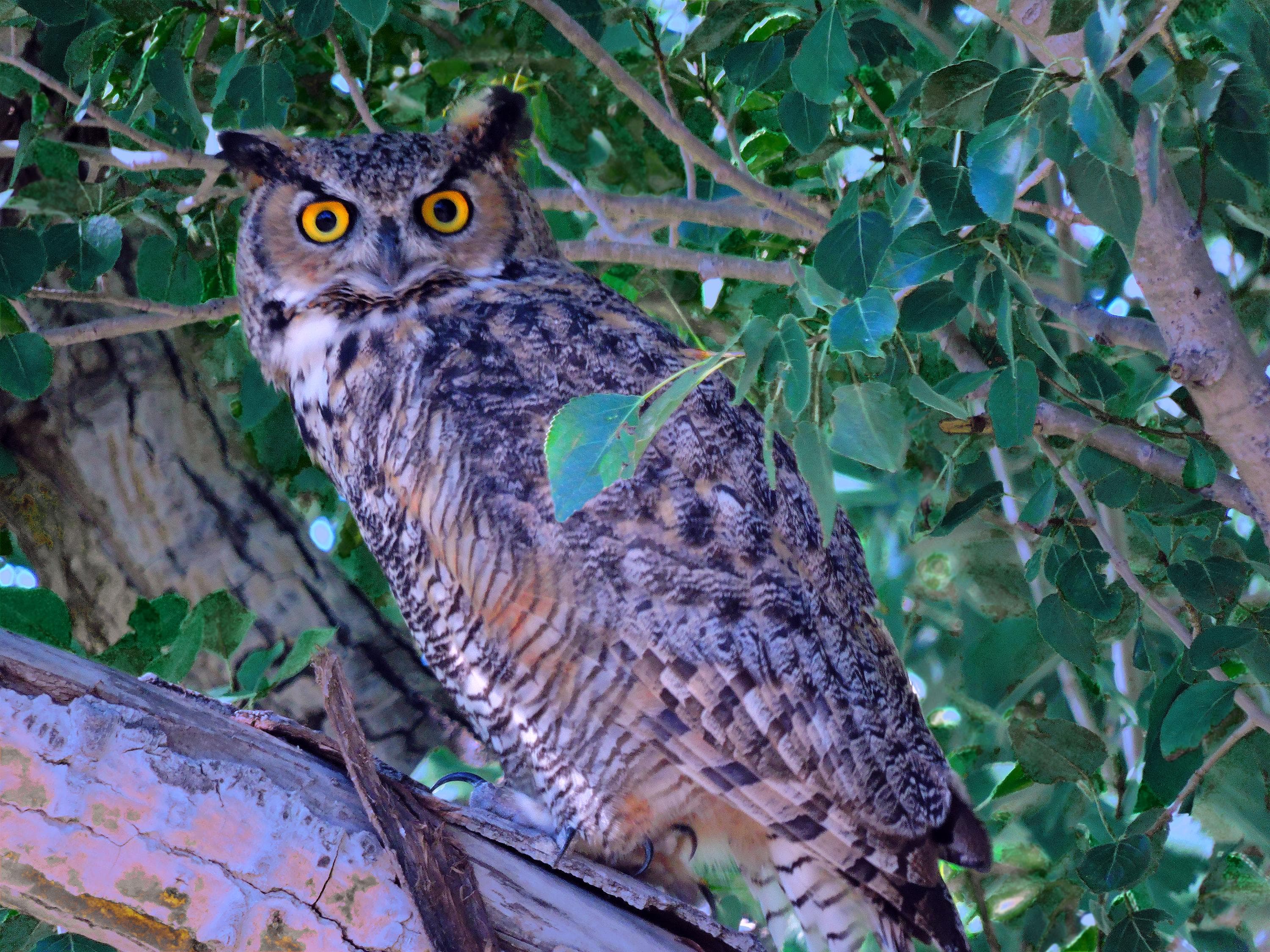
The most durable natural explanation, argued carefully by the investigator Joe Nickell and echoed by the science writer Brian Dunning, is that the family met a pair of great horned owls. It is not a foolish idea. A great horned owl stands close to two feet tall, which reaches the low end of the size the witnesses described. Its eyes shine gold in a beam of light. It has feathered tufts that can look like pointed ears, talons that could pass for clawed hands, and a habit of flying in complete silence and defending its nest with sudden, aggressive dives at anything that comes near. Two owls disturbed near a nest, seen in the dark by frightened people, could account for the raised "arms," the glowing eyes, the swooping approaches, the sense of being attacked from above. The French researcher Renaud Leclet came to the same conclusion, calling owls the best fit for the sightings.
It is a genuinely good theory, and it deserves to be taken seriously rather than waved away. But it leaves a stubborn residue that no owl comfortably explains. Owls do not glow with a silvery light of their own, seen and described the same way by nearly a dozen people across a whole family. Owls do not absorb a point-blank shotgun blast, ring like a struck bucket, tumble, and fly off intact, not once but repeatedly over four hours. And a nesting pair does not typically lay siege to a lit house full of shouting adults and barking dogs deep into the night, break off when a dozen armed police arrive, and then return at three-thirty in the morning for a second round. The owl theory explains the shape of the thing. It struggles with the light it gave off, the way it took a bullet, and the way it kept coming back.
The Green That Was Never There
Ask almost anyone where "little green men" comes from and, if they know the phrase has a real origin story, a fair number will point to Kelly. It is one of the tidiest bits of received wisdom about the whole affair, and it is wrong.
Read the earliest accounts, the ones printed in the local paper the day after and gathered from the witnesses while the night was still fresh, and there is no green anywhere in them. The family described the creatures as silvery, metallic, the color of unpolished nickel, glowing as if lit from inside. Green got added later, by newspapers passing the story down the wire, by the drift of retelling, by the way a good weird tale rounds itself off toward a familiar shape. The phrase "little green men" already existed in science fiction and in slang, and it attached itself to Kelly after the fact, coloring the memory of a case whose own witnesses never used it.
That gap between what was reported and what everyone now remembers is worth sitting with, because it works in both directions. It shows how quickly a real account gets smoothed into a cliche. It also shows how much of what "everybody knows" about famous mysteries is a later invention layered over the top. The people in that house did not see little green men. They saw something silver that glowed in the dark, and the fact that the whole world remembers it in the wrong color should make us wonder what else about the night has been repainted.
Eleven Witnesses and Nothing to Gain
The strongest thing the Kelly case has going for it is not the object in the gully or the bullets that clanged. It is the witnesses, and what happened to them afterward.
There were eleven people in that house, spanning three generations, and their accounts lined up on the essentials. That is hard to arrange as a hoax and hard to sustain as a shared delusion for four hours across adults and children alike. And crucially, no one profited. The family did not sell the story, did not go on a lecture circuit, did not charge admission at the farmhouse. What they got instead was ridicule. Curiosity seekers trampled the property. Neighbors laughed. The Suttons, already poor, found themselves the punchline of a joke that followed them for years, and several of them came to hate that the night had ever become public at all. Glennie Lankford, by the accounts of those who spoke with her, remained quietly certain to the end of her life that what she saw at her window was real, and just as quietly wished the whole world had never heard of it.
People who invent a hoax usually want something from it. The Kelly family got nothing they wanted and a great deal they did not. That is not proof of what came across the yard. But it is exactly the pattern you would expect from ordinary people who saw something they could not explain and could not talk anyone out of, and it is the reason serious investigators kept the case open long after the laughter died down.
What Kelly Remembers
The definitive record of the night is a slim, careful study called "Close Encounter at Kelly and Others of 1955," compiled by the investigators Isabel Davis and Ted Bloecher and published by the Center for UFO Studies in 1978. Davis interviewed people who had been there, weighed the contradictions honestly, and produced the document that everyone who writes about the case, believer or skeptic, still leans on. It is the reason we know as much as we do, and the reason we can say with confidence which parts of the popular version were added later.
Kelly itself has made its peace with the strangeness. For years now the tiny community has held a "Little Green Men Days" festival every August, leaning cheerfully into the color its own witnesses never used, with food and music and vendors gathered near where the Sutton house once stood. It is a friendly ending to a frightening story, and there is something fitting in a place turning its old terror into a summer celebration.
But the festival is a memorial, not an answer. Strip away the green paint and the souvenir stalls and you are left with the same hard core that faced the police in 1955: eleven frightened people, a house shot full of holes, hours of siege, a second wave at dawn, and figures that glowed, took a bullet like a tin can, and would not stay down. The owls may account for the silhouette. They do not account for the night. Whatever came out of that gully near Kelly walked up to the windows, looked in, and left nothing behind but the memory of its eyes.
Frequently Asked Questions
Did the witnesses actually call them "little green men"? No. The earliest accounts describe the creatures as silvery and metallic, glowing like unpolished nickel, with no mention of green at all. The color was added later as the story spread through the newspapers, which is why the case is remembered in a shade its own witnesses never reported.
Why didn't the gunfire kill any of them? That is the question at the heart of the whole affair. The family, experienced with firearms, fired repeatedly at close range and said the creatures were knocked over but never hurt, ringing like metal when struck and getting back up. No body, no blood, and no wounded animal were ever found, which is exactly why neither the alien nor the owl explanation has ever fully closed the case.
Could it really have just been owls? A pair of aggressive great horned owls fits the size, the glowing eyes, the pointed "ears," and the swooping attacks, and it is the most serious natural theory on offer. What it does not fit is the self-generated silvery glow, the way the figures absorbed close-range gunfire, and the four-hour siege that broke off for the police and resumed at dawn. The shape may be an owl. The behavior is harder to explain.
What did the police believe? The officers who responded did not think the family was lying. They found a house shot full of holes and people in genuine terror, though they found no trace of what had been shot at. The Air Force's Project Blue Book later filed the case as a hoax without investigating it in any depth, a label that sits uneasily against the size and consistency of the witness accounts.
Is there anything left to see in Kelly today? The original Sutton farmhouse is gone, but the community keeps the memory alive with its annual "Little Green Men Days" festival held near the site each August. What is not there is any physical evidence, which is part of why the encounter endures. There is nothing to test, only the accounts of the people who lived it, and those have never changed.
Further Reading
The essential source is "Close Encounter at Kelly and Others of 1955" by Isabel Davis and Ted Bloecher (Center for UFO Studies), the careful firsthand investigation that every later account draws from. For the wider context of 1950s entity cases and how the Kelly beings fit among them, "The UFO Encyclopedia" by Jerome Clark is the standard reference. And for the argument that creatures like these echo the goblins and night-visitors of much older folklore, "Passport to Magonia" by Jacques Vallee remains the most provocative book ever written on the subject.
- •Close Encounter at Kelly and Others of 1955, by Davis and Bloecher
- •The UFO Encyclopedia, by Jerome Clark
- •Passport to Magonia, by Jacques Vallee
For readers who would rather watch their own treeline after dark than take anyone's word for what moves out there, a pair of low-light night vision binoculars will show you how much an ordinary owl can look like a visitor when the eyes catch the light.
Want to explore more mysteries?
We've got plenty more rabbit holes to go down.