The Devil's Footprints: One Night, 100 Miles of Hoofprints in Snow
In February 1855, Devon woke to a single line of hoof-like prints in fresh snow, running over rooftops, walls, and a river. No one knows what made them.
On the night of February 8, 1855, snow fell over South Devon, England. It was a hard winter, one of the coldest anyone in the county could remember, and the fresh fall settled into a clean white sheet over villages, fields, estuaries, and rooftops. Sometime before dawn the snow stopped. The world outside was blank and unmarked.
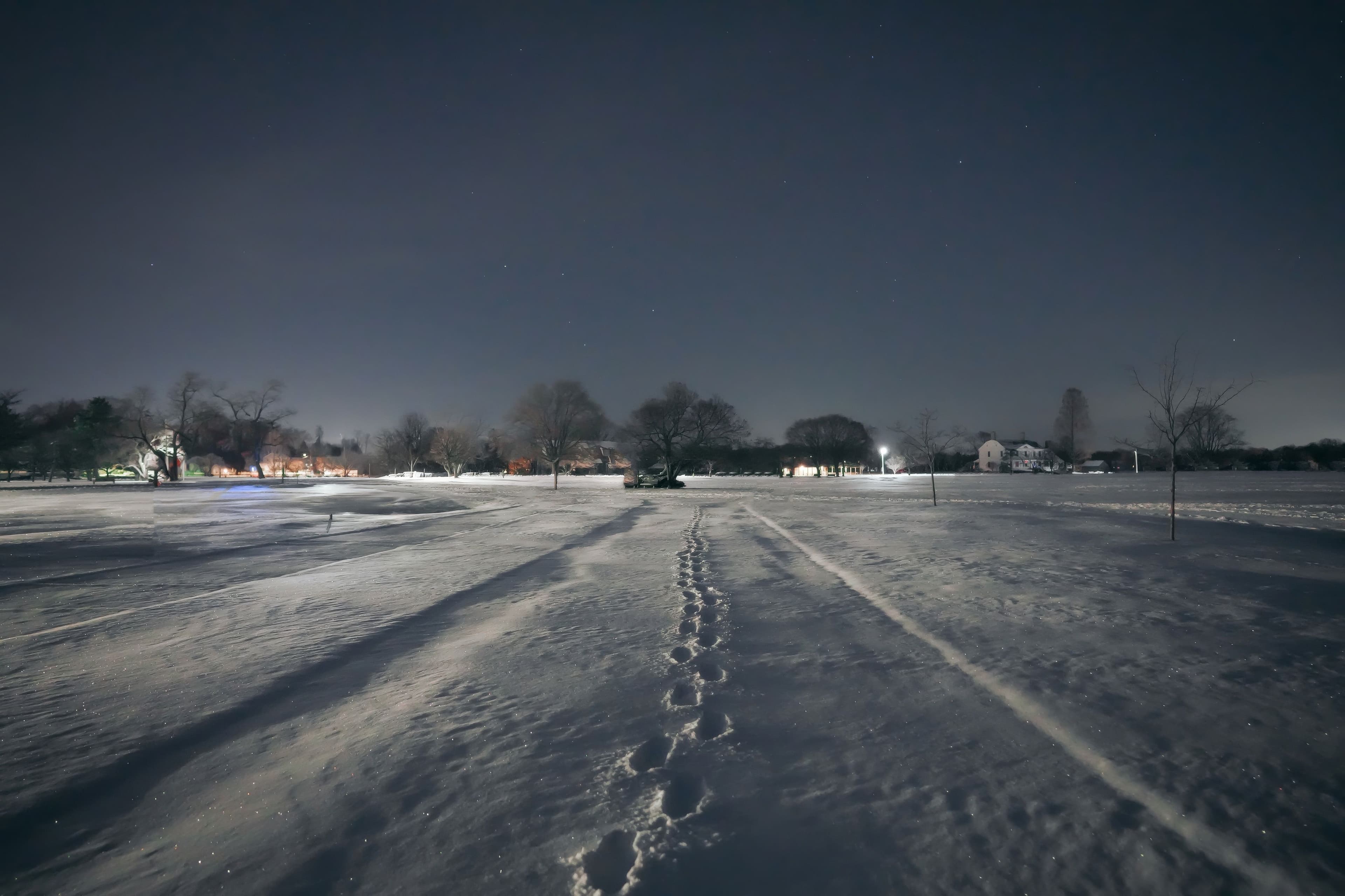
When the people of Exmouth, Topsham, Dawlish, Teignmouth, and dozens of other towns and villages woke on the morning of February 9, the snow was no longer blank. Running through their gardens, down their lanes, across their churchyards, and over their roofs was a single line of prints. Each one looked like the mark of a small hoof, roughly four inches long. They ran one in front of the other in a dead straight line, as if whatever made them had walked on two legs, placing each foot precisely ahead of the last. And they went on. Not for a few hundred yards. Not for a mile. Depending on which accounts you trust, the trail ran somewhere between 40 and 100 miles in a single night.
By breakfast, people were following the prints. By afternoon, some of them were following with pitchforks. And by Sunday, preachers in Devon pulpits were addressing the question their parishioners were already asking out loud: had the Devil himself walked through Devon in the night?
A century and a half later, the event has a name, the Devil's Footprints, and a long list of attempted explanations. Not one of them accounts for what the witnesses described.
What You'll Learn
- •What Appeared in the Snow That Night
- •A Trail That Ignored Every Obstacle
- •How Far Did the Prints Actually Go?
- •The Panic in the Parishes
- •The Story Reaches London
- •The Kangaroo Theory
- •Badgers, Mice, and a Parade of Ordinary Suspects
- •The Balloon With the Trailing Rope
- •The Problem No Theory Solves
- •Other Trails, Other Snows
- •Frequently Asked Questions
- •The Question That Stays in the Snow
What Appeared in the Snow That Night
The prints themselves were strangely consistent, and that consistency is one of the most unsettling things about the case. Witnesses across many miles of countryside, people who had never spoken to one another, described the same marks: a hoof-like impression about four inches long and roughly two and three quarter inches wide, pressed cleanly into the snow.
The spacing was the detail that made farmers and tradesmen stop and stare. The prints were about eight to eight and a half inches apart, and that interval barely varied, mile after mile. Horses do not walk like that. Neither do donkeys, deer, sheep, or any hoofed animal anyone in Devon had ever seen. Four-legged animals leave staggered tracks. These prints ran in a single file, one directly in front of the other, the way a person walks a tightrope.
Some witnesses said the marks looked as if they had been branded into the snow, the edges crisp, in places seemingly melted down to the ground beneath. Others described an occasional impression of claws. The descriptions vary at the edges, as eyewitness accounts always do. But the core picture, a single unbroken line of small cloven prints in perfect rhythm, repeats in account after account.
A Trail That Ignored Every Obstacle
If the prints had simply crossed open fields, Devon might have shrugged and blamed a stray animal. What the trail actually did is the reason people reached for the Devil.
The line of prints approached walls up to fourteen feet high and continued on the other side, with the snow on top of the wall undisturbed in some accounts and marked in others, as if the walker had passed over without breaking stride. The trail crossed rooftops. Witnesses found the prints running up to a house, over the roof, and down the far side, resuming in the garden beyond. They crossed haystacks the same way. In Woodbury, in Topsham, in villages along the Exe, the prints went where nothing that walks should be able to go.
Then there are the details that sound almost playful, and are somehow worse for it. In at least one account, the trail passed through a drainpipe roughly four inches in diameter, entering one end and emerging from the other. The prints approached closed doors and stopped, as if something had stood at the threshold, then continued elsewhere. They wove through narrow gaps in hedges without disturbing the branches.
And the trail crossed water. The estuary of the River Exe is around two miles wide between Exmouth and Powderham. The prints reportedly ran down to the water's edge on one side and resumed on the far bank, exactly in line, as if the two-mile stretch of cold tidal water had been no interruption at all. Some accounts say the same thing happened at the Teign.
Hunters in the village of Dawlish followed the trail with hounds toward woodland near Luscombe. The dogs, by the account that has come down to us, refused to go in. They came back baying and unwilling, and the men with them chose not to press the matter.
How Far Did the Prints Actually Go?
The honest answer is that nobody knows, and the uncertainty cuts both ways.
The trail, or trails, appeared across a swath of South Devon that included Exmouth, Lympstone, Topsham, Woodbury, Kenton, Dawlish, Teignmouth, and reportedly as far as Totnes and Torquay. Contemporary estimates of the total distance ranged from around 40 miles to as much as 100. Even the low number is absurd for a single creature in a single winter night, in deep snow, over rooftops and rivers.
Researchers who have tried to reconstruct the geography point out, fairly, that no single person walked the whole trail. The map of the Devil's Footprints is a mosaic assembled from dozens of local reports, and it is possible that separate lines of prints in separate parishes were stitched together into one continuous trail that never existed.
But that objection has a problem of its own. If the prints were made by many different ordinary causes in many different places, then dozens of unconnected animals and accidents all happened to produce the same four-inch cloven print, in the same single-file line, with the same eight-inch stride, on the same night, across a hundred square miles. The skeptical version of events requires a coincidence nearly as strange as the legend.
The Panic in the Parishes
The fear was real, and it was not confined to children. Accounts from the days that followed describe tradesmen arming themselves and groups of men following the trails as far as they dared. In some villages, people refused to leave their homes after dark. The South Devon of 1855 was a religious place, and the shape of the prints did not help: a cloven hoof has meant one thing in Christian folklore for a very long time.
Clergymen found themselves managing something close to a spiritual emergency. Some preached that the marks were a warning. Others worked hard in the opposite direction, telling their congregations that the prints were surely the work of an ordinary animal, precisely because they could see where the fear was heading.
One of those clergymen, Reverend G. M. Musgrave of Withycombe Raleigh, later admitted in print that he had offered his parishioners an explanation he did not particularly believe, because calming them mattered more than being right. That admission is worth holding onto. Some of the era's reassuring explanations were not conclusions. They were sedatives.
The Story Reaches London
The Devil's Footprints might have remained a local legend, except that the story got out fast. On February 16, 1855, The Times of London reported the affair, describing the considerable sensation in the towns along the Exe. The Illustrated London News took the story further, printing correspondence about the prints over the following weeks, including letters from residents describing what they had seen and sketches of the marks.
The letters did not settle anything. They widened the argument. Correspondents proposed explanations ranging from escaped animals to atmospheric causes, and other correspondents wrote back to explain why each proposal failed. A letter writer signing as "South Devon" provided one of the most detailed accounts of the trail's impossible behavior, the walls, the rooftops, the enclosed gardens. The national press, in other words, did exactly what the internet does with such cases now: it amplified, it speculated, and it reached no verdict.
One more thing makes the documentation unusually good for a 19th-century mystery. The vicar of Clyst St George, Reverend H. T. Ellacombe, quietly collected first-hand letters, sketches, and notes from the affected parishes, including material that was never published. His papers surfaced again in the 1950s, when the Devon folklorist Theo Brown studied them. The rediscovered documents confirmed that the contemporary accounts were not later embellishments. People really did report these things, in their own hands, in the days right after the snow.
The Kangaroo Theory
The first famous explanation came from Reverend Musgrave: a kangaroo. Two kangaroos, the story went, had escaped from a private menagerie at Sidmouth, and a kangaroo's bounding gait might leave odd, unfamiliar marks.
It is an explanation with a certain Victorian charm, and almost nothing else going for it. No escaped kangaroo was ever produced. No menagerie owner ever confirmed the loss. Kangaroo prints look nothing like four-inch cloven hooves, and a kangaroo does not place its feet in a single eight-inch-spaced line. It also does not walk over rooftops, pass through drainpipes, or cross a two-mile tidal estuary in February. Musgrave himself, as noted, later conceded he had floated the idea mainly to give his frightened parishioners something other than the Devil to think about.
The kangaroo theory survives in every retelling of this case not because it explains anything, but because it shows how far people were willing to reach. When the most plausible candidate on offer is an escaped marsupial nobody could find, the field is open.
Badgers, Mice, and a Parade of Ordinary Suspects
In the decades since, nearly every animal in the British countryside has been put forward. Badgers place their rear paws into their front paw prints and can leave a deceptively neat line. Foxes do something similar. Rats and rabbits bounding through deep snow leave compound marks that can freeze, thaw, and refreeze into hoof-like shapes. Hopping rodents such as wood mice leave small paired impressions that, after a partial thaw, can resemble tiny crescents. Swans and other large birds with ice-crusted feet have been suggested. So have herons, otters, and escaped donkeys.
Each of these candidates can explain a piece of the picture, a few hundred yards of trail in one field, under the right conditions. The researcher Mike Dash, who assembled the most thorough modern study of the case in the 1990s, went through the sources methodically and reached a conclusion that is more interesting than any single theory: no one cause can account for all the reports. The trails were too widespread, too varied in terrain, and too consistent in description to pin on any single animal.
Dash's study is often cited as the sensible last word, and in one way it is. But read carefully, it is also an admission. The best-documented investigation of the Devil's Footprints concluded that the event cannot be fully explained, only partitioned into smaller mysteries and assigned plausible-sounding fragments. What made the prints on the rooftops is not answered. What crossed the estuary is not answered. The conclusion is not an explanation. It is a filing system.
The Balloon With the Trailing Rope
One of the more inventive theories came much later, from the author Geoffrey Household, who collected material on the case. He suggested that an experimental balloon escaped from the dockyard at Devonport that night, trailing mooring ropes with shackles at their ends. As the balloon drifted across Devon on the wind, the dangling shackle would have kissed the snow again and again, leaving a line of small, regular, hoof-like dents across fields, walls, rooftops, and water alike.
It is the only theory that even attempts to explain the rooftops and the river crossings, and for that it deserves credit. It also strains under its own details. A balloon drifts with the wind, in a broadly consistent direction. The trails wandered, doubled back, turned through gardens, stopped at doors, and threaded hedges and a drainpipe. A trailing rope skipping across the country would also have snagged, on the first chimney, the first tree, the first telegraph wire. And a runaway balloon large enough to drag shackles across a hundred miles of countryside would have been seen by someone, somewhere, and its loss recorded. No record of such a balloon has ever been found.
The Problem No Theory Solves
Strip the case down to the claims that appear again and again in the primary accounts, and the difficulty becomes clear. Any complete explanation has to cover all of the following at once: prints shaped like small cloven hooves, in a single file, with a nearly invariant stride, appearing in one night, across dozens of parishes, continuing over walls and rooftops, passing through enclosed spaces, and resuming across two miles of open tidal water.
The conventional explanations each take a slice. The animals explain the fields but not the rooftops. The balloon explains the rooftops but not the doubling-back. The composite theory, many causes mistaken for one, explains the breadth but not the uniformity. Mass excitement explains the fear but not the sketches made by sober clergymen on the morning of February 9, before any panic had time to build.
There is also the timing. The prints appeared during one of the coldest nights of a notably severe winter, when almost nothing should have been moving at all. Whatever walked through Devon chose, or happened upon, the one night when the snow would record it perfectly.
Other Trails, Other Snows
The Devon prints are the most famous of their kind, but they are not alone, and that matters.
In 1840, fifteen years earlier, The Times reported a similar line of unexplained hoof-like tracks found in snow near Glenorchy in Scotland. The same year, members of Captain James Clark Ross's Antarctic expedition reportedly found hoof-shaped prints in the snow of Kerguelen Island, a remote scrap of land in the southern Indian Ocean with no hoofed animals on it.
And the phenomenon has not entirely stopped. In March 2009, a woman in the North Devon village of Woolsery woke after a night of snow to find a line of small hoof-like prints crossing her garden, single file, spaced much as the 1855 accounts describe. Investigators from the Centre for Fortean Zoology examined and photographed the trail. The prints ran a short distance and ended. No animal was identified.
One strange night can be argued away. A pattern that surfaces in Scotland, on a subantarctic island, and then again in Devon a century and a half later is harder to file and forget.
Frequently Asked Questions
Did the Devil's Footprints really happen, or is it a legend that grew over time?
The core event is unusually well documented for the period. The Times and the Illustrated London News covered it within days, and the private papers collected by Reverend Ellacombe in 1855, rediscovered in the 1950s, contain first-hand letters and sketches made while the prints were still in the snow. Whatever the marks were, they were really there. The legend did not create the prints. The prints created the legend.
Could the whole thing have been a hoax?
A hoaxer would have needed to lay tens of thousands of identical prints, across as much as 100 miles, over rooftops and walls, on both banks of a two-mile estuary, in deep snow, in a single freezing night, without leaving a single human footprint alongside the trail. No one has ever explained how that could be done in 1855, or named anyone who claimed credit. If it was a hoax, the method has stayed hidden longer than the mystery itself.
What is the strongest conventional explanation?
The composite theory: that many separate causes, badgers, rodents, birds, thaw-distorted tracks, were linked together by frightened residents into one impossible track. It is the explanation most researchers favor, and it still leaves the hardest reports untouched, the rooftop trails, the unbroken line across the Exe, and the eerie uniformity of prints described by witnesses who had never met. The theory explains why there were so many trails. It does not explain the trails themselves.
How big were the prints, exactly?
The most consistent descriptions put them at about four inches long and two and three quarter inches wide, shaped like a small hoof, sometimes described as cloven, with a stride of eight to eight and a half inches. The regularity of that stride, held over miles of varied ground, is the detail that no proposed animal matches.
Has anything like it happened since?
Yes. The most recent well-documented case came from Woolsery in North Devon in March 2009, when a similar single-file line of hoof-like prints appeared in a garden after overnight snow and was examined by investigators before it melted. Shorter and humbler than the 1855 trails, but the same shape, the same spacing, the same silence about what made it.
Why didn't anyone see what made the prints?
That may be the strangest part. Across dozens of towns and villages, on a night when the snow guaranteed that any traveler would leave a record, not one person reported seeing anything move. The only witness statement the night produced was the trail itself.
The Question That Stays in the Snow
The snow melted within days, and with it went the only physical evidence the case ever had. What remains are the letters, the sketches, the newspaper columns, and the rediscovered papers of a country vicar who thought the testimony of his parishioners was worth preserving even if he could not explain it.
Every winter since, snow has fallen on those same Devon villages, on Topsham and Dawlish and the banks of the Exe, and every winter it has recorded nothing stranger than foxes and postmen. Whatever crossed that countryside on the night of February 8, 1855 did it once, perfectly, in the one medium that could prove it had happened, and was gone before anyone could do more than measure its stride.
One hundred and seventy years of theories have taken their turn, and each one has walked a little way along the trail and stopped, like the hounds at Luscombe woods. The prints went on without them. They still do.
Further Reading
This article contains affiliate links. If you buy through them we may earn a small commission at no extra cost to you.
Want to explore more mysteries?
We've got plenty more rabbit holes to go down.