The Carroll A. Deering: The Ghost Ship of Diamond Shoals
In 1921 a five-masted schooner ran aground off Cape Hatteras with her sails set, food on the stove, and not one of her eleven crew aboard. They were never found.
Just after dawn on January 31, 1921, a surfman named C. P. Brady climbed the lookout tower at the Cape Hatteras Coast Guard station and saw something that did not belong. Out on Diamond Shoals, the shifting underwater sandbars that have wrecked more ships than anyone has ever counted, a five-masted schooner sat hard aground with every sail set. She was not signaling. No one moved on her decks. For four days the surf was too violent to reach her, and the great white ship simply sat there in the breakers, sails filling and slatting in the wind, while the men on shore watched and waited.
When rescue crews finally boarded her on February 4, they found the galley with food laid out as if a meal were about to be cooked, the crew's bunks and belongings in place, and the steering gear smashed apart. What they did not find was a single human being. The Carroll A. Deering had carried a captain and ten men. All eleven were gone, along with both lifeboats, the ship's papers, the navigation instruments, and the anchors. To this day, no one has accounted for them.
This article contains affiliate links. If you buy through them we may earn a small commission at no extra cost to you.
What You'll Learn
- •A Five-Masted Ship Named for a Boy
- •The Voyage That Began With a Sick Captain
- •Trouble in Barbados
- •The Last Men to See the Crew Alive
- •Dawn at Diamond Shoals
- •What the Boarding Party Found
- •The Government That Could Not Look Away
- •The Message in the Bottle
- •Theory: Mutiny on the Quarterdeck
- •Theory: Pirates, Rum-Runners, and Reds
- •The Graveyard of the Atlantic
- •What Still Doesn't Add Up
- •Frequently Asked Questions
A Five-Masted Ship Named for a Boy
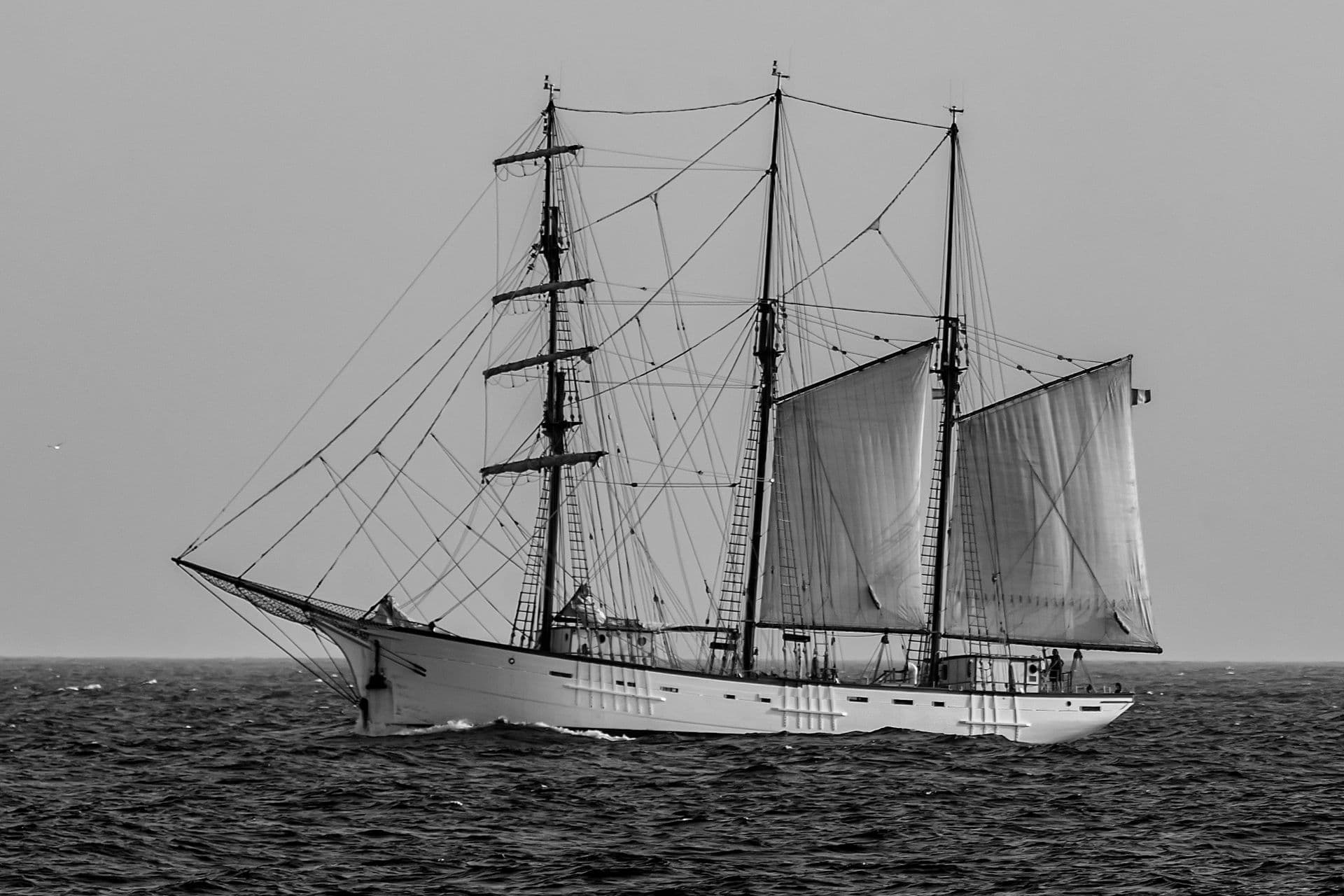
The Carroll A. Deering was new. She had been built in 1919 at Bath, Maine, by the G. G. Deering Company, and she was named for Carroll Atwood Deering, the son of the firm's owner. She was a big vessel for a sailing ship in the age of steam: roughly 255 feet long, around 1,879 gross tons, with five tall masts and a hull built to haul bulk cargo cheaply across long ocean distances. By 1920 ships like her were already becoming relics, the last generation of large commercial sailing craft working the Atlantic trade routes while smoke-belching freighters took over the world.
She was, in other words, exactly the kind of ship that should have lived a long and forgettable working life. Instead she lasted barely two years before becoming the most famous American ghost ship of the twentieth century.
The Voyage That Began With a Sick Captain
In September 1920 the Deering loaded coal at the Virginia coast and set out for Rio de Janeiro, a routine commercial run down the length of two continents. The trip went wrong almost immediately, though not in any dramatic way. Her captain, William H. Merritt, fell seriously ill soon after the ship reached open water, and he had to be put ashore along with his son, who was serving in the crew. The company needed a replacement, and fast.
The man they found was Willis B. Wormell, sixty-six years old and recently retired, a respected Maine shipmaster coaxed back to sea for one more voyage. He took command, picked up a crew, and carried the Deering on to Brazil. She reached Rio in early December 1920, unloaded her coal without incident, and turned for home. By every measure the hard part was over. A loaded ship is the one that founders in heavy weather. The Deering was running empty, light and high in the water, on a well-traveled route in winter. She had only to come home.
Trouble in Barbados
The Deering stopped at Barbados in January 1921, and it is here that the human story darkens. According to accounts later gathered by investigators and historians, Captain Wormell came ashore worried. He confided to people on the island that he did not trust his crew, and that he was especially uneasy about his first mate, Charles B. McLellan.
McLellan, for his part, had been drinking. He was reported to have grown loud and bitter in a Barbados tavern, complaining that the old captain was too soft on the men and could not handle them, and saying things about Wormell that crossed into open threat. By some accounts McLellan was briefly jailed for his behavior, and Wormell, despite everything, bailed him out so the ship could sail with its officers intact. That detail has haunted the case ever since. The captain who feared his first mate paid to keep that same man aboard for the final leg home.
The Deering left Barbados around January 9, 1921, and steered north up the American coast. Somewhere in the days that followed, between that warm island and the cold shoals of North Carolina, eleven men ceased to exist as far as the record is concerned.
The Last Men to See the Crew Alive
On January 28, 1921, the Deering passed the Cape Lookout lightship off the North Carolina coast. The lightship was an anchored floating beacon, manned around the clock, and her keeper that day was Captain Thomas Jacobson. What happened next is one of the strangest details in the entire affair.
A man hailed the lightship from the Deering's deck. He was thin, with reddish hair, and he did not look or sound like a ship's officer. He called across the water that the Deering had lost her anchors in a storm off Cape Fear, and he asked that the loss be reported to the company. Jacobson would have radioed it in, but the lightship's radio happened to be broken that day, so the message never went out.
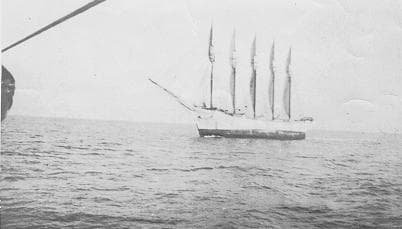
What unsettled Jacobson was not the lost anchors. It was the crew. The men were milling about the quarterdeck, the after part of the ship reserved for officers, where ordinary sailors had no business gathering. Discipline aboard a sailing ship was rigid. Crew did not loiter on the quarterdeck of a vessel under a captain like Wormell. And the man doing the talking was not the captain at all. An engineer aboard the lightship, James Steel, raised a camera and photographed the schooner as she passed. That photograph, the Deering gliding by under sail with her doomed crew somewhere aboard, is the last confirmed sighting of the ship with anyone alive on her. Within seventy-two hours she would be a wreck, and her people would be gone.
Dawn at Diamond Shoals
Cape Hatteras juts out into the Atlantic where the warm Gulf Stream collides with the cold Labrador Current, and the seabed beneath that collision is a maze of shifting sand called Diamond Shoals. Sailors have feared this water for four centuries. When surfman C. P. Brady spotted the Deering aground there at dawn on January 31, he was looking at a death trap that had already claimed hundreds of vessels.
The seas were furious. Lifesaving crews could not launch into that surf without dying themselves, so they waited, and watched the silent ship through their glasses, day after day, sails set and no one aboard answering. It was not until February 4, when a wrecking tug could finally get close, that men set foot on the Carroll A. Deering for the first time since she had become a ghost.
What the Boarding Party Found
The scene aboard read like a riddle with the answer torn out.
The ship was deserted, top to bottom. And yet it did not look like a vessel abandoned in panic, nor like one taken in a struggle. Among the things the boarding party recorded:
- •Every sail was set. The Deering had run onto the shoals under full canvas, the way a ship sails when someone is steering her, not the way she drifts when no one is.
- •Food was laid out in the galley, apparently in the middle of preparation, suggesting the crew had left, or been taken, with no time to finish a meal.
- •The steering apparatus was destroyed. The wheel was smashed and the binnacle that housed the compass was stove in. Something violent had happened at the helm.
- •Both lifeboats were gone, which would point to an orderly evacuation, except that an orderly crew does not abandon a sound, seaworthy ship in calm conditions and leave every sail flying.
- •The ship's log, the navigation instruments, the chronometer, and certain papers were missing, along with the captain's belongings and the crew's personal effects in some cabins, though other belongings remained.
- •The anchors were gone, consistent with the message passed to the lightship days earlier.
Each clue seemed to cancel out the next. Set sails argue against abandonment. Missing lifeboats argue for it. Food on the stove suggests sudden departure. Carefully removed papers and instruments suggest a deliberate, unhurried one. The Deering had been left, or emptied, in a way that fit no single ordinary event. On March 4, 1921, with the wreck a hazard to other ships, the Coast Guard dynamited her where she lay.
The Government That Could Not Look Away
Here is the part that lifts the Carroll A. Deering above the usual sea story. The disappearance of her crew did not stay a local tragedy on the Outer Banks. It became a matter for the United States government at the highest levels, because the Deering was not the only ship behaving strangely in those waters that winter.
In the same stretch of weeks and the same general region, other vessels vanished or fell silent. The sulphur freighter Hewitt disappeared around the same time, somewhere off the southeastern coast, and was never found. To officials in Washington it began to look less like a string of accidents and more like a pattern, and an alarming one. What if something, or someone, was systematically seizing American ships?
The investigation that followed pulled in five federal departments at once: Commerce, Treasury, Justice, the Navy, and State. Herbert Hoover, then Secretary of Commerce and not yet president, took a personal interest in the case. His assistant, Lawrence Richey, led much of the inquiry. Agents interviewed witnesses up and down the coast and overseas, chased rumors of piracy, and tried to reconstruct the Deering's final days. Wormell's widow pressed hard for answers, convinced her husband had met with foul play. Senator Frederick Hale of Maine, whose state had built and owned the ship, reportedly called it a plain case of mutiny.
After roughly two years of work, the federal investigation closed in 1922 without a conclusion. Five departments of the United States government, with the full weight of the post-war state behind them, could not say what had become of eleven men.
The Message in the Bottle
On April 11, 1921, a Buxton fisherman named Christopher Columbus Gray was walking the beach near Cape Hatteras when he found a bottle with a note inside. The note claimed to be from the Deering's engineer, Herbert Bates. In hurried words it described the ship being captured by an oil-burning vessel that resembled a sub-chaser, the crew handcuffed and the ship stripped, the men with no chance to escape.
For a moment it seemed the case had cracked open. Here, in a dead man's own hand, was confirmation of the piracy theory that had so worried Washington. Investigators took the note seriously. Handwriting was compared. And then the whole thing collapsed. Experts concluded the note did not match the engineer's known writing, but did resemble Gray's own. By the accepted account, Gray had forged it, reportedly hoping the attention might help him land a job as a lighthouse keeper.
The bottle was a hoax. What it does not do, though, is close the case. A forged confirmation of piracy is not the same as proof that piracy did not happen. Gray's lie only buried the genuine fear it imitated. The question of who, if anyone, took the Deering's crew was exactly as open the day after the hoax was exposed as it had been the day before.
Theory: Mutiny on the Quarterdeck
The mutiny theory has a terrible logic to it, and it begins in that Barbados tavern. A captain who told people he feared his crew. A first mate, drunk and resentful, threatening the old man. A crew of ten reportedly seen loitering on the quarterdeck where they did not belong, with a stranger doing the captain's talking to the lightship. To those who favor mutiny, the picture is of a ship that had already slipped its discipline by January 28, with Wormell perhaps no longer in command of his own vessel.
It would explain the man at the rail who was not the captain. It might explain the smashed wheel and binnacle, the wreckage of a struggle. But mutiny stumbles badly on the empty ship. If the crew rose up, killed or removed the officers, and took the lifeboats, where did ten or eleven men go? They never surfaced, never spent the missing money, never confessed on a deathbed, never turned up in a foreign port under a new name. A successful mutiny leaves survivors. This one, if it happened, left no one at all.
Theory: Pirates, Rum-Runners, and Reds
Three theories of seizure circled the case, each a child of its moment. The first was old-fashioned piracy, the note in the bottle's version, a raider boarding the Deering and carrying off her people. The second was Prohibition. The Volstead Act had taken effect in 1920, and the waters off the East Coast were thick with rum-runners moving liquor by sea. Some wondered whether the Deering's crew had fallen in with smugglers, been recruited, or been eliminated for what they saw.
The third theory belonged to the Red Scare. In 1921, fear of Bolshevik agents ran high, and a rumor took hold that Communist operatives were hijacking American merchant ships and spiriting them off to revolutionary Russia. Papers were said to have surfaced linking the disappearances to Soviet activity. No evidence ever firmed up beneath any of it. Pirates leave wreckage and witnesses. Smugglers talk. A captured ship sailed to Russia would have been seen by someone, somewhere. Each seizure theory explains why the crew vanished and then fails to explain why not one trace of them, or their captors, ever appeared.
The Graveyard of the Atlantic
There is a quieter explanation, and it is the sea itself. Diamond Shoals has earned its nickname. The Graveyard of the Atlantic has swallowed more ships than the records can hold, and a sudden gale off Cape Hatteras can turn survivable into fatal in an hour. Perhaps the Deering hit weather, the crew panicked, took to the boats, and were lost in the surf while the empty ship sailed on alone and grounded herself with her sails still set.
It is the explanation that asks for the fewest villains. But it carries its own dead weight. Experienced sailors do not abandon a sound ship in her boats unless they believe she is about to sink, and the Deering was not sinking. She grounded intact enough to sit on the shoals for days. The galley food, the deliberately removed instruments and papers, the smashed steering gear, the strange scene at the lightship before any storm: none of it fits a simple drowning at sea. And because Cape Hatteras sits at the northern reach of the waters later folded into Bermuda Triangle lore, the Deering was eventually drafted into that legend too, named alongside the Mary Celeste as a ship the ocean emptied for reasons of its own.
What Still Doesn't Add Up
Strip away the theories and a hard core of facts remains, and they refuse to settle into a story. A ship sails past a lightship with the wrong man at the rail and her crew where they should not be. Three days later she is aground under full sail with her wheel destroyed and her people gone. Her lifeboats are missing, which says they left on purpose, but her sails are set, which says no one steered her off. Food waits in the galley for a meal no one returned to eat. The papers and instruments are taken, which says someone had time and intent, but eleven men evaporate without a body, a boat, or a single later sighting, which says they had no time at all.
Five federal departments could not reconcile those facts in 1922, and no one has reconciled them since. Every explanation answers half the evidence and is broken by the other half. That is what makes the Carroll A. Deering endure. She is not a puzzle missing one piece. She is a puzzle whose pieces seem to belong to different puzzles entirely.
Frequently Asked Questions
What happened to the crew of the Carroll A. Deering?
No one knows. Eleven men, including Captain Willis B. Wormell, were aboard when the ship passed the Cape Lookout lightship on January 28, 1921, and none of them was ever seen again. No bodies, no lifeboats, and no survivors were recovered. The disappearance has never been explained, only theorized about.
Was the Carroll A. Deering really investigated by the US government?
Yes, and seriously. Because the Deering was one of several ships that vanished or were abandoned off the southeastern coast in early 1921, five federal departments, Commerce, Treasury, Justice, Navy, and State, took part in the inquiry. Secretary of Commerce Herbert Hoover followed the case personally, and his assistant Lawrence Richey helped lead it. The investigation closed in 1922 with no conclusion.
What was the message in the bottle?
A note found by a fisherman in April 1921 claimed the Deering had been captured by an oil-burning vessel and her crew handcuffed. It briefly seemed to confirm piracy, until handwriting analysis pointed to the finder, Christopher Columbus Gray, as its author. The hoax was exposed, but it never answered the underlying question of who, if anyone, took the crew.
Is the Carroll A. Deering connected to the Bermuda Triangle?
Not originally, but the case was later absorbed into Bermuda Triangle literature because Cape Hatteras lies at the northern edge of the waters often associated with that legend. Writers have listed the Deering alongside the Mary Celeste as a ship found sailing herself with no one aboard. The grounding site, Diamond Shoals, was already infamous as the Graveyard of the Atlantic long before the Triangle had a name.
Why couldn't anyone reach the ship for days?
The Deering grounded on Diamond Shoals during heavy weather, and the surf was too dangerous for lifesaving crews to launch their boats. For four days the schooner sat aground with her sails set while rescuers watched from shore, unable to board until a wrecking tug could finally approach on February 4, 1921.
Did the captain really fear his own crew?
By multiple accounts, yes. Captain Wormell reportedly told people in Barbados that he did not trust his men and was especially wary of his first mate, Charles B. McLellan, who had been heard drunkenly threatening him. That Wormell still sailed with the same crew, and reportedly even bailed McLellan out of trouble to keep his officers aboard, is one of the most unsettling threads in the whole case.
The Ship Is Still Out There, In a Way
After the Coast Guard dynamited the wreck, the sea kept moving what was left. Sections of the Deering drifted, were salvaged, and were carried by later storms along the Outer Banks, so that pieces of her ended up scattered across the very coast that took her crew. People built with her timber. The ocean rearranged her bones for decades.
The men are another matter. They walked the decks of a sound ship on a winter afternoon, hailed a lightship, were photographed under sail, and then stepped out of the record entirely, all eleven of them, somewhere in the dark water between Cape Lookout and Cape Hatteras. A captain who feared his crew. A crew gathered where they should not have been. A meal half made and a wheel smashed to pieces. The questions sit there on Diamond Shoals exactly where the Deering did, sails set, no one answering, waiting for a rescue that has not come in a hundred years.
Further Reading
- •Ghost Ship of Diamond Shoals: The Mystery of the Carroll A. Deering by Bland Simpson. The definitive book-length account of the case, drawing on the surviving government files and the people of the Outer Banks who lived nearest the wreck.
- •Graveyard of the Atlantic: Shipwrecks of the North Carolina Coast by David Stick. The classic history of the deadly waters off Cape Hatteras, the context that makes the Deering's fate so chilling.
- •Outer Banks Mysteries and Seaside Stories by Charles Harry Whedbee. A beloved collection of the legends and unexplained tales of the North Carolina coast, told the way the locals tell them.
Want to explore more mysteries?
We've got plenty more rabbit holes to go down.