The Tamam Shud Case: The Unidentified Man on Somerton Beach
In 1948, an unidentified man was found dead on an Australian beach with a torn scrap reading 'Tamam Shud.' Explore the code, the theories, and the 2022 DNA breakthrough.
On the morning of December 1, 1948, a couple walking along Somerton Park beach near Adelaide, South Australia noticed a man lying against the seawall. His legs were extended, feet crossed, and a half-smoked cigarette rested on his coat collar. He looked like he'd fallen asleep.
He hadn't. The man was dead.
What followed was one of Australia's most baffling investigations. The Tamam Shud case, also known as the Somerton Man mystery, features every element of a Cold War thriller: an unidentified body with all clothing labels removed, a possible undetectable poison, a mysterious code nobody could crack, a scrap of paper torn from a Persian poetry book bearing the words "Tamam Shud" (meaning "it is finished"), and a woman who may have known the dead man's identity but refused to say.
For over 70 years, nobody could identify him. In 2022, a DNA analysis tentatively identified him as Carl "Charles" Webb, a Melbourne electrical engineer. But even that hasn't answered the deeper questions: how did he die, why was he on that beach, and what does the code mean?
What You'll Learn
- •Who Found the Somerton Man?
- •What Was Found in His Pockets?
- •What Did the Autopsy Reveal?
- •What Does "Tamam Shud" Mean?
- •The Mysterious Code
- •Who Was Jessica Thomson?
- •Was the Somerton Man a Spy?
- •The 2022 DNA Identification
- •What Questions Remain?
- •Frequently Asked Questions
Who Found the Somerton Man?
At 6:30 AM on December 1, 1948, police were called to Somerton Park beach, about 11 kilometers southwest of Adelaide. A couple had found the body of a man lying on his back against the seawall, directly across from the Crippled Children's Home on the corner of The Esplanade and Bickford Terrace.
Several witnesses came forward. A couple who'd walked past the same spot at around 7 PM the previous evening had seen a man matching the description lying in the same position. They watched him extend his right arm fully and then drop it limply. Another couple observed him between 7:30 and 8 PM and noted he didn't move at all during the half hour they watched. They assumed he was drunk or sleeping.

One witness reported seeing a second man standing at the top of the stairs leading to the beach, looking down at the body. Years later, in 1959, another witness told police he'd seen a well-dressed man carrying another man on his shoulders along Somerton Park beach the night before the body was found.
The pathologist estimated the time of death at around 2 AM on December 1. But based on the witness accounts, the man may have been dying, or already dead, from as early as 7 PM on November 30.
What Was Found in His Pockets?
The dead man's pockets contained a strange collection of items and an equally strange collection of absences.
What he had:
- •An unused second-class rail ticket from Adelaide to Henley Beach
- •A bus ticket from the city (possibly unused)
- •A narrow aluminum comb manufactured in the United States
- •A half-empty packet of Juicy Fruit chewing gum
- •An Army Club cigarette packet containing seven cigarettes of a different brand (Kensitas)
- •A quarter-full box of Bryant & May matches
What he didn't have:
- •A wallet
- •Any identification
- •A hat (unusual for 1948)
Most strikingly, every label had been removed from every piece of his clothing. Someone had deliberately cut out all identifying tags from his shirt, tie, trousers, pullover, and jacket. His dental records matched no known person.

Weeks later, police traced a brown suitcase to the Adelaide Railway Station cloakroom that appeared to belong to the dead man. The suitcase contained more clothing (also with labels removed), a screwdriver, scissors, a knife, a stencilling brush, and a table knife that had been sharpened to a point. A name, "T. Keane," was found on some items, but no T. Keane matching the description was ever identified. Investigators believed the name was a false lead.
What Did the Autopsy Reveal?
The pathologist, John Burton Cleland, described the man as appearing "Britisher" in origin, approximately 40 to 45 years old, and in "top physical condition." He was 180 cm (5'11") tall, with grey eyes, fair to ginger-colored hair with some grey at the temples, broad shoulders, and a narrow waist.
His physical details were distinctive: his hands and nails showed no signs of manual labor, his big and little toes met in a wedge shape (consistent with someone who wore pointed boots or danced), and he had pronounced high calf muscles (suggesting regular use of high-heeled shoes or ballet training).
The autopsy found extensive congestion in the brain, pharynx, stomach, kidneys, liver, and spleen. The spleen was roughly three times normal size. His last meal was a pasty, eaten three to four hours before death. But toxicology tests found no foreign substance in his body.
Pathologist John Dwyer concluded: "I am quite convinced the death could not have been natural." He suggested the cause was likely a barbiturate or soluble hypnotic, a type of poison that could theoretically be metabolized and become undetectable by the testing methods available in 1948.
The coroner couldn't determine the cause of death, the man's identity, or even confirm whether the man seen alive on the beach the previous evening was the same person (since no one had seen his face).
What Does "Tamam Shud" Mean?
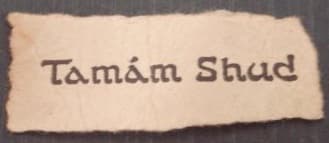
Months after the discovery, a small scrap of paper was found in a hidden fob pocket of the man's trousers that had been overlooked in the initial search. On it were printed two words: "Tamam Shud."
The phrase is Persian and translates to "it is finished" or "it is ended." It comes from the final page of the Rubáiyát of Omar Khayyám, a collection of Persian poetry widely known for its themes of mortality, living fully, and the transience of life.
The scrap had been torn from a specific edition of the book. Police launched a public appeal to find the copy it came from.

A man came forward, reporting that he'd found an rare edition of the Rubáiyát in the back seat of his unlocked car, parked near Somerton Park beach, around the time of the death. The torn final page matched the scrap perfectly.
But the book contained something else.
The Mysterious Code
On the inside back cover of the Rubáiyát, police could make out faint indentations left from previous handwriting. Using ultraviolet light, they revealed:
- •A local telephone number
- •Another unidentified number
- •Five lines of seemingly random letters:
WRGOABABD
MLIAOI
WTBIMPANETP
MLIABOAIAQC
ITTMTSAMSTGAB
(One line appeared to be crossed out, suggesting the writer made a correction.)
The text has never been satisfactorily deciphered. Cryptographers, intelligence analysts, and amateur codebreakers have spent decades attempting to crack it. Some believe it's an encryption key, others think it's a one-time pad cipher, and some have suggested it's simply the first letters of words in a message or passage.
In 2022, after the tentative identification of the Somerton Man as Carl Webb, researcher Derek Abbott proposed a much more conventional explanation: the letters might be the first names of horses Webb was betting on. Webb was known to have a fondness for horse racing. If true, the "code" that captivated the world for seven decades was never a code at all.
The telephone number on the book led police to a woman named Jessica Thomson (née Harkness), who lived on Moseley Street, just 400 meters from where the body was found.
Who Was Jessica Thomson?
When police traced the phone number and visited Jessica Thomson (she'd given her name as "Jestyn" in a statement), her reaction was striking. According to Detective Sergeant Lionel Leane, Thomson became visibly distressed and appeared to nearly faint when shown a plaster bust of the dead man's face.
Despite her obvious reaction, Thomson denied knowing the man.
She did, however, have a connection to the Rubáiyát. Thomson admitted she'd given a copy of the book to a man named Alfred Boxall during World War II, when they were both serving. But Boxall was tracked down alive and well, with his copy of the book intact. He wasn't the Somerton Man.
Thomson's involvement remains one of the most tantalizing aspects of the case. Her phone number was in the dead man's book. She lived steps from where he died. She physically reacted to seeing his likeness. And yet she refused to identify him.
In 1949, Thomson requested that police not keep a permanent record of her name or release her details, claiming it would be "embarrassing and harmful to her reputation" to be linked to the case. She maintained her silence until her death in 2007.
Her daughter Kate, in a 2014 television interview, said she believed her mother knew the dead man's identity. Former police detective Gerry Feltus, who worked the case extensively, also believed Thomson knew who the Somerton Man was.
Was the Somerton Man a Spy?
The espionage theory has been the most popular explanation since the 1970s. The circumstantial evidence is compelling:
Supporting the spy theory:
- •The deliberate removal of all clothing labels (standard tradecraft to prevent identification)
- •The apparent use of an undetectable poison (suggesting access to sophisticated methods)
- •The mysterious code (resembling intelligence encryption)
- •The Cold War timing (1948, the start of intense East-West espionage)
- •Adelaide's proximity to the Woomera weapons testing range, a sensitive military site
- •Jessica Thomson's wartime connections and her refusal to cooperate

Against the spy theory:
- •No intelligence agency has ever claimed the man
- •The 2022 identification as Carl Webb, a Melbourne engineer, doesn't match a spy profile
- •The "code" may be something conventional like horse racing abbreviations
- •Spies typically have backup identities and documentation, not zero identification
- •The sharpened table knife and stencilling brush suggest a tradesperson, not an agent
The spy theory gained traction partly because it was more dramatic than the alternatives. In the Cold War atmosphere of the 1970s, when the case was re-examined, espionage was the explanation people wanted.
The 2022 DNA Identification
In May 2021, the Somerton Man's body was exhumed from West Terrace Cemetery in Adelaide to obtain DNA samples. In July 2022, University of Adelaide professor Derek Abbott, working with renowned genealogist Colleen M. Fitzpatrick, announced their findings.
Using genetic genealogy (matching DNA to distant relatives in genealogical databases and then building out the family tree), they identified the man as Carl "Charles" Webb, born in 1905 in Melbourne. Webb was an electrical engineer and instrument maker.
Webb fit some of the physical profile: he was of the right age and general description. Research revealed he had a fondness for horse racing, which Abbott believes may explain the mysterious "code."
However, the identification hasn't been officially confirmed by South Australia Police or Forensic Science South Australia, though both expressed hope that verification would be possible. The DNA analysis was based on hairs provided to Abbott by police, not on samples independently collected and tested by forensic authorities.
If Webb is indeed the Somerton Man, it deflates some of the more dramatic theories. An electrical engineer from Melbourne who liked horse racing doesn't sound like a Cold War spy. But it raises new questions: why were his clothing labels removed? What was his connection to Jessica Thomson? And how did he die?
What Questions Remain?
Even with a tentative identification, the core mysteries of the Tamam Shud case remain:
Cause of death. No poison was detected in 1948, and none can be tested for now. The pathologist was convinced the death wasn't natural, but we may never know what killed him.
The code. Whether it's espionage encryption, horse racing notes, or something else entirely, the five lines of letters have never been conclusively explained.
Jessica Thomson's silence. Why did a woman with no admitted connection to the dead man nearly faint when shown his likeness? What was she protecting?
The removed labels. If the man was Carl Webb, why did he (or someone else) remove every label from his clothing?
The suitcase contents. The sharpened knife, stencilling brush, and other items suggest preparation for something. What was Webb (or whoever he was) planning?
The Tamam Shud case demonstrates how a single death, on a single beach, on a single evening in 1948, can produce a mystery that outlasts everyone involved. The phrase on the scrap of paper said it was finished. Over 75 years later, it clearly isn't.
For more mysteries involving unidentified individuals and hidden codes, explore Cicada 3301, the internet's most elaborate cryptographic puzzle. The Hinterkaifeck Murders present another case where the victim's connections held the key to an unsolved crime. And D.B. Cooper offers the story of another man who vanished into mystery, leaving only physical clues behind.
Frequently Asked Questions
Has the Somerton Man been identified?
In 2022, researcher Derek Abbott and genealogist Colleen Fitzpatrick announced that DNA analysis identified the man as Carl "Charles" Webb, a Melbourne electrical engineer born in 1905. However, South Australia Police have not officially confirmed this identification.
What does "Tamam Shud" mean?
It's a Persian phrase meaning "it is finished" or "it is ended." It was printed on a scrap of paper torn from the final page of the Rubáiyát of Omar Khayyám, a collection of Persian poetry about mortality and the transience of life.
Has the Somerton Man's code been cracked?
No. The five lines of letters found indented on the back cover of the Rubáiyát have never been satisfactorily deciphered. Theories range from espionage encryption to horse racing abbreviations to the first letters of a personal message. No interpretation has been officially accepted.
How did the Somerton Man die?
The cause of death was never determined. The pathologist believed it wasn't natural and suggested a barbiturate or soluble hypnotic poison that would have been undetectable by 1948 testing methods. No foreign substance was found in the body.
Why were the labels removed from his clothing?
Nobody knows. Removing clothing labels is associated with intelligence tradecraft (preventing identification through manufacturers), but it could also indicate someone who simply didn't want to be identified for personal reasons. If the man was Carl Webb, his motivation for removing the labels remains unexplained.
Further Reading
This article contains affiliate links. If you buy through them we may earn a small commission at no extra cost to you.
Want to explore more mysteries?
We've got plenty more rabbit holes to go down.