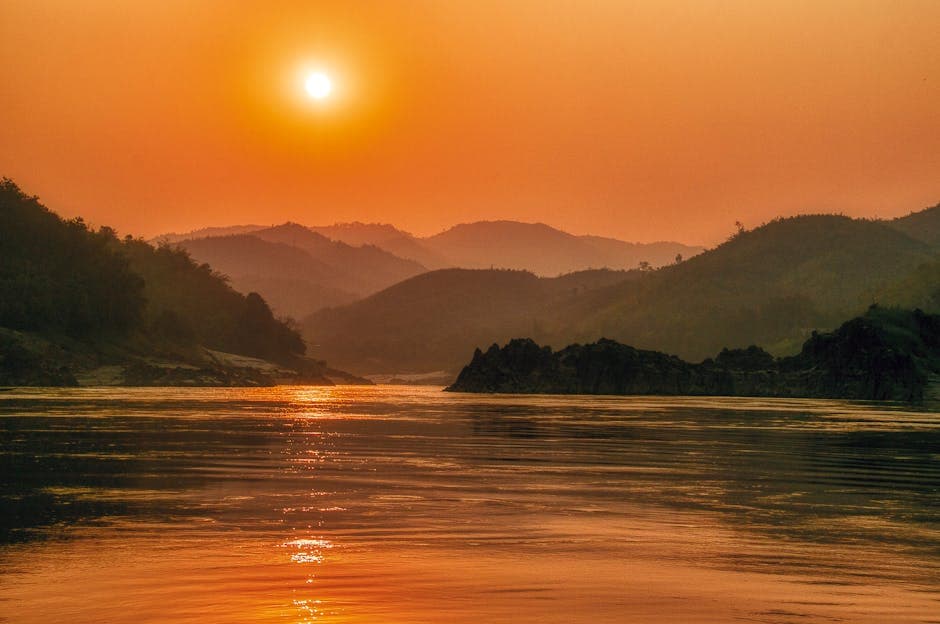
The Naga Fireballs: Mysterious Glowing Orbs That Rise From the Mekong River Every Year
Every October, glowing reddish-pink orbs silently rise from the Mekong River in Thailand and vanish into the sky. Thousands of people witness them. No one can fully explain what they are.
Every year, on the last night of Buddhist Lent - the full moon of the eleventh lunar month, usually falling in October - something extraordinary happens along a stretch of the Mekong River in northeastern Thailand. Reddish-pink orbs of light, ranging from the size of a tennis ball to a basketball, silently rise from the dark water and float upward into the night sky before disappearing. Some nights, witnesses count dozens of them. Other nights, hundreds.
The Thai people call them Bang Fai Phaya Naga - the fireballs of the Naga, the great serpent spirit believed to dwell in the Mekong. According to local tradition, the Naga breathes fire into the sky to celebrate the end of Buddhist Lent and the return of the Buddha from heaven. It's one of the most deeply held beliefs in Isan, Thailand's northeastern region, and every year tens of thousands of people gather along the riverbanks near the town of Phon Phisai in Nong Khai Province to watch.
What makes this phenomenon impossible to dismiss is that the fireballs are not a matter of faith alone. They're a matter of observation. Thousands of people - including scientists, journalists, and skeptics who traveled specifically to debunk the phenomenon - have seen them with their own eyes.
What the Fireballs Look Like
Eyewitnesses consistently describe the same thing. The orbs are reddish-pink or orange, roughly spherical, and completely silent. They emerge from the surface of the Mekong without any visible source, rise vertically anywhere from 30 to several hundred feet into the air, and then simply vanish - as though switched off. There's no smoke, no odor, no explosion. They don't arc or drift with the wind. They go straight up.
The number varies wildly from year to year. In some years, observers report only a handful. In others, several hundred fireballs have been counted in a single evening. There's no consistent pattern to the timing within the night - they might appear in clusters, or one by one, over the course of several hours.
What's particularly striking is the geographic range. The fireballs aren't confined to one spot. They've been reported along a 100-kilometer stretch of the Mekong, from Phon Phisai to Pak Ngum and beyond. Whatever produces them, it isn't a single localized source.
The Scientific Attempts
In 2003, a team from Maha Sarakham University attempted a scientific investigation. They proposed that the fireballs might be caused by the ignition of methane or phosphine gas - naturally produced by decomposing organic matter on the riverbed - that bubbles to the surface and spontaneously combusts upon contact with air.
It's a reasonable hypothesis on paper. But it has significant problems.
Phosphine gas does spontaneously ignite in air. However, phosphine combustion produces a characteristic greenish-white flame, not the reddish-pink orbs witnesses describe. Methane requires an ignition source and doesn't spontaneously combust at the temperatures found along the Mekong in October. And neither gas theory explains why the phenomenon occurs so reliably on one specific night of the year, coinciding precisely with the full moon of the eleventh lunar month.
The seasonal timing is the hardest thing for any conventional theory to account for. If the fireballs were caused by gas buildup on the riverbed, you'd expect them to appear somewhat randomly, or at least correlate with water temperature, water level, or decomposition cycles. Instead, they correlate with a date on the lunar calendar - a date that shifts each year on the Western calendar but stays fixed in the Buddhist one.
The Television Controversy
In 2002, a popular Thai television show called Koh Khon Dee aired footage that claimed to show Laotian soldiers on the opposite bank of the Mekong firing tracer rounds into the sky, suggesting the entire phenomenon was an elaborate hoax maintained by locals to attract tourists.
The broadcast caused a national uproar. Residents of Nong Khai were furious. The Laotian government denied any involvement. And the show's producers were forced to issue an apology.
But what's often overlooked is what happened after the controversy. In the years following the broadcast, researchers continued to observe the fireballs - and so did thousands of independent witnesses. The Thai Royal Navy conducted its own investigation, stationing boats on the river to ensure no one was firing projectiles, and the fireballs appeared anyway. Whatever people were seeing, it wasn't tracer rounds.
Historical Depth
The Naga fireballs aren't a modern invention. Local oral traditions describe the phenomenon going back centuries. Written accounts from Isan communities reference the lights at least as far back as the early 1900s, well before the region had any tourism infrastructure or reason to fabricate an annual event.
The consistency of the descriptions across generations is notable. The color, the silent vertical rise, the timing on the last night of Lent - these details don't change. Whatever produces the fireballs has been doing it the same way for a very long time.
What Doesn't Add Up
Every proposed explanation leaves something unexplained.
The gas hypothesis can't account for the timing, the color, or the silent vertical trajectory. Swamp gas and phosphine behave differently from what witnesses describe. The hoax theory collapsed under scrutiny and fails to explain the geographic range - you'd need hundreds of co-conspirators stationed along 100 kilometers of river, in two different countries, year after year, without a single one ever breaking their silence.
Ball lightning has been suggested, but ball lightning is vanishingly rare, short-lived, and doesn't recur predictably in the same location on the same calendar date annually. And the fireballs don't behave like ball lightning - they don't bounce, crackle, or move laterally.
Some researchers have speculated about piezoelectric effects caused by tectonic stress - the same hypothesis sometimes applied to earthquake lights. The Mekong does sit on geological fault lines. But there's no established mechanism that would produce this effect on a lunar calendar schedule, and the area doesn't experience notable seismic activity correlated with the fireballs.
The Naga and the River
For the people of Isan, the scientific debate is somewhat beside the point. The Naga is real to them - not as a metaphor, but as a presence. The Mekong is the Naga's domain, and the fireballs are its breath. Temples along the river display bones and artifacts said to belong to the great serpent. Monks speak of the Naga with the same matter-of-factness they use to discuss the weather.
It would be easy to dismiss this as folk belief layered onto a natural phenomenon. But the people who live along the Mekong have watched the river for generations. They know its moods, its cycles, its behavior. When they say the fireballs are something different from anything else the river does, that observation carries weight.
A Mystery in Plain Sight
The Naga fireballs are unusual among unexplained phenomena because they're completely public. This isn't a blurry photograph or a secondhand account. Every year, tens of thousands of people stand along the Mekong and watch glowing orbs rise silently from the water into the sky. Television cameras have captured them. Scientists have studied them. And the phenomenon keeps happening, right on schedule, indifferent to anyone's theories about what it is or isn't.
To this day, no explanation satisfies everyone. The fireballs remain exactly what their name suggests - a fire in the sky, rising from the water, beautiful and unexplained.
The Naga, if it exists, isn't hiding. It's putting on a show every October, in front of as many witnesses as care to watch. The question that lingers isn't whether the fireballs are real. Everyone agrees they are.
The question is what's down there, beneath the dark water of the Mekong, breathing fire into the sky.
Further Reading
This article contains affiliate links. If you buy through them we may earn a small commission at no extra cost to you.
Want to explore more mysteries?
We've got plenty more rabbit holes to go down.