The Georgia Guidestones: America's Most Mysterious Monument
Erected anonymously in 1980 with ten guidelines for humanity in eight languages, the Georgia Guidestones stood for 42 years before being bombed in 2022. Who built them, and why?
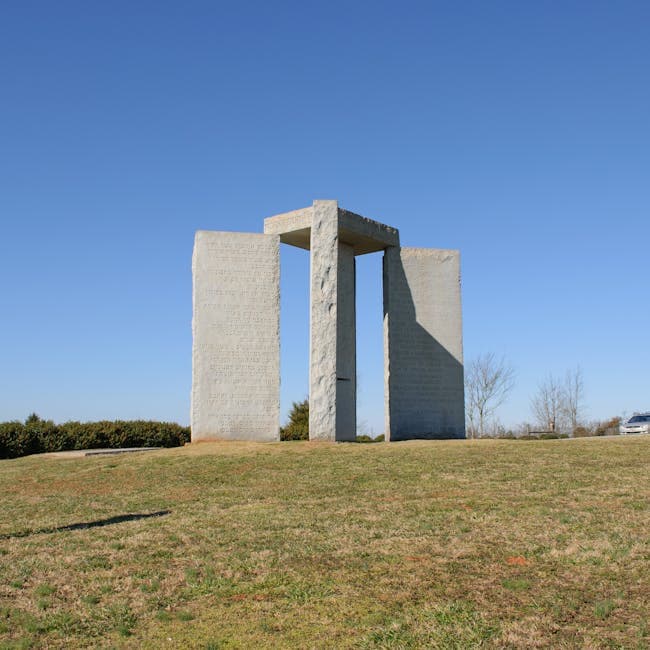
On a hilltop in rural Elbert County, Georgia, five granite slabs stood in a star pattern, rising 19 feet from the red clay earth. They'd been there since 1980, commissioned by a man nobody could identify, inscribed with ten guidelines for humanity in eight languages, and aligned with celestial events like a modern-day Stonehenge. For 42 years, the Georgia Guidestones attracted tourists, conspiracy theorists, preachers, and pilgrims. Some called them a message of hope for a post-apocalyptic world. Others called them a blueprint for totalitarianism. A few called them satanic.
Then, at 4:03 a.m. on July 6, 2022, someone detonated an explosive device at the base of the monument, toppling one of the five slabs and severely damaging the rest. By the end of the day, local authorities had demolished what remained. No suspect has ever been publicly identified. The guidestones are gone now, but the questions they raised are, if anything, louder than ever. Who was R.C. Christian? What did he want? And why did someone think the monument needed to be destroyed?
What You'll Learn
- •What Were the Georgia Guidestones?
- •The Ten Guidelines: What Did They Say?
- •Who Was R.C. Christian?
- •The Astronomical Features
- •Why Were the Guidestones Controversial?
- •How Were They Destroyed?
- •The Identity Mystery: Herbert Kersten and the Fort Dodge Connection
- •What the Guidestones Mean Now
- •Frequently Asked Questions
What Were the Georgia Guidestones?
The Georgia Guidestones consisted of six granite pieces: four upright slabs arranged in a paddle-wheel formation around a central column, topped by a capstone. The entire structure stood 19 feet 3 inches tall and weighed approximately 237,746 pounds (about 119 tons). It was made from locally quarried Pyramid Blue granite, sourced from Elberton, the self-proclaimed "Granite Capital of the World."
The monument was erected on a hilltop on farmland about 7 miles north of Elberton, on Georgia Highway 77. It was unveiled on March 22, 1980, before an audience of 100 to 400 people (accounts vary). The Elbert County government owned and maintained the site, which became a modest but steady tourist attraction, drawing an estimated 20,000 visitors per year.
Each of the four upright slabs was engraved with the same ten guidelines in two languages, for a total of eight languages across the monument: English, Spanish, Swahili, Hindi, Hebrew, Arabic, Traditional Chinese, and Russian. The capstone carried a shorter message in four ancient languages: Babylonian cuneiform, Classical Greek, Sanskrit, and Egyptian hieroglyphics, reading: "Let these be guidestones to an Age of Reason."

The Ten Guidelines: What Did They Say?
The ten inscriptions, in their English form, read:
- •Maintain humanity under 500,000,000 in perpetual balance with nature.
- •Guide reproduction wisely, improving fitness and diversity.
- •Unite humanity with a living new language.
- •Rule passion, faith, tradition, and all things with tempered reason.
- •Protect people and nations with fair laws and just courts.
- •Let all nations rule internally, resolving external disputes in a world court.
- •Avoid petty laws and useless officials.
- •Balance personal rights with social duties.
- •Prize truth, beauty, love, seeking harmony with the infinite.
- •Be not a cancer on the Earth. Leave room for nature. Leave room for nature.
The guidelines are a mix of the philosophical, the practical, and the deeply controversial. Some (numbers 5, 7, 8, 9) are fairly uncontroversial principles of good governance and personal ethics. Others sparked immediate and lasting debate.
Guideline 1 was, from the beginning, the flashpoint. The world's population in 1980 was about 4.4 billion. Calling for a maximum of 500 million implies a reduction of roughly 90%. The inscription doesn't say how this should be achieved, but critics immediately interpreted it as a call for mass depopulation, whether through eugenics, genocide, or forced sterilization. Supporters argued it was aspirational guidance for rebuilding after a catastrophe (nuclear war, pandemic, or ecological collapse), not a prescription for eliminating existing people.
Guideline 2, with its language about "guiding reproduction" and "improving fitness," carried unmistakable echoes of eugenics, the discredited movement to "improve" human populations through selective breeding. This connection became more disturbing when investigations into R.C. Christian's possible identity surfaced links to eugenic sympathies.
Who Was R.C. Christian?
In June 1979, a well-dressed, articulate man walked into the offices of the Elberton Granite Finishing Company and introduced himself as Robert C. Christian. He explained that this was a pseudonym and that he represented "a small group of loyal Americans" who wanted to erect a monument conveying a message to humanity. He asked to speak with the company's president, Joe Fendley.
Fendley, assuming the stranger was a crank, quoted an absurdly high price, expecting him to leave. Instead, Christian agreed and asked Fendley to begin immediately. He presented detailed specifications: dimensions, inscriptions, astronomical alignments, and language selections. He'd clearly been planning for years.
Christian also visited Wyatt Martin, president of the Granite City Bank, to arrange financing. He disclosed his real identity to Martin on the condition that Martin would never reveal it. Martin agreed and has maintained that oath to this day, even after Christian's death (Martin confirmed the man passed away "several years" before the monument's destruction).
What we know about Christian from his interactions with Fendley and Martin:
- •He was well-educated, articulate, and knowledgeable about astronomy, linguistics, and stonecutting.
- •He claimed to represent a group, not just himself, though the group's identity was never verified.
- •He described himself as a deeply patriotic American concerned about nuclear war, overpopulation, and environmental destruction.
- •He published a book in 1986 titled Common Sense Renewed, which elaborated on the guidestones' philosophy: a blend of population control advocacy, environmentalism, rational governance, and a call for world government.
- •The pseudonym "R.C. Christian" may have been an allusion to Christian Rosenkreuz, the legendary founder of the Rosicrucian Order, a secretive mystical society dating to the early 17th century.

The Astronomical Features
The Guidestones weren't just inscribed slabs. They were designed as a functional astronomical instrument, earning them the nickname "America's Stonehenge."
Cardinal alignment. The four upright slabs were oriented to mark the limits of the 18.6-year lunar declination cycle. A slot in the center column was aligned to the North Star (Polaris), visible through the opening at any time of year.
Sun slot. A horizontal slot cut through the center column was designed so that sunlight would pass through it at noon every day, hitting the south face of the central column and marking the day of the year like a calendar.
Capstone aperture. A hole drilled through the capstone allowed sunlight to illuminate the center column at noon, marking the sun's position throughout the year.
Summer solstice alignment. One of the slabs was aligned with the sunrise on the summer solstice, similar to the alignment at Stonehenge in England.
These features demonstrated significant astronomical knowledge and suggest that whoever designed the monument intended it to function as both a message and a timekeeping device, something that could still be useful even if modern technology was lost. This reinforced the interpretation that the Guidestones were designed for a post-apocalyptic audience.
Why Were the Guidestones Controversial?
The controversy around the Guidestones intensified dramatically in the 2010s and 2020s, driven by social media, conspiracy culture, and political polarization.
Population control fears. Guideline 1's call to maintain humanity under 500 million was interpreted by conspiracy theorists as evidence of a "New World Order" plot to depopulate the Earth. This theory connected the Guidestones to a web of conspiracies involving the United Nations, the World Health Organization, Bill Gates, and various shadowy elites.
Eugenic undertones. Guideline 2's language about "guiding reproduction" and "improving fitness and diversity" was seen as a call for eugenics. In an era of increasing awareness of the eugenics movement's historical horrors (forced sterilizations, racial "science," and its influence on Nazi ideology), this language was deeply troubling to many people regardless of their political orientation.
Religious opposition. Several prominent religious figures, including conservative political candidates, publicly condemned the Guidestones as satanic or anti-Christian. The monument's emphasis on "reason" over "faith" (Guideline 4) and its apparent call for a single world government (Guideline 6) were cited as evidence. Kandiss Taylor, a Republican candidate for Georgia governor in 2022, made demolishing the Guidestones a campaign promise, calling them a "Satanic monument."
Vandalism. Over the years, the Guidestones were repeatedly vandalized with spray paint. Messages ranged from "Jesus will beat you, Satan" to "Death to the New World Order." A polyurethane coating was eventually applied to make graffiti easier to remove.
The time capsule. A granite tablet at the base noted the existence of a time capsule buried beneath the monument, with spaces for the dates of burial and opening left blank. Whether a capsule was actually buried was never confirmed, adding another layer of mystery.

How Were They Destroyed?
At 4:03 a.m. on July 6, 2022, surveillance cameras captured a bright flash at the base of the monument. An explosive device, the type has not been publicly disclosed, detonated against one of the four upright slabs, toppling it and severely cracking the capstone and adjacent slabs.
The Georgia Bureau of Investigation (GBI) responded and released surveillance footage showing an individual and a vehicle near the monument shortly before the explosion. Despite the footage, no suspect was ever publicly identified. As of 2024, two years after the bombing, the GBI reported no significant progress on the case.
Within hours of the bombing, Elbert County authorities made the decision to demolish the remaining structure, citing safety concerns. A backhoe toppled the damaged slabs and the debris was removed. The speed of the demolition disappointed some researchers and preservationists who argued the remaining stones should have been studied and potentially relocated to a museum.
The site today is a bare hilltop with a concrete pad marking where the monument once stood. The granite fragments are reportedly in storage, though their ultimate disposition hasn't been announced.
The Identity Mystery: Herbert Kersten and the Fort Dodge Connection
For decades, R.C. Christian's identity remained one of the monument's biggest mysteries. Then, in 2015, the documentary Dark Clouds Over Elberton by filmmaker Chris Pinto proposed an answer: Herbert Hinie Kersten, a physician from Fort Dodge, Iowa, who died in 2005.
The evidence included:
Correspondence. The filmmakers traced letters connected to the Guidestones project to a Fort Dodge mailing address linked to Kersten.
Philosophical alignment. Kersten's known views, including advocacy for population control, concerns about nuclear proliferation, and interest in eugenics, closely matched the Guidestones' messaging and the ideas expressed in Common Sense Renewed.
CNN investigation. In 2024, journalist Thomas Lake at CNN published a report further supporting the Kersten identification, citing additional documentary evidence and interviews.
Troubling connections. Kersten was reportedly a supporter of David Duke, the white supremacist former Ku Klux Klan leader. If Kersten was indeed R.C. Christian, the Guidestones' language about "guiding reproduction" and "improving fitness" takes on a far darker implication. The monument's calls for population management may have been rooted not in environmentalism or post-apocalyptic planning, but in white supremacist ideology cloaked in universalist language.
This identification hasn't been officially confirmed. Wyatt Martin, the banker who is the only person who definitively knows R.C. Christian's identity, has neither confirmed nor denied the Kersten theory. Some researchers believe R.C. Christian was actually a collaboration between multiple individuals, possibly including Kersten and a man named Robert Merryman.
What the Guidestones Mean Now
The Georgia Guidestones existed for 42 years, and they provoked exactly the kind of response you'd expect from a cryptic, anonymous monument inscribed with instructions for humanity: fascination, fear, reverence, and rage. They were a Rorschach test. People saw in them whatever they were predisposed to see.
Environmentalists saw a warning about overpopulation and ecological destruction. Conspiracy theorists saw a blueprint for global tyranny. Religious conservatives saw occultism and satanism. Architecture enthusiasts saw an ingenious astronomical instrument. And the bomber, whoever they were, saw something that needed to be erased.
What's undeniable is that the Guidestones raised genuinely important questions, even if their answers were troubling. How should humanity manage its relationship with the planet's resources? What principles should guide governance? How do we balance individual freedom with collective responsibility? These aren't fringe concerns. They're central to every political and philosophical debate of the 21st century.
The destruction of the monument didn't resolve any of these questions. It just eliminated a physical object that made people confront them. The ten guidelines are still available to read, debate, and argue about. They just don't have a 19-foot granite stage anymore.
For another enigmatic monument with celestial alignments and unknown motives, explore Stonehenge, where builders 5,000 years ago created a structure whose exact purpose remains debated. If mysterious messages intrigue you, the Voynich Manuscript is a 600-year-old book written in an undeciphered script. And for a case where someone left coded taunts for authorities, the Zodiac Killer sent cryptograms to newspapers that took 51 years to crack.
Frequently Asked Questions
Who built the Georgia Guidestones?
The monument was commissioned in 1979 by a man using the pseudonym R.C. Christian, who claimed to represent "a small group of loyal Americans." The strongest evidence points to Dr. Herbert Hinie Kersten of Fort Dodge, Iowa, as the man behind the pseudonym, based on documentary research and investigations by filmmakers and CNN journalist Thomas Lake. The identification hasn't been officially confirmed.
Why were the Georgia Guidestones destroyed?
An explosive device was detonated at the base of the monument at 4:03 a.m. on July 6, 2022. The bombing destroyed one slab, and local authorities demolished the remaining damaged structure later that day. No suspect has been publicly identified, and the GBI has reported no significant progress on the case as of 2024.
What did the first guideline mean about 500 million people?
The first inscription read: "Maintain humanity under 500,000,000 in perpetual balance with nature." Since the world's population was already 4.4 billion in 1980 (and over 8 billion now), this implies a drastic reduction. Supporters argued it was guidance for rebuilding after a catastrophic event, not a call for eliminating existing people. Critics saw it as advocacy for mass depopulation, eugenics, or forced population control.
Were the Georgia Guidestones connected to the Rosicrucians?
The pseudonym "R.C. Christian" may have been an allusion to Christian Rosenkreuz, the legendary founder of the Rosicrucian Order, a mystical society that emerged in the early 1600s. However, no direct organizational link between the Guidestones and any Rosicrucian group has been established. The connection may have been purely symbolic, suggesting the patron saw himself in a tradition of anonymous benefactors sharing wisdom with humanity.
Is anything left at the Georgia Guidestones site?
The monument was completely removed after the July 2022 bombing. The site, on Highway 77 north of Elberton, Georgia, now consists of a bare hilltop with a concrete pad where the structure once stood. The granite fragments are reportedly in storage. Whether any memorial, museum display, or replacement will be created at the site hasn't been announced as of early 2026.
Further Reading
This article contains affiliate links. If you buy through them we may earn a small commission at no extra cost to you.
Want to explore more mysteries?
We've got plenty more rabbit holes to go down.